Aquarium tank sizes: choose the right dimensions
Before you buy a tank, mark its outline on the table or floor. Then imagine cleaning the back corner. The right aquarium needs to fit your room, your animals, and your reach, not just a number on the box.
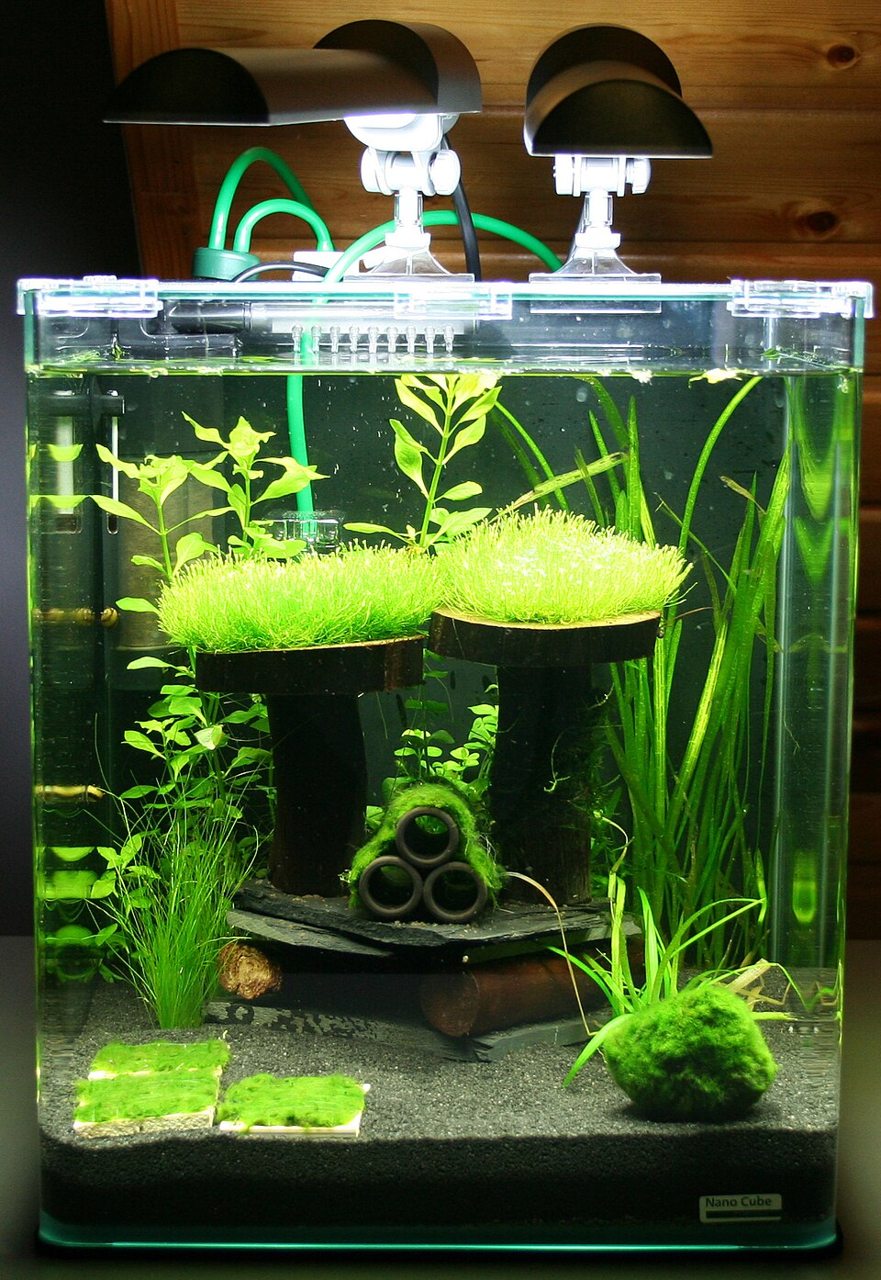
Measure three different kinds of space
Tank dimensions usually mean length × front-to-back width × height. Ask the seller which order they use. Height and front-to-back width are sometimes both called ‘depth,’ which makes an easy purchase surprisingly confusing.
- Length
- The distance from the left end to the right end.
- Front-to-back width
- The space for layers of plants, stones, and open water.
- Height
- The distance from the bottom glass to the rim.
Try a paper outline before choosing your layout. Leave a clear route to the glass and equipment. A beautiful arrangement that you cannot reach will be frustrating to look after.
Compare dimensions, not just liters
These are examples from ADA’s Cube Garden range, not sizes you must buy. The middle column is simple box geometry; the last is the maker’s listed capacity. Glass takes up space, and your substrate, stones, and waterline reduce the water you actually add.1
| Dimensions (cm) | Outside box volume | ADA capacity |
|---|---|---|
| 60 × 30 × 25 | 45 L | 41 L |
| 60 × 30 × 36 | 64.8 L | 60 L |
| 90 × 45 × 45 | 182.25 L | 166 L |
| 120 × 50 × 50 | 300 L | 273 L |
For a rectangular space, liters = length × width × water height in centimeters ÷ 1,000. Use inside measurements for a closer estimate, then allow for the objects in the tank. Record the water you add during the first fill if you want a more useful dosing figure.
Choose your fish before your glass
Start with the exact species you want to keep. Check adult size, group needs, swimming room, and water conditions in the fish guide. A tall, narrow tank and a long, low tank can hold the same volume while offering very different spaces.
There is no need to choose the largest tank you can squeeze into a room. Choose one whose water changes and equipment you can manage, then choose suitable animals. If you only want a planted display, you can make that the whole project.
Give the layout room to breathe
Extra front-to-back space can make it easier to separate a foreground from a background. ADA describes its 60 × 45 × 36 cm tank as a wider alternative for creating perspective.2 That is a design option, not a rule: a narrow aquarium can still look lovely with a simpler arrangement.
Planning a contest entry? The 2026 IAPLC rules do not restrict tank size.3 Pick dimensions that suit the composition and your home, rather than buying a supposed ‘official competition size.’
Try the cleaning position before buying
Stand where you will work and check the combined height of the stand and aquarium. As a practical starting point, keep the rim below your armpit so you can reach in without lifting your shoulder. Then test your actual reach to the bottom and far corner; body height alone cannot tell you what is comfortable.
You should not need a chair or steps for routine care. Allow room above the rim to move the light, remove the lid, and lift out equipment. Use the tank maker’s support instructions and a stand rated for the complete filled setup, not just the water.
A few common questions
Is a 60 × 30 × 36 cm aquarium really 65 liters?
Its outside box volume is 64.8 liters. That is not its usable water volume. ADA lists 60 liters for this model, before your layout and waterline reduce the amount you add.
Do I need a particular tank size to enter IAPLC?
No. The 2026 IAPLC rules place no restriction on aquarium size. Check the rules for the year you enter.
Sources
- ADA , Cube Garden product dimensions and capacities. Manufacturer’s specifications. Box volumes in the table are calculated from the outside dimensions, not measured water volumes.
- ADA , New Cube Garden sizes (2021). Manufacturer’s explanation of the wider and shallow models.
- IAPLC , 2026 guidelines and rules. The entry rules state that aquarium size is unrestricted.