Original work
A stone does one of two things. It sits there, or it dissolves.
Almost all the trouble comes from one mineral. Calcite is calcium carbonate, and it is the main mineral in limestone. When it dissolves in water containing carbon dioxide, one reaction produces both of the things aquarists measure.
The calcium ion is general hardness. The bicarbonate ion is carbonate hardness. So a limestone stone raises GH and KH together, at close to one to one in German degrees. That is a useful fingerprint. If both climb by similar amounts, a carbonate rock is the likely cause. If GH climbs and KH does not, something else is happening.
The hobby usually stops at "it raises hardness". You can do better, because carbonate chemistry gives a hard ceiling. We solved the standard carbonate equilibrium system for water sitting on calcite, using the usual constants at 25 degrees12, and the table below is the result21. The uninjected row assumes 0.5 mg/L of dissolved CO2, which is air equilibrium at about 350 parts per million. At a present day 420 parts per million the same arithmetic gives about 19 mg/L of calcium and 2.7 dGH rather than 2.521. Activity corrections are ignored, so real numbers will run a little higher, but the shape is right.
Three conclusions follow, and all three are useful.
An uninjected tank full of limestone will not become liquid rock. It drifts towards roughly 2.7 dGH and 2.7 dKH and stops.21 Many tap waters are already harder than that, and in hard tap water a limestone rock is close to chemically invisible, because the water has no room left to dissolve it.
Injecting CO2 roughly quadruples how much limestone the water can hold. A Seiryu Iwagumi in soft water at 30 mg/L of CO2 has a target of about 10 dGH and 10 dKH, not 2.5.21 The people who complain that their Seiryu tank keeps hardening are usually the people running CO2.
And water changes are what keep the rock dissolving. Every change resets the water below saturation. A tank on heavy weekly changes in soft water will pull calcium off the rock week after week. A tank left alone reaches equilibrium and stops.
Water at equilibrium with calcite, 25 C21
- 2.5
- dGH ceiling with no CO2 injection, open to air
- 6.8
- dGH ceiling at 10 mg/L CO2
- 8.6
- dGH ceiling at 20 mg/L CO2
- 9.9
- dGH ceiling at 30 mg/L CO2
- x4
- roughly what injection does to the ceiling
| Condition | pH at equilibrium | Calcium | Approx. GH | Approx. KH |
|---|---|---|---|---|
| Open to normal air, no injection | 8.2 | 19.4 mg/L | about 2.7 dGH | about 2.7 dKH |
| CO2 injected to 10 mg/L | 7.4 | 49 mg/L | about 6.8 dGH | about 6.8 dKH |
| CO2 injected to 20 mg/L | 7.2 | 61 mg/L | about 8.6 dGH | about 8.6 dKH |
| CO2 injected to 30 mg/L | 7.1 | 70 mg/L | about 9.9 dGH | about 9.9 dKH |
Folklore 01
"Seiryu stone will wreck your soft water tank."
It will not, on its own, if you know the ceiling. Uninjected, the rock cannot push you past roughly 2.7 dGH and 2.7 dKH21, which is inside the range most plants and most soft water fish tolerate. Under injection the ceiling is around 10 and 1021, which does matter for a Caridina shrimp tank or a wild caught blackwater fish. The advice should be conditional, not absolute.
Folklore 02
"Boil the rock and it will stop leaching."
Boiling kills organisms and removes loose dust. It does not change the mineral. Calcite is still calcite after boiling. Nothing you can do in a kitchen alters the solubility of a rock.
Stone
Nobody publishes a thin section of an aquarium rock.
Origin and appearance below are trade descriptions unless a source is given. The water chemistry column is more reliable, because anyone with a test kit and a bucket can check it. Confidence is stated for each row rather than implied.
| Stone | What it is | Origin | Effect on water | Confidence |
|---|---|---|---|---|
| Seiryu | Limestone, often described as metamorphosed. The white veins are calcite | Japan, around the Ibi river in Gifu. Most stone sold today is Chinese under the same name | Raises GH and KH strongly. Fizzes hard in acid | Chemistry high, geology medium |
| Ryuoh | The same rock type. Ryuoh is a trade name ADA uses | Japan | Raises GH and KH strongly | Chemistry high |
| Dragon stone, Ohko | A clay rich sedimentary rock, effectively a mudstone. Weathering hollowed it out | Japan, and now widely from China | Effectively inert. Crumbly, sheds clay dust | High |
| Lava rock | Basalt or scoria, a vesicular volcanic rock | Any volcanic region. Indonesia, Iceland, Italy, Turkey, and Armenia | Inert on normal timescales | High |
| Elephant Skin | Limestone weathered into rounded folds | China and Vietnam | Raises GH and KH. Less surface area than Seiryu per kilogram, so slower, but the same ceiling | Chemistry high |
| Pagoda | A layered calcareous sedimentary rock. The layering is the selling point | China | Raises GH and KH. The calcareous layers fizz | Chemistry medium |
| Petrified wood | Fossil wood with the cell walls replaced by minerals, usually silica | Indonesia, Madagascar, United States | Inert where the replacing mineral is silica. Some pieces are replaced by calcite instead. Acid test each one | High |
| Slate | A fine grained metamorphic rock made from shale | Worldwide. Wales, Spain, Brazil, China | Inert. Some slates carry carbonate or pyrite bands, so check for rusty streaks | High |
| Quartz and quartzite | Metamorphosed quartz sandstone, essentially pure silica | Worldwide | Fully inert. Silica does not measurably dissolve at aquarium pH | High |
| Frodo | Sold as metamorphic. Composition is not published and reports of its acid behavior disagree | Reported as Asian | Test it yourself. Unknown until you have soaked and measured it | Low |
| Yamaya, Manten, Koke | ADA trade names. Composition not published | Japan | Not published. Pale marking on Koke is consistent with carbonate. Test it | Low |
The vinegar test, and the four things it cannot tell you.
The geological version uses dilute hydrochloric acid at 5 to 10 percent4. Household vinegar is about 5 percent acetic acid4, a much weaker acid, so the kitchen version is a weaker form of an already limited test.
One. Dolomite barely reacts to cold acid.420 A dolomitic rock can pass the vinegar test and still slowly harden your water. Grind a corner to powder and retest if you want a real answer.
Two. It only detects carbonates. Gypsum is calcium sulfate.1 It raises GH, it dissolves far more readily than calcite, and it does not fizz at all.
Three. It is a spot test. A calcite vein on the hidden side of the rock is not tested.
Four. A weak fizz does not tell you how fast. Rate depends on surface area, and aquarium rocks are chosen for texture, which means a lot of surface area.

The test that actually works
- Day 0
- rock in a bucket of RO or distilled water. Record GH, KH and TDS. Cover it
- Day 7
- measure again
- Day 14
- measure again
Wood
The tannins are gone within a day. The brown is something else.
The hobby calls everything brown "tannins". In real water chemistry tannins are one family of plant polyphenols and they are a small, short lived part of the dissolved organic matter in natural water. A study of red mangrove tannins found their chemical half life in natural water was less than one day6, and that they are largely removed by binding to sediment6. What remains in a blackwater river, and in your tank, is the broader pool of humic substances and dissolved organic carbon.
That matters twice. It explains why a piece of wood keeps tinting water long after the tannins should be gone. And it means the useful measurements are dissolved organic carbon and color, not "tannin level".
Is the brown water good for fish? There is real evidence. Researchers isolated dissolved organic carbon from the upper Rio Negro and tested it on zebrafish held at pH 4.0 in ion poor water. It gave almost perfect protection against the ion regulation failure that low pH otherwise causes. It cut sodium and chloride losses and restored sodium uptake that had shut down completely.7 The brown water is not decoration. In soft acidic conditions it is doing physiological work at the gill. The older claim that tannins are antiseptic is much weaker: plant tannins do have antimicrobial activity in the laboratory, but nobody has shown the concentration in a tank is enough to matter.
Folklore 03
"Driftwood softens your water."
No. Softening means removing calcium and magnesium, and wood does not remove them. What wood can do is add weak organic acids, which consume a little alkalinity and pull KH down slightly. GH is untouched. If you want soft water you need reverse osmosis, rain water, or ion exchange.
Folklore 04
"Add wood and your pH will drop."
Only if your KH is already low. In water at 5 dKH or more, a normal amount of wood will tint the water and barely move the pH.1 People who add wood to hard tap water and see no pH change are not doing it wrong. The buffering chemistry is working exactly as expected.
Not folklore, just misread
The white slime on new wood.
Almost every new piece grows a white jelly coat in the first two to six weeks. It is saprophytic growth, fungi and water moulds eating the sugars left in the outer wood. ADA's own product notes warn buyers that Saprolegnia may appear at the initial stage5. It feeds on a limited supply and disappears. Shrimp, otocinclus and snails eat it. It is a sign the wood is fresh, not that it is bad.
Practical
Soaking, boiling and weighting.
Soaking makes wood sink and removes leachate, but a dense branch can take months and the water must be changed or it goes anaerobic. Boiling is the fast version: half an hour to two hours pulls out most of the soluble tannins and kills what is living on it, but it will not sterilise the inside of a thick piece and will not sink a log. Most professionals screw the wood to a slate base instead.
Substrate
How long aqua soil lasts depends on your tap water, not the calendar.
Somebody in a soft water city honestly reports two years of buffering. Somebody in a hard water city honestly reports three months. Both are telling the truth. Every water change brings in fresh carbonate for the soil's ion exchange sites19 to trade away, so the volume and hardness of your water changes set the lifespan. If you want the buffering to last, use reverse osmosis water rather than tap.
The physical lifespan is longer. Granules crush slowly under their own weight and under your fingers during replanting. Most people report a soil becoming noticeably muddy and compacted after two to four years. At that point it still holds plants, it just no longer behaves like fresh soil.
Grain size for an inert cap or a plain gravel bed sits between 2 and 5 mm. Below about 1 mm it compacts. Above about 5 mm, food and waste fall into gaps where nothing can reach them. Sand looks superb and is what many real habitats have, but it compacts and it moves in strong flow. Corydoras and other sand sifting fish do genuinely better on sand than on sharp gravel, and that is a welfare point rather than an aesthetic one.
Folklore 05
"Aqua soil is exhausted after a year, so replace it."
Nutrient exhaustion and buffering exhaustion are different things. A soil that has stopped lowering KH may still be a perfectly good rooting medium, and in a fertilised tank the water column supplies most of what the plants need anyway. If your water is soft and your plants are fine, there is no reason to tear down a tank on a calendar.
Folklore 06
"Deep sand creates hydrogen sulfide that will kill everything."
Real in principle, overstated in practice, and for a specific chemical reason. Sulfide production needs sulfate to reduce. Seawater carries about 2,700 mg/L of sulfate. World average river water carries about 8 to 11 mg/L1, roughly 250 to 350 times less21. Hydrogen sulfide also oxidises quickly when it meets oxygenated water. Black patches under sand are normal and are mostly iron sulfide, which is why they are black.
Start with the substrate decision guide for the choice between sand, gravel, capped mineral soil and aquasoil. For a complete soil-tank build, including which soil to use in Armenia, continue to the Walstad method. For what actually lives in the bed, see cycling and bacteria.
Carbon dioxide
The limit is not how much carbon exists. It is how fast it can reach the leaf.
Gases diffuse through water about ten thousand times more slowly than through air.8 A leaf under water sits inside a thin still layer called the diffusive boundary layer, and carbon dioxide has to crawl across it. In one study of four submerged species, that boundary layer accounted for 90 percent of the total resistance to carbon fixation.8
Two things follow. Raising the concentration helps a great deal: across fourteen submerged freshwater species, photosynthesis was about three times higher at saturating carbon supply than at ambient.8 And water movement helps too, because flow thins the boundary layer. That is why flow distribution is part of carbon management rather than a separate topic.
For scale: water in equilibrium with air holds about 15 micromoles per liter of CO2, which is about 0.66 mg/L8. Aquascapers aim for 25 to 30. That is roughly forty times the natural level21. It is not a small nudge.
Folklore 07
"Aquatic plants can only use CO2, not bicarbonate."
Wrong for about half of them. Bicarbonate use has been demonstrated in 50 percent of 80 tested freshwater flowering plant species8. Bicarbonate users can strip 40 to 70 percent of the dissolved inorganic carbon out of the water. Obligate CO2 users manage 1 to 4 percent.8 This is why some plants grow perfectly well in hard alkaline uninjected water and others sulk. It is not that they are easy or difficult. It is a different uptake pathway.
Folklore 08
"The pH and KH table tells you your CO2 level."
Only if every bit of your alkalinity is carbonate and there are no other acids. Alkalinity can come from carbonate, bicarbonate, borate, phosphate or hydroxide, so the measurement does not indicate the presence of any one of them.2 A planted tank also makes tannic, humic and uric acids, which lower pH with no CO2 involved. In a tank with driftwood, aqua soil or peat the table will overstate your CO2, sometimes badly.
The version that works is the pH drop method. Measure pH after degassing the water overnight with vigorous aeration, then measure it with CO2 running. A drop of one full pH unit is a tenfold rise in dissolved CO22, whatever your alkalinity is made of, because you are comparing the same water with itself.
Folklore 09
"30 ppm is completely safe."
Too confident. Atlantic salmon post smolts held for twelve weeks showed low mortality at every level from 5 to 40 mg/L, but significantly lower final weight at 12 mg/L and above, with growth declining as CO2 rose.10 Rainbow trout held six months at 24 mg/L against 8 mg/L showed survival above 97 percent in both groups and no growth difference.11 The accurate statement is that 30 mg/L is a manageable load for healthy tropical fish1011, and that the cost is invisible rather than absent.
Oxygen is the real killer. Almost every CO2 death happens at night, when plants consume oxygen instead of making it and the gas keeps arriving. Solenoid on a timer, off an hour before the light, and surface agitation overnight.
Verdict
Liquid carbon is not a substitute.
The manufacturer of the best known product rates its effectiveness at 6 to 7 against injection at 10, and states plainly that it is not produced or marketed as an algicide.9 The chemistry it is based on is a glutaraldehyde relative, which is a known disinfectant, and that is the simplest explanation for what users actually see: spot dosing kills black brush algae, and plants nearby are damaged at high dose. A carbon fertiliser would not behave like that. Its most reliable use is as a targeted algaecide, which is off label. It harms Vallisneria, some mosses and Riccia.
Light
A single leaf needs very little light. A dense carpet needs an enormous amount.
Measurements first. In submerged plants the light compensation point, where photosynthesis just balances respiration, has been measured at roughly 22 to 67 micromoles per square meter per second for detached leaves8. In dense plant communities, where leaves shade each other, light saturation was not reached even at a noon irradiance of about 1,5008. That range explains the whole confusion. The right number depends entirely on how much plant mass you have and how it is arranged.
Watts measure electricity going in, not light coming out. Lumens are weighted for the human eye, which is most sensitive to green, and green is the wavelength plants use least.18 PAR is the measurement that matters, and it has to be measured at the substrate, not at the surface.
| Band | PAR at substrate | What it supports |
|---|---|---|
| Low | 15 to 30 | Anubias, Java fern, Cryptocoryne, mosses, Bucephalandra. No CO2 needed |
| Medium | 30 to 60 | Most stem plants, easier carpets, usually with CO2 |
| High | 60 to 120 and up | Dense carpets, red plants, competition scapes. CO2 and full fertilisation are mandatory |
Folklore 10
"My plants are growing badly, so they need more light."
Backwards, and it is the most expensive mistake in the hobby. Light is the accelerator, not the food. If carbon or nutrients are limiting, extra light only widens the gap that algae grow into. Six to eight hours is the normal starting photoperiod. Start at eight if unsure, six if you have algae, and increase only after a month of stability.
Honest about the evidence
The bands above are convention.
They are repeated with great confidence across the hobby and we could not find a published measurement study behind them. The compensation point figures are measured and cited. The three band table is orientation, and it is labeled that way on purpose.
Water chemistry
Half the arguments in this hobby are unit confusion.
Hardness is not a single substance, so it has to be expressed by convention. The standard is to report it as an equivalent concentration of calcium carbonate. National degrees are all just that number divided by something. The table below is what lets you compare a hobby test kit with a water utility report or a scientific paper, which will almost always use mg/L as CaCO3.
| Unit | Equivalent | Note |
|---|---|---|
| 1 German degree, dH or dGH or dKH | 17.8 mg/L as CaCO3 | What almost every hobby kit reports |
| 1 French degree | 10 mg/L as CaCO3 | |
| 1 English or Clark degree | 14.3 mg/L as CaCO3 | |
| 1 milliequivalent per liter | 50 mg/L as CaCO3 | So 1 dKH is about 0.357 meq/L21 |
| USGS classification | soft 0 to 60, moderately hard 61 to 120, hard 121 to 180, very hard above 180 | All as CaCO33. In German degrees, soft is below 3.4 dH and very hard is above 1021 |
pH 6 is ten times more acidic than pH 7 and a hundred times more acidic than pH 8.2 A change of 0.5 is not small. And a pH number alone means very little: 6.5 in soft unbuffered water is a completely different situation from 6.5 in hard water pushed down by CO2.
GH is calcium plus magnesium. Shrimp and snails need calcium for their shells. KH is alkalinity, the capacity to neutralise acid, and it is consumed over time by nitrification and by organic acids.217 As KH falls towards zero, a small addition of acid causes a large pH swing. That is the old tank pH crash.
Anything that acts as a base registers on a KH kit. Carbonate, bicarbonate, borate, phosphate or hydroxide. An alkalinity number does not indicate the presence of any one of them2, which is the reason the CO2 table above fails in a tank full of wood and soil.
Kits report the nitrate ion. The literature reports nitrate nitrogen. Multiply nitrogen by 4.43 to convert21. A review recommending a maximum of 2 mg NO3-N/L to protect sensitive freshwater species13 is recommending about 9 mg/L on your test kit, not 221. A tank at 20 to 30 on the kit is 4.5 to 6.8 as nitrogen21: below the level shown to cause harm, above the conservative recommendation1316.
Algae
Ammonium starts algae. Nitrate mostly does not.
Nearly every piece of algae advice in circulation is downstream of one lake science idea applied to the wrong system. A lake is usually limited by phosphorus and has no competing higher plants. A planted aquarium is neither of those things.
Folklore 11. "High nitrate causes algae." Adding nitrate as potassium nitrate did not produce blooms in repeated tests, while a twentieth as much nitrogen as ammonium did.16 Algae take ammonium in preference and essentially stop using nitrate once ammonium is present above about 0.02 mg/L.1417 High nitrate is usually a symptom of the same organic load producing the ammonium.
Folklore 12. "High phosphate causes algae." Lake science, transferred to a system it does not fit. Dosing up to about 3 mg/L of phosphate week after week under very high light produced no green spot algae.16 In the planted hobby, low phosphate is more often associated with green spot algae than high phosphate is with anything.
Folklore 13. "Blue-green algae is an algae, so treat it like one." It is a bacterium20. That single fact explains why blackouts, flow and nitrate work on it, why algae eaters ignore it, and why an antibiotic clears it when an algaecide does not.
Three more corrections belong to the nitrogen cycle rather than to water chemistry, and they are large enough to have their own page. The hobby has named the wrong nitrite oxidising bacterium since 199822, the ammonia step in fresh water is often not done by bacteria at all23, and one organism can now be shown to do the whole job alone24.
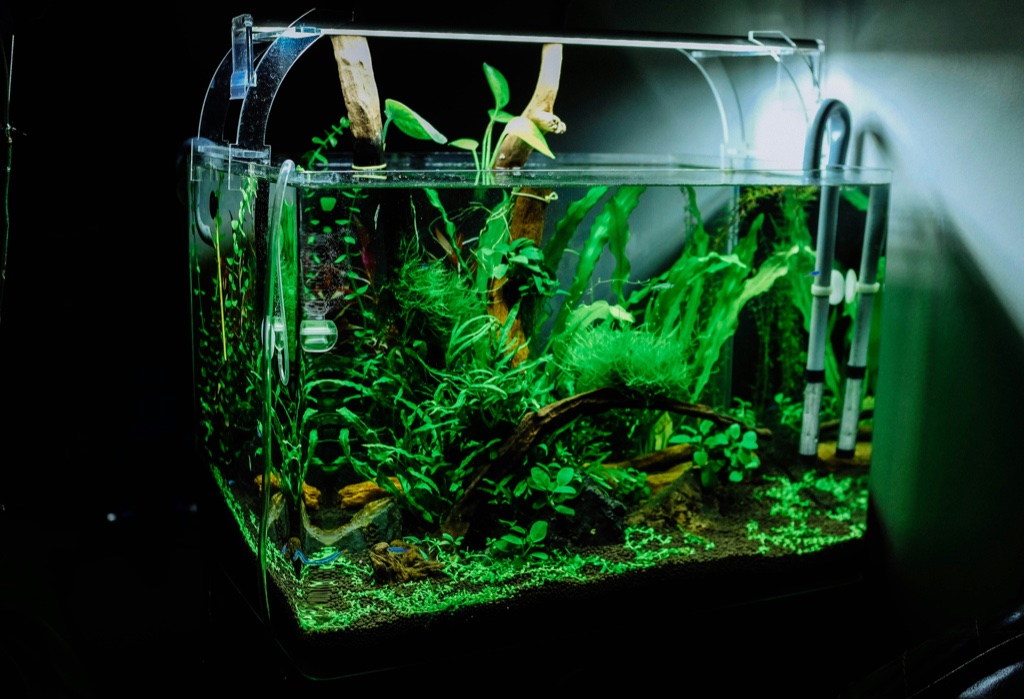
Plants, gentle circulation, and room to grow: the everyday ingredients of a planted aquarium.
The fixing order, when something is wrong.
Remove the ammonium source first. That means uneaten food, dead leaves, a dead animal, an overstocked tank, or a brand new soil still leaching.12 Then check carbon and flow, because a plant that cannot get carbon cannot compete. Then check nutrients, and feed the plants rather than starving them, because the most damaging idea in circulation is that you can starve algae out. Starving a tank starves the plants first. Algae are smaller, faster, and have far lower total demand, and a weakened plant stops competing and stops releasing the compounds that inhibit algae.15 Only then reduce light. Manual removal and a large water change buy you the time to do all four. Chemical treatment is last, and on blue-green algae it is the wrong chemistry entirely.
- Hem, J.D. (1985). Study and Interpretation of the Chemical Characteristics of Natural Water, 3rd edition. US Geological Survey Water-Supply Paper 2254. Public domain. Used for calcite solubility in contact with air, the hardness unit conversions, and the seawater and river water sulfate figures. Full text PDF
- Morin, G. Understanding the General Chemistry of the Planted Aquarium. Seachem Laboratories. Used for the equilibrium constants, and for the statement that an alkalinity measurement does not indicate any one compound. PDF
- Hardness of Water. USGS Water Science School. The natural water classification used in the units table. usgs.gov
- The Acid Test for Carbonate Minerals and Carbonate Rocks. Geology.com. Used for the dilute hydrochloric acid protocol and the cold dolomite limitation. geology.com/minerals/acid-test.shtml
- Layout Materials: Stones, and Layout Materials: Driftwood. Aqua Design Amano. Used for ADA's own descriptions of Ryuoh, Koke, Yamaya and Manten, and for the Saprolegnia warning on branch wood. Stones and Driftwood
- Maie, N., Pisani, O. and Jaffe, R. (2008). Mangrove tannins in aquatic ecosystems: their fate and possible influence on dissolved organic carbon and nitrogen cycling. Limnology and Oceanography 53(1): 160 to 171. The under one day half life. DOI 10.4319/lo.2008.53.1.0160
- Duarte, R.M., Smith, D.S., Val, A.L. and Wood, C.M. (2016). Dissolved organic carbon from the upper Rio Negro protects zebrafish against ionoregulatory disturbances caused by low pH exposure. Scientific Reports 6: 20377. Open access. DOI 10.1038/srep20377
- Pedersen, O., Colmer, T.D. and Sand-Jensen, K. (2013). Underwater photosynthesis of submerged plants: recent advances and methods. Frontiers in Plant Science 4: 140. Open access. The source for the diffusive boundary layer, the 90 percent resistance figure, the threefold rise at saturating carbon, the 50 percent of 80 species bicarbonate result, and the light compensation points. DOI 10.3389/fpls.2013.00140
- Flourish Excel product page. Seachem Laboratories. The manufacturer's own 6 to 7 against 10 rating, and its statement that the product is not marketed as an algicide. seachem.com/flourish-excel.php
- Mota, V.C., Nilsen, T.O., Gerwins, J., Gallo, M., Ytteborg, E. and others (2019). The effects of carbon dioxide on growth performance, welfare and health of Atlantic salmon post-smolt in recirculating aquaculture systems. Aquaculture 498: 578 to 586. DOI 10.1016/j.aquaculture.2018.08.075
- Good, C., Davidson, J., Welsh, C., Snekvik, K. and Summerfelt, S.T. (2010). The effects of carbon dioxide on performance and histopathology of rainbow trout in water recirculation aquaculture systems. Aquacultural Engineering 42(2): 51 to 56. DOI 10.1016/j.aquaeng.2009.11.001
- Francis-Floyd, R., Watson, C., Petty, D. and Pouder, D.B. Ammonia in Aquatic Systems. University of Florida IFAS Extension, FA031. The 100 times toxicity difference between NH3 and NH4+, and the 0.05 mg/L tissue damage threshold. ask.ifas.ufl.edu/publication/FA031
- Camargo, J.A., Alonso, A. and Salamanca, A. (2005). Nitrate toxicity to aquatic animals: a review with new data for freshwater invertebrates. Chemosphere 58(9): 1255 to 1267. The 2 mg NO3-N/L recommendation. DOI 10.1016/j.chemosphere.2004.10.044
- Dortch, Q. (1990). The interaction between ammonium and nitrate uptake in phytoplankton. Marine Ecology Progress Series 61: 183 to 201. The ammonium preference behind the nitrate and algae correction. DOI 10.3354/meps061183
- Gross, E.M. (2003). Allelopathy of aquatic autotrophs. Critical Reviews in Plant Sciences 22(3-4): 313 to 339. Used for the point that weakened plants stop releasing algae inhibiting compounds. DOI 10.1080/713610859
- Barr, T. The Estimative Index of Dosing. Barr Report. The repeated nitrate and phosphate dosing observations, and the note that nitrate above 40 ppm can cause fish health issues. barrreport.com
- Walstad, D. (2017, reissued 2023). Nitrogen Uptake by Aquatic Plants. Open access, with its own reference list to the primary literature. Used for the nitrification stoichiometry and the alkalinity consumed per unit of ammonium oxidised. PDF
- Walter, A. and Schoebel, H. (2023). Shed light on photosynthetic organisms: a physical perspective to correct light measurements. Photosynthesis Research 156(3): 325 to 336. Why lumens are the wrong unit for plants. DOI 10.1007/s11120-023-01001-5
- Tropica Aquarium Soil, and ADA Aqua Soil. Manufacturer instructions, including the water change schedule for the first four weeks. tropica.com and adana.co.jp
- Rock type definitions. Wikipedia entries for Limestone, Dolomite, Mudstone, Basalt, Petrified wood, Slate, Quartzite and Cyanobacteria. Used only for uncontested definitions, each of which sources its own primary literature. Limestone
- Our own arithmetic. Not a published source. Three sets of numbers on this page are calculated by us and should be checked rather than trusted. One, the carbonate ceiling table and every ceiling figure derived from it: the standard calcite-carbonate equilibrium system solved at 25 degrees C for a fixed dissolved CO2, charge balance 2[Ca2+] = [HCO3-], using log K1 -6.35, log K2 -10.33, log Ksp(calcite) -8.48, activity corrections ignored, from sources 1 and 2. The atmospheric assumption, stated because it moves the headline number. The uninjected row is solved at 420 ppm, the present atmosphere, which is 0.63 mg/L of dissolved CO2 at 25 degrees, and returns 19.4 mg/L calcium, pH 8.2 and 2.7 dGH. An earlier version of this table assumed 350 ppm and printed 18 mg/L and 2.5 dGH. Hardness rises as the cube root of CO2, so 20 percent more CO2 buys 6 percent more hardness: that is why the figure moves so little, and why the headline above says under 3 dGH rather than either number. The second digit is inside the error this model already carries from ignoring activity corrections and assuming perfect equilibrium. The 0.66 mg/L quoted in the carbon dioxide section is source 8's 15 micromoles per litre, a value nearer 20 degrees, and is not the number this table was built on. The three injected rows are insensitive to the atmospheric figure and reproduce exactly. Two, the unit conversions: 1 dKH as 0.357 meq/L, the USGS classes restated in German degrees, the nitrate ion to nitrate nitrogen factor of 4.43 and the 2, 9, 4.5 and 6.8 mg/L figures that follow from it. Three, the ratios: seawater to river sulfate at 250 to 350 times, and injected CO2 at roughly forty times the air-equilibrium level. calculated, repeatable, unverified by a third party
- Hovanec, T.A., Taylor, L.T., Blakis, A. and DeLong, E.F. (1998). Nitrospira-like bacteria associated with nitrite oxidation in freshwater aquaria. Applied and Environmental Microbiology 64(1): 258 to 264. The paper that displaced Nitrobacter as the aquarium nitrite oxidiser. DOI 10.1128/aem.64.1.258-264.1998 open access
- Bagchi, S., Vlaeminck, S.E., Sauder, L.A., Mosquera, M., Neufeld, J.D. and others (2014). Temporal and spatial stability of ammonia-oxidizing archaea and bacteria in aquarium biofilters. PLoS ONE 9(12): e113515. The archaeal ammonia step in freshwater filters. DOI 10.1371/journal.pone.0113515 open access
- van Kessel, M.A.H.J., Speth, D.R., Albertsen, M., Nielsen, P.H., Op den Camp, H.J.M. and others (2015). Complete nitrification by a single microorganism. Nature 528: 555 to 559. Comammox. DOI 10.1038/nature16459



Continue
Where to go next.
Water changes
A tank can read zero nitrate and still need a water change, and the arithmetic says why.
Planning a tank
Where the tank goes, what the room does to it, and every decision that has to be made before buying anything.
Choose a substrate
Choose between inert sand, capped mineral soil and aquasoil.
Oxygen and aeration
How air stones, bubbles and sponge-filter airlifts move gases through the surface.
Peroxide oxidators
How a peroxide oxidator adds oxygen without surface agitation.