Step one
Measure the light, then filter on the number instead of the word.
Every other plant finder asks you to choose between low, medium and high, which are three words with no agreed meaning. This one takes a figure. Photosynthetically active radiation is the light between 400 and 700 nanometres, counted as photons: micromoles per square meter per second16. That is what a plant responds to, and it is not what a phone light meter reads.
The meter you already own is the one in your pocket, and the calculator below is built for it. A phone or a cheap meter reads lux, which is weighted by human vision. The human eye peaks in the green at 555 nanometres, and green is exactly where chlorophyll absorbs least, so a photometric reading systematically misdescribes plant light. A 2023 paper on light measurement for photosynthetic organisms puts it plainly: photometric quantities are incorrect for this purpose and luxmeters should be avoided17. For a rough estimate with your phone, choose your light source in the calculator. The conversion depends on its spectrum.
What that means
- Lumens
- Photons
- DLI
- Of noon
Two real measurements to hold against your own reading. The light compensation point of a submerged leaf, where photosynthesis just balances respiration, has been measured at roughly 22 to 67 micromoles per square meter per second16. And a dense stand of plants shading itself did not saturate even at a noon irradiance of about 150016. One leaf needs very little. A carpet competing with itself needs an enormous amount. That gap is why the hobby argues about light forever.
The bands the filter uses are the hobby conventions: low 15 to 30, medium 30 to 60, high 60 to 120 or more, measured at the substrate22. Nobody has published a measurement study behind those three bands, so treat them as orientation rather than law. The tool tells you which band a plant sits in and leaves the precise number to your own meter.
The plant finder
What was taken away, and by what
Shown on purpose, never filtered out
The 24 plants in this catalog that carry an invasive or Red Book warning.
Check a plant’s identity and local protection status before you buy or collect it. Water hyacinth doubles its biomass in six to fourteen days, and ten plants can become about 655,360 individuals in eight months8. Collecting a single wild Salvinia natans in Armenia carries a compensation tariff of 25,000 AMD, and a Siberian iris 10,0005. Neither of those belongs in a notes field. Water hyacinth, Elodea nuttallii and Salvinia molesta are all on the EU list of invasive alien species of Union concern, and so are fanwort and parrot's feather, which are ordinary shop plants across the region7. The tropical floaters are a smaller and different problem: water lettuce populations in ordinary temperate water bodies remain ephemeral and fail to overwinter, and a January revisit of Hungarian sites found no floating individuals at all, with long-term survival documented mainly in water warmed by springs or industrial effluent9. The duckweeds are the reverse case, native and unstoppable: they grow and survive from 5 to 40 degrees with an optimum of 20 to 30, and Lemna tolerates a wider band than any other duckweed genus, about 11.4 to 38.1 degrees10. And Elodea nuttallii keeps growing whenever the water is above 4 degrees, which is most of an Armenian winter in a lowland river11.
What they look like
Six growth habits, which is the distinction that actually decides where a plant goes.
The filter above sorts on light and carbon. The eye sorts on habit: what floats, what roots in the substrate, what is tied to wood or stone and must never be buried. A plant put in the wrong one of those six places will fail no matter how good the light is.
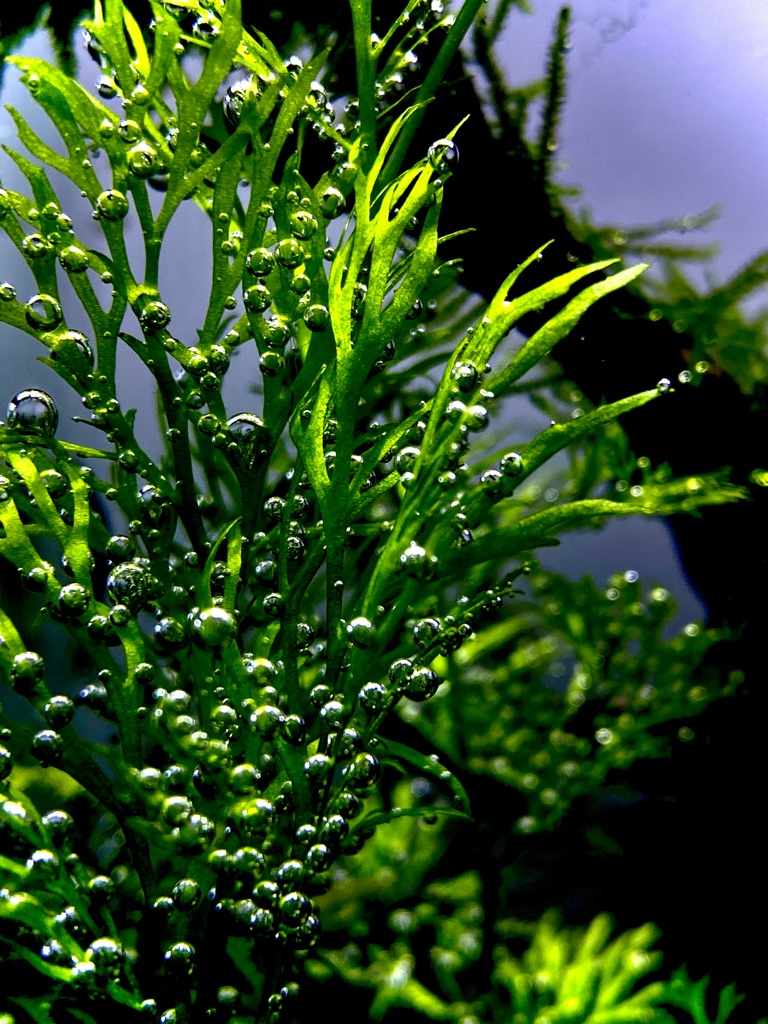
-
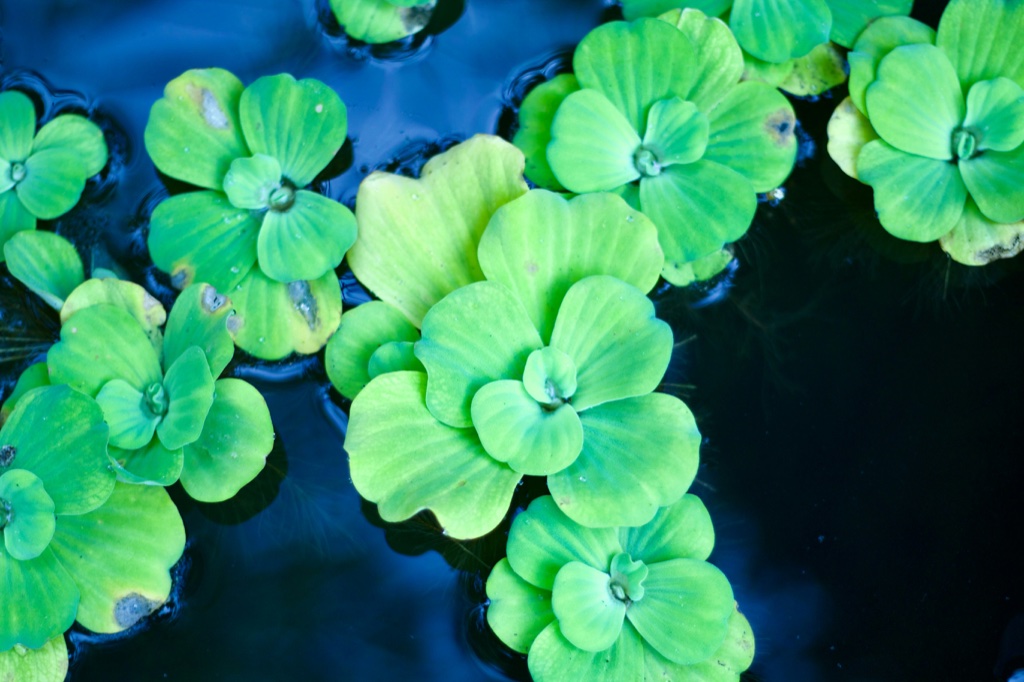
Floating Photograph Les -
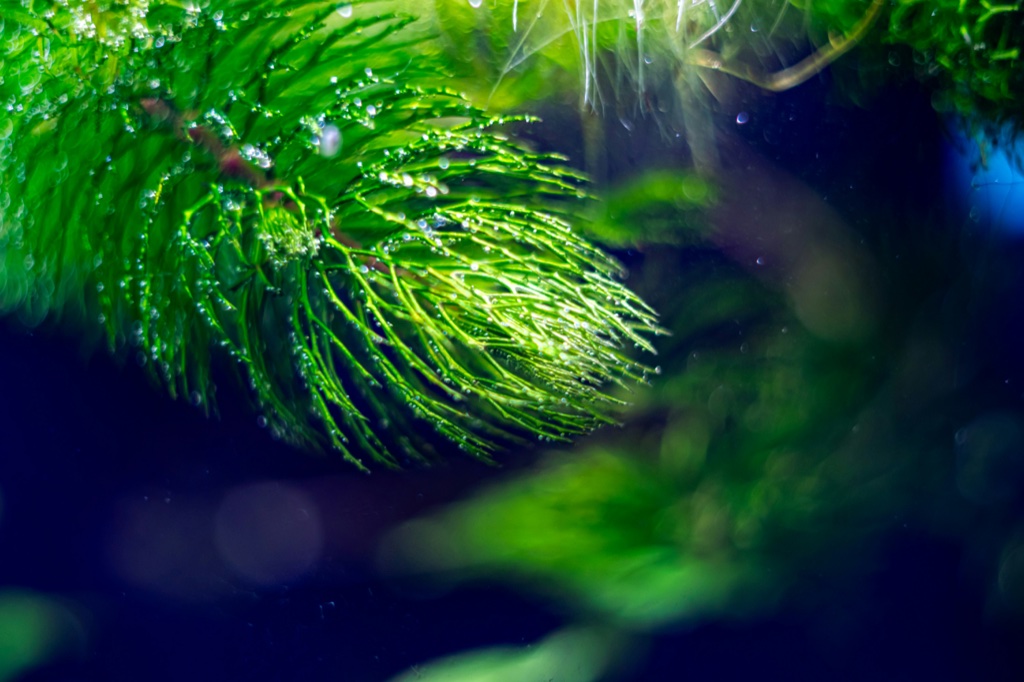
Submersed Photograph Sergey Gorban -
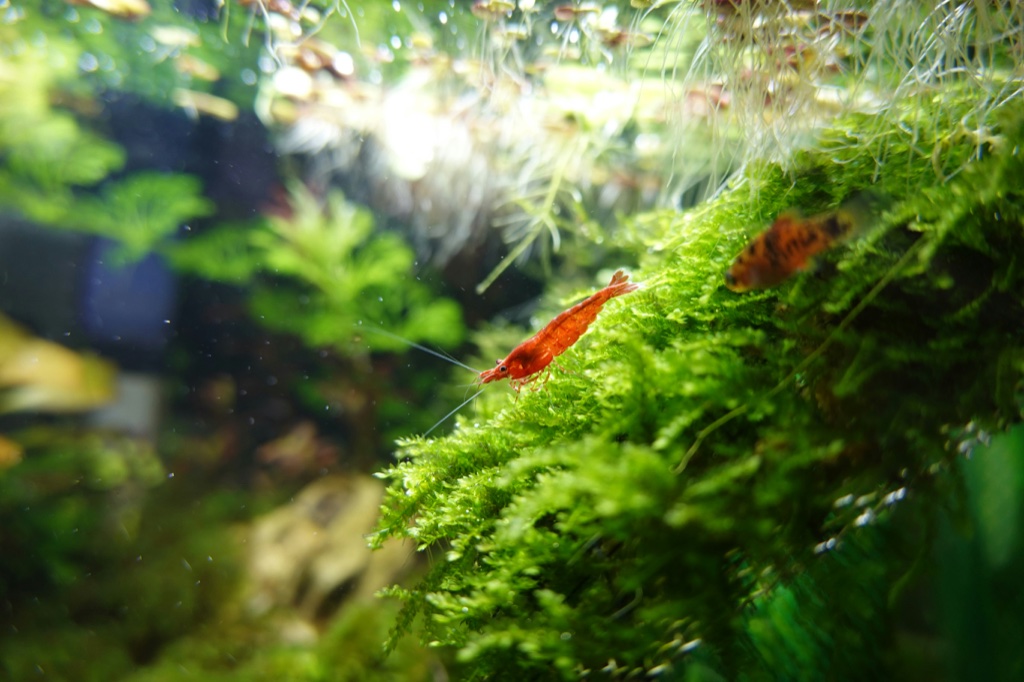
Mosses Photograph Penfer -
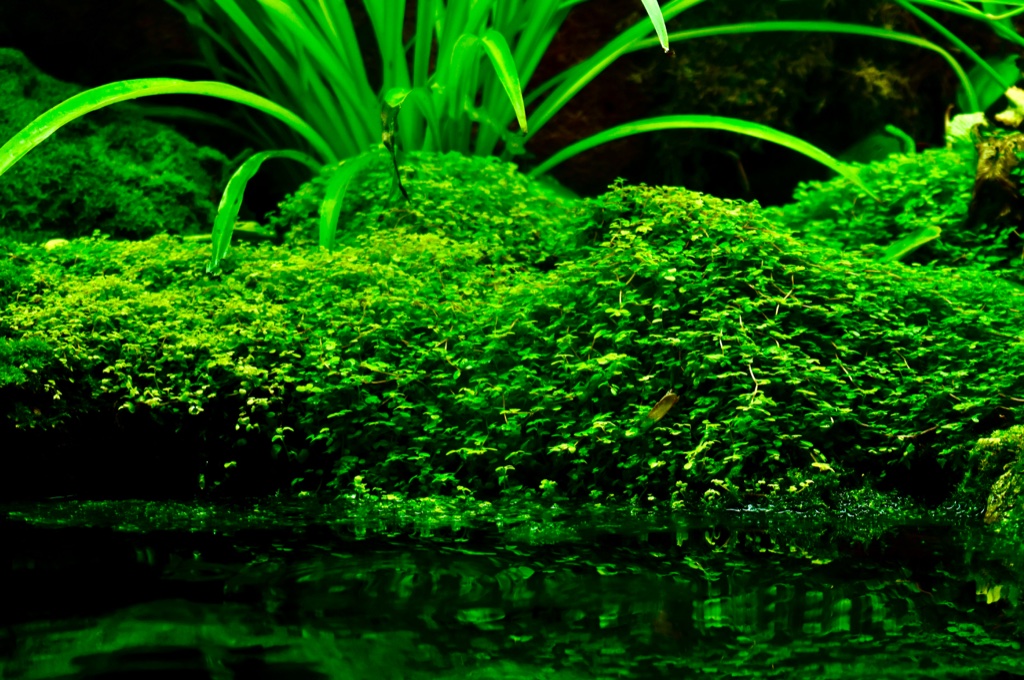
Carpeting Photograph Zorawar Bhangoo -
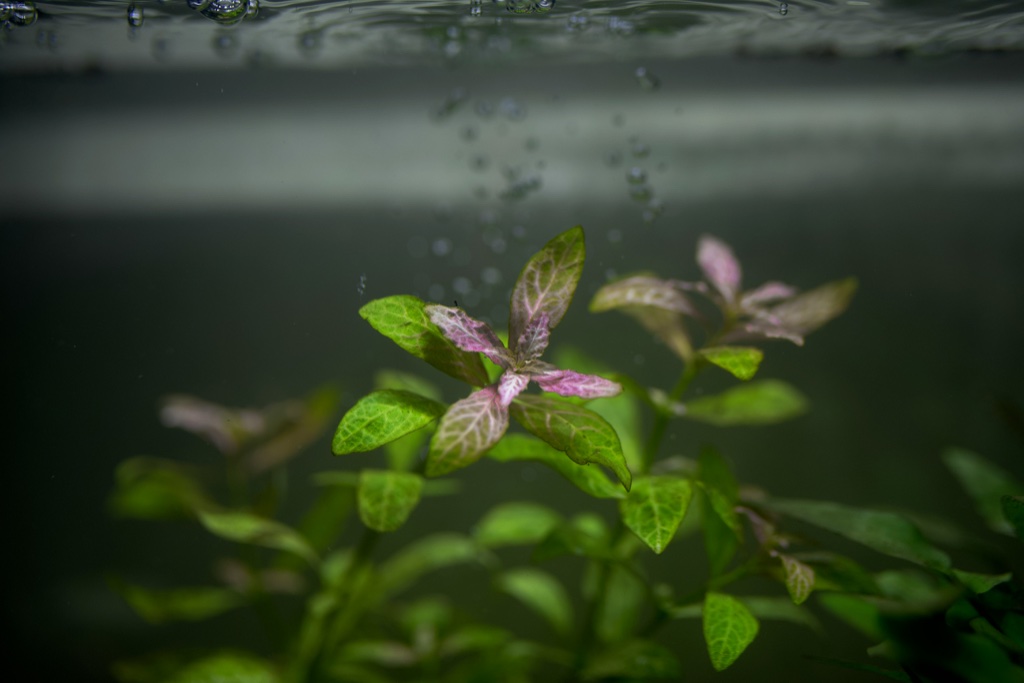
Stem plants Photograph Gabriele Proietti Mattia -

Epiphytes Photograph Josephina Kolpachnikof
The photographs on this page were taken by other people and shared on Unsplash. Every one of them is named, with thanks, on the credits page.
How the tool decides
The rules, and one of them is the reason this is not just a filtered list.
An unknown is never a no. Where a figure is not published the plant stays in the results, and the tool says how many plants it could not judge. A tool that treated a blank field as a failure would quietly delete half the catalog and look confident doing it.
Root feeder against leaf feeder is a real division, and it is measured. Winkel and Borum grew five species in split chambers with the leaves in one compartment and the roots in another, and four of the five were tissue-cultured plants from a commercial aquarium plant nursery. With the water at air equilibrium, root uptake supplied 98 percent of photosynthesis in the isoetid Lobelia dortmanna, 86 percent in Lilaeopsis, 75 percent in Vallisneria americana, 28 percent in the stem plant Ludwigia repens, and Hydrocotyle verticillata could not use root carbon at all14. The number that predicted the result was the shoot to root area ratio: 0.98 for Lobelia against 56.4 for Hydrocotyle14. A plant with as much root surface as leaf surface can feed itself from below. A plant with fifty times more leaf than root cannot. The extreme case was settled earlier and by a different method: across five isoetid species, root-zone CO2 accounted for 65 to 95 percent of external carbon uptake, more than 85 percent in two of them, and a pH-drift test confirmed that not one of the five could use bicarbonate at all15. Those plants live in cold soft carbon-poor lakes and solved the carbon problem by mining the sediment. Two of them, Littorella uniflora and a Lobelia, are on a shelf in Yerevan.
And the hobby reads that result backwards. Every one of those percentages collapses as the water gets richer in carbon. Lobelia falls from 98 percent to 46, Ludwigia from 28 to 314. In every species measured, including the isoetid, the maximum photosynthesis achievable on root carbon was below the maximum achievable on leaf carbon: 69 percent of the leaf ceiling for Lobelia and 3 percent for Ludwigia14. Root uptake is a substitution for leaf uptake, not an addition to it. Saying a soil tank gets its carbon from the substrate so it needs no injection inverts the logic: the soil route matters because the water is carbon-poor.
The nutrient side runs the same way, and it is the practical half. Root tabs are for plants with real root systems: swords, crypts, some Vallisneria and bulb plants. Stem plants and mosses feed heavily from the water column, and for those, dosing the water is more effective than dosing the substrate22. There is a sting in the tail too. Aquatic plants prefer to take ammonium in through their leaves rather than their roots, and adding ammonium to the water suppressed root uptake by 77 percent in eelgrass13, so nitrogen buried under the gravel works against the plant's own preference.
Bicarbonate is a leaf capability, not a root one. Bicarbonate use has been demonstrated in 50 percent of 80 tested freshwater flowering species, and the users strip 40 to 70 percent of the dissolved inorganic carbon from the water while obligate CO2 users manage 1 to 4 percent16. That is why some plants grow perfectly well in hard uninjected water and others sulk. It is not that they are easy or difficult. It is a different carbon pathway, and in Yerevan, on bicarbonate-based tap water, it is the single most useful thing to know about a plant. Bicarbonate cannot use the root route at all, because it is an ion and the root route works by gas-phase diffusion through the plant's own air channels14.
What the catalog holds
- 93
- plant records, each with its sources
- 42
- that grow wild in Armenia, with the GBIF occurrence count where one was read
- 34
- named lines Gazanik actually stocks, with the shop's own prices
- 24
- carrying an invasive or Red Book warning, never hidden by the filter
- 6
- on the Armenian Red Book of Plants, with a per-specimen tariff attached
- 0
- floating plants stocked anywhere in the Armenian specialist trade
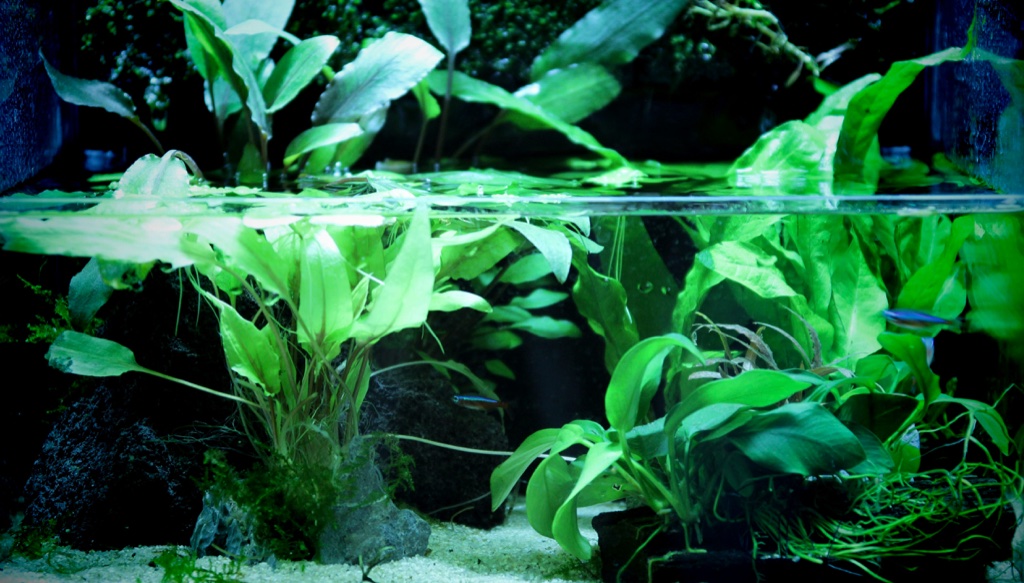
Why floating plants are the engine and not the garnish. Gases diffuse about ten thousand times more slowly in water than in air, and in one study of four submerged species the boundary layer of stripped water around the leaf accounted for 90 percent of the total resistance to carbon fixation23. A floating leaf has its stomata in open air at roughly 420 parts per million with wind across it, and no boundary layer problem at all. They are also the fastest nutrient strippers measured: water lettuce cleared 6.4 milligrams per liter of nitrogen supplied as ammonium in 4.3 hours, and the same amount supplied as nitrate took 44 hours13. Elodea nuttallii in water holding equal ammonium and nitrate removed 75 percent of the ammonium in 16 hours and left the nitrate almost untouched13. That preference for ammonium is the whole mechanism by which a planted tank beats algae to the nitrogen. It is also, exactly, the category the Armenian trade does not sell. One caution comes with the enthusiasm: free-floating plants and rootless submerged plants are close to mutually exclusive, and the mechanism runs both ways. A dense hornwort stand drives dissolved inorganic nitrogen down and pH up, and raised pH is the single strongest inhibitor of Lemna gibba, while nitrogen loading flips the same system into floating-plant dominance12. A tub is one of those two states, not both.
The Armenian record
Somebody already did this work in 1981, and it is sitting there waiting to be read.
A. M. Barseghyan recorded 755 species of higher plants in the aquatic and wetland communities of Armenia: 620 vascular plants in 240 genera and 82 families, plus 103 mosses, 32 liverworts and 5 stoneworts. Seventeen families hold 448 of the vascular species, 72.2 percent, and the largest genus by a distance is Carex with 49 species, 7.9 percent of the whole flora on its own. Twelve pondweeds2. Pages 72 to 113 are an annotated conspectus giving habitat, district, named locality and altitude for every species, built from his own collecting between 1955 and 1979 and a revision of five herbaria. It is open access, free to download, and it is scanned without a text layer, which is most of why nobody uses it.
Read the shape of that number before the number itself. A flora dominated by sedges, grasses and willows is a flora of margins, not of open water. Armenia is dry, high and continental, and its truly submerged flora is small: the pondweeds, the hornworts, a few water lilies, the duckweeds and a handful of others. Anyone imagining Armenian rivers as lush underwater gardens should read the counts first. That is not a disappointment, it is a design brief, and it is almost the exact opposite of the soft-water tropical palette the hobby press sells.
Barseghyan's 1975 survey of the lake found thirteen flowering aquatic species in it: four pondweeds, two hornworts, two milfoils, three duckweeds, Zannichellia and a water crowfoot. He blamed the low number on the lake's size and depth and on constant wind-driven wave action, which throws several tonnes of plants onto the beaches every year3.
Sevan runs strongly magnesian at pH 8.8 to 9.2, at 1900 meters, with a maximum depth of 90 meters and more than 28 rivers flowing in against one flowing out3. That is far above anything a tropical planted tank runs at, and it is the hardest single fact for anyone who imagines a Sevan biotope tank as an easy project.
Flowering plants stop at 5 to 6 meters. From 6 to about 16 meters the lake belongs to stoneworts and aquatic mosses, one of which is Fontinalis antipyretica, willow moss, sold across Europe as a coldwater aquarium plant and growing wild in Sevan all year round, under the ice included. The Secchi disc was still visible at 21 meters3.
Barseghyan opens by saying no specialist study of Sevan's higher plants existed, and that a distorted picture had taken root in the Sevan Hydrobiological Station's own publications: continuous Butomus beds below 5 to 6 meters, stands at 30 meters, and duckweed at 18 to 21 meters. Duckweed floats3. A confident published claim, repeated because nobody with the right training checked it. The same failure mode as the aquarium hobby's bacteria story.
Barseghyan's survey is still the standard one, the only modern work on the lake's floating vegetation is a satellite study, and the lake has risen since he wrote24. A season of shoreline walking would update a seventy year old record, and this hub would publish it.
Yerevan tap runs GH 2.9 to 10.9 and pH 6.0 to 7.3 across four districts, sampled 2002 to 2004, soft to moderately hard and bicarbonate based because it comes through volcanic rock rather than limestone19. Soft enough for most of the shop range, alkaline enough to suit the natives, and different enough between districts that the tool distinguishes all districts from some.
Before you go to a river with a bucket
The four most beautiful native Armenian water plants are exactly the four you may not touch.
Plants are state property in Armenia. The Law on Flora of 1999 lists the lawful uses of wild flora in Article 21 and a home aquarium is not one of them, Article 17 prohibits any activity that reduces the numbers of a Red Book plant, and Article 18(c) prohibits transferring a plant into a different habitat, which is the clause that makes releasing an aquarium plant unlawful6. The Red Book of Plants was approved by Government Decision N 72-N of 29 January 2010 and registers 675 plant species4. Six aquatic or wetland species on it matter here, plus one iris.
| Armenian | Scientific | Family | Tariff, AMD |
|---|---|---|---|
| Ծովոսպ լողացող | Salvinia natans | Salviniaceae | 25,000 |
| Կոկոռ դեղին | Nuphar lutea | Nymphaeaceae | 25,000 |
| Ջրաշուշան սպիտակ | Nymphaea alba | Nymphaeaceae | 15,000 |
| Ջրապզուկ միջին | Utricularia intermedia | Lentibulariaceae | 15,000 |
| Ջրաերեքնուկ եռատերև | Menyanthes trifoliata | Menyanthaceae | 10,000 |
| Ջրահարս փոքր | Najas minor | Najadaceae | 10,000 |
| Հիրիկ սիբիրյան | Iris sibirica | Iridaceae | 10,000 |
Every tariff read directly from the current consolidated Armenian text of law HO-88-N. Article 6 adds a multiplier: selling, buying, acquiring, exchanging, exporting or importing an illegally collected Red Book plant is charged at five times the tariff, and the same acts on any other wild species at two times5. And the geography makes it worse rather than better: all of Lake Sevan is inside Sevan National Park, 124,759 hectares of water and wetland, and Armenia's protected areas total about 387,054 hectares, 13.1 percent of the country20. The single most attractive place in the country to look for native aquatic plants has the strongest protection over it.
The iris finding
Armenia has its own pond iris, and it is the Siberian one.
Siberian iris has 25 Armenian occurrence records and sits in the Red Book at 10,000 AMD a specimen5, so buy nursery stock and leave the wild ones where they are. The yellow flag every pond book recommends has yet to be recorded in the country at all1, and it is a serious invader in North America and New Zealand, so keep that one in a container with no route to a stream.
Nobody is watching
Armenia carries out no monitoring or control of invasions at all.
The 2024 national invasive species work reports two things plainly: no studies of invasive species impact on Armenian biodiversity have been published, and no monitoring or control of invasions is carried out in the country21. In a country with no invasive species monitoring, the only control is the person holding the bucket.
Never release anything
Not into a stream, a ditch, an irrigation canal or a storm drain.
Kill a tropical floater deliberately at the end of the season: freeze it, compost it, or dry it on concrete. The plant twin of the fish rule, and it is the law: Article 18(c) of the Law on Flora prohibits transfer into a different habitat and acclimatisation6.
Where can I actually get one
Find plants to share or buy
Start by asking in local Facebook aquarium groups for spare cuttings. A few plants shared after a tank trim can get your garden growing for free. Tell people about your tank and the plants you'd like to try.
The specialist
Gazanik, Գազանիկ. The shop's own store index reports 77 products in its plants category, and its full product list runs to 159 plant lines: 37 Anubias, 25 Bucephalandra, 13 Java fern, 10 Cryptocoryne, 9 Echinodorus and about 10 mosses18. Both counts are reported here so nobody thinks one contradicts the other.
Arshakunyats 54/49, Yerevan. +374 55 555 735. gazanik.am
Share with other keepers
Local aquarium groups. Ask whether anyone has spare stems or floating plants, and arrange a pickup nearby. As your tank grows, you can pass cuttings along too. Meet other aquarium keepers.
Look online
Ozon and Wildberries. Try searching for live aquarium plants on either platform. Check the plant's name, delivery to your address, and how the seller packs it for the trip. You can also look for nearby sellers on list.am.
Four lines on that shelf are quietly the most interesting things in the country. Most of the Gazanik range is tropical, but four of its lines are genuinely temperate species and nobody in the Armenian hobby appears to have noticed: Hottonia palustris at 700 AMD, a European native marsh plant; Littorella uniflora at 1,200, a cold northern lake isoetid; Myriophyllum elatinoides at 500, a temperate South American milfoil; and Proserpinaca palustris at 1,200, a temperate North American marsh plant18. Those four will take an unheated Yerevan flat without complaint. Filter this page to a tank temperature of 21 degrees and watch what survives.
- GBIF, Global Biodiversity Information Facility. Occurrence search. Every Armenian occurrence count on this page and in the catalogue, read for country code AM on 9 September 2026. Lake Sevan basin counts used the bounding polygon 44.9 to 45.55 east, 40.1 to 40.65 north. GBIF records presence, not absence: a zero means nobody has uploaded a record. gbif.org
- Барсегян, А. М. (1981). Водно-болотная флора Армении и ее анализ. Barseghyan, A. M., The aquatic and wetland flora of Armenia and its analysis. Takhtajania 8: 53 to 120, Yerevan. The national checklist: 755 species of higher plants, of which 620 vascular in 240 genera and 82 families, plus 103 mosses, 32 liverworts and 5 charophytes. Pages 72 to 113 are a conspectus giving habitat, district, locality and altitude for every species. Open access, scanned. arar.sci.am
- Барсегян, А. М. (1975). Водная растительность бассейна озера Севан. Barseghyan, A. M., The aquatic vegetation of the Lake Sevan basin. Takhtajania 6: 73 to 87, Yerevan. Lake Sevan's thirteen flowering aquatic species, its five stoneworts and three aquatic mosses including Fontinalis antipyretica between six and sixteen metres, the pH of 8.8 to 9.2, and the correction of the Sevan Hydrobiological Station's published macrophyte depths. Open access, scanned. arar.sci.am
- Red Book of Plants of the Republic of Armenia. Approved by Government Decision N 72-N of 29 January 2010. Describes 452 plant species and 40 fungi and registers 675 plant species across six categories. Note that 71-N is the animals Red Book and 72-N is the plants Red Book.
- RA Law HO-88-N, on tariffs for compensation of damage caused to fauna and flora as a result of environmental offences. Adopted 3 May 2005, current consolidated Armenian text. Article 5 carries the per-specimen tariff tables read into the table above; Article 6(8) sets a five times multiplier for selling, buying, exchanging, exporting or importing an illegally collected Red Book plant, and Article 6(8.1) a two times multiplier for other wild species. arlis.am
- RA Law on Flora, 1999, as amended. Article 17 on Red Book protection, Article 18(c) prohibiting transfer into a different habitat and acclimatisation, Article 21 listing the lawful uses of flora, Article 24 on Red Book use by Government decision. English text via FAOLEX; the translation is rough in places and should be checked against the Armenian text on ARLIS. faolex.fao.org PDF
- Commission Implementing Regulation (EU) 2016/1141, consolidated text 02016R1141 of 2 August 2022. The list of invasive alien species of Union concern. Aquatic plants on it include Eichhornia crassipes, Elodea nuttallii, Salvinia molesta, Cabomba caroliniana, Myriophyllum aquaticum, M. heterophyllum, Alternanthera philoxeroides, Ludwigia grandiflora and L. peploides. Not on it, checked directly: Pistia, Elodea canadensis, Egeria densa, Azolla, Lemna, Ceratophyllum, Vallisneria. Armenia is not in the EU so it does not bind anyone here, and it is still the best published expert judgement available. eur-lex.europa.eu
- Adhikari, P. and others (2026). Evaluation of habitat suitability and assessment of the invasion risk of water hyacinth in global freshwater ecosystems. Plants 15(8): 1279. Open access. Optimal growth 25 to 30 C, growth slowing below 10, tolerance to about 40, biomass doubling in six to fourteen days, ten plants to about 655,360 in eight months, among the 100 worst aquatic weeds, more than 50 countries, and annual mean temperature at 31.1 percent model contribution. DOI 10.3390/plants15081279
- Kis, and others (2026). Data on the distribution and ecology of Pistia stratiotes L. in Hungary. Ecology and Evolution. Open access. Populations in ordinary temperate water bodies remain ephemeral and fail to overwinter; long-term survival is documented mainly in thermally influenced water; a January revisit found no floating individuals. DOI 10.1002/ece3.73488
- Appenroth, K.-J. and others (2023), Survival strategies of duckweeds, Plants 12(11): 2215, and (2026) Temperature-dependent clonal and species-level growth variation in Spirodela, Landoltia and Lemna, Plants 15(11): 1649. Both open access. Growth and survival from 5 to 40 C with an optimum of 20 to 30; Lemna tolerating about 11.4 to 38.1 C, a wider band than Landoltia or Spirodela; frost-sensitive fronds and overwintering turions. DOI 10.3390/plants12112215
- Rimac, A. and others (2024). Ecology of Elodea canadensis and Elodea nuttallii: insights from nature. Plants 13(12): 1624. Open access. E. nuttallii growing in winter whenever water is above 4 C, both species native to temperate North America and invasive across Europe, and E. nuttallii listed as of Union concern since 2017. DOI 10.3390/plants13121624
- Szabo, S. and others (2022). Disentangling the mechanisms sustaining a stable state of submerged macrophyte dominance against free-floating competitors. Frontiers in Plant Science 13: 963579. Open access. Free-floating and rootless submerged macrophytes as close to mutually exclusive; raised pH as the strongest single inhibitor of Lemna gibba; dense Ceratophyllum stands generating low dissolved inorganic nitrogen and alkaline pH. DOI 10.3389/fpls.2022.963579
- Walstad, D. (2017, updated 2023). Nitrogen Uptake by Aquatic Plants. Free PDF, carrying its own reference list to the primary literature. The Pistia stratiotes result of 4.3 hours against 44, citing Nelson, Smith and Best (1980); the Elodea nuttallii result of 75 percent of ammonium in 16 hours, citing Ozimek, Gulati and van Donk (1990) Hydrobiologia 200: 399 to 407; and the 77 percent suppression of root uptake in eelgrass. dianawalstad.com PDF The eelgrass figure is not Walstad’s measurement and should not be read as one. It traces to Thursby, G.B. and Harlin, M.M. (1982), Leaf-root interaction in the uptake of ammonia by Zostera marina, Marine Biology 72(2): 109 to 112, which is paywalled and which we have not read beyond its bibliographic record. Zostera marina is a marine seagrass, not a freshwater aquarium plant, and we could find no equivalent measurement in any freshwater aquatic plant. Treat the direction as suggestive and the number as belonging to another system. primary traced 10 September 2026
- Winkel, A. and Borum, J. (2009). Use of sediment CO2 by submersed rooted plants. Annals of Botany. Open access. Five species in two-compartment split chambers, four of them tissue-cultured plants from Tropica Aquarium Plants in Denmark. Table 3 gives the root contribution percentages at four water-column CO2 levels and Table 2 the maximum photosynthesis ceilings. Also the shoot-to-root area ratios and the finding that bicarbonate cannot use the root route because it is an ion. Read here through parts 3 and 4, which records the method caveats in full.
- Boston, H. L., Adams, M. S. and Pienkowski, T. P. (1987). Utilization of sediment CO2 by selected North American isoetids. Root-zone CO2 accounted for 65 to 95 percent of external carbon uptake across five species, more than 85 percent in two of them, and pH-drift confirmed that none of the five could use bicarbonate at all. Also Wium-Andersen (1971) on Lobelia dortmanna, the founding demonstration, and Sondergaard and Sand-Jensen (1979) on Littorella uniflora. All read through .
- Pedersen, O., Colmer, T. D. and Sand-Jensen, K. (2013). Underwater photosynthesis of submerged plants: recent advances and methods. Frontiers in Plant Science 4: 140. Open access. The light compensation point of 22 to 67 micromoles per square metre per second for detached leaves; dense communities not saturating at 1500; bicarbonate use in 50 percent of 80 tested species; bicarbonate users stripping 40 to 70 percent of dissolved inorganic carbon against 1 to 4 percent for obligate CO2 users; and PAR defined as 400 to 700 nanometres in micromoles per square metre per second. DOI 10.3389/fpls.2013.00140
- Walter, A. and Schoebel, H. (2023). Shed light on photosynthetic organisms: a physical perspective to correct light measurements. Photosynthesis Research 156(3): 325 to 336. Photometric quantities are incorrect for describing lighting systems for photosynthetic organisms, and luxmeters and similar photometric sensors should be avoided. DOI 10.1007/s11120-023-01001-5
- Gazanik, Arshakunyats 54/49, Yerevan. Live product data, 9 September 2026. Three readings of the shop's own published catalogue: the store index, which reports 77 products in the plants category; the full product list, which returns 159 published plant lines; and its search, which returned zero results for Salvinia, Pistia, Limnobium, Azolla, Lemna, Riccia, Ceratophyllum, Elodea, Egeria and Najas, against 20 for anubias, 10 for moss and 1 for vallisneria. Every price and genus count on this page comes from that read. gazanik.am
- Shahinyan, H. V. (2005). On the hydrogeochemical characteristics of some drinking waters supplying the city of Yerevan. Proceedings of NAS RA, Earth Sciences LVIII(1), 41 to 45. Sampling 2002 to 2004, four Yerevan districts and the source springs. The GH 2.9 to 10.9 and pH 6.0 to 7.3 behind the Yerevan tap preset and behind the derived yerevan_tap_ok field. arar.sci.am PDF
- Armenian shops, community listings, customs rules, and protected-area records. Local plant availability, Armenian plant names, the Georgia land-border allowance, and the protected-area figures used on this page.
- Arakelyan, M. and others (2024). Invasive alien species of animals in Armenia. BioInvasions Records 13(2): 293 to 303. The two findings quoted here: no studies of invasive species impact on Armenian biodiversity have been published, and no monitoring or control of invasions is carried out in Armenia. DOI 10.3391/bir.2024.13.2.01
- Aquatic plant nutrition and light reference. Root tabs and the four plant groups they are actually for; the folklore check on bicarbonate; the light bands of 15 to 30, 30 to 60 and 60 to 120 or more, published there with the explicit note that they are convention and that no measurement study behind them could be found.
- Botanical, legal, and retail references for aquatic plants in Armenia. Temperature, overwintering, native occurrence, protected status, local stock, and gas-exchange figures used by the plant finder.
- Plant finder reference catalogue. The species records behind the filters, with a source attached to each scientific and local field.
Continue
Where to go next.
The whole plant table
The same records with every field showing, sortable, nothing filtered out.
Forgiving to demanding
Plant difficulty scored, which is almost entirely light and carbon and both are decisions you make before you buy.
Plants, the room and the pond
Light is the accelerator and not the food, with the rest of the plant folklore corrected.
Choose a substrate
Choose the bed that matches the roots, rescaping plan and water chemistry.
Aquarium plant fertilizers and boosters
Read fertilizer and booster labels before buying or mixing a supplement.