This page continues
Make the permanent room and water decisions before choosing equipment.
Where to put the tank
Floor, stand, sunlight, sockets, water access, and maintenance space before the tank becomes permanent.
Treating tap water
Chlorine, chloramine, conditioners, and a simple routine for preparing replacement water.
Heat, cooling, and the winter heater
Summer temperature, cooling choices, and heater sizing for the room the tank actually lives in.
Electrics and power cuts
Safe sockets, drip loops, residual-current protection, and what to do when the power stops.
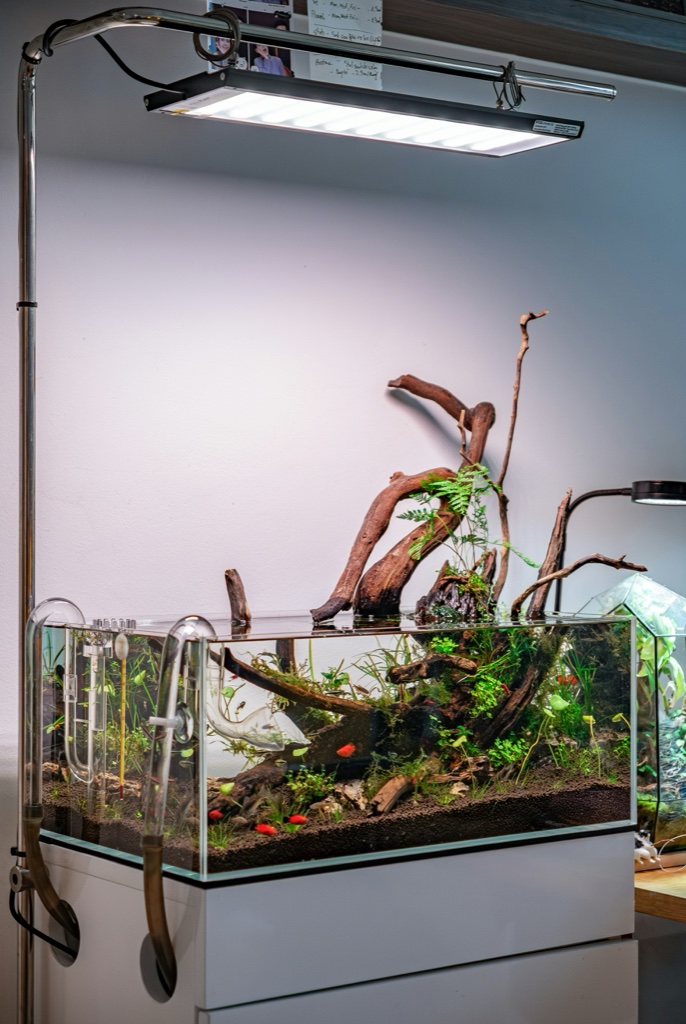
The pre-purchase checklist
Everything to decide before you buy anything, in the order the decisions constrain each other.
The order matters. Each stage narrows the one after it, which is why livestock comes last and the room comes first. Items marked irreversible cannot be changed once the tank is filled without taking the whole thing apart. Items marked reversible can be fixed on a Saturday, and are listed only because doing them in the wrong order wastes money.
Stage A
The room, before anything at all is bought
Eight decisions, and six of them are permanent. This is the stage people skip, and it is the stage that decides whether the hobby stays enjoyable.
- A1
The exact spot, checked for direct sun in June and in December. irreversible Midday sun in Yerevan runs from 28.7 to 73.1 degrees across the year1, so a winter-shaded corner can be a summer oven.
- A2
Distance from the window and from any radiator. irreversible Stability beats any particular temperature.
- A3
Doors, walkways and vibration. irreversible Decides whether shy fish ever come out from behind the wood.
- A4
Distance to a tap and to a drain, measured in meters and in bucket trips. irreversible This single item decides whether water changes actually happen.
- A5
Socket position: beside the tank and above the water line. irreversible Hard to move afterwards and never moved in practice.
- A6
Is there a 30 mA residual current device?2 reversible If not, buy a portable one now, before the tank arrives, not after the first spill.
- A7
Measure the room at six in the morning in the coldest month and at three in the afternoon in the hottest. reversible These two numbers size the heater and decide the whole summer strategy. Nothing else on this page can be answered without them.
- A8
Access above, in front and behind. irreversible A tank you cannot reach into is a tank you cannot maintain, and a tank you cannot sit in front of is a tank nobody looks at.
Stage B
The water, before choosing any livestock
All reversible, all cheap, and all commonly done in the wrong order. Testing the tap water after buying the fish is testing it backwards.
- B1
Test the tap for general hardness and carbonate hardness. reversible This decides the species list and it decides whether RO is a need or a purchase.
- B2
Test the tap for free chlorine and total chlorine. reversible Settles whether standing water overnight is a real method at your address.
- B3
Test the tap for nitrate. reversible Rarely a problem, occasionally decisive, and cheap to rule out.
- B4
Decide about RO from B1 and the species shortlist, not from what other people own. reversible
- B5
Buy a conditioner regardless of the fish. reversible It protects the filter, not the fish, and no species choice changes that.
Stage C
The tank itself
The stage everybody starts with, and it is third. Weight, floor loading, stand construction and levelling are the companion page's subject and are settled alongside C1 and C2.
- C1
Volume and footprint, against the space measured in A8. irreversible
- C2
Stand, levelling and floor loading. irreversible See Materials and water for the companion page.
- C3
Open top or cover glass, knowing it is a handicap in July and a saving in January. reversible Seasonally, which is the point.
- C4
Substrate type and depth. irreversible In practice, because changing it means dismantling the scape.
- C5
Hardscape layout. irreversible Same reason.
Stage D
The equipment
Every item here follows from a number measured in stage A. If A7 was skipped, this whole stage is guesswork.
- D1
Filter type and turnover. An air-driven sponge filter is the power-cut-resilient choice, for the reasons above. Sizing is the companion page's subject.
- D2
Heater wattage from the sizing table, against the six a.m. room temperature rather than the evening one. Do not oversize.
- D3
Two smaller heaters rather than one large one, on anything over about 100 liters3. The best value decision on this page.
- D4
A thermometer that is not part of the heater, read every day. The only thing that catches a drifting controller.
- D5
Surface movement: spray bar, angled return, or air pump. Buy the movement, not the bubbles.
- D6
An air pump and a battery or small UPS behind it, even if the filter does not need one. The cheapest insurance on the whole tank.
- D7
A clip fan, if the summer plan is evaporative cooling, and a decided source of mineral-free top-up water to go with it.
- D8
Lighting, and the ability to lift it clear of the glass in summer.
- D9
A drip loop and a label on every single cable. Ten minutes, once, at setup.
Stage E
The livestock, last
Last, because every previous stage has been narrowing this list. Choosing here first is how people end up buying a chiller.
- E1
Species chosen against the summer room temperature from A7 and the hardness from B1, not against a photograph.
- E2
Chronic thermal limits checked, not acute CTMax figures from a forum. If no measured figure exists for a species, say so out loud rather than assuming the fish is tough.
- E3
Stocking chosen with the Armenian altitude penalty in mind. Thirteen percent less oxygen in Yerevan than the book assumes, sixteen in Gyumri4.
- E4
Filter cycled before any fish go in. Our cycling page covers what is really happening in there.
And the single question that stands behind the whole list. Which maintenance task, in this plan, will I resent? Find it now and design it out. The task you resent is the task you skip, and the skipped task is where the decline begins.
The point of all of it
Nothing on this page is about the aquascape, and all of it decides whether the aquascape survives.
A tank that is well sited, correctly heated, safely wired and easy to reach asks for twenty minutes a week and gives them back with interest. The same tank three meters further from the tap, in the sun, with a heater twice the size it needed and an extension lead on the floor, asks for an hour, gets it grudgingly, and starts going backwards in its second summer. Neither outcome is about skill. Both were decided in an afternoon before anything was bought.
Site it out of the sun and away from the radiator. Free, permanent, and the largest single term in the whole summer problem.
Measure the room at six in the morning and at three in the afternoon. Two numbers, and almost every equipment decision follows from them.
Buy surface movement, not bubbles. The airstone works by renewing the surface, and there are quieter ways to buy the same thing.
Size the heater correctly and fit two small ones instead of one big one. A correctly sized heater cannot cook the tank. An oversized one can, in about two hours.
Put every appliance behind a 30 mA device2, and give every cable a drip loop. It costs almost nothing and it is the only item here that is about you rather than the fish.
Condition the water for the filter's sake, whatever fish you keep. The nitrifiers are the slowest thing in the tank to come back.
Do the boring part once, properly, before the tank is full. Then stop planning, sit down in front of it, and enjoy your tank.
- Our own climate research, P6, the Armenian climate file. Armenian hydrometeorological service, WMO Climate Normals 1991 to 2020, as submitted to WMO and archived by NOAA and NCEI, together with quantities derived in that file. The source of every Armenian temperature, humidity, vapour pressure, sunshine, station pressure and solar altitude figure on this page, including the 82 and 90 days above 30 C, the 34.5 C July mean daily maximum, the 887 and 846 hPa station pressures, and the winter indoor humidity floor of 14 to 22 percent.
- IEC 60364-4-41, Low-voltage electrical installations, Part 4-41: Protection for safety, protection against electric shock. Paywalled at the IEC. The international basis for additional protection of general purpose socket outlets by a residual current device not exceeding 30 mA. The 30 mA figure quoted here is the widely adopted national practice derived from it. This page is not electrical advice and does not substitute for an electrician.
- Our own calculation, not a published finding. The steady-state energy balance. Everything on this page marked computed comes from one model, stated in full in the cooling section so it can be argued with. Named inputs: a 100 L tank of 80 by 35 by 40 cm; an overall 5.5 watts per square metre per kelvin through the glass; 3.5 watts per square metre per kelvin of convection from the open surface; evaporation from the Lewis relation; latent heat 2,440 kJ per kilogram; ice enthalpy 334 kJ per kilogram; barometric pressure 887 hPa from 1; saturation vapour pressure from Buck 3. It is a model presented as an order of magnitude, not a measurement, and no tank has been instrumented to check it. The bucket and water-change arithmetic on this page is ours too. How we handle our own arithmetic
- Our own calculation, not a published finding. The oxygen and aeration budget. Named inputs: the Benson and Krause saturation equation 3, corrected for station pressure 1 and saturation vapour pressure 3; the measured temperature quotient of 1.92 4; a 3 mm bubble rising 40 cm at 25 cm per second with an ordinary film coefficient; the zero-wind transfer velocity of 2.07 cm per hour 10 applied to a 0.28 square metre surface; and an assumed 85 percent of saturation. The whole-tank demand range of 60 to 250 milligrams an hour is an order-of-magnitude estimate and not a measurement, and the power-cut clock inherits that uncertainty. How we handle our own arithmetic
Continue
Where to go next.
Choose your aquarium dimensions
Compare dimensions, usable water volume, and comfortable reach before buying.
Heat, cooling and the winter heater
What a Yerevan summer does to a tank, five ways to cool one, and how to size a winter heater.
Electrics and power cuts
The socket, the drip loop, the residual current device, and how long a tank is safe with the power off.
Floor loading and glass thickness
Floor loading and glass thickness, which is what siting actually turns on.
Easy setups
The setups that remove most of these decisions by not having the equipment.