Substrate

Aquarium substrate: choose soil, sand or gravel

Sand, gravel, capped mineral soil and aquasoil can all grow a planted tank. They differ in where the nutrients sit, how much chemistry they change, how calmly they can be replanted, and how long you expect the layout to stay put.8

Start with the tank, not the bag. A rooted garden that will stay planted for years can make deep soil do useful work. A river biotope with no root feeders needs none of it. A layout you expect to rebuild next winter should come apart cleanly.

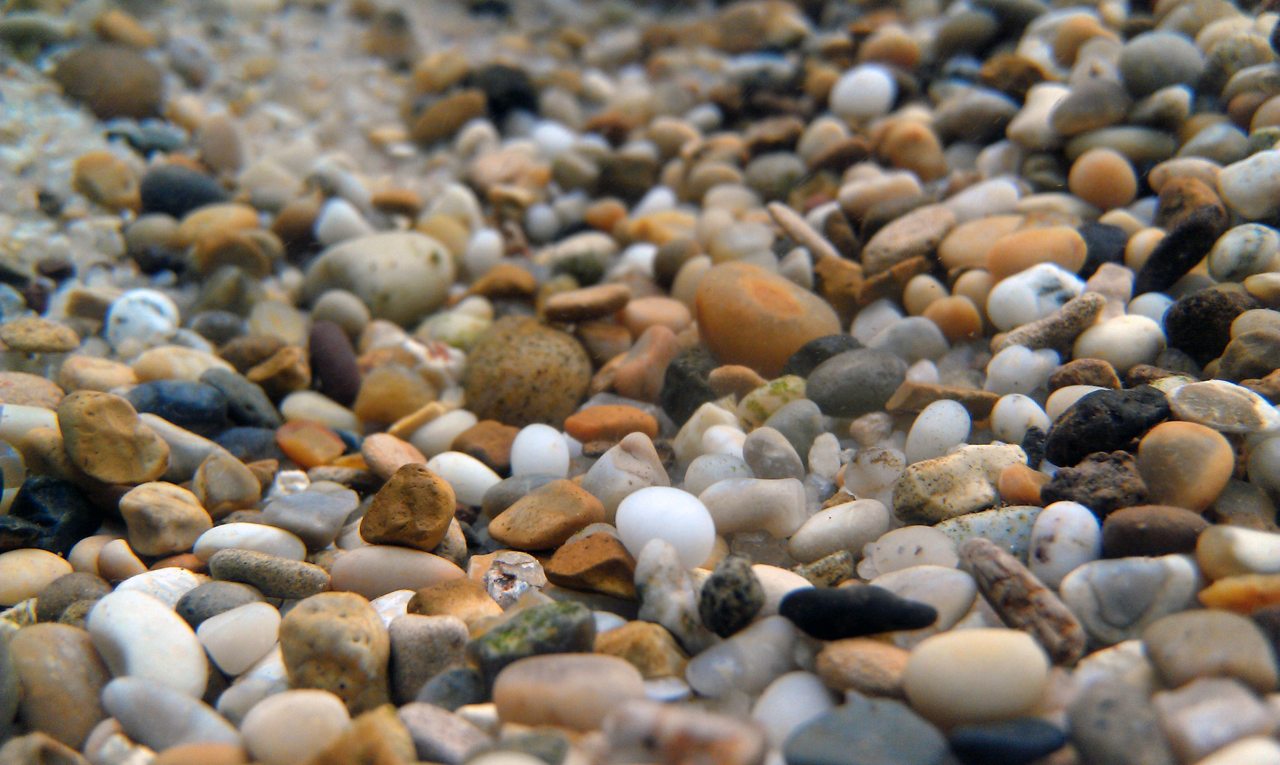
A close view of aquarium gravel
A close look at the grain sizes and rounded edges of aquarium gravel.Green Yoshi · CC BY 3.0 · Resized; uncropped.

The material

Three useful beds, for three different jobs.

A substrate does three separate things: it holds the layout, gives roots somewhere to anchor, and sometimes stores or releases nutrients. No material has to do all three. Inert sand can hold plants while root tabs feed them; a mineral soil can feed roots while a gravel cap keeps it in place; aquasoil packages structure, nutrients and water conditioning in one clean granule.

The clean slate

Inert sand or fine gravel

It does not promise to feed the plants or lower the pH. That is the virtue. Use it for biotopes, epiphyte-heavy layouts, tanks you plan to rescape, and any build where water chemistry should come from the water rather than the floor.

The long-set garden

Mineral soil under a cap

A thin soil layer under coarse sand or small gravel puts a large nutrient and ion-exchange reserve at the roots. Walstad describes roughly 2.5 to 4 cm of soil under about 2.5 cm of gravel.1 It rewards dense planting and leaving the roots alone.

The controllable planted layout

Commercial aquasoil

Baked soil granules are easier to slope, plant and replant than capped mud. ADA describes its Amazonia line as nutrient-rich natural soil that moves the water toward mildly acidic conditions.2 That convenience costs more and its chemical effect is finite.

Below the surface

Depth creates a chemistry ladder, not a poison switch.

Oxygen enters from the water above and is consumed on the way down. The upper millimeters are oxidising; deeper zones become low in oxygen, then anoxic. Microbes do not all start producing sulfide the moment that happens. They use the most favourable available electron acceptor first, moving from oxygen to nitrate and then through manganese and iron compounds before sulfate reduction becomes favourable.3

Oxygen present

Roots respire, organic matter is decomposed aerobically, and ammonia oxidation can proceed. This is the skin of almost every established bed.

Nitrate present

Facultative bacteria can use nitrate when oxygen is gone, returning part of the fixed nitrogen to the atmosphere as nitrogen gas. That is denitrification, not decay escaping as poison.

Iron reduction

Iron and manganese oxides become more soluble. A black band commonly records iron sulfide in the bed; color alone is not evidence that the water column is being dosed with hydrogen sulfide.

Sulfate reduction

Sulfide production needs a strongly reducing zone, usable organic carbon and sulfate. The practical warning is a persistent rotten-egg smell when the bed is disturbed, not simply a dark patch behind the glass.

The living part

Rooted aquatic plants carry their own air supply.

Wetland and aquatic plants grow air spaces called aerenchyma through their leaves, stems and roots. Oxygen can move down those connected spaces to buried tissue that would otherwise be starved. Some leaks from young root tips as radial oxygen loss, creating a narrow oxidised zone around the root.4

That protection is local, not a way to oxygenate an entire bed. Measurements around submerged plant roots found oxygenated zones only about 100 to 250 micrometres thick,5 and work on seagrasses found the effect concentrated at actively growing tips.6 This is why a planted soil can work for years while an equally deep, unplanted pocket full of decaying material can become strongly reducing.

The root habit matters more than the plant's price. Cryptocoryne, Echinodorus and Vallisneria can use a bed as a nutrient reservoir. Anubias, Microsorum and most mosses sit on wood or stone; burying the rhizome solves no problem for them and can create one.

The choice

Choose by planting, rescaping and water chemistry.

What you are buildingStart withWhy it fitsWhat to watch
Dense rooted garden, kept for yearsCapped mineral soil or aquasoilPuts nutrients where the root mass is and supports a large planted bedPlant heavily from the start; avoid frequent uprooting in capped soil
Nature layout that changes every yearAquasoilHolds slopes and comes apart more cleanly than capped mudIts pH and KH effect weakens as exchange sites fill
River or blackwater biotope with few rooted plantsInert sandThe bed stays visually and chemically quiet; epiphytes and floaters do not need rich soilFeed the rooted plants individually if you add them later
Corydoras or other sand-sifting fishSmooth fine sandAllows natural foraging without sharp edgesKeep the surface open enough to clean and do not bury rich organic pockets beneath feeding areas
First planted tank, uncertain planInert fine gravel plus root tabsCheap, reversible and easy to diagnoseIt offers no buffering and no hidden nutrient reserve; that predictability is the point

You want the tank to stay put.

Use capped soil or aquasoil, plant the whole bed early, and let roots make the substrate more stable with time. The detailed local soil and cap choices are on the Walstad method page.

You want to keep changing it.

Use aquasoil if you want its water-conditioning effect, or inert material if you do not. Both tolerate replanting better than opening a cap over fine soil.

You do not need roots in the bed.

Choose the texture for the fish and the look. Put nutrients in the water column, where the epiphytes and floating plants can reach them.

The first month

The first month tells you what the bed is releasing.

A new rich bed is not finished material. Organic matter dissolves, microbes bloom, and ammonium can enter the water before the filter and the plants can use it. ADA's own initial-stage guidance tells owners of Amazonia to expect humic color and ammonia and to use frequent water changes when dissolved material clouds the water.7

Plant before livestock. Fill the bed with fast growth, run the filter, and measure ammonia and nitrite rather than choosing a fixed waiting period. Water changes remove what the new bed has released; they do not “wash out” a nutrient reserve held in soil particles. Add animals when the readings, not the calendar, say the new system is processing its waste.

After that, maintain the bed you chose. Do not deep-vacuum capped soil. Siphon the exposed surface of inert sand. Replenish root nutrition when growth tells you to. If a previously healthy bed develops a persistent rotten-egg smell, remove the decaying pocket and restore circulation or roots there; the smell changes what you do, while a dark layer by itself does not.

For the organisms carrying out those changes, continue to cycling and bacteria. For the full soil-tank build in Armenia, continue to the Walstad method.
  1. Walstad, Diana L. Ecology of the Planted Aquarium. Fourth edition, 2023, Echinodorus Publishing. The soil-under-gravel construction and the ecological case for a planted mineral substrate. The author's aquarium page identifies the current edition.
  2. Aqua Design Amano. Aqua Soil series. Manufacturer documentation for Amazonia Pro and Amazonia Ver. 2: natural black soil, nutrient content, and the intended mildly acidic water condition. adana.co.jp. Manufacturer literature, not an independent comparison.
  3. Stumm, W. and Morgan, J.J. (1996). Aquatic Chemistry: Chemical Equilibria and Rates in Natural Waters, 3rd edition. Wiley. The sequence of terminal electron acceptors as natural water and sediment become reducing.
  4. Pedersen, O., Binzer, T. and Borum, J. (2004). Sulphide intrusion in eelgrass. Plant, Cell & Environment 27: 595 to 602. Oxygen transport through aerenchyma, radial loss to sediment, and sulfide entry when internal oxygen falls. DOI 10.1111/j.1365-3040.2004.01173.x.
  5. Lai, W.-L. and others (2006). Environmental factors regulating radial oxygen loss from roots of Myriophyllum spicatum and Potamogeton crispus. Aquatic Botany 84: 333 to 340. The measured 100 to 250 micrometre oxygen diffusion zone around roots. DOI 10.1016/j.aquabot.2005.12.010.
  6. Martin, B.C. and others (2019). Oxygen loss from seagrass roots coincides with colonisation of sulphide-oxidising cable bacteria and reduces sulphide stress. ISME Journal 13: 707 to 719. Open access. The localisation of radial oxygen loss at young root tips and its association with lower rhizosphere sulfide. pmc.ncbi.nlm.nih.gov.
  7. Aqua Design Amano (2012). Aqua Soil Amazonia, Initial Stage Maintenance. Manufacturer guidance on humic colour, organic clouding, ammonia and frequent early water changes. adana.co.jp.
  8. Aquarium substrate decision guide. The practical comparison of inert beds, capped mineral soil, and aquasoil used to organize this page. Technical claims are cited to the books, papers, and manufacturer documents above.

Continue

Where to go next.