Styles and history

Aquascaping styles: history and planted-tank designs

Every English biography tells it as a sequence. He was a cyclist, then he became an aquarist. The Japanese gambling authority that licensed him still publishes his racing record, and the dates overlap by about eight years.1

How this page works. Each style gets what is documented, then what is repeated without a source. Corrections are marked and both sides are cited. Sources are at the foot of the page, with addresses you can open.

The record

Registration number 008787. Sixteen seasons. A five percent win rate.1

Keirin in Japan is not a club sport. It is a licensed, state regulated, professional gambling sport, and every rider has a public file. Amano's is still online. He first raced on 23 June 1974 at Yahiko in Niigata. He retired on 2 November 1990.1

Between 1976 and that last race he started 965 times. He won 49 of them. That is a win rate of 5.0 percent,1 and it is the record of a working professional who never won a championship. He rode the top grade twice in sixteen years.1

Aqua Design Amano dates from 1982.23 So for roughly eight years he was running an aquarium company and racing for prize money in the same weeks. Japanese Wikipedia states it plainly, citing his own career: sixteen years of keirin, while traveling to tropical rainforests and publishing photographs.24

The correction. Do not write that he was a cyclist before he became an aquarist. The primary record shows two careers running together. The tidy version is wrong, and it has been copied into almost every English profile of him.

The JKA racer profile, still published
Takashi Amano, two careers123

1954
born 18 July, Maki, Niigata Prefecture
1974
turns professional. First race, Yahiko
1975
first rainforest journey
1982
starts Aqua Design Amano
1990
retires from racing, 2 November
1992
incorporates the company. First photo book. Fuji Grand Prix
2015
dies 4 August, aged 61
8
years the two careers overlapped
Two founding dates are both correct. He began the business in 1982 and incorporated it on 21 April 1992. If the hub prints one date it prints 1982 and footnotes 1992. The 1992 pivot is real: the company became a corporation, his first photo book came out, and he took the Fuji Film Nature Photo Contest Grand Prix in the same year.

The idea

He did not claim to be copying nature. He said the opposite, in print, in 1992.

In an essay titled Artifice Over Nature he described showing a photograph of one of his tanks to Hiroya Kawanabe, an animal ecologist at Kyoto University.4 Amano's record of the reply is that a waterscape that beautiful does not exist in nature, and only human hands can reach it. He printed the remark approvingly, under that title.

So the founder of the Nature Aquarium accepted in public that he was making something more beautiful than nature, and treated that as the point. Every article that says he tried to recreate nature exactly is repeating a story he did not tell.

Two more details from the same essay. The layout in the photograph had been set up four years earlier, and he chose the plants for how they would look many years on.4 A contest Iwagumi is grown in ten weeks.5 His own showpiece was a four year object.

The photograph is the output

He wrote that the aquarium and the ecological landscape photograph are the same work in two different dimensions.2 The contest that defines the style judges one image: front view, whole tank, no cropping, no retouching.6 A judge never sees the water.

Why the odd habits exist

Fine leaves at the back, coarse at the front. Substrate sloped steeply upward, which no riverbed does. One species of fish in a shoal. These are photographic habits, not biological ones. They make a flat image read as deep.

And the counter move

ADA's own judging criteria now award up to ten points for long term maintenance, and ask directly whether a layout was built only for a photograph.6 The company penalises what its founder's practice implies. That tension is real.

Checked and failed

The rules the hobby repeats, and where each one actually comes from.

None of these is a small point. Each is taught as settled fact, in English, in Russian, and shortly in Armenian if nobody checks. Printing the provenance next to the rule is the only way to stop the chain.

Correction 01

Riparium is a German word from 1912.

The hobby credits the term to an American supplier around 2008 or 2009. It is in Paul Kammerer's Das Terrarium und Insektarium, Leipzig, 1912, page 30, inside a four part scheme with paludarium, rivarium and insularium.14 Paul Krefft repeats the scheme in 1926.15 Riparium has meant a shoreline setup for over a century.

What survives of the modern story is narrower: an American supplier and its blog popularised the word in the English planted tank hobby from about 2009 and sold the hanging planter format. The personal attribution usually attached to it cannot be verified and should not be printed.

Correction 02

Every metric Dutch rule in English comes from one 2009 forum post.

One species per ten centimeters of tank width. A finger's gap between groups. No two neighbouring groups at the same height. All of it traces to Marco Aukes, writing on a British forum between 15 and 18 November 2009. He opened by saying it was his own view and not necessarily the correct story.11

He then judged the American contest's Dutch category from 2014. The contest rubric turned his post into scored criteria labeled as traditional federation rules.18 The disclaimer did not travel with them.

Correction 03

The golden ratio is not in the field's journal.

The recipe everyone repeats is: divide the tank length by 2.618 and put the focal point there. Trace it and it is one affiliate blog post from November 2006.8 English Wikipedia adds that Iwagumi focal points reflect Pythagorean tuning and cites that same post, which says nothing of the kind.248

Search all 1,228 indexed articles in 41 years of The Aquatic Gardener and no article is about the golden ratio. Amano has 49 entries in that index, four of them on perspective and two on improving an Iwagumi layout.21 None is about it. The psychology does not support it either: Boselie 1992 and Green 1995 both find the case weak.910

Correction 04

Two of the four Iwagumi stone names are not classical.

Oyaishi, Fukuseki, Soeishi and Suteishi are taught as ancient Japanese garden doctrine. JAANUS, the standard scholarly terminology database, has soe-ishi and sute-ishi. It does not have oyaishi or fukuseki, and the classical term for the main stone is shuseki.7

The four part scheme looks like ADA's own codification, built from real garden vocabulary. That is not a criticism. A teachable scheme is useful. It is simply not a thousand years old.

The styles

Nine ways of building the same box.

Two of them are institutions with judges and rulebooks. Two are labels applied after the fact. One is a trademark. Reading them as one list of equals is the first mistake.

Triangular planted aquarium
Photo: Brudinho5 · CC BY-SA 4.0

Nature Aquarium

ADA publishes it as a numbered process, and it is far more work than the pictures suggest. Daily water changes for the first fortnight. First trim at one to two weeks. Fish at week seven, after a clean nitrite test. Layout complete at about week eight.5

Read that eight week deadline for what it is. That is not how a natural system behaves. It is a production schedule, and it fits the photograph.

Iwagumi rock detail
Photo: Moritz Holzinger · CC BY-SA 3.0

Iwagumi

A garden word, centuries old, that ADA borrowed. Odd stone counts have a documented reason and it is compositional, not religious: an even number invites the eye to pair them, and a pair splits the frame.724

It is the hardest style, and the reasons are mostly biological. A carpet has almost no biomass in weeks one to six, so surplus light feeds algae instead. And the classic stone fights the water. See the carbonate ceiling table on the water page.

The Enchanted Garden
Photo: Shay Fertig · CC BY-SA 3.0

Dutch

The oldest organised style, and the one English describes least accurately. The Dutch federation does not run a photo contest. It runs a home inspection. Judges travel to the entrant's house.

Eight of the fifteen scored criteria are biological, weighted at 50 percent against 30 for aesthetics and 20 for general. And the federation now has judging categories for Iwagumi and Nature Scaping, and none called Dutch style.12

Biotope

Not a theme. A reconstruction of one named stretch of one named river, which can be judged right or wrong against evidence. A biotope tank can be ugly and still be excellent.

It is the part of the hobby that touches real science most directly, because it depends on published collection records and habitat measurements. A local Armenian stream biotope is cheap, legal to source and genuinely original.

Luis Embalo’s planted aquarium
Photo: Ghostsword · CC BY 3.0

Jungle

A label applied after the fact. No founder, no manifesto, no Japanese name, and English Wikipedia cites nothing for its origin. Treat it as a useful word, not a school.

It is also the most forgiving planted tank there is. Huge plant mass from day one, so it outcompetes algae, hides equipment and tolerates missed water changes. For a first tank in a country with no CO2 supply chain, teach this before Iwagumi.

Walstad, the natural planted tank

Ordinary soil under a gravel cap, heavy planting on day one, no injected carbon, the fish food as fertiliser. Three of the claims made about it in her name are not hers.

It also happens to be the structurally correct method for Armenia, because its main input is dirt and dirt cannot be import blocked. Full page.

Wabi-Kusa

A planted ball of substrate, grown emersed, dropped into water. It is ADA's, and there is a documentary date: the Japanese trademark was filed on 31 October 2006 and registered in August 2007.16 A filing is a lower bound on use, not an invention date.

The rice paddy origin story is not supported. A search of ADA's whole Japanese and English archive, including the company's own article on the product's birth, returns nothing about paddies. ADA's own account is purely horticultural.17

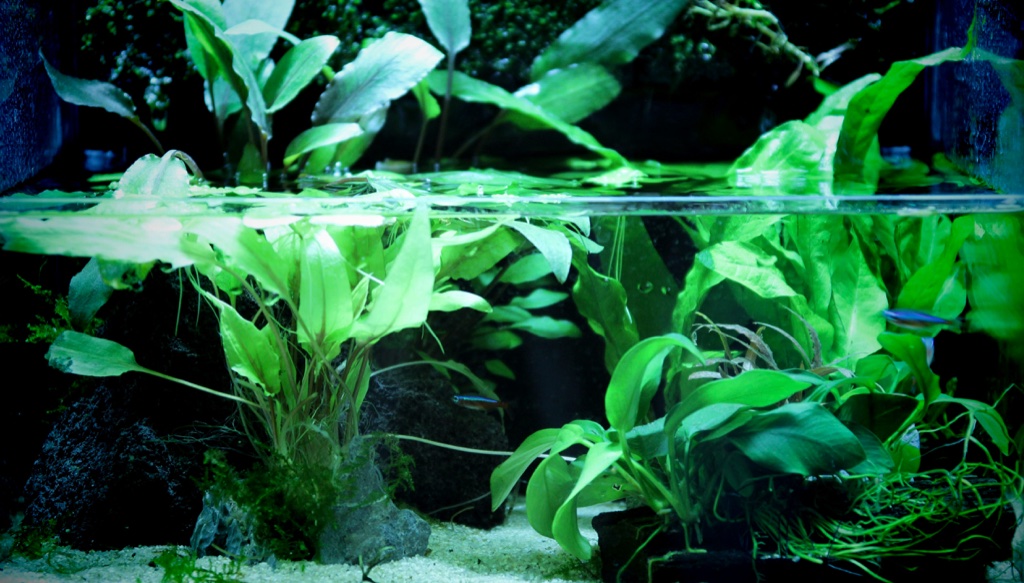
A planted tank photographed across the waterline, broad leaves growing out into the air above and the same plants continuing below over dark rock and pale sand, with a neon tetra among them.
Photo: Tommy Sze · Unsplash

Paludarium and riparium

Both words are German, both from 1912, and the definitions in circulation genuinely conflict.14 English Wikipedia contradicts itself across two of its own articles.24

The honest position is to use the contest rules as the working authority, because a judge had to be able to apply them, and then to note the 1912 origin. These are small fields: the American contest ran 15 riparium entries in 2023,18 and in 41 years the field's journal has published exactly one riparium article.21

Blackwater and botanical

Tannins lower pH in soft water with little carbonate buffering. In hard tap water leaves will stain the water brown and move the pH very little. That condition is the whole point and it is usually dropped.

The strongest claim here is not about tannins at all. It is ion regulation: dissolved organic carbon from the Rio Negro gave near complete protection to fish against ion loss at pH 4.22 The brown water is doing physiological work at the gill.

Taiwanese style, and an honest admission

Despite direct searching, no citable source defining or historicising Taiwanese style could be found. The hobby uses the term constantly and has never documented it. Anything published about it should say so.

What can be verified is the surrounding record. Chinese Taipei won the international contest's grand prize in 2005 and 2006, and Hong Kong in 2007 and 2008. Chinese Taipei's entries fell from 30 in 2021 to 12 in 2026.19 And the contest rules now evaluate nothing above the waterline and deduct points for material that cannot be maintained.6 Ornaments were never going to score on a sheet that gives half its marks to whether the tank is a good home for a fish.

What replaced it was the diorama: the same impulse with natural materials. Miniature trees of wood and moss, forced perspective, a path receding into the distance.

Terminology

The four Iwagumi stone names, against the scholarly database.

JAANUS is the Japanese Architecture and Art Net Users System, the standard terminology reference for Japanese garden and building vocabulary. Two of the four names the hobby teaches are in it. Two are not.

Iwagumi stone roles, checked against JAANUS, 20017
Hobby nameKanjiMeaningClassical termJob in the layout
Oyaishi親石parent stone, the main stoneNot in JAANUS. The classical main stone is shusekiLargest, best face, set off center, tilted. Its top sets the height of everything
Fukuseki副石secondary or deputy stoneNot in JAANUSClearly smaller, so the eye is never confused about which stone is in charge
Soeishi添石accompanying stoneYes. Stones set near the main stone to draw attention to itPoints the eye at the main stone and does nothing else
Suteishi捨石discarded stoneYes, from the tea garden. One of the seven trump stones of the rojiSet apart, often half buried, to break the neatness so the group looks found

One practical rule that is genuinely useful and rarely stated: every stone in an Iwagumi should look like it came from the same parent rock. Same type, same grain, same weathering, same direction of vein. Mixed stone reads as a rockery, not a landscape.

The Dutch rules

How English got its Dutch rules, dated.

This chain matters for the Armenian and Russian editions, because whoever translates the rules becomes the next link in it. A Czech article from 2013 already reproduces the whole set and cites the 2009 forum thread as its source.2911

The transmission chain, 2000 to 20212528262724111813
DateSourceWhat it introduced
Jan 2000Thomas Barr, Aquatic Plants DigestFirst English use of "street" for a planted lane
Jun 2003Matt Hennig, Tropical Fish HobbyistWikipedia's source for "the 1930s" and for "frequently omits rocks and driftwood". Not obtained
2004Aquatic Plant Central forumFirst English rule list. Three species per foot. Focal points at one third and two thirds
Jan 2008Robert Paul Hudson, Freshwater and Marine AquariumOne species per four inches. At least 80 percent of the floor planted. Schooling fish at least ten
2008 to 2009WikipediaMass amplification. Imports the 80 percent. Adds the incorrect gloss that streets run left to right
Nov 2009Marco Aukes, UK Aquatic Plant SocietyThe metric rules, opened with a disclaimer that they were his own view
2014AGA contest guidelinesThe forum post becomes scored criteria, labeled as traditional federation rules
2018, 2021Vin Kutty, Barr Report and AGA guide80 to 90 percent coverage. No more than a quarter of species red. Denies substrate terracing

Fabricated

"One third of the substrate must be left open."

No source anywhere. Two independent searches found nothing. The nearest real statements point the other way. Treat as invented.

False as a rule

"Dutch style uses no hardscape at all."

Aukes, who judged the category for a decade, says wood or rock covered with moss or ferns is allowed, as long as you do it in one place.11 The absolute version circulates on content farms.

Wikipedia error

"Streets run left to right."

They run front to back and narrow as they recede, because their entire purpose is perspective. Draw a road on paper: broad at the bottom, slim at the horizon.

Vocabulary

Use straatje, and nothing else.

Straat and straatje appear in federation judging reports across 1997, 2004, 2006 and 2008.12 Plantenstraat, leiding and "Leiden Street" are not attested; the last appears to have been invented on a machine generated page.

1912

Kammerer's four way scheme, published in Leipzig.

Under the heading Aquaterrarium, on page 30, with both of the words the hobby argues about listed in the index on page 209.

Paul Kammerer, Das Terrarium und Insektarium, 1912, page 3014
TermMeaning in 1912Where the hobby is now
Paludariuma marsh setupStill used. Attested in Dutch newspapers in the hobby sense from 2 May 193130
Rivariuma running stream setupEffectively lost. The hobby has no word for this today
Ripariuma bank or shore setupReintroduced to English around 2009 and widely miscredited to that reintroduction
Insulariuman island, water on all sidesLost entirely

The ancestor of all of it is the Wardian case. Nathaniel Bagshaw Ward ran his first shipping test in July 1833 and published in 1842.31 The case is the direct forerunner of the terrarium, the vivarium and the glass aquarium. Commercially it moved 20,000 tea plants to Assam and rubber to Ceylon and Malaya.31

Dated 2026

The diorama backlash stopped being an opinion and became a rule.

For years people said competition aquascaping had turned into model making. In 2026 one of the two flagship contests wrote that complaint into its rulebook, and the other publicly defended the opposite position.

A new Classic category. The Aquatic Gardeners Association added it for 2026. Its guidelines say current trends lean to dramatic scale and heavy forced perspective, and that Classic entries are judged instead on plant husbandry, balance and natural impression. Layouts are meant to be close to life size.18

The scoring sheet asks directly whether the composition is presented without forced perspective or scale manipulation, and it rewards species diversity and difficult species. The committee chair said plant led entries rarely rank highly and in the committee's opinion should be celebrated.18

ADA has done the opposite. Its 2023 statement defends the single standard and defends perspective technique directly, arguing that photograph based judging is what lets small tanks compete at all, so perspective skill is a legitimate skill.20

Both contests are shrinking. The international contest took 2,617 entries in 2021 and 1,452 in 2026.19 The American contest ran over 700 aquascapes in 2020 and 426 entries in 2025.18 Two organizations, two continents, about 40 percent down each.

Do not write that international contest judges have turned against the diorama. No individual judge has said so. The organization that has said so is the American one, on the record, in its own guidelines. That distinction is the difference between reporting and rumour.

The contests, and who won them The Walstad method in depth
The Enchanted Garden
Photo: Shay Fertig · CC BY-SA 3.0

Image boxes on this site are 5 to 2. Grand prize photographs in the international contest measure 1.9 to 1 up to 3.4 to 1 and cluster between 2.4 and 2.9,32 because that is the shape of a 120 centimeter tank photographed square on. Anything cropped to 16 by 9 has already lost the layout.

The last one he built is being dismantled this month.

"Forests Underwater" opened at the Lisbon Oceanarium on 21 April 2015, three and a half months before Amano died. It is 40 meters long and holds 160,000 liters.23 It was built as a two year temporary exhibit and stayed open for eleven. It is scheduled to close on 30 September 2026,23 which is three weeks after this page was written. Any page that describes it must carry that date and be rechecked after it passes.

  1. Racer profile and career record, Takashi Amano, registration 008787. KEIRIN.JP, JKA. The primary racing record. keirin.jp/pc/racerprofile?snum=008787
  2. Biography, AmanoTakashi.jp. His own site, archived 25 December 2019. Source for the photography, the rainforest work and his own statements of belief. web.archive.org snapshot
  3. Company profile, Aqua Design Amano Co., Ltd. Gives the 21 April 1992 incorporation date and the current officers. adana.co.jp/en/contents/adainfo/
  4. Amano, Takashi. "Artifice Over Nature." Aqua Journal vol. 277, reprint of a 1992 essay, published online 30 November 2018. adana.co.jp/en/aquajournal/amanos-view_012/
  5. Start Nature Aquarium. ADA's own numbered setup process, including the daily water changes and the week eight completion. adana.co.jp/en/contents/process/
  6. IAPLC Guidelines and Rules, and Judging Criteria. The photographic requirements, and the ten points for long term maintenance. iaplc.com/e/application/ and iaplc.com/e/judging_criteria/
  7. JAANUS, Japanese Architecture and Art Net Users System, 2001. Entries for ishigumi, shuseki, soe-ishi and sute-ishi. aisf.or.jp/~jaanus/deta/i/ishigumi.htm
  8. Farris, Arthur. "The Golden Rule of Aquascaping." Aquatic Eden, 16 November 2006. The origin of the 2.618 recipe. aquatic-eden.com
  9. Boselie, Frans. "The Golden Section has no Special Aesthetic Attractivity!" Empirical Studies of the Arts 10(1), 1992. DOI 10.2190/QB14-NK7B-ARYT-W5QT
  10. Green, Christopher D. "All That Glitters." Perception 24(8), 1995, 937 to 968. A century of golden section experiments reviewed. DOI 10.1068/p240937
  11. Aukes, Marco. "Crash course Dutch style Aquascaping." UK Aquatic Plant Society forum, 15 to 18 November 2009. The origin of every metric Dutch rule in English, with its own disclaimer. Archived copy
  12. College Bondskeurmeesters, NBAT. The judging categories including Group E aquascaping, the fifteen criteria, the three headings and the diploma thresholds. cbkm.nl/keuringen/verenigingskeuring
  13. Kutty, Vin. Some Rules for Dutch Style Aquascaping. Aquatic Gardeners Association, 2021, 15 pages. PDF
  14. Kammerer, Paul. Das Terrarium und Insektarium. Leipzig: Verlag Theodor Thomas, 1912. Page 30, with Paludarium and Riparium indexed on page 209. Google Books WqA9AAAAIAAJ
  15. Krefft, Paul. Das Terrarium. Pfenningstorff, 1926, page 8. Repeats the same four way scheme. Google Books KpxQAQAAIAAJ
  16. Japanese trademark 佗び草, application 2006101256. Filed 31 October 2006, registered 10 August 2007 as 5069788, owner Aqua Design Amano Co., Ltd. TMview JP502006000101256
  17. Sugimoto, Shunsuke. "The Birth of Wabi-kusa." DOOA and Web Aqua Journal, 16 November 2018. ADA's own account of the product's origin, which is purely horticultural. dooa.jp
  18. AGAIAC Guidelines, including the 2026 Classic category and every scoring rubric. agaiac.org/guidelines. Contest committee chair's letter at agaiac.org
  19. IAPLC annual entry announcements, 2021 to 2026. The entry counts behind the 40 percent decline. 2021 and 2026
  20. Frequently Asked IAPLC Questions. 8 December 2023. ADA's defence of the single standard and of forced perspective as craft. iaplc.com/e/2023/12/08/faq/
  21. The Aquatic Gardener complete index, 1985 to 2026. Published in full and free to read: 163 issues, 1,228 article entries, 318 authors. aquatic-gardeners.org
  22. Duarte, R.M., Smith, D.S., Val, A.L. and Wood, C.M. (2016). Dissolved organic carbon from the upper Rio Negro protects zebrafish against ionoregulatory disturbances caused by low pH. Scientific Reports 6: 20377. Open access. DOI 10.1038/srep20377
  23. Forests Underwater. Oceanário de Lisboa. Opening date, dimensions, and the closure scheduled for 30 September 2026. oceanario.pt
  24. Secondary sources used and named as such. English Wikipedia's Aquascaping and Takashi Amano articles, and Japanese Wikipedia's 天野尚 and 石組, the last of which cites the primary garden literature on stone setting. en.wikipedia.org/wiki/Aquascaping
  25. Barr, Thomas, and Miller, Roger S. Posts to the Aquatic Plants Digest, 2000 and 2001, archived at The Krib. First English use of "street" for a planted lane. thekrib.com
  26. "tsunami" (Carlos). "Weekly topic: Dutch aquarium style", 23 February 2004, and "Weekly topic: Dutch streets", 19 March 2004, Aquatic Plant Central. The first English rule list: three species per foot, focal points at one third and two thirds. Archived copy
  27. Hudson, Robert Paul. "Going Dutch." Freshwater and Marine Aquarium Magazine, January 2008. Source of the one species per four inches and the at least 80 percent of the floor planted figures. Print.
  28. Hennig, Matt. "Amano versus Dutch: two art forms in profile." Tropical Fish Hobbyist, June 2003. Print only and not obtained Listed because it is Wikipedia’s cited source for "the 1930s" and for "frequently omits rocks and driftwood", and the chain cannot be shown without naming it.
  29. grunda. "Holandské akvárium." rybicky.net, 6 November 2013. A Czech article reproducing the whole Aukes rule set and citing the 2009 forum thread as its source. rybicky.net
  30. "De natuur in miniatuur." Dagblad van Noord-Brabant, 2 May 1931, reprinted in Limburger koerier, 30 May 1931. The earliest Dutch newspaper attestation of paludarium in the hobby sense, found through the Koninklijke Bibliotheek Delpher archive. resolver.kb.nl
  31. "Wardian case", English Wikipedia. Secondary. Source for Nathaniel Bagshaw Ward, the July 1833 shipping test, the 1842 book and the 20,000 tea plants to Assam. An encyclopaedia, not a primary source, and named as one. en.wikipedia.org/wiki/Wardian_case
  32. Intrinsic image dimensions, IAPLC Grand Prize Works archive. Measured off the width and height attributes shipped in the archive’s own <img> tags at iaplc.com/e/grand_prize_works/, twelve images: 3.27, 2.83, 1.90, 2.20, 2.57, 2.84, 3.13, 3.21, 2.39, 2.50, 2.84 and 3.44 to 1. Tabulated in the cross-site design research at , part 2. Measured, not asserted.

Continue

Where to go next.