Library · Reading

Aquarium books, articles and journals

Most aquarium plant books are picture books with a caption under each photograph. They are pleasant and they teach almost nothing. Every book below was chosen because it contains something you cannot easily get elsewhere, and every entry says what the book gets wrong.

ISBNs are printed only where a library catalog confirmed them. Where an edition, a year or a volume number could not be settled, this page says so rather than guessing. Papers carry a DOI, so they can be found from any country, and every one is marked open, free or paywalled.

A cafe counter lit by two green pendant lamps, with a small planted aquarium set among books, glass jars and a trailing houseplant.
An aquarium sharing a café counter with books and houseplants.ph-c-sang · Unsplash License · Resized; uncropped.

How to use this

Three tiers, and they are about how you read, not about how clever the book is.

Tier 1

Start here

Five entries. Read them front to back. If you buy two books in your life, buy Walstad and Randall.

Tier 2

Go deeper

Six entries. You read these once you have a tank running and specific questions. Several are out of print and expensive.

Tier 3

Reference works

You do not read these. You look things up in them, and you cite them when somebody claims something is a fact. Check a university library before buying.

Tier 1

Start here.

Ecology of the Planted Aquarium

Author
Diana Louise Walstad
Publisher
Echinodorus Publishing, Chapel Hill
Edition
Fourth, April 2023. 225 pages31
ISBN
979-8-9875741-0-2
Cost
Low. A self published paperback, not an art book

Who it is for

Anyone who wants to know why a planted tank works, not just how to set one up. Walstad is a microbiologist. She treats the aquarium as a small ecosystem and cites the primary literature on every page. The reference list at the back is itself a reading list, and a very good one.

What it gets wrong or leaves out

It is a scientific argument, not a manual, with almost no pictures. The low tech soil method works, but the book undersells how badly it can go in the first two months: a new soil tank leaks ammonia and often grows a lot of algae before it settles, so give your planting time to settle in. And it is a plant and chemistry book. Fish appear mainly as a source of nutrients and as a thing that can be poisoned.

A correction you will need

Many websites, shop listings and machine written articles claim a 2025 or 2026 edition. There is no such edition. The fourth edition is April 2023, confirmed on the author's own site.3 Walstad did publish a separate and different book, Aquarium Fish Reproduction, in 2025, and that is probably where the confusion started. If a source cites a 2025 edition of this book, that source did not check. Earlier editions exist from 1999 with several ISBNs attached to the same catalog cluster, and the catalog does not say cleanly which belongs to which, so none is printed here.
Nature Aquarium World

Author
Takashi Amano
Publisher
TFH Publications, Neptune City
Book 1
1994. 978-0-7938-0089-6. A later printing is recorded as 978-0-7938-2078-81
Book 2
1997. 978-0-7938-2077-11
Book 3
Usually cited as 1996 or 1997. No ISBN is printed here. Open Library holds no record for this volume, checked 8 September 20261

Who it is for

Everyone, once. These are photograph books. There is text, but the point is the pictures. Amano photographed his own tanks on large format cameras and the images set the visual standard the whole hobby has copied since. Look at them the way you would look at a painter's catalog.

What it gets wrong or leaves out

The books show finished tanks at their best moment. They do not show the tank at week three, or the trimming schedule, or the failures. A beginner who reads only these will conclude that this look is easy and normal. It is neither, and many of the tanks photographed were built for the photograph and rebuilt often. The technique text is thin and, in the English translation, sometimes vague. Amano's monthly column in the field's journal, running from 2001 to 2015, is far more practical than these books.

In Russian

Yes, and this is the one Amano title that exists in Russian. Мир природного аквариума, publisher Аквариум, 2008, 300 pages, ISBN 978-5-98435-808-8, translated by A. Pirogov and A. N. Gurzhiy. Out of stock at Russia's largest bookshop chain as of 8 September 2026, so second hand only.

Nature Aquarium: Complete Works 1985 to 2009

Author
Takashi Amano
Publisher
TFH Publications, 20111
ISBN
978-0-7938-0649-2
Also
Aquarium Plant Paradise, 978-0-7938-0518-1. Year not settled: 1999 per Open Library, frequently cited as 19971

Who it is for

The single volume to own if you can only own one Amano book. It covers twenty four years in one place and shows how the style changed. The early tanks are busier. The late tanks are simpler and colder. You can watch a person change their mind over two decades, which is more instructive than any single image.

What it gets wrong or leaves out

It is expensive and heavy, and it is a commercial product of the company Amano founded. Every tank in it uses that company's equipment. That is not dishonest, it is just what it is, and you can also use the book to explore the company’s equipment. Aquarium Plant Paradise is the weakest of the titles: a plant picture book with short entries, and Kasselmann covers the same ground far better.

Sunken Gardens

Subtitle
A Step-by-Step Guide to Planting Freshwater Aquariums
Author
Karen A. Randall
Publisher
Timber Press, Portland
Year
2016 per Open Library, widely cited as 2017, which is probably the trade release date. Unsettled1
ISBN
978-1-60469-592-2

Who it is for

The best beginner book in English. Randall edited the field's journal for years, has 58 entries in its index under her own name4, and has spent decades answering beginners' questions. It shows. The book is practical, honest about cost, and does not assume you will buy expensive equipment.

What it gets wrong or leaves out

The shopping advice focuses on North America. Use our local guides to find equipment and plants in Armenia. It is also light on chemistry: it tells you what to do and not always why, so it pairs with Walstad rather than replacing her.

Encyclopedia of Aquarium Plants

Author
Peter Hiscock
Publisher
Barron's Educational Series, 20031
ISBN
978-0-7641-5521-5
Mini edition
Interpet, 2005. 978-1-84286-104-21

Who it is for

A first plant identification book. Hiscock is clear, the photographs are usable, and the plant entries give light and hardness needs in plain language. The Mini edition is small, cheap and easy to find second hand, which matters in a market where importing books is expensive.

What it gets wrong or leaves out

Two problems, both about age. Plant naming has moved: Echinodorus in particular has been split, and several species listed here now sit in Helanthium or Aquarius. Use the book for pictures and check the name somewhere current. And the lighting advice predates LED, so anything given in watts per gallon or watts per liter should be ignored. That measure never worked well and it does not work at all for LED.

Tier 2

Go deeper.

Aquarium Plants

Author
Christel Kasselmann
English
Krieger Publishing, 2003. 978-1-57524-091-6. Out of print, second hand prices high1
German
Aquarienpflanzen, Eugen Ulmer, second edition 1999, 504 pages. 978-3-8001-7454-61
French
Plantes d'aquarium, Ulmer, 2001. 978-2-84138-126-51
Note
A third German edition exists and was reviewed in the journal in volume 23 number 2, so it appeared around 2010.4 Its ISBN is not confirmed here

Who it is for

This is the reference book on aquarium plants. Kasselmann is a botanist who collects in the field, in Madagascar, Brazil, Laos, Australia and the Okavango Delta, and describes plants from having seen them growing wild. She has 30 entries in the journal index. Nobody else in this hobby combines field work and a publication record like that.

What it gets wrong or leaves out

It is a botany book. It will not teach you how to make a tank look good. It is expensive and hard to find, and the English translation is twenty years behind the German. If you read German, read the German.

In Russian, and this is the important part

Four Russian titles exist, and Kasselmann is easier to find in Russian than in English. The substantial one is Атлас аквариумных растений, Аквариум-Межиздат, 376 pages, ISBN 5-98435-069-6, year not stated on the retailer page and needing confirmation. The others are short popular books: Атлас аквариумных растений. 200 видов, 2009, 128 pages, 978-5-9934-0315-1; Самые популярные аквариумные растения, 2008, 95 pages, 978-5-98435-925-2; and Эхинодорус, 2009, 168 pages, 978-5-9934-0198-0. All four were out of stock on 8 September 2026 and circulate second hand.

Planted Aquariums: Creation and Maintenance

Author
Christel Kasselmann
Publisher
Krieger Publishing, 20051
ISBN
978-1-57524-265-1

Who it is for

The companion to the plant atlas, and the one where Kasselmann tells you how to run the tank rather than how to name the plant. Reviewed in the journal in volume 18 number 4.4

What it gets wrong or leaves out

German technical culture from twenty years ago, with detailed advice about equipment of its era. Read it for the reasoning, which holds completely, and translate the hardware into whatever is on the shelf today.

Pedersen, Christensen and Andersen

Format
Journals, not a book. Their work sits in peer reviewed papers and roughly fifty articles in the field's quarterly
Index count
Ole Pedersen 13 entries, Claus Christensen 8, Troels Andersen 54
Start with
Pedersen, Colmer and Sand-Jensen 2013, which is open access and is number one in the paper list below7

Who it is for

These three are the science side of a Danish plant nursery, and they are the most under read serious writers in the hobby. The reason is simple: they publish in journals rather than in books, so you have to go to the papers. The list below tells you exactly which ones and in what order.

Where the work actually is

In the journal index, verified 8 September 2026: Interactions Between Light and CO2 Stimulate the Growth of Aquatic Plants at v14n1, CO2 in Planted Aquaria at v20n3, Hunting for Pogostemon helferi at v21n2, Plants' Acclimation to Life Under Water at v19n4, Light: The Driving Force for Growth of Aquatic Plants at v20n2, Leaf Gas Films at v23n1, Root Uptake of CO2 for Use in Shoot Photosynthesis at v21n1, Growing Under Water: How Plants Cope with Low CO2 at v29n2, Tissue Culture Aquatic Plants for the End User at v25n4, and The Algal-Free Planted Aquarium: Grazing Control at v24n3.

One exchange is worth reading in order. Andersen and colleagues published the light article in volume 20 number 2, and Diana Walstad published a rebuttal in volume 20 number 3.4 Two serious people disagreeing in print is rarer in this hobby than it should be.

The Optimum Aquarium

Authors
Kaspar Horst and Horst E. Kipper
Publisher
AD aquadocumenta Verlag, Bielefeld, 19861
ISBN
978-3-925916-02-1
Status
Long out of print. Expensive and hard to find

Who it is for

Historical interest, and more than that. This is the book that made CO2 injection and laterite substrates normal in the hobby, years before Amano was known outside Japan. If you want to understand where the modern high tech planted tank came from, it came from here.

What it gets wrong or leaves out

It is a commercial book for a specific equipment brand and it reads like one. Several of its rules have not held up, especially substrate heating cables, which were sold as essential and are now understood to make little difference in most tanks.

The Baensch atlases

Series
Aquarium Atlas, by Hans A. Baensch with Rüdiger Riehl and later Gero W. Fischer
Publishers
Mergus Verlag in German, Microcosm in English
Verified ISBNs
978-1-89008-712-8, 978-1-89008-713-5, 978-1-89008-706-7, 978-3-88244-058-4, 978-1-89008-724-1, 978-1-89008-725-8, 978-3-88244-504-6

Who it is for

Identification. Thousands of species, a photograph and a data block for each. If you want to know what a fish is, how big it gets and what water it came from, this is where you look.

A warning about the numbering

Do not publish a volume number next to an ISBN on this series until somebody has the physical book in hand. The German and English volumes do not line up cleanly, editions were reprinted with new numbers, and the catalog records disagree with each other. The ISBNs above are what the catalog says and no more.

What it gets wrong or leaves out

It is a species catalog, so the care advice per species is two or three lines and often dated. Taxonomy has moved a great deal since the 1990s and many names in volume 1 are now synonyms. It is also almost entirely a fish book, with only light plant coverage.

Aquatic Plant Book

Author
Christopher D. K. Cook
Publisher
SPB Academic, The Hague, 1990. Revised edition Backhuys, Leiden, 19961
ISBN
978-90-5103-043-3 (1990), 978-90-5103-132-4 (1996 revised)

Who it is for

Serious plant people only. A world identification key to aquatic plant genera. Kasselmann herself reviewed it in the journal at volume 6 number 1,4 which tells you the level.

What it gets wrong or leaves out

It is a key, not a guide. Line drawings, not photographs. It stops at genus for most groups and it will not tell you how to grow anything. Buy it only if you need to identify a plant nobody can name for you.

Forests Underwater, Lisbon
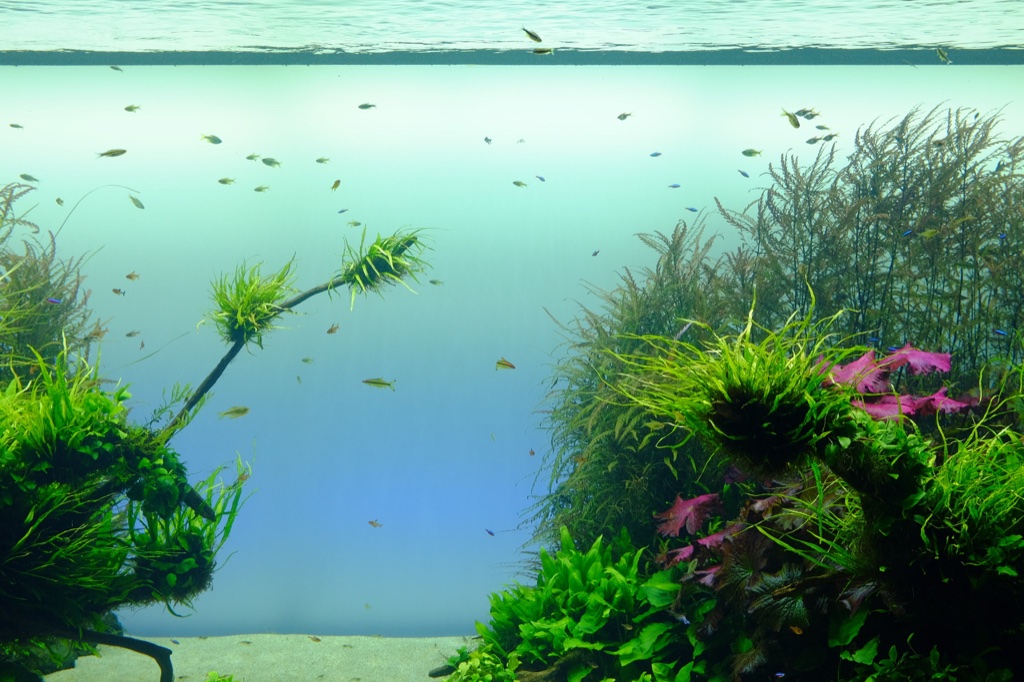
Forests Underwater, the public aquarium installation in Lisbon.Georg Pirrung · CC BY 3.0 · Resized; uncropped.

Tier 3

Reference works you consult rather than read.

These are the books behind the hobby. You look up the chapter you need, and you cite them when somebody claims something is a fact. None of them mentions your aquarium.

Tier 3, with the ISBN as the catalog records it
FieldWorkISBNWhy it matters, and what it omits
LimnologyWetzel, Limnology: Lake and River Ecosystems, Academic Press, third edition 2001. A fourth edition exists as Wetzel's Limnology, edited by Jones and Smol, 2023978-0-12-744760-5
978-0-12-822701-5
Everything argued about online, nutrient limitation, light attenuation, stratification, why green water happens, was worked out in lakes decades ago. Wetzel is the standard text and Kalff is more readable. They omit aquariums completely, and small closed systems behave differently from lakes in ways neither book addresses. Use them for mechanisms, not for numbers.
LimnologyKalff, Limnology: Inland Water Ecosystems, Prentice Hall. Year unsettled: 2002 usually, Open Library records first publication 2001978-0-13-033775-7
IchthyologyHelfman, Collette, Facey and Bowen, The Diversity of Fishes, Wiley-Blackwell, second edition 2009978-1-4443-1190-7Fishes of the World is the classification: when a shop calls something a rasbora and the fish is actually Trigonostigma or Boraras, this is the book that says so. Helfman and Moyle explain how fish work. All three omit aquarium keeping entirely and are priced like university textbooks. Check a Yerevan university library before buying. Open Library merges all five editions of Fishes of the World into one record, so confirm the edition against the ISBN.
IchthyologyMoyle and Cech, Fishes: An Introduction to Ichthyology, Prentice Hall, fifth edition 2004978-0-13-100847-2
IchthyologyNelson, Grande and Wilson, Fishes of the World, Wiley, fifth edition 2016978-1-118-34233-6
Aquatic botanySculthorpe, The Biology of Aquatic Vascular Plants, Edward Arnold, 1967. Predates the ISBN system; reprints exist978-3-87429-257-3
978-0-312-07945-1
Sixty years old and still the best single account of how a plant lives underwater. Leaf form, gas transport, submerged versus emersed growth. Almost everything the Danish nursery scientists later measured, Sculthorpe described first. It omits all modern molecular work and all aquarium practice.
Amazon limnologySioli (ed.), The Amazon: Limnology and Landscape Ecology, Dr W. Junk, 1984. Cite the DOI, 10.1007/978-94-009-6542-3, because the ISBN is not confirmednot confirmedSioli is the origin of the three way split every biotope aquarist repeats: white water, black water, clear water. If you say blackwater in an article, this is what you are citing whether you know it or not. Val and Almeida-Val explain what living in that water does to a fish's body. Both are academic, expensive and paywalled. For a free starting point, explore the open-access papers below.
Amazon fishVal and Almeida-Val, Fishes of the Amazon and Their Environment, Springer, 1995. 10.1007/978-3-642-79229-8not confirmed

A measurable gap

A search for aquascaping at Russia's largest bookshop returns nothing.

Prefer to read in Russian? Start with these editions.

Checked 8 September 2026

A search for акваскейпинг at Chitai-Gorod, the largest bookshop chain in Russia, returns nothing at all 2 You’ll find five Russian-language editions below.

That is the gap this hub exists to fill, and unlike most claims of that kind it is measurable.

Verified in Russian

Five titles, two authors

Amano's Мир природного аквариума, 2008, and four Kasselmann titles, 2008 and 2009. All out of stock and circulating second hand.21 That is the entire Russian translated literature of this hobby from the list above.

No Russian edition found

Everyone else

Walstad, Randall, Hiscock, Baensch, Horst and Kipper, Cook, Wetzel, Kalff, Helfman, Moyle and Cech, Nelson, Sculthorpe, Sioli, Val and Almeida-Val. Searched at Chitai-Gorod and Open Library.21 Read these in English, which is how they are sold. A Soviet era or small press translation may well be sitting on somebody's shelf without ever reaching either catalog, and if you own one, say so.

Written in Russian, not translated

Two worth knowing

K. N. Bogdan, Голландский аквариум, AST and Stalker, 2001, ISBN 978-5-17-008194-3, and Ваш аквариум, same publisher and year, ISBN 978-5-17-008195-0.12 The first is a Russian language book specifically on the Dutch style, and it is worth reading before this hub writes anything about the Dutch style in Russian, because it may carry the rules from a different and older chain of sources.

The papers

Ten papers, ranked, and seven of them are free to read.

The hobby runs on repeated claims. Somebody said it in 1985, somebody copied it in 1998, and by now it is a fact everyone knows. Some of those claims are right and several are wrong, and the only way to tell them apart is to read the papers.

Every paper below was checked on 8 September 2026 against at least one of Crossref, Europe PMC and OpenAlex, and every one carries a DOI so it can be found from any country.6 Look for the open-access label to read a paper without a university login.

The ten most useful papers, if you read nothing else6
#PaperWhat it settlesDOIAccess
1Pedersen, Colmer and Sand-Jensen (2013). Underwater photosynthesis of submerged plants: recent advances. Frontiers in Plant Science 4:1407The one to read on carbon. What "carbon limited" actually means, and it summarises the paywalled Maberly and Spence result inside itself10.3389/fpls.2013.00140Open
2Dortch (1990). The interaction between ammonium and nitrate uptake in phytoplankton. Marine Ecology Progress Series 61, 183 to 20114Why plants take ammonium in preference to nitrate, which is why your nitrate reading is not a fertiliser plan10.3354/meps061183Free
3Hovanec, Taylor, Blakis and DeLong (1998). Nitrospira-like bacteria associated with nitrite oxidation in freshwater aquaria. Applied and Environmental Microbiology 64(1), 258 to 2648The organism named in almost every shop explanation was not detected. The hobby has named the wrong bacterium since 199810.1128/aem.64.1.258-264.1998Free
4Emerson, Russo, Lund and Thurston (1975). Aqueous ammonia equilibrium calculations: effect of pH and temperature. Journal of the Fisheries Research Board of Canada 32(12)10The table behind every ammonia toxicity chart. In practice any ammonia calculator that implements these equations replaces it10.1139/f75-274Paywall
5Ip and Chew (2010). Ammonia production, excretion, toxicity, and defense in fish: a review. Frontiers in Physiology 1:13410What ammonia actually does to a fish, and the open access route into a subject that is otherwise behind paywalls10.3389/fphys.2010.00134Open
6Duarte, Smith, Val and Wood (2016). Dissolved organic carbon from the upper Rio Negro protects zebrafish. Scientific Reports 6:2037711Why botanicals and leaf litter protect fish, rather than merely staining the water. The evidence behind blackwater practice10.1038/srep20377Open
7Bagchi, Vlaeminck, Sauder, Mosquera and colleagues (2014). Temporal and spatial stability of ammonia-oxidising archaea. PLoS ONE 9(12):e11351512Archaea are in your filter too. The two bacteria story was never the whole story10.1371/journal.pone.0113515Open
8Ladich and Fay (2013). Auditory evoked potential audiometry in fish. Reviews in Fish Biology and Fisheries 23(3)13How fish hearing is actually measured, and audiograms for 111 species across 51 families. The paper behind every claim about noise and fish10.1007/s11160-012-9297-zOpen
9van Kessel, Speth, Albertsen and colleagues (2015). Complete nitrification by a single microorganism. Nature 528(7583), 555 to 5599Comammox. One organism does the whole job, which rewrites the two step story the hobby still teaches10.1038/nature16459Free
10Maberly and Spence (1983). Photosynthetic inorganic carbon use by freshwater plants. Journal of Ecology 71(3), 705 to 72414Which plants can use bicarbonate and which cannot, which is the real reason some plants fail in hard water. Summarized inside paper number one10.2307/2259587Paywall

A practical note on the paywalled two

Authors are allowed to send you their own paper, and most will if you email and ask politely. This is normal academic behavior, not a favor. For a hobbyist in a country with no research library it is the main route in.

The full article list from which these ten were drawn runs to about forty papers across eight topics: the nitrogen cycle, nitrogen from the plant's side, carbon and what carbon limited really means, ammonia and nitrite and nitrate as poisons, water types and blackwater, fish hearing and stocking, allelopathy, and the ornamental trade. Every one has a DOI and an access marking. Those topic pages sit with the materials and water section of this library.

The journal

Forty one years of the field's only journal, with an open index.

The Aquatic Gardener is the quarterly journal of the Aquatic Gardeners Association. The association describes it as the largest and only English language journal devoted to aquarium plants and planted aquaria, and on the evidence that description is fair.

It publishes its complete index in full, free, with no account needed. That is unusual and generous, and it is the single best English language source we have found.

The journal

What it is

Founded 1985, first issue September 1985, quarterly, ISSN 1073-6999. A printed magazine of 40 to 44 pages in full color.4 Latest indexed issue is volume 38 number 4, dated October to December 2025 and published August 2026. Published by a US non profit. The association also runs a free annual online aquascaping contest, kept online permanently since 2000, and a convention roughly every two years.

The index, counted 8 September 20264

163 issues, 1,228 entries

163 issues listed, 318 authors, 1,228 article entries and 495 distinct keywords. Issues per decade: 14 in the 1980s, 48 in the 1990s, 38 in the 2000s, 40 in the 2010s and 22 so far in the 2020s.4 Every one of the 163 issues is marked as having a PDF, and those PDFs are members only. The index is open, the articles are not.

Membership

Twenty dollars a year is the right option

Digital only is 20 dollars for one year, 35 for two, 50 for three. Print and digital outside the USA is 35 dollars a year and would be slow to Armenia.5 Digital gives the same access to 41 years of back issues, which is the actual value. Payment is by card through PayPal without needing a PayPal account, which matters because PayPal account creation is not straightforward in Armenia.

The honest gap

It is a plant journal. Do not go to it for fish.

Start here to find the most useful parts of the archive.

Counted from the index, 8 September 20264

1,228
total article entries, 1985 to 2026
26
entries containing the literal word fish anywhere
~50
entries mentioning any animal at all, broadly counted
0
articles on Corydoras
0
articles on Betta
0
articles on goldfish
0
articles on rasbora
0
articles on danio
0
articles on Apistogramma

Six of the most commonly kept freshwater aquarium genera in the world. Forty one years. Zero articles.

Count it three ways and you get three numbers. The literal string fish gives 26 of 1,228 entries. Widen it to any animal term and it is about 50. An earlier pass reported 45. All three measure slightly different things, and all three land in the same place: somewhere between two and four per cent of the journal is about animals.

Five of the 26 fish entries are one person's short Species Spotlight column.4 Two are marketing pieces from an equipment maker. Two are algae eater articles, which is to say the fish are being discussed as tools. The genuinely substantial fish content in 41 years amounts to roughly five articles.

Shrimp arrived late. Only 19 entries mention shrimp or snails,4 and the substantial ones are recent: a Caridina breeding piece at v20n4, two Species Spotlights at v29n3 and v29n4, a nano shrimp tank at v36n1, a guide to shrimp contests at v37n3_4 and one more at v38n1. The shrimp boom of the 2010s barely registered until the 2020s.

The journal's geography is tropical and Anglophone. Thailand appears seven times across 1,228 entries, Australia seven, Madagascar six, Brazil five, Poland once as a shop profile and Ukraine once in a piece on children's aquarium contests, and a search for Armenia, Caucasus, Sevan, USSR, Soviet, Russia, Georgia, Turkey or Iran returns zero.4 So the first serious write up of a Caucasus biotope has never been written, and the journal takes submissions.

The index is also a negative test. If a claim has a real published origin in the English speaking planted hobby, there is a decent chance it appears here. Searching it settled that no article by the person widely credited with inventing the riparium appears in the whole 41 years; the word itself appears once, in a judge's column from 2023. Search the index before repeating an origin story.

So: use the journal for plants, water chemistry, substrate, CO2, lighting, aquascape composition, contest history and field botany, where it is superb. For fish, go to the ichthyology works in Tier 3 and the physiology papers above. It is called the Aquatic Gardeners Association, and it does exactly what the name says.

How the hub checks a page The Armenian scene
  1. Open Library. The catalogue used to verify every ISBN, publisher and year on this page. openlibrary.org. Where its record was ambiguous, the ambiguity is printed rather than resolved.
  2. Chitai-Gorod, the largest bookshop chain in Russia. chitai-gorod.ru. Searched for акваскейпинг, returning no results, and for each author on the list, returning the five Russian titles recorded above.
  3. Diana Walstad's own site. dianawalstad.com/aquariums. Carries a free 23 page preview and settles the fourth edition date of April 2023 against the widely repeated 2025 claim.
  4. Aquatic Gardeners Association. Complete index of The Aquatic Gardener in full and free to read: the article index and the issue list. Source of every count, every issue code and every article title attributed to the journal on this page.
  5. Aquatic Gardeners Association membership form, page updated 10 November 2025. aquatic-gardeners.org/applic.html. Source of the prices and of what membership includes.
  6. Crossref, Europe PMC and OpenAlex. Every DOI on this page was resolved against at least one of the three. All three are free to search.
  7. Pedersen, O., Colmer, T.D. and Sand-Jensen, K. (2013). Underwater photosynthesis of submerged plants: recent advances. Frontiers in Plant Science 4:140. doi.org/10.3389/fpls.2013.00140. Open access, PMC3659369.
  8. Hovanec, T.A., Taylor, L.T., Blakis, A. and DeLong, E.F. (1998). Applied and Environmental Microbiology 64(1), 258 to 264. doi.org/10.1128/aem.64.1.258-264.1998. Free to read on PubMed Central, not under an open licence.
  9. van Kessel, M.A.H.J. et al. (2015). Complete nitrification by a single microorganism. Nature 528(7583), 555 to 559. doi.org/10.1038/nature16459. Free to read at the publisher.
  10. Ip, Y.K. and Chew, S.F. (2010). Frontiers in Physiology 1:134. doi.org/10.3389/fphys.2010.00134. Open access. And Emerson, K. et al. (1975), doi.org/10.1139/f75-274, paywalled.
  11. Duarte, R.M., Smith, D.S., Val, A.L. and Wood, C.M. (2016). Scientific Reports 6:20377. doi.org/10.1038/srep20377. Open access, PMC4745052.
  12. Bagchi, S. et al. (2014). PLoS ONE 9(12):e113515. doi.org/10.1371/journal.pone.0113515. Open access, PMC4257543.
  13. Ladich, F. and Fay, R.R. (2013). Reviews in Fish Biology and Fisheries 23(3). doi.org/10.1007/s11160-012-9297-z. Open access, PMC4560088.
  14. Dortch, Q. (1990). Marine Ecology Progress Series 61, 183 to 201. doi.org/10.3354/meps061183. Free at the publisher, which puts its back issues online. And Maberly, S.C. and Spence, D.H.N. (1983), Journal of Ecology 71(3), doi.org/10.2307/2259587, paywalled.

Continue

Where to go next.