Livestock and biogeography

Aquarium fish: natural habitats and temperature needs

An unheated tank is not cold. It is whatever temperature the room is, minus a little for evaporation. In a normally heated Yerevan apartment that is 19 to 23 degrees24, which is a subtropical tank with a real species list, not a coldwater one.

A fish is not a decoration. It is an animal that evolved in one place, in water with one chemistry, at one temperature range. A shop puts a cardinal tetra and a platy a meter apart and prices them the same. Nothing on the shelf says that one comes from water so soft and acidic most fish would die in it, and the other from hard limestone water in Mexico. Biogeography is the missing label.

The better question

What temperature is the room, all day and all night, in the coldest week of the year?

That is the question, and it has two variables rather than one. The absolute temperature matters. The daily swing matters as much. A tank that moves 5 degrees between afternoon and dawn is harder on fish than a steady tank at either end of that range.

Yerevan sits on the Ararat plain in a dry continental climate with genuinely cold winters. The January daily mean is about minus 3.5 degrees and the mean daily minimum about minus 7.8.23 Indoors is a different matter, and that is where the honest answer lives.

In a heated apartment during the heating season the room runs 20 to 24 degrees and an unheated tank sits at roughly 19 to 2324. That is a perfectly usable subtropical tank.

In a room heated only in the evening the tank swings, and the swing is the problem rather than the low point.

If the heating fails for a few days the tank tracks the building. In a cold winter that can reach 12 to 15 degrees or lower24, and most tropical fish will not survive it.

In summer the risk reverses. An unheated tank in an un-airconditioned Yerevan room can exceed 30 degrees24, which is worse for a coldwater fish than winter is for a tropical one. Warm water holds less dissolved oxygen, and a coldwater species has a high oxygen demand.

So the conclusion nobody in the hobby likes. For most people in Yerevan an unheated tank is not the simple option. It is the option with the widest temperature range and the least control. A heater is not there to make the tank hot. It is there to stop the tank moving.
What a heater actually costs. Calculated, not measured24

60 L
tank in a 20 degree room, held at 24
100 W
heater, running about 10 to 20 percent of the time
10-20 W
average draw, so 0.24 to 0.48 kWh a day
7-15
kWh per month
~50
AMD per kWh assumed, so roughly 350 to 750 AMD a month24
That is less than the cost of the fish that die when the heating goes off. The method is shown so it can be repeated with a current local tariff, which we could not verify from the regulator and which should be checked before this figure is published in the Armenian edition24. The heater's real risks are different and worth naming: a stuck heater cooks a tank and a failed one does nothing. Both are handled the same way, with a separate thermometer that you actually look at.
Species that genuinely suit an unheated room at 18 to 23 degrees. Every temperature and size figure below is FishBase1; conservation categories are IUCN2
SpeciesTemperature1Max size1SourcingVerdict
Tanichthys albonubes, white cloud mountain minnow18 to 22 C, survives to 54.0 cm TLFarmed, alwaysThe best answer. Small, hardy, shoaling, beautiful in a group, breeds readily
Barbodes semifasciolatus, gold barb18 to 24 C7.6 cm TLFarmedExcellent. Slightly larger and more active
Corydoras paleatus, peppered cory18 to 23 C6.6 cm SLFarmedExcellent bottom fish for a cool tank
Danio rerio, zebra danio18 to 24 C3.8 cm SLFarmedVery hardy, but fast and busy. Needs length rather than volume
Rhinogobius duospilus15 to 25 C6.2 cm SLMostly wild caughtA genuinely cool water stream goby. Interesting, less available
Sewellia lineolata, hillstream loach20 to 24 C5.7 cm SLMostly wild caught. IUCN VulnerableOnly in a hillstream build. See the note below
Sahyadria denisonii, Denison barb15 to 25 C15 cm TLSome farmed now. IUCN EndangeredDo not, in a normal tank. Too big, and the conservation status matters

The hillstream caution

A hillstream loach in a still planted tank is a fish in the wrong place.

Sewellia lineolata is genuinely a cool water fish, it is beautiful, and it lives on rock surfaces, which makes it a real aquascaping animal. But its habitat is fast flowing, highly oxygenated water over bedrock, sand, gravel and boulders, with riffles and runs, and it typically has no aquatic plants at all. It eats benthic algae and biofilm.9

So a hillstream tank is a different build: strong powerhead flow, a lot of flat stone, low temperature, and biofilm on the rocks. That is a legitimate and unusual aquascape, and it is one the Armenian hobby could own.

Invertebrates and plants

What else takes a cool room.

Neocaridina davidi handles roughly 18 to 26 degrees and breeds more slowly when cool. The Amano shrimp has a documented high tolerance of fluctuation and a large thermal safety margin.13 Ramshorn and Malaysian trumpet snails are effectively indifferent. Nerites slow right down when cool.

Plants that do well below 22 degrees: Cryptocoryne, Anubias, Java fern, Vallisneria, hornwort, Eleocharis acicularis, Lobelia cardinalis, Marsilea, Elodea and Egeria, Bacopa. Poor below 22: most demanding red stems, Hemianthus callitrichoides, most high light carpets. They do not die, they stall, and a stalled carpet is an algae farm.

The honest verdict, in five lines. An unheated tank in a normally heated Yerevan apartment is a subtropical tank at 19 to 23 degrees24, and that is a real and good option. It only holds if the room heating is reliable. A tank that swings 5 degrees or more day to night is worse than a steady tank at either end. Summer overheating is the bigger risk here, not winter cold. And if you want cardinal tetras, rams, chili rasboras or bee shrimp, you need a heater and you should stop looking for a way around it.

Awkward for the hobby

A planted Amazon tank is not an Amazon biotope.

The signature Amazon habitat is igapo, flooded forest. Trees stand in water for months. The bottom is sand under a thick bed of fallen leaves and branches. Aquatic plants are largely absent from true blackwater igapo, because the water is too dark and too poor to support them.5

A lush planted tank with cardinal tetras in it is a beautiful thing. It is a Nature Aquarium with South American fish in it. The honest Amazon biotope is sand, wood, leaf litter and brown water, and it can be judged right or wrong against published field records. Saying so is not pedantry. It is the difference between a design and a reconstruction.

Whitewater5

Rivers off the Andes, carrying fine sediment that looks like milky coffee, and dissolved minerals with it. pH near neutral, roughly 6.5 to 7.0. The Solimoes and the main Amazon channel.

Blackwater5

Rivers draining old, deeply weathered sandy lowlands with almost nothing left to dissolve. What they carry is organic carbon leached from leaf litter. The color of strong tea, extremely ion poor, and often pH 4 or below. The Rio Negro.

Clearwater5

Rivers draining the ancient Guiana and Brazilian shields. Little sediment, little organic carbon, genuinely transparent. pH variable, often mildly acidic. The Tapajos and the Xingu.

Why it is not just acid

Water that is both very acidic and very low in sodium and calcium should kill a freshwater fish, because the gill cannot hold its salts. Rio Negro organic carbon is itself protective67. Blackwater fish are adapted to a package: low pH plus humic substances plus low ions. Give them the low pH without the humics and you have made things worse.

One number for scale. The Rio Negro basin on the Brazilian side alone has 1,165 recorded fish species. Of those, 54.3 percent are under 10 centimeters standard length and 13.4 percent are found nowhere else.8 The Amazon is not mainly a place of big fish. It is mainly a place of small fish, which is exactly why so much of this hobby comes from there. And the Amazon blackwaters hold about 8 percent of the world's known freshwater fish species6, in water most aquarists would describe as unfit.

South American aquascaping fish, with where they are actually from. Distribution, size, pH, hardness and temperature are FishBase1; conservation categories are IUCN2
SpeciesWhere exactly1Max size1Water and temperature1
Paracheirodon axelrodi, cardinal tetraUpper Orinoco and Rio Negro basins3.0 cm SLpH 4.0 to 6.0, dH 5 to 12, 23 to 27 C. IUCN Least Concern
Paracheirodon innesi, neon tetraBlackwater and clearwater tributaries of the Solimoes2.5 cm SLpH 5.0 to 7.0, dH 1 to 2, 20 to 26 C
Hemigrammus rhodostomus, rummynoseLower Amazon and Orinoco5.0 cm TLThe true species. Most trade fish are a different one sold under the same name
Hyphessobrycon amandae, ember tetraAraguaia River basin2.0 cm SL24 to 28 C
Nematobrycon palmeri, emperor tetraAtrato and San Juan basins, Colombia4.2 cm SLPacific slope of Colombia, not the Amazon at all. A biotope builder needs to know that
Mikrogeophagus ramirezi, ramOrinoco llanos, Venezuela and Colombia4.2 cm SLpH 5.0 to 6.0, 27 to 30 C A ram at 24 is a ram kept cold, and that is one real reason it dies
Corydoras sterbaiCentral Brazil and Bolivia6.8 cm SLpH 6.0 to 8.0, dH 2 to 25, 21 to 25 C. Genuinely tolerant
Otocinclus vittatusAmazon, Orinoco, Parana, Xingu, Tocantins3.3 cm TLpH 6.0 to 7.5, 20 to 25 C. Needs a mature tank with biofilm
Hypancistrus zebra, zebra plecoRio Xingu onlyabout 9 cmIUCN Critically Endangered. Captive bred or not at all

Why a blackwater tetra and a hard water livebearer are not interchangeable

The gill does different work. In very soft acidic water a fish is fighting a constant loss of sodium and chloride, and fish from that water have gills tuned for uptake at low concentration. Fish from hard alkaline water have the opposite problem and the opposite tuning.

The numbers do not overlap. Neon tetra dH 1 to 2. Molly dH 11 to 30.1 There is no value that satisfies both. A compromise at dH 8 is outside the published range of one and near the bottom of the other.

The consequences look different, so people miss them. A hard water fish in soft acidic water usually shows obvious distress and dies fairly quickly. A soft water fish in hard alkaline water often looks fine for months. It just fails to breed, colors poorly, and dies early for no visible reason. The second failure mode is far more common, and it is invisible, which is why the idea that fish adapt to anything survives.

So pick your water first. Then pick fish from places whose water matches. Do not pick fish and then try to build water that suits all of them, because in most cases no such water exists. For what comes out of the tap here, see materials and water chemistry.

Shrimp

Two genera that look alike, cost differently, and want almost opposite water.

Getting this wrong is the most common way people kill shrimp. Every color form of Neocaridina davidi in the shops, cherry red, yellow, blue, orange, black rili, is one species. They are color strains, not species.3 Caridina is a far larger genus, over 300 species across Asia, Africa and Oceania, and two of its groups matter here.

The bee and crystal shrimp of the trade sit in the Caridina cantonensis complex from southern China, split into named species in 2014, which is why older sources write C. cf. cantonensis and newer ones write C. logemanni103. The Sulawesi shrimp come from the ancient lakes of Poso and the Malili system11, and they live in warm hard alkaline lake water, which is the opposite of what bee shrimp want.

Dwarf shrimp parameters. Practitioner knowledge, not measured science. Origins are from the taxonomic literature31011
Neocaridina davidiCaridina, bee and crystalSulawesi Caridina
OriginTaiwan, China, Korea, JapanSouthern ChinaAncient lakes of Sulawesi
GHroughly 6 to 15roughly 4 to 6high, 6 to 8 and up
KH2 to 8, tolerantclose to 0 to 13 to 6
pH6.5 to 8.05.5 to 6.57.5 to 8.5
Temperature18 to 26 C20 to 24 C27 to 30 C
TDS150 to 400100 to 160150 to 250
Difficultybeginnerintermediate to hardexpert
Sourcingfarmed everywherefarmed, mostly Asia and Europemostly wild caught from endemic ancient lakes

Be honest about the table

Those ranges are hobby consensus, not published measurements.

They come from breeders and from shrimp keeping communities, and they are repeated with great confidence everywhere. We could not find a peer reviewed study establishing any of them. What the scientific literature does confirm is the biogeography underneath: which species come from where, and therefore which water they evolved in. Treat the numbers as practitioner knowledge, which is real but is not measured.

Practical, for Armenia

Neocaridina is the correct starting shrimp here.

It suits hard tap water, it is farmed, it is cheap, it breeds without intervention, and it needs no reverse osmosis unit. Crystal and bee shrimp require remineralised RO water, which is an equipment purchase and an ongoing cost, and it should be presented as one. Put crystal shrimp in Yerevan tap water and they will fail to moult properly and die. Put Neocaridina in the same water and they will breed until the tank is full of them.

Two warnings

Copper, and the journey.

Copper kills shrimp, and many fish medications contain it. Check every product before it goes in a shrimp tank. Soil can carry it too, which matters here more than most places and is covered on the Walstad page.

Shrimp also arrive from transport in poor physiological condition, and the trade has almost no evidence based handling protocol. A 2026 review makes exactly that argument and names temperature, dissolved oxygen, carbonate chemistry and nitrogenous waste as the parameters that matter in transit.14 Acclimatise slowly, over hours, by drip.

Why they never breed

The Amano shrimp is amphidromous.

Caridina multidentata, catalogued for decades as C. japonica, is the same animal under an older name.4 Adults live in fresh water. The larvae must develop in brackish or salt water and migrate back up the rivers as juveniles.12 So females carry eggs, the eggs hatch, and the larvae die in fresh water. Every Amano shrimp in the trade is either wild caught or produced in a hatchery that runs a brackish larval phase.

Sold in ordinary shops, to ordinary customers

The three worst, and what actually happens to them.

These are not exotic mistakes. They are on the shelf, priced as beginner fish, in tanks that cannot house them. Every figure below is from the standard reference databases and can be checked in a minute, which is the point.

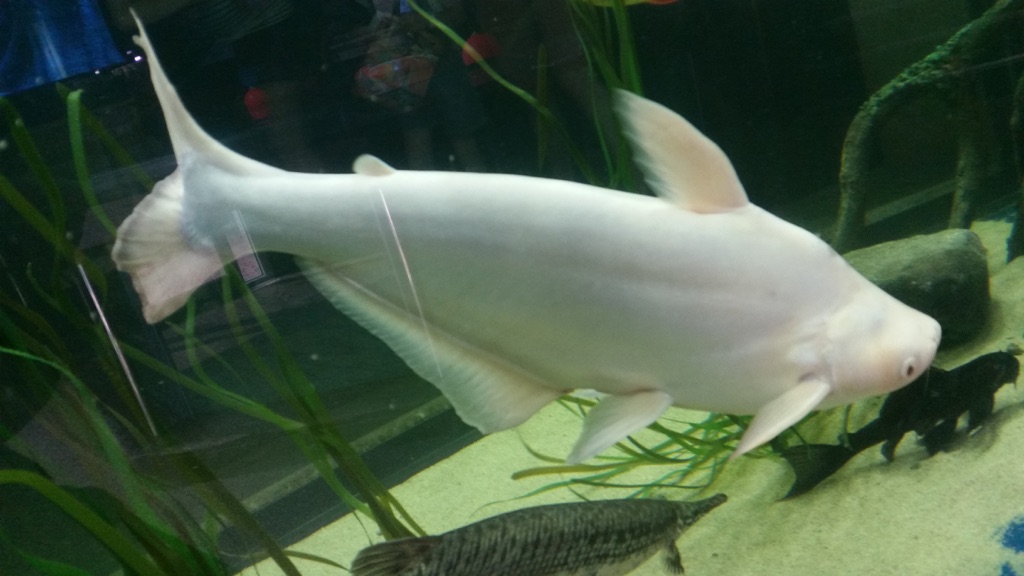
An albino iridescent shark (Pangasianodon hypophthalmus) swimming in a public aquarium.
Photo: Emőke Dénes · CC BY-SA 4.0

1. Pangasianodon hypophthalmus

The iridescent shark or pangasius catfish. Maximum length 130 cm, maximum published weight 44 kg. Native to the Mekong, Chao Phraya and Maeklong basins.1 IUCN Endangered.2 Sold at 5 to 8 cm to people with 60 to 100 liter tanks.

It reaches 30 cm within a year or two. It is a skittish, fast swimming, open water river fish with poor eyesight. In a small tank it panics and injures itself repeatedly on the glass and the hardscape. Then it either dies of organ failure from stunting, or is dumped, or released. It cannot be rehomed, because almost nobody has a tank that fits a meter long catfish.

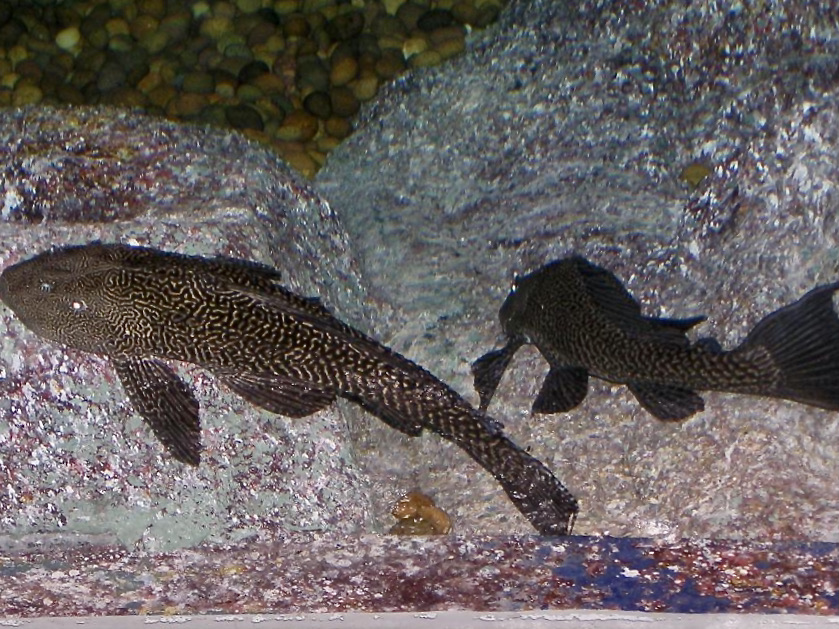
Two Amazon sailfin catfish (Pterygoplichthys pardalis) resting on stone in a public aquarium.
Photo: NasserHalaweh · CC BY-SA 4.0

2. The common pleco

Pterygoplichthys pardalis reaches 57.8 cm. Hypostomus plecostomus reaches about 25 to 28 cm.1 Sold at 4 to 6 cm as an algae eater.

It eats algae as a juvenile and then largely stops. As an adult it is a very large armoured nocturnal fish producing an enormous quantity of waste, which overwhelms the filter of any normal tank. It rasps at the slime coat of slow moving fish. It uproots and eats soft plants. When it becomes unmanageable it gets released, and Pterygoplichthys is now established as an invasive on several continents, undermining riverbanks with its breeding burrows. Meanwhile the customer still has an algae problem, because a 40 cm pleco1 is not an algae solution.

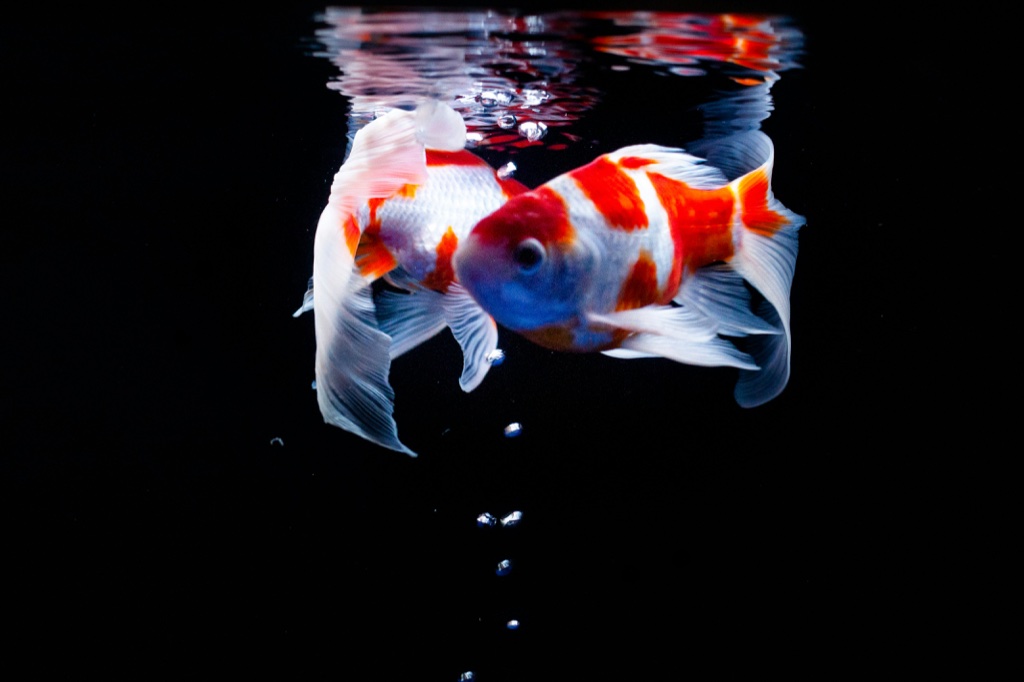
Two red and white fancy goldfish with long flowing fins meet head to head just below the water surface against a black background.
Photo: Antoine Peltier · Unsplash

3. Carassius auratus

The goldfish. Maximum length 48 cm. Maximum reported age 41 years. Temperature range 0 to 41 degrees.1 Sold in bowls, in unfiltered tanks, as a fairground prize, and as a beginner fish for children.

In a bowl, ammonia rises within days because the fish is a heavy waste producer with no filter to process it. Gills and skin are damaged, fins redden and fray, and it dies within weeks to months. When it does not die it is stunted: the body stops growing and the organs do not, which shortens life and causes organ failure. An animal that should have lived 15 to 40 years lives one or two. By a wide margin this is the most numerous case of aquarium animal suffering in the world, simply because of how many are sold this way.

The next tier, still routinely mis-sold. Sizes and tank lengths are FishBase1; conservation categories are IUCN2; what shops sell them as is our own observation24
SpeciesSold asReality
Balantiocheilos melanopterus, bala sharkPeaceful community shoaler35 cm SL, needs over 150 cm of tank. IUCN Vulnerable
Gyrinocheilus aymonieri, Chinese algae eaterAlgae eater28 cm SL, territorial as an adult, stops eating algae and rasps at other fish
Crossocheilus oblongus, Siamese algae eaterSmall algae eater16 cm SL, and shops frequently sell a different, less useful species under the name
Epalzeorhynchos frenatum, rainbow sharkCommunity fish15 cm TL. The reference database asks for 120 cm of tank. Aggressive to similar shaped fish
Phractocephalus hemioliopterus, red-tailed catfishNovelty135 cm TL, 44 kg. Sold at 8 cm
Otocinclus speciesNew tank algae fixUsually starved on arrival. Needs a mature tank with established biofilm
Trichogaster lalius, dwarf gouramiEasy beginner fishFarmed stock carries a well known untreatable viral disease
Hypancistrus zebra, zebra plecoPremium display fishIUCN Critically Endangered. Captive bred or not at all
Sulawesi Caridina shrimpColourful shrimpWild caught from endemic ancient lakes, and expert level parameters

Wild caught is not automatically bad, and farmed is not automatically good

The case for one wild fishery. Riverine communities in the middle Rio Negro make a living catching small ornamental fish, mostly the cardinal tetra, and that income depends on the flooded forest staying intact.1819 If the fishery collapses those families do not stop needing income; they move to logging, cattle, mining or commercial food fishing, all of which do far more damage. The biology supports it too: the cardinal tetra is small, extremely abundant, short lived, and breeds in enormous numbers during the flood19. Population genetics work across the Orinoco and Negro found a large, widely distributed population.25

Where that argument gets weaker. It is a specific argument about a specific fishery and does not transfer to every wild caught fish. Mortality in the supply chain is high and poorly documented, which is a welfare cost even where the population effect is small.17 And it is used as a general licence by people who have not read it.

What farming costs. Domestication in an ornamental fish can deplete immune gene diversity and compromise immunocompetence26, which is a mechanism rather than a guess, and it fits what the hobby observes about mass produced strains being fragile. Fancy goldfish, balloon mollies, long-finned bettas and blood parrot cichlids are all selected for traits that impair swimming, feeding, vision or organ function. And the trade does not consistently know what it is selling: researchers barcoded 172 ornamental cyprinid species precisely because border officials cannot reliably identify what is in the boxes.20

Where the numbers came from

"Keep them in a group of at least twelve" is a composition rule.

It comes from Dutch aquascaping aesthetics, not from fish biology. The Dutch tradition wants a visible school because a school reads as a single design element. It happens to be good for the fish as well, but that is a coincidence, and the two justifications should not be confused. Follow it forward rather than backward and you arrive at the contest bench, where two hundred fish of one species is an ordinary stocking and the fish are worth half the marks.

The one attributable source. The guide hosted by the Aquatic Gardeners Association says a dozen or so fish of one main species is the minimum, that single fish of many random species fail to give the effect of a school, and that you should stock lightly.21 It is honest about being a rule for how the tank looks.

And the journal is silent. Of 1,228 indexed articles across 41 years, 32 carry a keyword of Fish, Snails or shrimp22. That is 2.6 percent24. Most of those 32 are about algae eating, or about fish food as a plant nutrient, or about ammonia toxicity.

Search it for the standard fish and it returns nothing. No article22 whose title or keywords mention Otocinclus, Corydoras, goldfish, Betta, gourami, rasbora, danio, Apistogramma, hillstream loach or white cloud mountain minnow. Not one, in four decades.

So when someone says the minimum is six, there is no journal article to point to, because the journal never covered the subject. The number came from forums, shops and aquarium atlases, and it has been repeated until it sounded like a finding.

That is also an opportunity. A hub that publishes properly sourced, plainly written species accounts is not competing with an existing body of work. There is a hole where that body of work should be, and it has been there for forty one years22.

What the water decides Biotope, and the styles
A shoal of cardinal tetras spreads over a stone ridge carpeted in moss and hairgrass, tall ribbon leaves to the left and red stem plants in the foreground.
Photo: chuttersnap · Unsplash

Two abbreviations appear in every fish measurement on this page and they are not the same thing. SL is standard length, snout to the base of the tail fin. TL is total length, snout to the tip. TL runs 15 to 25 percent larger than SL for a small fish, so a 3.0 cm SL cardinal tetra is roughly a 3.7 cm fish in the net24. The hobby mixes them freely, which is one reason quoted adult sizes vary so much.

Your checklist before buying fish

Look up the adult size before you buy. The reference database is free. This single habit prevents almost everything on this page.

Look up the conservation status. If it is Endangered or Critically Endangered, buy captive bred or do not buy.

Ask whether it is wild caught or farmed. A good shop knows. A shop that does not know is telling you something.

For wild caught fish, ask where from. A cardinal tetra from the Rio Negro has an argument behind it. A peat swamp nano fish from a habitat being cleared does not.

Quarantine every new fish for two to four weeks. This protects the animals you already have, and it gives a starved wild caught fish a chance to eat.

Never release anything. Not a fish, not a snail, not a plant, not tank water. Egeria, Cabomba, Hygrophila polysperma, Melanoides tuberculata, Neocaridina davidi1516, Pterygoplichthys and Carassius auratus are all established outside their native ranges because aquarists released them.

And buy fewer, better animals. Almost every welfare problem on this page is a consequence of fish being cheap.

  1. Froese, R. and Pauly, D. (eds.) (2026). FishBase, version 2025-2. Every maximum length, temperature range, pH and hardness range, and native distribution on this page. fishbase.se
  2. IUCN (2025). The IUCN Red List of Threatened Species, version 2025-2. Categories retrieved through the Red List checklist dataset published on GBIF. iucnredlist.org
  3. GBIF Secretariat (2026). GBIF Backbone Taxonomy. Name authorities and synonymy for Neocaridina davidi, Caridina cantonensis, C. logemanni and C. mariae. gbif.org
  4. WoRMS Editorial Board (2026). World Register of Marine Species. Caridina multidentata Stimpson, 1860, AphiaID 586329, accepted; Caridina japonica De Man, 1892, listed as a junior synonym. marinespecies.org
  5. Sioli, H. (ed.) (1984). The Amazon: Limnology and Landscape Ecology of a Mighty Tropical River and its Basin. Springer. The whitewater, blackwater and clearwater classification the whole hobby borrows. DOI 10.1007/978-94-009-6542-3
  6. Duarte, R.M., Smith, D.S., Val, A.L. and Wood, C.M. (2016). Dissolved organic carbon from the upper Rio Negro protects zebrafish against ionoregulatory disturbances caused by low pH exposure. Scientific Reports 6: 20377. Open access. DOI 10.1038/srep20377
  7. Duarte, R.M., Ferreira, M.S., Wood, C.M. and Val, A.L. (2013). Effect of low pH exposure on sodium regulation in two cichlid fish species of the Amazon. Comparative Biochemistry and Physiology A 166(2): 441 to 448. DOI 10.1016/j.cbpa.2013.07.022
  8. Beltrao, H., Zuanon, J. and Ferreira, E. (2019). Checklist of the ichthyofauna of the Rio Negro basin in the Brazilian Amazon. ZooKeys 881: 53 to 89. Open access. The 1,165 species, the 54.3 percent under 10 cm, and the 13.4 percent endemic. DOI 10.3897/zookeys.881.32055
  9. Sewellia lineolata species profile. Seriously Fish. Habitat description, temperature, diet and the absence of aquatic plants in its range. seriouslyfish.com
  10. Klotz, W. and von Rintelen, T. (2014). On some ornamental shrimp from Guangdong Province, southern China and Hong Kong, with descriptions of three new species. Zootaxa 3889(2): 151 to 184. The split that produced C. logemanni and C. mariae. GBIF record
  11. Klotz, W., von Rintelen, T., Wowor, D., Lukhaup, C. and von Rintelen, K. (2021). Lake Poso's shrimp fauna revisited: five new species of Caridina. ZooKeys 1009: 81 to 122. Open access. DOI 10.3897/zookeys.1009.54303
  12. Kondo, S., Hamasaki, K. and Dan, S. (2021). Larval performance of three amphidromous shrimp species in the genus Caridina under different temperature and salinity conditions. Crustacean Research 50: 41 to 56. Why Amano shrimp do not breed in fresh water. DOI 10.18353/crustacea.50.0_41
  13. Ravaux, J. and others (2025). Thermal tolerance and vulnerability to climate warming in the freshwater shrimp Atyaephyra desmarestii and Caridina multidentata. Journal of Thermal Biology. DOI 10.1016/j.jtherbio.2025.104121
  14. Conway Holroyd, S., Spicer, J.I., Ellis, R.P. and Turner, L.M. (2026). An ecophysiological approach to improving health outcomes of ornamental shrimp during aquarium trade and transportation. Conservation Physiology 14. DOI 10.1093/conphys/coag046
  15. Jablonska, A. and others (2018). First record and DNA barcodes of Neocaridina davidi in Central Europe, from a thermally polluted canal of the River Oder, Poland. Knowledge and Management of Aquatic Ecosystems 419: 14. DOI 10.1051/kmae/2018004
  16. Prati, S. and others (2024). Invisible invaders: range expansion of feral Neocaridina davidi offers new opportunities for generalist intracellular parasites. Biological Invasions 26: 3739 to 3757. DOI 10.1007/s10530-024-03324-3
  17. Evers, H.-G., Pinnegar, J.K. and Taylor, M.I. (2019). Where are they all from? Sources and sustainability in the ornamental freshwater fish trade. Journal of Fish Biology 94(6): 909 to 916. DOI 10.1111/jfb.13930
  18. Ladislau, D.S. and others (2021). Ichthyological ethnoknowledge of the piabeiros from the Amazon region, Brazil. Journal of Ethnobiology and Ethnomedicine 17: 26. Open access. Eighty nine fishers interviewed in Barcelos. DOI 10.1186/s13002-021-00468-7
  19. Project Piaba. Founded 1991, working in the middle Rio Negro around Barcelos. The organisation's own statement of the argument. projectpiaba.org
  20. Collins, R.A. and others (2012). Barcoding and border biosecurity: identifying cyprinid fishes in the aquarium trade. PLoS ONE 7(1): e28381. Open access. The 172 species reference library. DOI 10.1371/journal.pone.0028381
  21. Kutty, V. (2021). Some Rules for Dutch Style Aquascaping. Aquatic Gardeners Association, 15 pages. The only attributable source for the dozen fish rule, and it is honest about being a composition rule. PDF
  22. The Aquatic Gardener complete index, 1985 to 2026. Published in full and free to read: 1,228 article entries. The source for the 32 animal keyword entries and for the searches that return nothing. aquatic-gardeners.org
  23. Climate of Armenia. Yerevan January means and record low, 1991 to 2020 normals, used for the indoor temperature reasoning. en.wikipedia.org/wiki/Climate_of_Armenia
  24. Our own arithmetic and our own estimates. Not a published source. The heater running cost: a 60 L tank held 4 degrees above a 20 degree room, an assumed duty cycle of 10 to 20 percent on a 100 W heater, giving 10 to 20 W average, 0.24 to 0.48 kWh a day and 7 to 15 kWh a month. The money line multiplies that by an assumed 50 AMD per kWh. We could not verify the current Armenian household tariff from the regulator, so the tariff is marked unsourced on the page and only the energy figures should be relied on. The indoor temperature figures of 19 to 23, 12 to 15 and above 30 degrees are inference from the published outdoor climate normals in source 23 plus ordinary apartment heating, not measurements; nobody has logged tank temperatures in Armenian apartments across a winter. Also ours: 32 of 1,228 restated as 2.6 percent, and 3.0 cm SL restated as roughly 3.7 cm TL. calculated, repeatable, unverified by a third party
  25. Sanchez-Bernal, D., Martinez, J.G., Farias, I.P., Hrbek, T. and Caballero, S. (2023). Phylogeography and population genetic structure of the cardinal tetra (Paracheirodon axelrodi) in the Orinoco basin and Negro River. PeerJ 11: e15117. Open access. The large, widely distributed population behind the sustainable fishery argument. DOI 10.7717/peerj.15117 open access
  26. Smallbone, W., Ellison, A., Poulton, S., van Oosterhout, C. and Cable, J. (2021). Depletion of MHC supertype during domestication can compromise immunocompetence. Molecular Ecology 30(3): 736 to 746. The immune gene cost of domestication in an ornamental fish. DOI 10.1111/mec.15763

Continue

Where to go next.