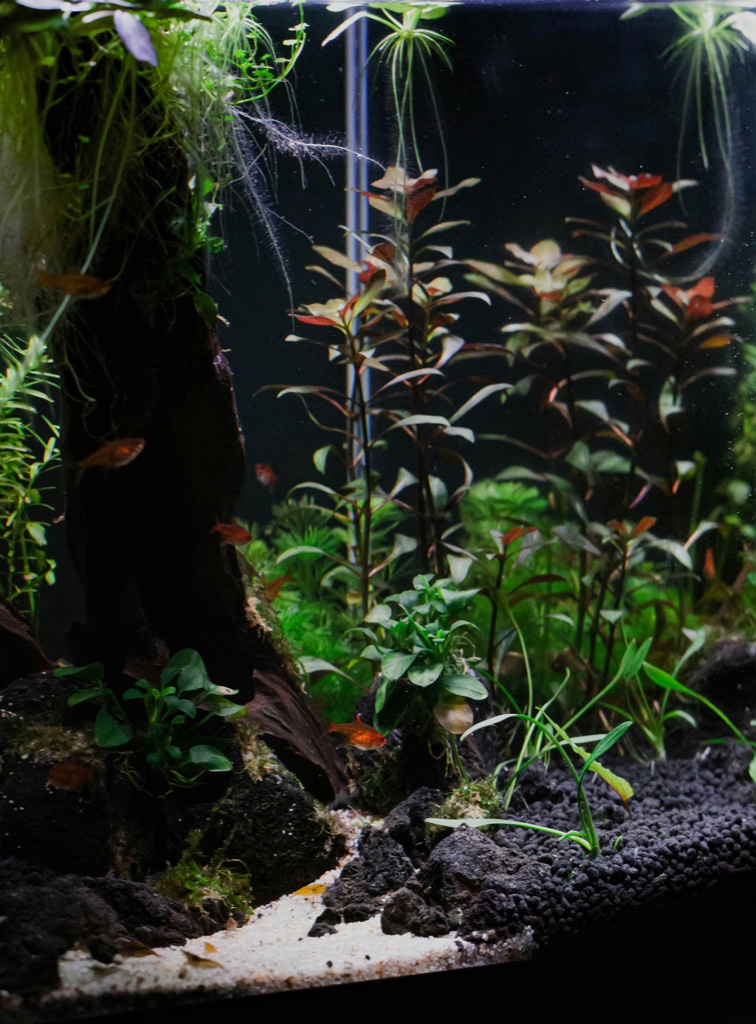
Before any list
Use the label as a starting point, then look at what the species needs.
Beginner, intermediate, and advanced are quick signals. They become useful when they lead you to the practical questions: tank size, adult size, water range, group size, current, heat, and light.
The split across the fish list is 54 beginner, 40 intermediate, 16 advanced6. Across the plants it is 61, 26 and 67. Neither split was calculated. Both were assigned, species by species, from reading.
Plant light bands work the same way: low, medium, and high are useful shopping language, while measured light needs are continuous. Published work places the light compensation point of submerged leaves at 22 to 67 micromoles per square meter per second, while dense plant communities can keep responding at much higher light levels9.
Group size also works better as a starting point than as a magic number. Begin with the familiar six, then use the fish's behavior and the room it has to decide whether the group should grow.10
The tables below keep the familiar labels and add the conditions behind them. Together they give you a faster way to choose a good fit.
- 110
- fish species, of which 58 carry enough published water data to score
- 52
- fish we cannot rank at all, named in full further down
- 93
- plants, all 93 of them scorable
- 34
- hardscape materials, 8 with no published composition
- 21
- fish flagged as routinely mis-sold
Compare the practical demands
The score brings the tank, equipment, and water needs into one view.
The score runs from 0 to 100, with lower numbers marking a more forgiving fit.13 Use it to compare species, then open the species profile for the details.
The idea is simple. Difficulty is not a property of an animal. It is the size of the gap between what a species has published as its comfortable range and what your room, your tap and your wallet actually supply. A wide published window is forgiving because you can be wrong and it still works. Equipment is demand because equipment fails and costs money. A big tank is demand because it is heavy, expensive and hard to move. A large obligate group is demand because you cannot buy three and see how it goes.
Lower is more forgiving. The score runs from 0 to 100. Nothing scores 0 or 100 in practice, and the range the real fish occupy is narrower than that, which the tables show.
Fish, block one: the published window, 35 points
- 15
- temperature. A window 10 degrees wide or more scores zero demand, 3 degrees or less scores the full 15, linear between1
- 10
- pH. A window 3 units wide or more scores zero demand, 0.5 or less scores the full 101
- 10
- hardness. A window 15 dGH wide or more scores zero demand, 2 or less scores the full 101
Fish, block two: equipment, 25 points
Fish, block three: the room, 40 points
- 25
- minimum volume, compared on a log scale because the step from 40 to 80 liters is a bigger real change than 200 to 240. Zero demand at 40 liters, full at 240. The figure is OATA's where OATA publishes one and Seriously Fish's where it does not346
- 15
- minimum group. Zero at 1 fish, full at 12. This block rests on the weakest evidence on the page and we say so10
Plants, the same shape, different inputs
- 30
- published temperature, pH and hardness windows, 30 points split three ways7
- 30
- light, from the floor of the published PAR band. Zero at 15 micromoles, full at 6079
- 25
- carbon dioxide. None scores zero, beneficial scores 12, required scores the full 257
- 15
- substrate. An epiphyte needs none and scores zero. Nutrient-rich scores 15, because that is a soil decision made before the tank is filled7
And the local block, 25 points
- 75%
- the general score is rescaled to 75 percent of its value, freeing 25 points13
- 0
- if the published range covers all of Yerevan tap, so it works in every district untreated5
- 12
- if the ranges merely overlap, so it works in some districts and you have to test yours5
- 25
- if there is no overlap on either axis, so no district's tap is inside the published range without treatment5
The profile adds diet, temperament, breeding behavior, price, and local availability. Those details complete the choice after the score narrows the field.
The group block is worth 15 points. Treat the familiar minimum of six as the beginning, then watch how confidently the fish feed, explore, and spread through the available space.10
FishBase pH and hardness figures describe wild habitats16. They make a useful compatibility screen; feeding, color, breathing, and activity show how the fish is settling in.
The fish file tests for overlap and the plant file tests for coverage, which are different questions. So we recomputed both from the raw minimum and maximum, identically, into three outcomes: every district, some districts, no district13. On the overlap question our version reproduces the fish file exactly, at 56 species6.
Fish, ranked
The forgiving end is where the good fish are.
Of 110 species6 we can score 58, which is 53 percent13. Scores run from 23.1 at the forgiving end to 75.3 at the demanding end13, which is a narrower real range than the 0 to 100 the formula allows, and that is itself worth knowing: there is no such thing as an impossible community fish in this dataset.
The bands below are quartiles of the scored list, not opinions. The lower cut is 38, the median is 45.2 and the upper cut is 51.113, giving 15 forgiving, 28 middle and 15 demanding13.
Equipment is the block that separates the bands most cleanly, and it is also the cheapest to fix. 76 of 110 species need a heater and 17 do not, with 17 left open because no temperature range is published. Only 22 need real flow and 19 need aeration6. A heater is a one-off purchase. A 700 liter tank is not.
| # | Species | Demand13 | In Yerevan13 | Its label6 | Temp1 | pH1 | GH1 | Room46 | Kit6 | Yerevan tap513 |
|---|---|---|---|---|---|---|---|---|---|---|
| 1 | Tanichthys albonubes, White cloud mountain minnow | 23.1 | 29.3 | beginner | 18 to 22 C | 6 to 8 | 5 to 19 | 40 L, group of 5 | none | Some districts |
| 2 | Betta splendens, Siamese fighting fish | 23.7 | 17.8 | beginner | 24 to 30 C | 6 to 8 | 1 to 15 | 41 L, group of 1 | heater | Every district |
| 3 | Poecilia reticulata, Guppy | 24.3 | 30.2 | beginner | 18 to 28 C | 7 to 8 | 9 to 19 | 60 L, group of 6 | none | Some districts |
| 4 | Danio rerio, Zebra danio | 25.8 | 31.4 | beginner | 18 to 24 C | 6 to 8 | 5 to 19 | 60 L, group of 6 | none | Some districts |
| 5 | Corydoras paleatus, Peppered cory | 26.6 | 31.9 | beginner | 18 to 23 C | 6 to 8 | 5 to 19 | 60 L, group of 5 | none | Some districts |
| 6 | Barbodes semifasciolatus, Gold barb | 28.5 | 33.3 | beginner | 18 to 24 C | 6 to 8 | 5 to 19 | 80 L, group of 5 | none | Some districts |
| 7 | Poecilia sphenops, Molly | 28.8 | 46.6 | beginner | 18 to 28 C | 7.5 to 8.2 | 11 to 30 | 110 L, group of 5 | none | No district |
| 8 | Trichogaster chuna, Honey gourami | 29 | 33.7 | beginner | 22 to 28 C | 6 to 8 | 5 to 19 | 60 L, group of 1 | heater | Some districts |
| 9 | Xiphophorus maculatus, Platy | 29.4 | 34 | beginner | 18 to 25 C | 7 to 8 | 9 to 19 | 60 L, group of 5 | none | Some districts |
| 10 | Oryzias latipes, Medaka, Japanese ricefish | 32.9 | 36.7 | beginner | 18 to 24 C | 7 to 8 | 9 to 19 | 60 L, group of 6 | none | Some districts |
| 11 | Apistogramma cacatuoides, Cockatoo dwarf cichlid | 35.4 | 38.6 | intermediate | 24 to 25 C | 6 to 8 | 5 to 19 | 60 L, group of 1 | heater | Some districts |
| 12 | Corydoras pygmaeus, Pygmy cory | 36.4 | 27.3 | intermediate | 22 to 26 C | 6 to 8 | 2 to 25 | 40 L, group of 8 | heater | Every district |
Read one row properly and the rest read themselves. The white cloud mountain minnow publishes 18 to 22 degrees, pH 6 to 8, and 5 to 19 dGH1. The pH window is two whole units and the hardness window is fourteen degrees, so almost any tap water in the world is inside it. It needs no heater, no aeration and no added flow6, which means it survives a power cut and costs nothing to run. It asks for 40 liters and a group of five46, which fits on a desk. Every one of those is a way for you to be wrong and for the fish to be fine. That is the entire definition of forgiving, and it also happens to be a beautiful fish in a group.
The middle band, where most of the hobby actually lives.
A page of extremes is not useful, because 28 of 58 scored fish are in neither tail13. These are the fish that ask for one specific thing and are otherwise easy. Usually that one thing is a heater, and a heater is a solved problem.
| # | Species | Demand13 | In Yerevan13 | Its label6 | Temp1 | pH1 | GH1 | Room46 | Kit6 | Yerevan tap513 |
|---|---|---|---|---|---|---|---|---|---|---|
| 24 | Trigonostigma espei, Lambchop rasbora | 42.6 | 43.9 | beginner | 23 to 28 C | 6 to 6.5 | 0 to 12 | 40 L, group of 8 | heater | Some districts |
| 25 | Corydoras sterbai, Sterba's cory | 43.3 | 32.5 | beginner | 21 to 25 C | 6 to 8 | 2 to 25 | 80 L, group of 6 | heater | Every district |
| 26 | Amatitlania nigrofasciata, Convict cichlid | 43.4 | 44.6 | beginner | 20 to 36 C | 7 to 8 | 9 to 20 | 180 L, group of 2 | heater | Some districts |
| 27 | Trichopodus trichopterus, Three spot gourami | 44.3 | 45.2 | beginner | 22 to 28 C | 6 to 8 | 5 to 19 | 180 L, group of 1 | heater | Some districts |
| 28 | Mikrogeophagus ramirezi, Ram cichlid | 44.8 | 45.6 | intermediate | 27 to 30 C | 5 to 6 | 5 to 12 | 60 L, group of 1 | heater | Some districts |
| 29 | Nannostomus beckfordi, Golden pencilfish | 45 | 45.7 | beginner | 24 to 26 C | 6 to 8 | 5 to 19 | 60 L, group of 8 | heater | Some districts |
| 30 | Apistogramma agassizii, Agassiz dwarf cichlid | 45.4 | 46.1 | intermediate | 26 to 29 C | 5 to 7 | 0 to 12 | 110 L, group of 1 | heater | Some districts |
| 31 | Corydoras julii, Julii cory | 45.5 | 34.1 | beginner | 23 to 26 C | 6 to 8 | 2 to 25 | 80 L, group of 6 | heater | Every district |
| 32 | Hyphessobrycon eques, Serpae tetra | 45.6 | 46.2 | beginner | 22 to 26 C | 5 to 7.8 | 10 to 25 | 80 L, group of 10 | heater | Some districts |
| 33 | Corydoras aeneus, Bronze cory | 46.3 | 46.7 | beginner | 25 to 28 C | 6 to 8 | 5 to 19 | 80 L, group of 6 | heater | Some districts |
| 34 | Paracheirodon innesi, Neon tetra | 46.5 | 59.9 | beginner | 20 to 26 C | 5 to 7 | 1 to 2 | 45 L, group of 10 | heater | No district |
| 35 | Gymnocorymbus ternetzi, Black widow tetra | 47 | 47.3 | beginner | 20 to 26 C | 6 to 8 | 5 to 19 | 110 L, group of 8 | heater | Some districts |
The demanding end, and what each one is actually asking for.
Nothing here is beyond a careful person in their first year. What these species have in common is that the demand is structural rather than skilful: a tank size, a group size, a current. You cannot improvise your way past 700 liters, but you also cannot fail at it through inexperience. Decide before you buy, not after.
| # | Species | Demand13 | In Yerevan13 | Its label6 | Temp1 | pH1 | GH1 | Room46 | Kit6 | Yerevan tap513 |
|---|---|---|---|---|---|---|---|---|---|---|
| 47 | Iriatherina werneri, Threadfin rainbowfish | 52.2 | 51.2 | intermediate | 26 to 30 C | 6 to 8 | 5 to 12 | 80 L, group of 8 | heater | Some districts |
| 48 | Pseudomugil furcatus, Forktail blue eye | 57.4 | 55 | intermediate | 24 to 26 C | 6 to 8 | 5 to 12 | 60 L, group of 8 | heater, flow | Some districts |
| 49 | Apteronotus albifrons, Black ghost knifefish | 57.5 | 55.1 | advanced | 23 to 28 C | 6 to 8 | 5 to 19 | 1000 L, group of 1 | heater, flow | Some districts |
| 50 | Pterophyllum scalare, Angelfish | 58.4 | 55.8 | intermediate | 24 to 30 C | 6 to 8 | 5 to 13 | 250 L, group of 5 | heater | Some districts |
| 51 | Phenacogrammus interruptus, Congo tetra | 60.3 | 57.2 | intermediate | 23 to 26 C | 6 to 8 | 5 to 19 | 180 L, group of 8 | heater | Some districts |
| 52 | Moenkhausia pittieri, Diamond tetra | 60.7 | 57.5 | beginner | 24 to 28 C | 6 to 7 | 5 to 12 | 110 L, group of 8 | heater | Some districts |
| 53 | Sewellia lineolata, Tiger hillstream loach | 62.2 | 58.7 | advanced | 20 to 24 C | 6 to 7.5 | 1 to 10 | 80 L, group of 4 | heater, aeration, flow | Some districts |
| 54 | Hemigrammus bleheri, Rummynose tetra | 63.8 | 59.9 | intermediate | 23 to 26 C | 5 to 6 | 5 to 12 | 80 L, group of 12 | heater | Some districts |
| 55 | Symphysodon aequifasciatus, Discus | 64 | 48 | advanced | 26 to 30 C | 5 to 8 | 0 to 12 | 250 L, group of 6 | heater, flow | Every district |
| 56 | Melanotaenia boesemani, Boeseman rainbowfish | 71.4 | 65.5 | beginner | 27 to 30 C | 7 to 8 | 9 to 19 | 250 L, group of 8 | heater | Some districts |
| 57 | Chromobotia macracanthus, Clown loach | 72.3 | 66.2 | advanced | 25 to 30 C | 5 to 8 | 5 to 12 | 700 L, group of 5 | heater, aeration, flow | Some districts |
| 58 | Devario aequipinnatus, Giant danio | 75.3 | 68.5 | beginner | 22 to 24 C | 6 to 8 | 5 to 19 | 180 L, group of 8 | heater, aeration, flow | Some districts |
Does the published label agree with the derived score?
Partly, and the shape of the partial agreement is the interesting bit.
| Published label | Scored | Mean demand13 | Lowest | Highest | Spread |
|---|---|---|---|---|---|
| beginner | 35 | 41.6 | 23.1 | 75.3 | 52.2 |
| intermediate | 18 | 48.2 | 35.4 | 63.8 | 28.4 |
| advanced | 5 | 59 | 38.7 | 72.3 | 33.6 |
The means rise in the right order, so the labels are carrying real signal. The spreads overlap almost end to end, so the label cannot separate an individual species: knowing a fish is called beginner tells you very little about where it sits. That is the honest verdict on our own field, and it is why this page exists.
| Species | Its label6 | Our rank13 | Demand13 | Room46 | Kit6 | What the label hides |
|---|---|---|---|---|---|---|
| Devario aequipinnatus, Giant danio | beginner | 58 of 58 | 75.3 | 180 L, group of 8 | heater, aeration, flow | Needs 180 litres, and 8 of them |
| Melanotaenia boesemani, Boeseman rainbowfish | beginner | 56 of 58 | 71.4 | 250 L, group of 8 | heater | Needs 250 litres, and 8 of them |
| Moenkhausia pittieri, Diamond tetra | beginner | 52 of 58 | 60.7 | 110 L, group of 8 | heater | Small tank, but a group of 8, which is 8 fish to buy and feed |
| Trigonostigma heteromorpha, Harlequin rasbora | beginner | 42 of 58 | 50.4 | 60 L, group of 8 | heater | Small tank, but a group of 8, which is 8 fish to buy and feed |
| Xiphophorus hellerii, Swordtail | beginner | 40 of 58 | 50 | 110 L, group of 5 | heater | Needs a heater, and the published window is only 6 C wide |
| Trichopodus leerii, Pearl gourami | beginner | 39 of 58 | 48.6 | 180 L, group of 1 | heater | Needs 180 litres, for one fish |
| Brachygobius doriae, Bumblebee goby | advanced | 17 of 58 | 38.7 | 45 L, group of 6 | heater | Published pH is a single point, 8, not a range |
| Apteronotus albifrons, Black ghost knifefish | advanced | 49 of 58 | 57.5 | 1000 L, group of 1 | heater, flow | Needs 1000 litres, for one fish |
| Sewellia lineolata, Tiger hillstream loach | advanced | 53 of 58 | 62.2 | 80 L, group of 4 | heater, aeration, flow | Equipment on three fronts: heater, aeration, flow |
| Symphysodon aequifasciatus, Discus | advanced | 55 of 58 | 64 | 250 L, group of 6 | heater, flow | Needs 250 litres, and 6 of them |
| Chromobotia macracanthus, Clown loach | advanced | 57 of 58 | 72.3 | 700 L, group of 5 | heater, aeration, flow | Needs 700 litres, and 5 of them |
Read the disagreement this way
The label is usually right about the fish and wrong about the tank.
Every beginner-labeled fish our score puts near the bottom is easy to keep alive and hard to house. The giant danio is hardy across 5 to 19 dGH and pH 6 to 8, and it also wants 180 liters, a group of eight, aeration and flow16. Both statements are true. The word beginner only carries the first one.
And the other direction
An advanced label can be a warning about something the score cannot see.
The bumblebee goby scores in the forgiving half on our measure and is labeled advanced, correctly, because it is a brackish fish sold as freshwater16. Salinity is not one of our inputs. When a human label and a formula disagree, check what the formula is not looking at before you trust it.
The part no book can tell you
The neon tetra is the fish every shop recommends first, and here it is one of the worst matches on the list.
Difficulty is not a property of the animal. It is a relationship between the animal and the water that comes out of your tap, and our own data proves it with the single most-sold beginner fish in the world.
The published hardness range for Paracheirodon innesi is 1 to 2 dGH1. Yerevan tap runs 2.9 to 10.9 dGH across the districts sampled, from Avan, Kanaker and Nork at the soft end to Davtashen at the hard end5. Those two ranges do not touch. Not one district in the city is inside the published range for this fish, untreated.
On the general ranking the neon sits at number 34 of 58 with a demand score of 46.513, which is respectable and roughly what the trade says. Re-score it for the water in the building and it falls to number 54, on 59.913. Nothing about the fish changed. The tap did.
The molly fails from the exact opposite direction, which is the proof that this is a matching problem and not a fragility problem. Poecilia sphenops publishes a floor of 11 dGH1, above the hardest tap in the city. It is general rank 7 and Yerevan rank 3113. One famous beginner fish wants water softer than Yerevan has and another wants it harder. Neither is a difficult animal. Both are badly matched here, and a shop that stocks them both and calls them both easy is not lying, it is just not local.
Now the encouraging half, which is much the larger half. Of the 59 fish where both axes are published, 56 overlap Yerevan tap and only 3 do not13. Of those, 9 cover the whole city range, meaning they work in any district with no treatment, no remineraliser and no reverse osmosis unit13. Yerevan tap is soft to moderately hard and close to neutral because it comes through volcanic rock rather than limestone, and that is a genuinely good starting water. Most of the world would take it.
Yerevan tap against the fish list513
- 9
- fish whose published range covers every district untreated
- 47
- work in some districts. Test your own tap, then decide
- 3
- no district's tap is inside the published range
- 51
- question open, because pH or hardness is unpublished
- 2.9 to 10.9
- dGH measured across four districts, pH 6 to 7.3
| General # | Yerevan # | Species | Demand13 | In Yerevan13 | Published GH1 | Yerevan tap513 |
|---|---|---|---|---|---|---|
| 2 | 1 | Betta splendens, Siamese fighting fish | 23.7 | 17.8 | 1 to 15 | Every district |
| 12 | 2 | Corydoras pygmaeus, Pygmy cory | 36.4 | 27.3 | 2 to 25 | Every district |
| 13 | 3 | Corydoras panda, Panda cory | 37.2 | 27.9 | 2 to 25 | Every district |
| 1 | 4 | Tanichthys albonubes, White cloud mountain minnow | 23.1 | 29.3 | 5 to 19 | Some districts |
| 18 | 5 | Otocinclus vittatus, Otocinclus | 39.2 | 29.4 | 2 to 18 | Every district |
| 3 | 6 | Poecilia reticulata, Guppy | 24.3 | 30.2 | 9 to 19 | Some districts |
| 22 | 7 | Nannostomus marginatus, Dwarf pencilfish | 41.4 | 31 | 0 to 15 | Every district |
| 4 | 8 | Danio rerio, Zebra danio | 25.8 | 31.4 | 5 to 19 | Some districts |
| 5 | 9 | Corydoras paleatus, Peppered cory | 26.6 | 31.9 | 5 to 19 | Some districts |
| 25 | 10 | Corydoras sterbai, Sterba's cory | 43.3 | 32.5 | 2 to 25 | Every district |
| 6 | 11 | Barbodes semifasciolatus, Gold barb | 28.5 | 33.3 | 5 to 19 | Some districts |
| 8 | 12 | Trichogaster chuna, Honey gourami | 29 | 33.7 | 5 to 19 | Some districts |
Where the two rankings disagree, which is the whole point of having both.
A fish that falls when we re-score it for Yerevan is a fish the general advice gets wrong here. A fish that rises is a local opportunity that the general advice is too cautious about.
| Species | General # | Yerevan # | Move | Published GH1 | Yerevan tap513 | Why |
|---|---|---|---|---|---|---|
| Brachygobius doriae, Bumblebee goby | 17 | 47 | -30 | 9 to 19 | No district | No district sits inside the published range untreated |
| Poecilia sphenops, Molly | 7 | 31 | -24 | 11 to 30 | No district | No district sits inside the published range untreated |
| Paracheirodon innesi, Neon tetra | 34 | 54 | -20 | 1 to 2 | No district | No district sits inside the published range untreated |
| Apistogramma cacatuoides, Cockatoo dwarf cichlid | 11 | 16 | -5 | 5 to 19 | Some districts | Works in some districts, not all. Test your own tap |
| Oryzias latipes, Medaka, Japanese ricefish | 10 | 15 | -5 | 9 to 19 | Some districts | Works in some districts, not all. Test your own tap |
| Barbodes semifasciolatus, Gold barb | 6 | 11 | -5 | 5 to 19 | Some districts | Works in some districts, not all. Test your own tap |
| Xiphophorus maculatus, Platy | 9 | 13 | -4 | 9 to 19 | Some districts | Works in some districts, not all. Test your own tap |
| Trichogaster chuna, Honey gourami | 8 | 12 | -4 | 5 to 19 | Some districts | Works in some districts, not all. Test your own tap |
| Symphysodon aequifasciatus, Discus | 55 | 35 | +20 | 0 to 12 | Every district | Published range covers every district untreated |
| Corydoras julii, Julii cory | 31 | 14 | +17 | 2 to 25 | Every district | Published range covers every district untreated |
| Nannostomus marginatus, Dwarf pencilfish | 22 | 7 | +15 | 0 to 15 | Every district | Published range covers every district untreated |
| Corydoras sterbai, Sterba's cory | 25 | 10 | +15 | 2 to 25 | Every district | Published range covers every district untreated |
| Otocinclus vittatus, Otocinclus | 18 | 5 | +13 | 2 to 18 | Every district | Published range covers every district untreated |
| Corydoras pygmaeus, Pygmy cory | 12 | 2 | +10 | 2 to 25 | Every district | Published range covers every district untreated |
| Corydoras panda, Panda cory | 13 | 3 | +10 | 2 to 25 | Every district | Published range covers every district untreated |
| Hyphessobrycon eques, Serpae tetra | 32 | 30 | +2 | 10 to 25 | Some districts | Works in some districts, not all. Test your own tap |
The corydoras finding
Four Corydoras species rise into the top fifteen once the tap is taken into account.
They publish wide hardness windows that swallow the whole city range, so the local block costs them nothing while it costs their competitors twelve points. In a general guide they are unremarkable. Here they are close to the best-matched fish available, and they are calm, cheap, long-lived and endlessly watchable. This is the kind of thing a local hub can say and a global one cannot.
A caution about one of our own results
Discus rises twenty places and you should still not start with discus.
Its published pH and hardness ranges genuinely do cover Yerevan tap, so our local block gives it nothing to pay. The score is measuring water chemistry, and discus are demanding for reasons the score has no input for: water change volume, temperature held high and steady, disease sensitivity and diet. When a formula produces a surprising winner, the formula is usually the thing that is incomplete. We are leaving the row in rather than quietly filtering it out, because hiding it would make the score look better than it is.
Fish to explore by profile
58 of the 110 fish carry enough published water data to score, and the other 52 are named here so you can still find them.
A species is unrankable here when at least one of its three water windows is unpublished. 17 fish have no published temperature range, 36 have no pH range and 49 have no hardness range16. Taking the union of those three gives 52 species we will not put a number on13.
Several of these are excellent aquarium fish, and some are on the shelf in Yerevan now. Open the species profile, compare its known habitat and adult size with your tank, and ask the shop about the water in which it has been kept.
All 52 of them, named in full, so you can look up the one you want. Ancistrus cirrhosus (no temperature, pH or hardness at all), Aphyocharax anisitsi, Balantiocheilos melanopterus, Botia almorhae (no temperature, pH or hardness at all), Carassius auratus, Corydoras habrosus, Crossocheilus oblongus, Danio choprae (no temperature, pH or hardness at all), Danio erythromicron, Danio margaritatus (no temperature, pH or hardness at all), Epalzeorhynchos frenatum, Garra flavatra (no temperature, pH or hardness at all), Gastromyzon sp. (no temperature, pH or hardness at all), Gyrinocheilus aymonieri, Hypancistrus zebra, Hyphessobrycon amandae, Hyphessobrycon elachys, Hyphessobrycon herbertaxelrodi, Hyphessobrycon megalopterus, Hyphessobrycon pulchripinnis, Hyphessobrycon sweglesi, Hypostomus plecostomus, Jordanella floridae, Kryptopterus vitreolus (no temperature, pH or hardness at all), Macropodus opercularis, Melanotaenia praecox, Microdevario kubotai (no temperature, pH or hardness at all), Misgurnus anguillicaudatus, Myxocyprinus asiaticus, Nannostomus trifasciatus, Neolamprologus multifasciatus, Notropis chrosomus (no temperature, pH or hardness at all), Oryzias woworae, Osteoglossum bicirrhosum, Panaqolus maccus (no temperature, pH or hardness at all), Pangasianodon hypophthalmus, Pangio semicincta (no temperature, pH or hardness at all), Paracheirodon simulans, Pethia padamya (no temperature, pH or hardness at all), Phractocephalus hemioliopterus, Poecilia wingei (no temperature, pH or hardness at all), Poropanchax normani, Potamotrygon motoro, Prionobrama filigera, Pristella maxillaris, Pterygoplichthys pardalis, Puntigrus tetrazona, Puntius titteya (no temperature, pH or hardness at all), Rhinogobius duospilus, Sahyadria denisonii, Tateurndina ocellicauda, Tucanoichthys tucano (no temperature, pH or hardness at all).
Plants are the opposite case and it is worth noticing why. All 93 of 93 plants carry a full set of windows, so none is unrankable7. That is not because plants are better studied. It is because the tropical plant ranges are aquarium trade convention rather than measured tolerances, and our own file says so on each record7. Complete data and trustworthy data are different things. The fish list is more honest about its holes; the plant list is more complete and softer underneath.
Difficulty disguised as a bargain
A fish sold at 5 cm that reaches 30 is not an easy fish. It is a deferred one.
None of the scores above can see this, and it is the most common way a first tank ends. 21 of our 110 species are flagged as routinely sold into tanks that cannot house them6. The animal is genuinely undemanding for the first year. Then the arithmetic arrives.
These are not hidden by the finder on /fish/ and they are not hidden here, for the same reason: the buyer meets them in the shop regardless6, and a catalog that omits them teaches nothing. The defence is one habit, and it takes a minute: look up the adult size before you buy. That single check prevents almost every row in this table.
| Species | Adult size1 | Tank it needs46 | IUCN2 | The difficulty hidden in the sale |
|---|---|---|---|---|
| Myxocyprinus asiaticus, Chinese high-fin banded shark | 135 cm TL | 20000 L | not assessed | Stocked in Yerevan. A temperate large river fish that outgrows every home aquarium, loses its juvenile shape and colour entirely as it matures, and needs cool fast water. |
| Phractocephalus hemioliopterus, Red-tailed catfish | 135 cm TL | 20000 L | not assessed | Sold at 8 cm as a novelty. It reaches 135 cm and 44 kg. There is no home aquarium anywhere in Armenia that can house an adult, and there is nowhere to rehome one. |
| Pangasianodon hypophthalmus, Iridescent shark | 130 cm SL | 10000 L | Endangered | The worst single mis-sale in the trade. Sold at 5 to 8 cm to people with 60 to 100 litre tanks, and it reaches 130 cm and 44 kg. It grows to 30 cm within a year or two in a home tank. |
| Osteoglossum bicirrhosum, Silver arowana | 90 cm TL | 4000 L | Least Concern | Reaches 90 cm TL. Sold at 10 cm with the yolk sac barely gone. It is a surface predator that jumps, so the tank needs a lid it cannot lift, and no home aquarium in Armenia is large enough. Stocked at Gazanik. |
| Pterygoplichthys pardalis, Common pleco | 57.8 cm TL | 800 L | not assessed | Sold at 4 to 6 cm as an algae eater. It eats algae as a juvenile and then largely stops. |
| Apteronotus albifrons, Black ghost knifefish | 50 cm TL | 1000 L | Least Concern | Reaches 50 cm TL. Sold at 8 cm. Nocturnal, eats small tankmates, needs a large dark tube to rest in, and is unusually sensitive to medication. Stocked at Gazanik. |
| Potamotrygon motoro, Ocellate river stingray | 50 cm WD | 3000 L | Least Concern | Reaches 50 cm disc width. Venomous barb capable of a serious human injury. Requires pristine water, heavy filtration and a very large footprint, and Armenia has no specialist aquatic veterinary provision. |
| Carassius auratus, Goldfish | 48 cm TL, record | 100 L | not assessed | Sold in bowls, in unfiltered tanks and as a prize for children, and this is by a wide margin the most numerous case of aquarium animal suffering in the world. In a bowl, ammonia rises within days. |
| Balantiocheilos melanopterus, Bala shark | 35 cm SL | 600 L | Vulnerable | Sold as a peaceful community shoaler at 6 cm. It reaches 35 cm, FishBase asks for over 150 cm of tank, and it is IUCN Vulnerable. |
| Chromobotia macracanthus, Clown loach | 30.5 cm TL | 700 L | Least Concern | FishBase gives 30.5 cm TL. Sold at 4 cm. Slow growing, long lived, and needs a group, so the correct tank is very large and the mistake takes years to become obvious. |
| Misgurnus anguillicaudatus, Weather loach | 28 cm SL | 300 L | not assessed | Sold small as a hardy beginner fish and reaches 28 cm. It needs about 300 litres and a covered tank, because it climbs out. |
| Gyrinocheilus aymonieri, Chinese algae eater | 28 cm SL | 300 L | not assessed | Sold as an algae eater. It reaches 28 cm, adults are territorial, it stops eating algae as it grows and it rasps at the flanks of other fish. |
| Hypostomus plecostomus, Common pleco | 25 cm SL | 600 L | Least Concern | Reaches 25 cm SL and commonly more in captivity. Sold at 5 cm as an algae eater. It stops eating algae as it grows, produces an enormous waste load, and uproots or flattens planted layouts. |
| Crossocheilus oblongus, Siamese algae eater | 16 cm SL | 200 L | not assessed | Sold as a small algae eater. It reaches 16 cm, and shops frequently sell a different and much less useful species under the same name. |
| Epalzeorhynchos frenatum, Rainbow shark | 15 cm TL | 200 L | not assessed | Sold as a community fish. It reaches 15 cm, FishBase asks for 120 cm of tank, and it is aggressive towards anything with a similar body shape, including its own species. |
| Sahyadria denisonii, Denison barb | 15 cm TL | 250 L | Endangered | Sold as a shoaling community fish. It reaches 15 cm, it is IUCN Endangered, and it is subtropical at 15 to 25 C, so it does not belong in a warm community tank either. |
| Trichogaster lalius, Dwarf gourami | 9.5 cm TL | 80 L | not assessed | Sold as an easy beginner fish. Farmed stock carries a well known and untreatable viral disease, usually attributed to an iridovirus and to intensive line breeding of colour strains. |
| Hypancistrus zebra, Zebra pleco | 8 cm TL | 80 L | Critically Endangered | Sold as a premium display fish. It is IUCN Critically Endangered, its home stretch of the Rio Xingu was altered by the Belo Monte dam, and Brazilian export of wild fish is prohibited. |
| Gastromyzon sp., Borneo sucker loach | 6 cm TL | 80 L | not assessed | Stocked in Yerevan and sold into the opposite expectation. Hillstream loaches are widely believed to be cool water fish. Gastromyzon is equatorial Bornean and it is not one. |
| Brachygobius doriae, Bumblebee goby | 4.2 cm TL | 45 L | Least Concern | A brackish fish sold as freshwater. Published pH is a flat 8.0 with dH 9 to 19. It also refuses dry food almost universally and needs live or frozen feeding. Stocked at Gazanik. |
| Otocinclus vittatus, Otocinclus | 3.3 cm TL | 60 L | not assessed | Sold as a new-tank algae fix, which is close to a death sentence. It eats soft biofilm and diatoms, not hair algae, and a brand new sterile tank has nothing for it. |
Sizes and conservation categories are FishBase and the IUCN Red List12. Tank figures are OATA's where OATA publishes one and argued from adult size and behavior otherwise, labeled as such in the dataset46. Full profiles for every one of these are on the fish finder, which will also tell you which are stocked in Yerevan.

Plants, ranked
Plant difficulty is almost entirely light and carbon, and both are decisions you make before you buy anything.
This is the cheerful part of the page. 70 of 93 plants need no injected carbon dioxide at all, 15 merely benefit from it, and only 8 require it7. The demanding end of the plant world is small and clearly marked, and you can see it coming from the shelf label.
The light picture is less comfortable. 42 of 93 plants want high light, 38 medium and only 13 low7. High light is the engine of the whole demanding end: it drives growth, growth drives carbon and nutrient demand, and the mismatch between them is what algae eats. Remember that those bands are convention with no located measurement study behind them9, which is exactly why our score uses the numeric floor of the band rather than the word.
The plant bands are quartiles of the same kind. The lower cut is 17 and the upper is 47, giving 24 forgiving, 39 middle and 30 demanding13. The plant range is far wider than the fish range, which is the formula agreeing with every gardener who has kept both: the gap between java moss and dwarf baby tears is larger than the gap between any two community fish.
All 93 plants are rankable, with 0 unrankable7, and every single one overlaps Yerevan tap: 46 cover the whole city range and 47 cover part of it, with 0 excluded outright13. For plants, the water here is simply not the problem. The light is.
| # | Plant | Demand13 | In Yerevan13 | Its label7 | Light, PPFD79 | CO27 | Substrate7 | GH7 | Yerevan tap513 | In the shop12 |
|---|---|---|---|---|---|---|---|---|---|---|
| 1 | Ceratophyllum demersum, Hornwort | 0 | 0 | beginner | low, from 15 | none | none | 2 to 25 | Every district | no |
| 2 | Lemna trisulca, Ivy-leaved duckweed | 0 | 0 | beginner | low, from 15 | none | none | 2 to 25 | Every district | no |
| 3 | Ceratophyllum submersum, Soft hornwort | 2 | 13.5 | beginner | low, from 15 | none | none | 2 to 25 | Some districts | no |
| 4 | Fontinalis antipyretica, Willow moss | 2 | 1.5 | intermediate | low, from 15 | none | none | 2 to 20 | Every district | no |
| 5 | Taxiphyllum barbieri, Java moss | 3.2 | 2.4 | beginner | low, from 15 | none | none | 2 to 18 | Every district | yes |
| 6 | Vesicularia ferriei, Weeping moss | 4.4 | 3.3 | beginner | low, from 15 | none | none | 2 to 18 | Every district | yes |
| 7 | Microsorum pteropus, Java fern | 7.5 | 5.6 | beginner | low, from 15 | none | none | 2 to 18 | Every district | yes |
| 8 | Microsorum pteropus 'Windelov', Windelov java fern | 7.5 | 5.6 | beginner | low, from 15 | none | none | 2 to 18 | Every district | yes |
| 9 | Anubias barteri var. nana, Anubias nana | 9.7 | 7.3 | beginner | low, from 15 | none | none | 2 to 18 | Every district | yes |
| 10 | Anubias barteri var. nana 'Petite', Anubias nana Petite | 9.7 | 7.3 | beginner | low, from 15 | none | none | 2 to 18 | Every district | yes |
| 11 | Anubias barteri var. barteri, Broadleaf anubias | 9.7 | 7.3 | beginner | low, from 15 | none | none | 2 to 18 | Every district | not checked |
| 12 | Lemna minor, Common duckweed | 10 | 7.5 | beginner | medium, from 30 | none | none | 1 to 30 | Every district | no |
Two plants score a flat zero, hornwort and ivy-leaved duckweed13. They are rootless or floating, so they need nothing from the substrate; they take low light; they need no carbon; and their published windows are wide on all three axes7. Every input in the formula is at its forgiving end at once. Hornwort is not sold by the one specialist shop in the country12, which is a supply problem rather than a plant problem, and it is worth knowing before you go looking for it.
Where a first tank should actually start.
Low light and no carbon dioxide, which between them remove the two most expensive inputs. There are 13 of them in the dataset and 7 are on the shelf in Yerevan712. Eleven of the thirteen also need nothing from the substrate at all, because they are mosses, ferns, epiphytes or floaters. A tank built entirely from this table with a cheap light and plain gravel will look good, stay clean and cost very little. It is not a compromise version of the hobby. Several of these are in competition-winning layouts.
| Plant | Light, PPFD79 | Placement7 | Substrate7 | Demand13 | In Yerevan13 | In the shop12 |
|---|---|---|---|---|---|---|
| Ceratophyllum demersum, Hornwort | low, from 15 | background | none | 0 | 0 | no |
| Lemna trisulca, Ivy-leaved duckweed | low, from 15 | floating | none | 0 | 0 | no |
| Ceratophyllum submersum, Soft hornwort | low, from 15 | background | none | 2 | 13.5 | no |
| Fontinalis antipyretica, Willow moss | low, from 15 | epiphyte | none | 2 | 1.5 | no |
| Taxiphyllum barbieri, Java moss | low, from 15 | epiphyte | none | 3.2 | 2.4 | yes |
| Vesicularia ferriei, Weeping moss | low, from 15 | epiphyte | none | 4.4 | 3.3 | yes |
| Microsorum pteropus, Java fern | low, from 15 | epiphyte | none | 7.5 | 5.6 | yes |
| Microsorum pteropus 'Windelov', Windelov java fern | low, from 15 | epiphyte | none | 7.5 | 5.6 | yes |
| Anubias barteri var. nana, Anubias nana | low, from 15 | epiphyte | none | 9.7 | 7.3 | yes |
| Anubias barteri var. nana 'Petite', Anubias nana Petite | low, from 15 | epiphyte | none | 9.7 | 7.3 | yes |
| Anubias barteri var. barteri, Broadleaf anubias | low, from 15 | midground | none | 9.7 | 7.3 | not checked |
| Hygrophila polysperma, Dwarf hygrophila | low, from 15 | background | any | 10.2 | 7.7 | not checked |
| Cryptocoryne wendtii, Wendt cryptocoryne | low, from 15 | midground | nutrient-rich | 25.9 | 19.5 | yes |
The middle band, which is where a second year goes.
Medium to high light, and almost every one of them still needs no injected carbon dioxide. The step up from the table above is one decision at a time, and none of those decisions is expensive.
This band also exposes a genuine flaw in our own light block, and it is better to name it than to hide it. Several floating plants sit here on a high light score. A floater lives at the surface, where the light is strongest before any of it is lost to the water, so a PPFD figure measured at the substrate is the wrong measurement for it. In practice a floating plant is one of the easiest things you can put in a tank. Read those rows as high light delivered, not high light required, and treat their score as too harsh by roughly the width of the light block13.
| # | Plant | Demand13 | In Yerevan13 | Its label7 | Light, PPFD79 | CO27 | Substrate7 | GH7 | Yerevan tap513 | In the shop12 |
|---|---|---|---|---|---|---|---|---|---|---|
| 38 | Limnophila sessiliflora, Dwarf ambulia | 24.3 | 18.3 | beginner | medium, from 30 | none | any | 2 to 15 | Every district | yes |
| 39 | Cryptocoryne wendtii, Wendt cryptocoryne | 25.9 | 19.5 | beginner | low, from 15 | none | nutrient-rich | 2 to 16 | Every district | yes |
| 40 | Hygrophila difformis, Water wisteria | 25.9 | 19.5 | beginner | medium, from 30 | none | any | 2 to 16 | Every district | yes |
| 41 | Potamogeton lucens, Shining pondweed | 29 | 33.8 | intermediate | medium, from 30 | none | nutrient-rich | 5 to 25 | Some districts | no |
| 42 | Salvinia natans, Floating fern | 32 | 24 | beginner | high, from 60 | none | none | 2 to 20 | Every district | no |
| 43 | Pontederia crassipes, Water hyacinth | 32 | 24 | beginner | high, from 60 | none | none | 2 to 25 | Every district | no |
| 44 | Azolla filiculoides, Water fern | 32 | 24 | beginner | high, from 60 | none | none | 1 to 20 | Every district | no |
| 45 | Pistia stratiotes, Water lettuce | 34 | 25.5 | beginner | high, from 60 | none | none | 2 to 20 | Every district | no |
| 46 | Salvinia molesta, Giant salvinia | 34 | 25.5 | beginner | high, from 60 | none | none | 2 to 20 | Every district | no |
| 47 | Riccardia chamedryfolia, Coral moss | 34.8 | 26.1 | intermediate | medium, from 30 | beneficial | none | 1 to 12 | Every district | yes |
| 48 | Juncus effusus, Soft rush | 35 | 26.2 | beginner | high, from 60 | none | any | 2 to 25 | Every district | not checked |
| 49 | Lythrum salicaria, Purple loosestrife | 35 | 38.2 | beginner | high, from 60 | none | any | 3 to 25 | Some districts | not checked |
The demanding end, named so you can recognize it on the shelf.
These are the plants that fail for people, and they fail in a specific and predictable way: bought under a shop light, planted under a weaker home light, no carbon, and then blamed on the buyer. It is a mismatch, not a talent gap. The point of naming them is not to warn you off. It is so that when you do want one, you buy the light and the carbon first and the plant second.
| # | Plant | Demand13 | In Yerevan13 | Its label7 | Light, PPFD79 | CO27 | Substrate7 | GH7 | Yerevan tap513 | In the shop12 |
|---|---|---|---|---|---|---|---|---|---|---|
| 82 | Cabomba caroliniana, Fanwort | 55.4 | 41.5 | intermediate | high, from 60 | beneficial | any | 1 to 12 | Every district | not checked |
| 83 | Proserpinaca palustris, Mermaid weed | 56.8 | 42.6 | intermediate | high, from 60 | beneficial | any | 2 to 14 | Every district | yes |
| 84 | Rotala rotundifolia, Rotala | 57.6 | 43.2 | intermediate | high, from 60 | beneficial | any | 1 to 12 | Every district | yes |
| 85 | Alternanthera reineckii, Alternanthera reineckii | 70.4 | 52.8 | intermediate | high, from 60 | beneficial | nutrient-rich | 2 to 12 | Every district | yes |
| 86 | Eleocharis acicularis, Dwarf hairgrass | 80.9 | 60.6 | intermediate | high, from 60 | required | nutrient-rich | 2 to 14 | Every district | yes |
| 87 | Glossostigma elatinoides, Glosso | 86.3 | 76.7 | advanced | high, from 60 | required | nutrient-rich | 1 to 10 | Some districts | yes |
| 88 | Pogostemon helferi, Downoi | 87.7 | 65.8 | advanced | high, from 60 | required | nutrient-rich | 2 to 12 | Every district | not checked |
| 89 | Pogostemon erectus, Pogostemon erectus | 87.7 | 65.8 | intermediate | high, from 60 | required | nutrient-rich | 2 to 12 | Every district | not checked |
| 90 | Eriocaulon species, Eriocaulon | 89 | 78.7 | advanced | high, from 60 | required | nutrient-rich | 0 to 6 | Some districts | yes |
| 91 | Rotala macrandra 'Mini Pink', Rotala macrandra Mini Pink | 89.5 | 79.2 | advanced | high, from 60 | required | nutrient-rich | 1 to 8 | Some districts | yes |
| 92 | Blyxa japonica, Blyxa | 89.5 | 79.2 | intermediate | high, from 60 | required | nutrient-rich | 1 to 8 | Some districts | yes |
| 93 | Micranthemum callitrichoides 'Cuba', Dwarf baby tears | 89.5 | 79.2 | advanced | high, from 60 | required | nutrient-rich | 1 to 8 | Some districts | yes |
| Plant | Light, PPFD79 | Its label7 | Demand13 | In the shop12 | What it actually needs |
|---|---|---|---|---|---|
| Micranthemum callitrichoides 'Cuba', Dwarf baby tears | high, from 60 | advanced | 89.5 | yes | Sold everywhere as HC Cuba. The hardest carpet in the trade and the most expensive way to learn that light without carbon feeds algae. |
| Blyxa japonica, Blyxa | high, from 60 | intermediate | 89.5 | yes | One line at Gazanik. A soft-water rosette that turns bronze in high light and iron. It is a rosette, so the root feeding argument applies to it, but nobody has measured this genus. |
| Rotala macrandra 'Mini Pink', Rotala macrandra Mini Pink | high, from 60 | advanced | 89.5 | yes | The hardest plant in the shop. Requires injected CO2, strong light and stable soft water at once, and drops every leaf if any of the three moves. |
| Eriocaulon species, Eriocaulon | high, from 60 | advanced | 89 | yes | Two lines at Gazanik. A heavy root feeder with a dense root mass and short stiff leaves, the isoetid body plan. |
| Pogostemon erectus, Pogostemon erectus | high, from 60 | intermediate | 87.7 | not checked | A stiff conifer-shaped stem plant. Grows quickly and needs the carbon to match. |
| Pogostemon helferi, Downoi | high, from 60 | advanced | 87.7 | not checked | Six Pogostemon lines at Gazanik and the species were not all read, so this is recorded as unknown. |
| Glossostigma elatinoides, Glosso | high, from 60 | advanced | 86.3 | yes | Grows upward and shades itself the moment light drops, which turns a carpet into a mat of stems in about three weeks. |
| Eleocharis acicularis, Dwarf hairgrass | high, from 60 | intermediate | 80.9 | yes | Carpeting plants have dense roots and short leaves, which is the closest thing in the hobby to an isoetid, the plant type that genuinely lives off sediment carbon. |
| Published label | Scored | Mean demand13 | Lowest | Highest | Spread |
|---|---|---|---|---|---|
| beginner | 61 | 25 | 0 | 49.2 | 49.2 |
| intermediate | 26 | 48.5 | 2 | 89.5 | 87.5 |
| advanced | 6 | 79.8 | 36.5 | 89.5 | 53 |
A disagreement worth reading
Willow moss is labeled intermediate and ties for third most forgiving on our measure.
Fontinalis antipyretica takes low light, needs no carbon, needs no substrate and covers the whole Yerevan tap range7. Our formula sees nothing hard about it, and it is right about all of that. What the intermediate label is carrying is temperature: it is a cool-water moss that sulks in a warm tropical tank. That is a real constraint our window block underweights, because a wide published range and a wrongly-centred one look the same to it.
And the other way
Blyxa japonica is labeled intermediate and ties for the most demanding plant on our measure.
It requires carbon dioxide, wants high light and a nutrient-rich substrate7, which is every expensive input at once. It is also sold in Yerevan12. Availability is not a difficulty rating, and the shelf is not sorted by how easy something is.

Stone and wood
For hardscape, forgiving means inert and known. Those are two conditions, not one.
A rock has no tolerance window and no group size, so it needs a different test. The one that matters is whether it changes your water, and whether anybody can say why it does or does not.
Of 34 materials, 17 are inert, 1 raises hardness slightly, 8 raise it strongly, and 8 have no published composition at all8. That last group is the interesting one, and the rule this hub applies to it is written into the dataset: "Unknown is never treated as inert anywhere in this tool. It is treated as possible carbonate until you have soaked the piece and tested the water."8
Inert is not enough on its own, because confidence varies. 23 materials are rated high confidence, 4 medium and 7 low8, where high means the behavior follows from a mineral identification nobody disputes and low means the composition is a trade description and nothing more. Combining the two tests leaves 16 materials that are both inert and confidently identified8. That is the genuinely forgiving list, and it is a good list: basalt, scoria, obsidian, pumice, slate, quartz and most of the standard woods.
The Armenian angle is a real advantage here. 12 of the 34 materials are collectable locally rather than imported8, and the country is volcanic, which is why basalt and scoria are both free and inert. The demanding end is the opposite: 14 materials contain or may contain calcium carbonate, and for those the carbonate ceiling sets the maximum hardness they can produce8.
A short list of materials is in the catalog specifically so you can recognize and avoid them. 4 are flagged as things that should never enter an aquarium, and three of them are sold or lying around in Armenia under names one word away from a material that is good8. That is a difficulty problem too, and it is entirely avoidable by reading.
The hardscape catalog8
- 16
- inert and confidently identified, of 34
- 8
- no published composition, treated as possible carbonate
- 14
- carry or may carry calcium carbonate
- 17
- established safe for shrimp, against 11 unsafe and 6 never established
- 4
- should never enter a tank, kept in the catalog on purpose
| Material | Type | Effect8 | Confidence8 | In Armenia8 | Safe for shrimp8 |
|---|---|---|---|---|---|
| Dragon stone | stone | inert | high | sold | yes |
| Lava rock | stone | inert | high | locally-collectable | yes |
| Slate | stone | inert | high | import-only | yes |
| Quartz and quartzite | stone | inert | high | import-only | yes |
| Armenian basalt | stone | inert | high | locally-collectable | yes |
| Armenian volcanic scoria | stone | inert | high | locally-collectable | yes |
| Obsidian | stone | inert | high | locally-collectable | yes |
| Pumice | stone | inert | high | locally-collectable | yes |
| Spiderwood | wood | inert | high | import-only | yes |
| Bogwood | wood | inert | high | import-only | yes |
| Red moor wood | wood | inert | high | import-only | yes |
| Mangrove root | wood | inert | high | import-only | yes |
| Manzanita | wood | inert | high | import-only | yes |
| Cholla wood | wood | inert | high | import-only | yes |
| Malaysian driftwood | wood | inert | high | import-only | yes |
| Talawa wood | wood | inert | high | import-only | yes |
| Material | Type | Confidence8 | In Armenia8 | Safe for shrimp8 | What is actually known |
|---|---|---|---|---|---|
| Frodo stone | stone | low | import-only | not established | Low. There is no identification to be confident about. |
| Yamaya stone | stone | low | import-only | not established | Low. Trade description only. |
| Manten stone | stone | low | import-only | not established | Low. Reported inert, by sellers, with nothing behind the report. |
| Koke stone | stone | low | import-only | not established | Low, and leaning the wrong way. The pale surface marking is consistent with carbonate. |
| Armenian river stone | stone | medium | locally-collectable | not established | Medium, and it is the piece that is unknown rather than the class. The catchment geology is published. Which pebble you picked up is not. |
| Metallurgical slag | other | low | sold | no | Low, and the hardness question is not the point. Smelter waste carries whatever the smelter was processing. |
| Sulphide mineralised rock | other | low | locally-collectable | no | Low on hardness, and certain on the thing that matters. Sulphide minerals oxidise in oxygenated water to give sulphuric acid plus dissolved metals. |
| Rock salt and evaporite | other | low | locally-collectable | no | Low, and misleadingly so. The salt is obvious. The gypsum that usually travels with a Miocene evaporite sequence is not. |
Unknown is a workable state, not a dead end. Soak the piece in a bucket of your own tap water for two weeks, measure the GH and KH at the start and at the end, and you have converted an unknown into a known for that specific rock. That is a weekend of patience and one test kit. If you do it, the result belongs in the club log, because right now nobody has published it for Armenian river stone.
What this page is for
Nobody is bad at this. Tanks fail from mismatches, and a mismatch is a thing you can look up.
Every failure this page describes has the same shape. A species with a narrow published window meets water outside it. A plant that needs 60 micromoles meets a light that gives 25. A fish that reaches 30 cm meets a 60 liter tank. None of those is a skill problem, and none of them gets better with experience alone. They get better with one lookup before the purchase.
Start at the forgiving end because it is good, not because it is safe. 15 fish and 24 plants sit in the lowest quartile of our score13. That includes white clouds, corydoras, gold barbs, java fern, anubias and the mosses. This is not the beginner shelf. It is most of what wins competitions.
Measure your tap once. Every row on this page that says "some districts" becomes a clean yes or no the moment you know your own GH. The city range is 2.9 to 10.9 dGH and that is a wide spread for one city5, so your building's number matters more than the city average.
Buy the conditions before the species. Light, then carbon, then plant. Tank, then group, then fish. Done in that order almost nothing fails. Done in reverse it is a race you cannot win.
Take the label as a hint and the number as an argument. Our own beginner and advanced fish labels overlap almost completely once scored13. Neither is an authority. The published windows underneath are what you are actually working with.
Look up the adult size. Always. 21 species in this dataset are routinely sold into tanks that cannot hold them6, and that single habit defeats every one of them.
And the cost argument is on your side. 7 of the 13 genuinely undemanding plants are already in the one specialist shop in the country, and 34 plants in total12. 17 of 110 fish need no heater at all6, against 76 that do6. The forgiving tank is also the cheap tank and the quiet tank, and it does not look like a compromise once it has grown in.
- Froese, R. and Pauly, D. (eds.) (2026). FishBase, version 2025-2. Every maximum length, temperature range, pH range and hardness range for a named fish on this page, and the null values that make a species unrankable. Note the caveat carried in our own field notes: the pH and dH figures are wild habitat values, not measured tolerance limits. fishbase.se
- IUCN (2025). The IUCN Red List of Threatened Species, version 2025-2. Conservation categories in the mis-sold table, retrieved through the Red List checklist dataset published on GBIF. iucnredlist.org
- Seriously Fish species profiles. The fallback source for minimum tank volume and footprint where OATA publishes none, and the habitat descriptions behind the aeration and flow flags. seriouslyfish.com
- Ornamental Aquatic Trade Association species care sheets. The first-choice source for minimum tank volume and minimum group where OATA publishes one, per the
min_tank_landmin_groupfield notes in our fish dataset. Where OATA is silent the figure is argued from adult size and behaviour and is labelled that way in the file. ornamentalfish.org - Shahinyan, H. V. (2005). On the hydrogeochemical characteristics of some drinking waters supplying the city of Yerevan. Proceedings of NAS RA Earth Sciences LVIII(1): 41 to 45. Sampling 2002 to 2004, four districts and the source springs. Hardness printed in mg-eq/L and converted at 2.804 dGH per unit. The district range is 2.9 dGH in Avan, Kanaker and Nork to 10.9 in Davtashen, with pH 6.01 to 7.30 across all districts. It is one dataset, it is twenty years old, and it rises in summer, so test your own tap.
- Aquarium fish reference, 110 species. The
difficulty,needs_heater,needs_aeration,needs_flow,min_tank_l,min_group,mis_sold,warningandarmeniafields, and the field notes quoted on this page verbatim. The file states which fields are judgements and which are copied from a source, and this page relies on that distinction rather than papering over it. - Aquarium plant reference, 93 plants. The
light_need,ppfd_min,co2_need,substrate_need,difficultyand water range fields. Its own field note records that the tropical species ranges are aquarium trade convention rather than measured tolerances, while the Armenian native ranges are the tolerances implied by where Barseghyan and GBIF actually record the plants. - Hardscape materials reference, 34 materials. Chemistry, shrimp safety, hazards, and Armenian availability for the stone and wood comparisons on this page.
- Aquarium light and PAR reference. States that the low, medium and high PAR bands are hobby convention and that no published measurement study behind them could be located, and gives the measurements that do exist: a light compensation point of 22 to 67 micromoles per square metre per second for submerged leaves, and dense communities that do not saturate at 1500.
- Shoaling and group-size reference. Pitcher's 1983 definitions of shoal and school, FishBase group records, and the practical use of six as a starting group rather than a universal threshold.
- Gazanik product data, read 9 September 2026. The only specialist aquarium retailer in Armenia, read from its own published catalogue and its search. A true means the shop listed the named line on that date; a false means the shop's own catalogue lists none; a null means only the genus was read and is not the same as a no. Stock changes daily.
- Demand-score arithmetic. Fish scores combine the published temperature, pH, and hardness window with heater, aeration, flow, tank-volume, and group needs. Plant scores combine the published water window with light, carbon dioxide, and substrate needs. The Yerevan view adds the overlap with the city's measured tap-water range. Lower scores indicate a more forgiving fit; the detailed weights and formulas appear beside the tables.



Continue
Where to go next.
Find a fish
The full finder behind the fish half of this page, filterable on volume, temperature and hardness.
Find a plant
The plant finder, where difficulty is almost entirely light and carbon.
Find a hardscape
For hardscape, forgiving means inert and known, and this is where that is recorded material by material.
Easy setups
The setups that are forgiving by construction rather than by species choice.
What nobody tells you
Why most beginner failure is a mismatch rather than a lack of skill, argued against the thirty things the shop will not say.