This page continues
The plant and the build have pages of their own.
The pothos and the species list
Why pruning is the water change, which houseplants really tolerate permanent submersion, and the toxicity question answered rather than repeated.
Building it, and what it costs
The summer behind glass, the four real costs, and the assembly order with the two skipped steps named.
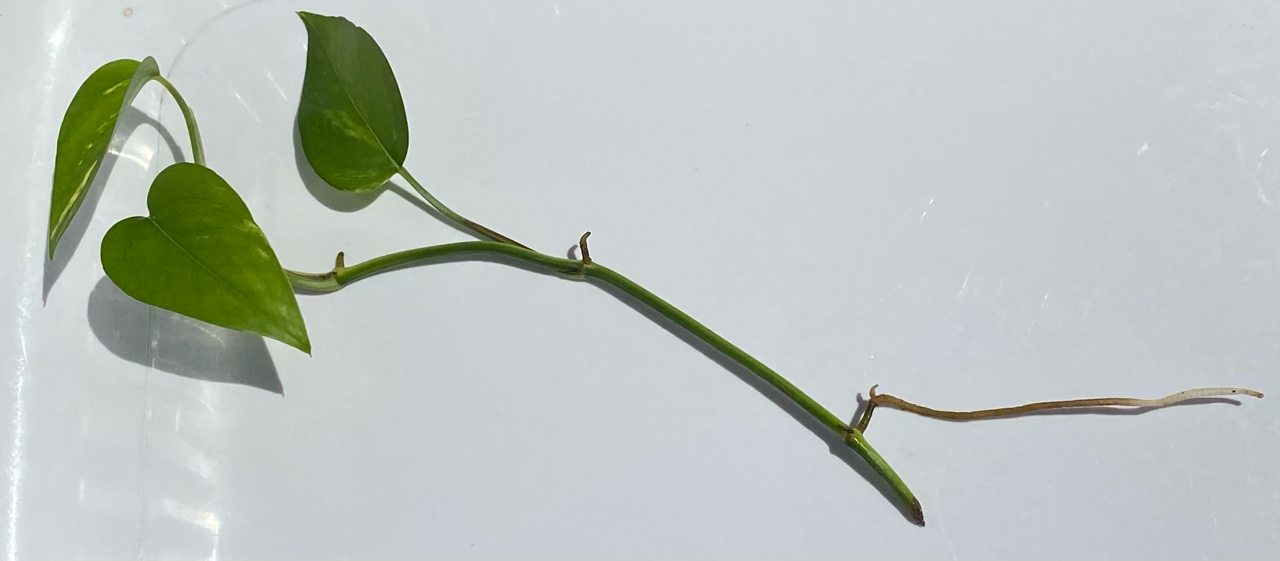
The design
Long, shallow, on the sill, and the plant leaves the water.
A tank roughly a meter long and a quarter of a meter front to back, filled to about 15 centimeters. Pothos sits with its stem across the rim, its roots hanging in the water, and its vines trained up the wall beside the window and across the glass. No filter, no heater, no lamp, no air pump.
It is an old configuration and almost nothing written about it explains why it works. The explanations that circulate are mostly wrong, or right for the wrong reason, and the wrong reason leads people to build the same thing at 60 centimeters deep and wonder why it fails.
The four claims, taken one at a time below. The plants get enough light. The pothos keeps the water clean. The tank stays clear. No equipment is needed.
The working dimensions used for every number on this page are 100 by 25 centimeters with the water at 15 centimeters, which is 37.5 liters over 0.25 square meters of surface, a mean depth of 0.15 meters2. Scale the arithmetic if your sill is different; the depth is the part that must not change.
The four claims, and the verdicts
- Light
- True, and understated. It is the best winter plant window in the region1
- Cleaning
- True at this scale. The scale is small and is quantified below2
- Stays clear
- True, and shade is doing more of the work than nutrient uptake2
- 3 of 4
- No equipment is true in winter and spring and false in a Yerevan July. The failure is thermal, not mechanical2
Claim four, first half
Volume cancels. Only depth survives. That is why a shallow tank needs no air pump.
Oxygen enters water across the air to water interface and nowhere else. So the supply term scales with surface area and the thing being supplied scales with volume, and that single asymmetry decides the shape of a tank that has to run itself.
dM/dt = k * A * (Cs - C) the standard two-film expression
dC/dt = (k / d) * (Cs - C) divide by V, substitute mean depth d = V/A
tau = d / k time constant of the approach to saturation
k is the gas transfer velocity in meters per day, A the surface area, Cs the saturation concentration, C the actual concentration. Volume has disappeared from the second line. Two containers holding the same water do not re-oxygenate at the same rate; the shallower one does it faster, in exact inverse proportion to mean depth.
| Mean depth | k = 0.3 m/day, still and sheltered indoors3 | k = 0.5, light air movement3 | k = 1.0, breeze or ripple3 |
|---|---|---|---|
| 0.15 m, this build | 12 h | 7 h | 4 h |
| 0.30 m | 24 h | 14 h | 7 h |
| 0.45 m | 36 h | 22 h | 11 h |
| 0.60 m, a standard 60 cm tall tank | 48 h | 29 h | 14 h |
| 1.00 m | 80 h | 48 h | 24 h |
A 15 centimeter column refills its own oxygen roughly four times faster per liter than a 60 centimeter one holding the same water. Our own working rule is that an unaerated container at or below about 40 cm of mean depth refills its oxygen inside a single night, and past about 70 cm it cannot2. This build sits at 15 cm, with a factor of nearly three in hand.
A shallow tank is also mixed for free. Night cooling makes the surface water denser so it sinks, and the overturn happens every night. A container much deeper than half a meter, warmed at the top, stratifies instead, and the cut-off bottom layer goes anoxic2. At 15 cm there is no stratified layer to worry about.
So the claim is confirmed, and confirmed for the right reason: in a shallow tank, depth substitutes for a pump. In a 60 cm tank with the same plant and the same fish, the identical claim is false2.
The limits, and they are not small
Unconditional is exactly what this is not.
Stocking. Depth sets the resupply rate. It does not set the demand. Overstock a shallow tank and it runs out of oxygen at the same rate as anything else, only faster, because there is less water per fish.
Temperature. Warm water holds less oxygen and every animal in it needs more. That is the summer section below, and it is where this design fails.
The root mass. A pothos root mass respires all night, and at a few hundred grams fresh it competes with the fish for the overnight oxygen budget of 37 liters2. The margin that depth buys is spent slowly by the plant.
And do not buy the pump anyway
An air pump is the wrong first purchase, and in this build it fixes nothing.
It raises k by breaking the surface and it prevents stratification, both real. It also strips carbon dioxide, which is the carbon supply for the submerged plants, and stripping ammonia and carbon dioxide away from the plants is Walstad's stated reason for running her tanks without filters or aerators2. See the soil tank method.
The cheaper interventions do the same job and are free at design time: reduce depth, increase surface area, let air reach the surface. A pump earns its place in a container deeper than about 60 cm and in a winter ice hole. Not here, and above all not as a response to a tank that is too hot.
The correction nobody applies
Every oxygen table in every aquarium book is written for sea level, and Yerevan is not at sea level.
Gas solubility is proportional to the partial pressure of the gas above the water, and partial pressure falls with barometric pressure. Yerevan's Arabkir station sits at 1113 meters, with a station pressure of about 887 hectopascals against 1013 at sea level4.
Correcting the Benson and Krause freshwater saturation equation5 by the standard factor, with the saturation vapour pressure from Buck6, gives the table below2.
| Water temperature | Sea level5 | Yerevan, 887 hPa5 | Gyumri, 846 hPa5 | Yerevan shortfall2 |
|---|---|---|---|---|
| 20 C | 9.09 | 7.93 | 7.56 | -12.8 % |
| 22 C | 8.74 | 7.63 | 7.26 | -12.7 % |
| 26 C | 8.11 | 7.07 | 6.73 | -12.8 % |
| 30 C | 7.56 | 6.58 | 6.26 | -13.0 % |
| 34 C | 7.06 | 6.14 | 5.83 | -13.0 % |
A Yerevan tank holds about 13 percent less oxygen than the same tank at sea level, at every temperature. Gyumri, at 1513 meters, loses about 16 to 17 percent42. It is not a large correction and it applies on exactly the days when the margin is thinnest, which is what makes it worth carrying. Every stocking table written in English or Russian is optimistic here by roughly an eighth.
The same correction applies to carbon dioxide, and nobody applies that one either. At 887 hPa the partial pressure of atmospheric carbon dioxide is 12.5 percent below sea level, so both the air concentration and the dissolved concentration fall by 12.5 percent2. A Yerevan tank at air equilibrium holds about 0.55 mg/L of free carbon dioxide at 25 C rather than the 0.63 mg/L a sea-level tank holds2. At altitude every gas is scarcer, and the submerged plant is slightly more carbon limited than the textbook says. The leaf in air loses the same 12.5 percent and does not care, for the reason set out next.
The correction this page most wants on the record
"There is far more carbon dioxide in air than in water" is the usual explanation, and it is wrong.
The claim as it is normally stated: a plant with its leaves in air has unlimited carbon, because air holds about 400 ppm7 and an aquarium at equilibrium with air holds only 0.5 to 0.7 mg per liter2.
The conclusion is right. The reason is not. And the difference matters, because the wrong reason makes people think injecting carbon dioxide into the water closes the gap. It does not close it nearly as much as those two numbers imply.
Put air and water side by side in the same units. Atmospheric carbon dioxide was 425.62 ppm as a global annual mean in 2025 and about 428 ppm through the first half of 20267. Convert that to a molar concentration with the ideal gas law, and convert the water in equilibrium with it using Henry's law with a van 't Hoff temperature correction2.
| Condition | In the air, micromoles per liter2 | Dissolved at equilibrium2 | Air to water ratio2 |
|---|---|---|---|
| Sea level, 20 C | 17.8 | 16.4, which is 0.72 mg/L | 1.09 |
| Sea level, 25 C | 17.5 | 14.3, which is 0.63 mg/L | 1.22 |
| Yerevan, 887 hPa, 20 C | 15.6 | 14.4, which is 0.63 mg/L | 1.09 |
| Yerevan, 887 hPa, 25 C | 15.3 | 12.5, which is 0.55 mg/L | 1.22 |
In molar terms the air and the water hold almost the same amount of carbon dioxide. The dissolved concentration is 82 to 92 percent of the gas-phase concentration, because that is what Henry's law says2. The famous comparison sounds like a factor of hundreds only because it sets a mixing ratio against a mass concentration, which are not the same kind of number. The real ratio is about 1.1 to 1.2, depending on temperature2.
The real difference is transport, and it is four orders of magnitude
diffusion coefficient of CO2 in air about 1.6 x 10^-5 m2/s
diffusion coefficient of CO2 in water about 1.9 x 10^-9 m2/s
ratio roughly 8,000 to 10,000
Carbon dioxide moves through water something like ten thousand times slower than through air2. The still film of water clinging to a submerged leaf, the diffusive boundary layer, is therefore the bottleneck, and it is not a small one.
Black, Maberly and Spence measured the boundary layer at 90 percent of the total resistance to carbon fixation in four submerged freshwater macrophytes8. Nine tenths of the difficulty is a film of water a fraction of a millimeter thick.
Across fourteen submerged freshwater species, underwater photosynthesis rose on average threefold when carbon supply went from ambient to saturating9. The submerged leaf is running at a third of what it could do.
It just does not matter. In air the boundary layer is a minor resistance and stomata dominate, and stomata are under the plant's own control. That is the whole asymmetry.
A leaf in air is not carbon limited and a leaf under water is, and the cause is the diffusion coefficient, not the concentration. Say it that way and the rest of the page follows.
Thinking about adding carbon dioxide? Raising dissolved carbon dioxide from 0.7 to 25 mg/L is a thirty-five-fold rise in the gradient across the boundary layer2, and that is why injection transforms a planted tank. It still does not make a submerged leaf equal to an aerial one, because the aerial leaf has four orders of magnitude more transport. But it moves a long way, and it is a real intervention rather than a marginal one.
The general form of the claim is stronger than the pothos version, and worth stating plainly. Plants with leaves in air outgrow plants with leaves under water, in the same water, by a wide margin, because only one of them is carbon limited. That covers pothos. It also covers duckweed, Salvinia, frogbit, water lettuce and every emergent marginal plant. Those are aquatic plants whose leaves are in air, and they are the same case, not a different one. Pothos is not special. Pothos is available, which in Armenia is the thing that decides it: the one specialist aquascaping shop in the country stocks no floating plants and no hornwort, and every household has a pothos.
And the claim that must not be made
A shallow tank does not give the plants more carbon dioxide.
It is tempting to write it and it is false. The same k over d term that governs oxygen governs carbon dioxide2. In a planted tank, photosynthesis pulls dissolved carbon dioxide below air equilibrium during the day and the water then re-absorbs it from the atmosphere.
What shallow buys is that it re-absorbs four times faster per liter, so it has less trouble falling below equilibrium. That is a real and useful benefit and it is a completely different mechanism. The ceiling is still 0.55 to 0.63 mg/L of free carbon dioxide at Yerevan's pressure2, and nothing about the shape of the tank moves that ceiling.
The corollary, which is the honest one. The pothos advantage is not something the shallow tank shares. The pothos has its leaves in air. The Vallisneria does not, at any depth.
What follows for the plant list
Either inject carbon, or pick plants that do not need it.
This build does the second. The submerged planting has to be species that are slow, undemanding and content at air-equilibrium carbon: Anubias, Java fern, Cryptocoryne, mosses, Bucephalandra. No carpets, no demanding stems, no red plants.
The reason is not only carbon. It is also the competition in the section below: the pothos strips nitrogen toward zero, and a demanding stem plant is the first thing to notice. The plant finder filters on light, carbon and difficulty together, which is the right way to pick this list.
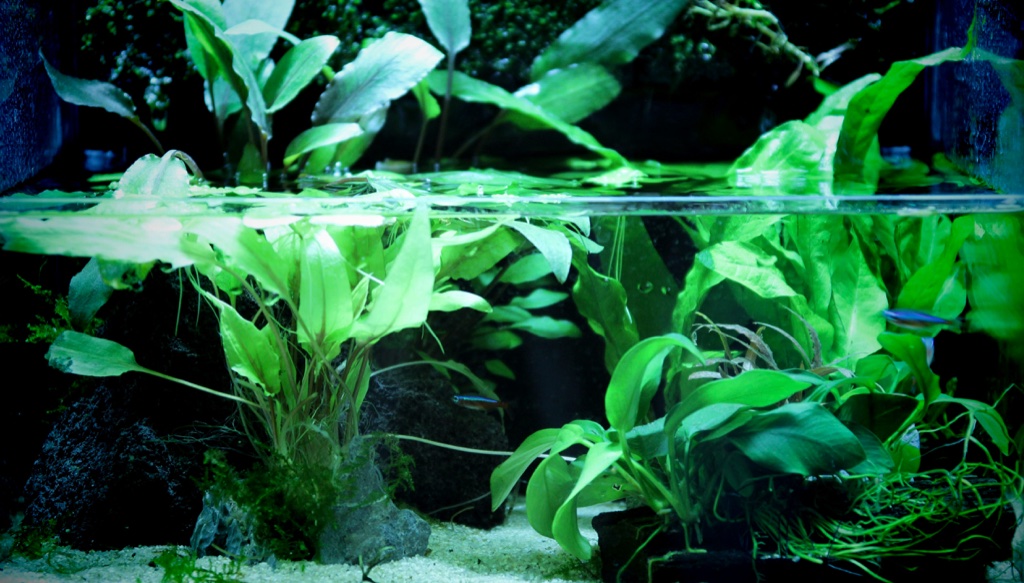
Claim one, and it is understated
A window is a winter instrument. In Yerevan a south one collects more light in January than in June.
A vertical surface is a poor collector when the sun is overhead and an excellent one when the sun is low. The sun's midday altitude in Yerevan runs from 26.4 degrees at the winter solstice to 73.1 degrees at the summer solstice4, so the same pane of glass is a different device in February and in July.
Daily light integral on the outside of a south-facing window, from the NASA POWER photosynthetically active radiation field scaled to a tilted vertical surface, 2001 to 2020 climatology1, with a double-glazing transmission of 0.75 applied2.
| Yerevan south window | Jan1 | Feb1 | May1 | Jun1 | Jul1 | Dec1 |
|---|---|---|---|---|---|---|
| Outside the glass1 | 24.6 | 28.6 | 19.0 | 20.2 | 21.3 | 20.3 |
| Inside double glazing2 | 18.5 | 21.5 | 14.2 | 15.1 | 16.0 | 15.2 |
The Yerevan south window peaks in February, and in January it is 3.1 times a Berlin south window and 4.7 times a Stockholm one1. Gyumri's January south window is the brightest in the country at 29.4 moles per square meter per day1. For a houseplant that is an unusually good position and the founder found it by living there.
Is it enough for a pothos? There is a measured saturation point to check it against, and the answer is yes with room to spare. Brito, Mantuano, De Toni and Mantovani measured photosynthetic light response curves for Epipremnum aureum and found that the light levels that saturate photosynthesis in the field, around 1,000 micromoles per square meter per second, are reached only by the large leaves the plant puts up at canopy height, not by the small understorey leaves at around 10010. Just inside double glazing at a Yerevan south window on a clear January noon, photosynthetic photon flux density is about 1,170 micromoles per square meter per second12.
On a clear Armenian winter day a pothos at a south window is sitting at or just above the measured light saturation point of its own species. There is nowhere indoors on earth where it can get more useful light than that.
And the climbing matters, which is the part of the design that is better than it looks. The same study found that vertical plants in high light produced leaves 9 to 13 times larger than plants in other conditions, with the highest relative growth rate and net assimilation rate10. A pothos allowed to trail downward makes small leaves. A pothos climbing a wall beside a bright window is the experimental treatment that won. Growth is nitrogen removal, so this is not decoration.
Your window is not this window. Work out which one you have.
A south sill and a north sill in the same flat are different light budgets by a large factor, and no page can tell you which you have. There is also no universal conversion between lux, photosynthetic photon flux density and daily light integral. Lux is weighted by human vision, which peaks in the green at 555 nanometres; plants use photons roughly equally from 400 to 700 nanometres and care most about red and blue, exactly where the eye is least sensitive. The factor therefore depends entirely on the spectrum of the source, and any calculator offering one number for all light is lying. The tool below makes you name the source first, then converts. It is the same tool that drives the plant finder, so the two cannot drift apart.
What that means
- Lumens
- Photons
- DLI
- Of noon
The verdicts above are written for a houseplant, which is the right frame for the pothos and the wrong one for the water. For the water, compare the DLI figure against the aquarium bands in the next table. A reading that is comfortable for a foliage plant on the sill can be several times what the tank below it can use.
Measure at the position the leaf will actually occupy, at the time of day the sun is on the glass, and repeat it in January and in June. The same spot can be shaded in June and in full sun in December, because of the 47 degree swing in midday sun altitude4.
Now the surprise, which is what the light does to the water rather than to the leaf
The tank's horizontal surface receives the beam through the window plus roughly half the sky diffuse. Taking the outdoor horizontal daily light integral for Yerevan1, a glazing transmission of 0.75, capture of the direct beam during the hours the sun is south of the east-west line, and half the diffuse2.
| Over the water | January2 | June2 | Against the bands2 |
|---|---|---|---|
| Open water, no leaves over it | 8.7 | 23.7 | 2.5 to 7 times the top of the high band |
| 30 percent leaf cover | 6.1 | 16.6 | Still well above it |
| 50 percent leaf cover | 4.4 | 11.8 | The target. About 1.5 times the high band in winter |
| 70 percent leaf cover | 2.6 | 7.1 | Approaching the high band in winter |
| The hobby's bands, converted2 | low 0.43 to 0.86, medium 0.86 to 1.7, high 1.7 to 3.5 | From 15 to 30, 30 to 60 and 60 to 120 micromoles per square meter per second at the substrate over an eight-hour photoperiod | |
A bare shallow tank on a Yerevan south windowsill is an algae farm by construction. It is not a marginal call and it is not a matter of doing something slightly wrong. Eight point seven moles per square meter per day in January, with no injected carbon to match it, is a light budget the plants cannot use, and everything left over feeds algae.
Which reverses the usual reading of this build. The reason the tank stays clear is not mainly that the pothos strips nutrients. It is that the pothos is shading the water Nutrient competition is real and does some of the work, but the shade term moves the surface from seven times the high-light band to about one and a half times it, and that is the larger intervention by a wide margin.
So the canopy over the water is the algae control, and it should be maintained deliberately rather than allowed to happen. Aim for roughly half the water surface under leaf. This also predicts a failure other people will report and be puzzled by: the same build with the plant trained away from the water goes green.
How much to trust these two numbers. The capture fractions for a horizontal surface behind a vertical window, 0.53 in January and 0.49 in June, are geometry plus judgement rather than a radiation model, and could be wrong by 30 percent either way. The conclusion that a Yerevan sill is far above the hobby's high-light band survives a 50 percent error in either direction. The exact 8.7 and 23.7 do not, and are not load bearing.
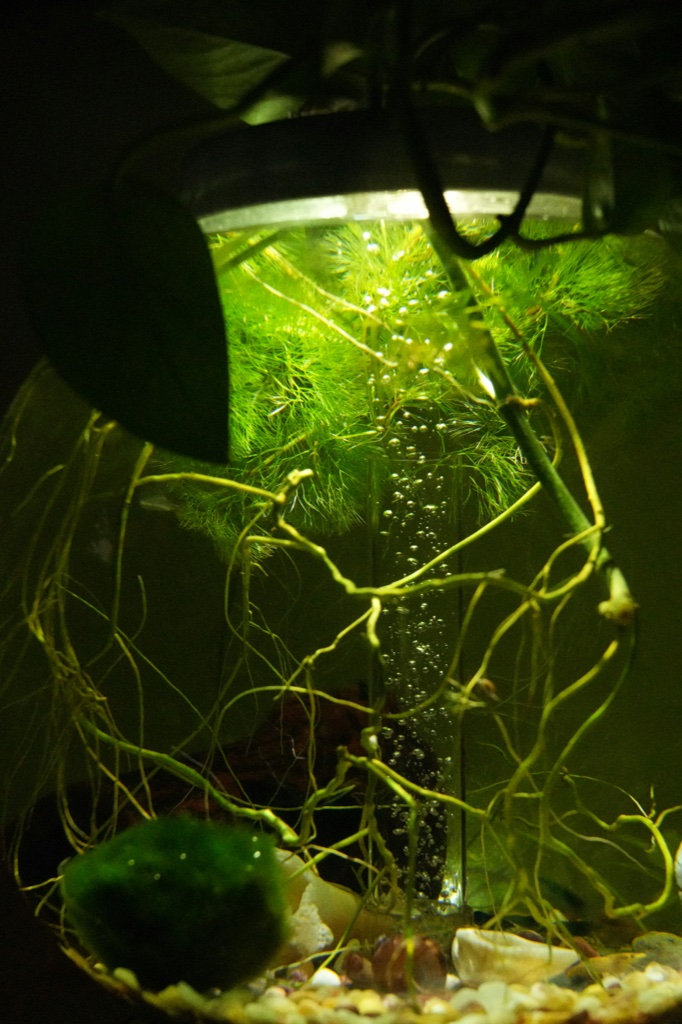
The same sill, two liters, nothing bought
There is a version of this that costs nothing and stocks itself: a jar of pond mud in the same window.
This page is a designed tank on a sill. The smallest honest version of the same idea is a 1 to 2 liter glass jar holding two spoons of sediment, a few dead leaves and water from a river or a pond, covered with a square of cotton and an elastic band, standing in the same window. You stock nothing. What appears was already in the sediment as a resting egg or a cyst. Ecologists call that buried layer an egg bank and treat it as a reservoir that restocks the water when the habitat refills11.
Two things on this page transfer directly to it, and are the reason it is mentioned here rather than only in the children's section. The light section above is the same problem in two liters instead of forty, and it decides the outcome: a covered infusion ends either in sterility or, in the presence of sunlight, in a practically stable equilibrium in which animals and green plants adjust to each other12. And the summer overheating warning applies harder, because two liters behind glass has almost no thermal mass.
A jar from a pond: what appears, in what order, and how to record it
- NASA POWER, SYN1deg satellite-derived solar radiation and photosynthetically active radiation, 2001 to 2020 climatology, processed to tilted vertical and horizontal surfaces in our own sibling climate research. Source of the south-window and horizontal daily light integrals for Yerevan, Gyumri, Berlin and Stockholm, and of the clear January noon flux inside double glazing. power.larc.nasa.gov open data; the window geometry is ours
- Our own arithmetic and our own estimates. Not a published source. Reaeration: the two-film expression divided by volume to give the depth form, the time constants, and the 40 cm and 70 cm working rules. Carbon: the air and water molar concentrations by the ideal gas law and Henry's law with a van 't Hoff temperature correction, at sea level and at 887 hPa; the 12.5 percent altitude reduction; the thirty-five-fold gradient on injection. Oxygen: the pressure correction applied to source 4 with vapour pressures from source 5; the stored and overnight-delivered oxygen for 37.5 litres; the demand-to-supply ratio at a temperature quotient of 2. Light: the 0.75 double-glazing transmission, the capture fractions of 0.53 in January and 0.49 in June, and the conversion of the hobby's light bands to a daily integral over eight hours. Nitrogen: the load table from the 0.092 feed-to-ammonia factor, the tissue export table, the growth-to-removal table, the root surface area against an areal nitrification rate of 0.05 to 0.15 g per square metre per day, and the floating mat comparison. Heat and water: the whole indoor energy balance for eight scenarios, the evaporation and transpiration figures, the top-up share, the tank volumes of tap water a year, and the mineral addition. Also ours: the 50 kg loaded weight, the 1.3 microgram whole-tank imidacloprid figure, and the Yerevan tap water spread of 2.9 to 10.9 dGH and 170 to 470 mg/L, which comes from our own materials research. calculated, repeatable, unverified by a third party
- Cole, J.J. and Caraco, N.F. (1998). Atmospheric exchange of carbon dioxide in a low-wind oligotrophic lake measured by the addition of sulfur hexafluoride. Limnology and Oceanography 43(4): 647 to 656. The zero-wind gas transfer velocity used as the still-surface case, roughly 2.07 cm per hour. DOI 10.4319/lo.1998.43.4.0647 open access
- Armenian hydrometeorological service, WMO Climate Normals 1991 to 2020, as submitted to WMO and archived by NOAA NCEI, with station pressures, solar altitudes and derived quantities computed in our own sibling climate research. Source of every Armenian temperature, humidity, sunshine, station pressure and sun angle figure here, including Yerevan Arabkir at 1113 m and 887 hPa, Gyumri at 1513 m and 846 hPa, the 82 and 13 days a year at or above 30 C, and the January mean of minus 2.4 C. primary normals public; the derived quantities are ours
- Benson, B.B. and Krause, D. (1984). The concentration and isotopic fractionation of oxygen dissolved in freshwater and seawater in equilibrium with the atmosphere. Limnology and Oceanography 29(3): 620 to 632. The saturation equation used here is the form published in APHA Standard Methods for the Examination of Water and Wastewater. DOI 10.4319/lo.1984.29.3.0620 paywalled; the equation is reproduced in many open sources
- Buck, A.L. (1981). New equations for computing vapor pressure and enhancement factor. Journal of Applied Meteorology 20(12): 1527 to 1532. Every saturation vapour pressure used in the pressure correction and the evaporation terms. DOI 10.1175/1520-0450(1981)020<1527:NEFCVP>2.0.CO;2 open access
- NOAA Global Monitoring Laboratory. Trends in Atmospheric Carbon Dioxide, global means. Data files co2_annmean_gl.txt and co2_mm_gl.txt. Global annual mean 425.62 ppm for 2025, monthly global means around 427 to 428 ppm through the first half of 2026. gml.noaa.gov/ccgg/trends/global.html open data
- Black, M.A., Maberly, S.C. and Spence, D.H.N. (1981). Resistances to carbon dioxide fixation in four submerged freshwater macrophytes. New Phytologist 89(4): 557 to 568. The boundary layer at 90 percent of total resistance. DOI 10.1111/j.1469-8137.1981.tb02335.x paywalled; the 90 percent figure is quoted as reported in the review literature
- Nielsen, S.L. and Sand-Jensen, K. (1989). Regulation of photosynthetic rates of submerged rooted macrophytes. Oecologia 81(3): 364 to 368. The threefold average increase in underwater photosynthesis at saturating carbon across fourteen species. DOI 10.1007/BF00377085 paywalled; quoted as reported in the review literature
- Brito, C., Mantuano, D., De Toni, K.L.G. and Mantovani, A. (2025). Increasing leaf sizes of the vine Epipremnum aureum (Araceae): photosynthesis and respiration. PeerJ 13: e19214. The canopy light saturation near 1,000 micromoles per square metre per second, and the finding that vertical plants in high light produced leaves 9 to 13 times larger with the highest relative growth rate. DOI 10.7717/peerj.19214 open access
- Hairston, N.G. Jr. (1996). Zooplankton egg banks as biotic reservoirs in changing environments. Limnology and Oceanography 41(5): 1087 to 1092. DOI 10.4319/lo.1996.41.5.1087. And Brendonck, L. and De Meester, L. (2003), Egg banks in freshwater zooplankton: evolutionary and ecological archives in the sediment, Hydrobiologia 491: 65 to 84, DOI 10.1023/A:1024454905119.
- Woodruff, L.L. (1912). Observations on the origin and sequence of the protozoan fauna of hay infusions. Journal of Experimental Zoology 12(2): 205 to 264. The sterility or stable microcosm alternative, and the role of sunlight in deciding between them. DOI 10.1002/jez.1400120204. Public domain; full text at archive.org public domain, full text free
Continue
Where to go next.
The pothos and the species list
Why pruning is the water change, which houseplants really tolerate submersion, and the toxicity question answered.
Building it, and what it costs
The summer behind glass, the four real costs, and the assembly order with the two skipped steps named.
Easy setups
The five setups the windowsill tank is the smallest of.
A jar from a pond
The version that costs nothing and stocks itself, in the same window.