This page continues
The biology behind the jar has a page of its own.
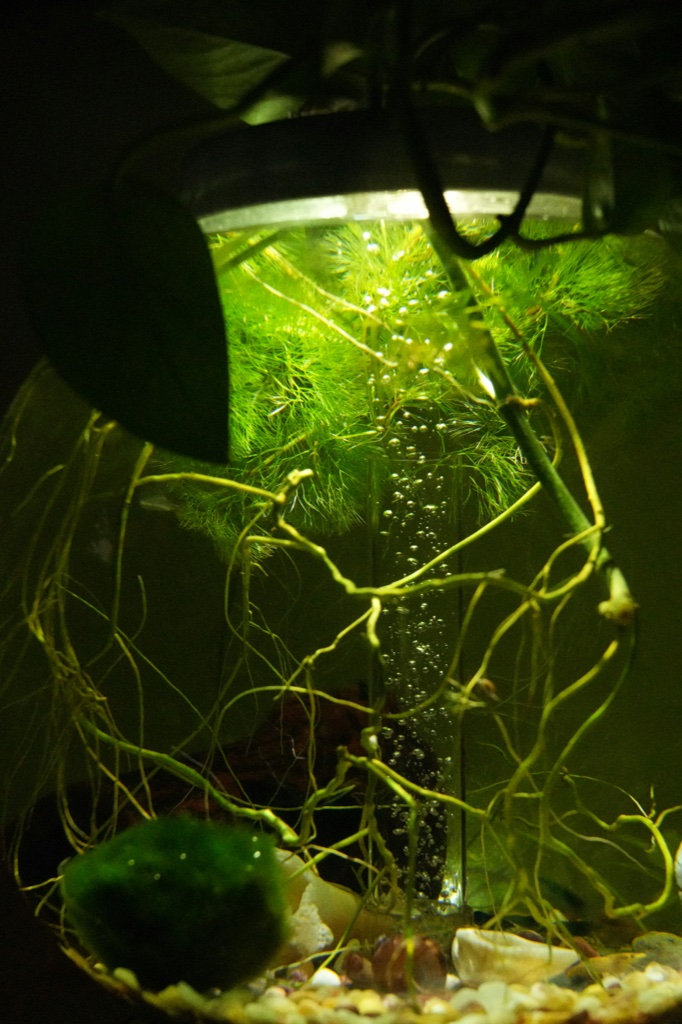
Materials and method
What you need. All of it is already in the kitchen except the gauze.
Use a clear glass preserving jar that holds one to two liters. Wide-mouthed is better than narrow, because you have to get your hand and a spoon in, and because a wide mouth means more water surface and more gas exchange. Clear glass, not tinted. No lid.
| Item | Where | Why |
|---|---|---|
| 1 to 2 L glass jar | The kitchen, or any hardware shop | Clear sides so you can watch the water column and the glass itself, which is where the crawling ciliates and the rotifers live |
| Cotton gauze, or a square of old cotton shirt, or fine mesh | Any pharmacy sells gauze by the meter for very little | The cover. Both directions. See the safety section: this is the single most important component and it is the cheapest |
| A wide elastic band or a length of string | Anywhere | Holds the cloth on. A screw lid does not do this job, it does the opposite one |
| A jar or bottle for transport | Anywhere | Carry the mud and the water home separately from the display jar, so you can pour rather than slosh |
| A spoon or small trowel | The kitchen | For the top two or three centimeters of sediment. Deeper is older and, on the resurrection ecology evidence, less likely to hatch4 |
| A hand lens, 10x, or a phone | Optics shops, stationers, or the phone in your pocket | See the section on seeing small things. Not optional if you want past the ostracods |
| A notebook | Anywhere | The difference between an experiment and an ornament |
| Sticky label and a marker | Anywhere | Jar A or jar B, the date, and the place you collected from. Two months later you will not remember |
Pick the spot, and read the safety section first. A slow edge of a river, the shallow margin of a lake, a pond, a ditch that has held water for weeks. The Illinois study that hatched the most animals used roadside drainage ditches only a few centimeters deep1. Unglamorous water is good water for this.
Take sediment first. Two or three spoonfuls, the top two or three centimeters, from two or three different spots a meter apart rather than one big scoop. Different spots means different egg banks5. You want enough to cover the bottom of the jar to about 2 cm.
Then leaf litter. Two or three dark soggy leaves from in the water or right at the edge, not fresh green ones. A short piece of dead reed or stem is good too. Two or three small leaves in two liters, not a jar packed with them, for the tannin reason above6.
Then water, from the same place. Fill to about three quarters, leaving several centimeters of air. If you have to top up later, use rainwater or water that has stood open for a day, not fresh tap water.
Home, and let it settle. It will be a brown cloud. Stand it somewhere and leave it alone for a day; the sand and silt drop out and the water clears enough to see through. If it never clears, that is a finding, not a failure.
Cover it. Cloth and band, now, not later. Not a lid. The cloth lets air in and keeps insects on their own side of it, both ways. Woodruff plugged his flasks with cotton for exactly this reason7.
Put it on the windowsill. Bright, but out of hours of direct summer sun, which cooks a two liter jar. North or east facing is the easy answer in a Yerevan flat. Then label it and write down the date, the place, and the weather.
Do not feed it, filter it, aerate it, heat it or change the water. Every one of those turns it into a different experiment. The only intervention is topping up evaporation, and you note that in the log when you do it.
One legal note, and it is short. Taking a spoon of mud, some dead leaves and a jar of water is not fishing, and the amateur fishing rules, the gear rules and the species list on our Armenia page do not apply to it. What does apply is protected areas. Offences committed inside a protected area are treated more severely under the Criminal Code8, so do not collect inside a national park, reserve or sanctuary. An ordinary irrigation ditch, the edge of a village pond or an unremarkable stretch of river bank is what you want anyway.
Safety
Six things to get right. Five of them are about the jar and the important one is about the lake.
None of this is a reason not to do the project. All of it takes about a minute to act on. It is here in full because a page that says "be careful" and stops is not a safety section.
1. The cover works in both directions
An open jar of standing water on a windowsill is a mosquito nursery, and it is one indoors.
The cloth is usually explained as keeping bugs out of the jar. That is half of it. The other half is that a jar of warm, still, nutrient-rich water is precisely the habitat a mosquito is looking for. Adult female Aedes mosquitoes lay eggs on the inner walls of containers that hold water, above the waterline, and the eggs stick to the wall like glue. Mosquitoes only need a small amount of water to lay eggs, and bowls, cups, fountains, vases and any other container storing water make a good nursery9.
The timescale is inside your observation window. A mosquito egg takes 7 to 10 days to develop into an adult mosquito9. So an uncovered jar set up on a Saturday can be releasing adults into the room before the third weekend. Larvae live in the water, are very active and are visible; they are called wigglers9, which at least means you can see the mistake.
Cloth and an elastic band solves both directions at once, and it is the whole answer. Put it on before the jar goes on the sill, not after you see a wiggler. And if you do see wigglers, the fix is not to swat them: pour the jar out down an indoor drain, per the next point, and start again with a cover on.
This also matters more in an Armenian summer than a European one, because a Yerevan flat in July is warm enough to run the mosquito life cycle at its fast end.
2. How the experiment ends
Never pour the jar back into a river, a lake or any natural water. Never move water or animals between two water bodies.
This is the rule the whole hobby breaks and the reason so much is broken. A jar that has sat for two months contains an assembled community, possibly including something that was rare where you took it and is now abundant, plus whatever came in on your hands, your spoon and the leaves. Putting that back is not returning it. It is an introduction.
The stakes here are documented locally. Armenia's 2024 invasive alien animal checklist lists 40 species, of which 6 are fish, arriving by escape, release and as transport contaminants, and it also finds that no monitoring or control of animal invasions is carried out in Armenia at all10. There is no safety net to catch a mistake here.
To end it properly: pour the water down an indoor sink or toilet. Put the sediment and the leaves in the household bin or on a compost heap well away from any water. Wash the jar with hot water. Do not tip it into the yard drain, the ditch you took it from, or a park pond, and do not carry a jar from one pond to stock another.
3. Where not to collect
Not below a mine, a smelter, a sewage outfall or heavy agriculture. In Armenia that is a specific list of rivers, and the numbers are published.
Our hardscape page records the measurements, and they are worth repeating because they are not marginal. Copper in the Akhtala river near its mouth runs 381 to 788 micrograms per liter against a catchment background of 3.0011. That is over a hundred times background. The Alaverdi river near its mouth runs 238 to 315 µg/L, the Debed 4.5 km below Alaverdi runs 79 to 86, and the Chochkan below the tailings dump 84 to 37911. In the Sevan gold mining area, arsenic in the Sotk and Masrik reaches 13.16 µg/L against a background of 0.4 to 1.611.
Copper at those concentrations is lethal to the invertebrates the jar is for, so the jar will simply not work, and that is before any question of a child handling the water. Upper Pambak and upper Debed are at background and are fine11. Away from the mining districts, ordinary ponds, ditches and river margins are what you want. Avoid the few meters downstream of a visible pipe, and avoid a channel running straight off an intensively farmed field after rain.
4. Blooms and skin
Do not collect from water with a paint-like scum on it, and do not put your hands in it.
Cyanobacteria, also called blue-green algae, are the most common cause of harmful algal blooms in fresh water, some blooms produce toxins that make people and animals sick, and they can look like foam, scum, mats or paint on the surface and can change the water's color to green, blue, brown or red12. Blooms are more likely where water is warm, slow moving and full of nutrients such as nitrogen or phosphorus, which get in from fertiliser, sewage and urban runoff12. The public health advice is plain: stay out if the water looks discoloured, has scum, or smells bad12.
A warm still jar on a sunny sill is, on that description, a small version of the same conditions, so a jar can produce its own surface film. A thin grey bacterial skin is normal and is the zoogloea described above7. A thick blue-green or turquoise paint-like scum with a strong musty smell is the one to treat as a cyanobacterial bloom: do not put fingers in it, end the jar as in point 2, and wash up afterwards.
Wash hands after touching the jar or the water, every time. This is the same rule that already applies to any aquarium and it is not specific to pond water.
5. It is glass
Two kilograms of water in a slippery glass jar, at head height, near a child.
A full two liter jar weighs a little over two kilograms and the outside is often wet. Put it at the back of the sill, not the front edge. Put it on a tray or a folded towel. An adult carries it between the sink and the sill. If there is a smaller child in the house, choose a shelf they cannot reach rather than a sill they can. A plastic PET jar is a legitimate substitute for a young child and costs almost nothing in optical quality; a clear straight-sided sweet jar or a large mineral water bottle with the top cut off both work.
6. The real risk
The dangerous part is the visit to the water, and it is not the microbes.
There are around 300,000 drowning deaths worldwide each year. Children under 5 account for nearly a quarter of them. Drowning is the fourth leading cause of death for children aged 1 to 4 and the third leading cause for children aged 5 to 1413. Young children are at particular risk because of an underdeveloped ability to assess risk and a lack of swimming and water safety skills, and the risk rises when children interact with water outside active adult supervision13.
So: an adult goes to the water, every time, and stays within arm's reach. Collect from a bank you can stand on, not from a rock in the current, and not from a steep or undercut edge. That is the whole instruction, and it is the only part of this page that is not negotiable.
Observation schedule
Week by week, with what to look for and roughly when.
Look every day for the first week, then twice a week, then weekly. Five minutes is enough. The schedule below is our synthesis of the two studies this page relies on, applied to a windowsill jar; the day counts inside it are from Woodruff's flasks and the Illinois sediment cores, and the arrangement into weeks is ours.14 Woodruff himself watched daily for three months7. That is the standard to aim at, not to be discouraged by.
Days 0 to 2
It goes cloudy, and that is the experiment starting.
Sediment settles out over the first day. Then the water goes milky. Woodruff's infusions became markedly turbid within forty eight hours from the development of countless bacteria7. Look at the bottom for small bubbles caught in the litter: gas appears among the litter within the first few days and is chiefly carbon dioxide7. Record: water color, clarity, smell, bubbles yes or no.
Days 3 to 7
A skin on the surface, and the water starts to brown.
From about the third day a bacterial surface mat, the zoogloea, begins to form; it thickens over weeks, and may fall to the bottom as a sheet and re-form7. By day 3 or 4 the water darkens, and it keeps darkening toward brown7, helped by tannin leaching from the litter, which rose steeply over the first 14 days in the submerged decomposition experiment6. Nothing is visibly alive yet. Nothing is supposed to be.
Week 2
First animals. Get the hand lens out.
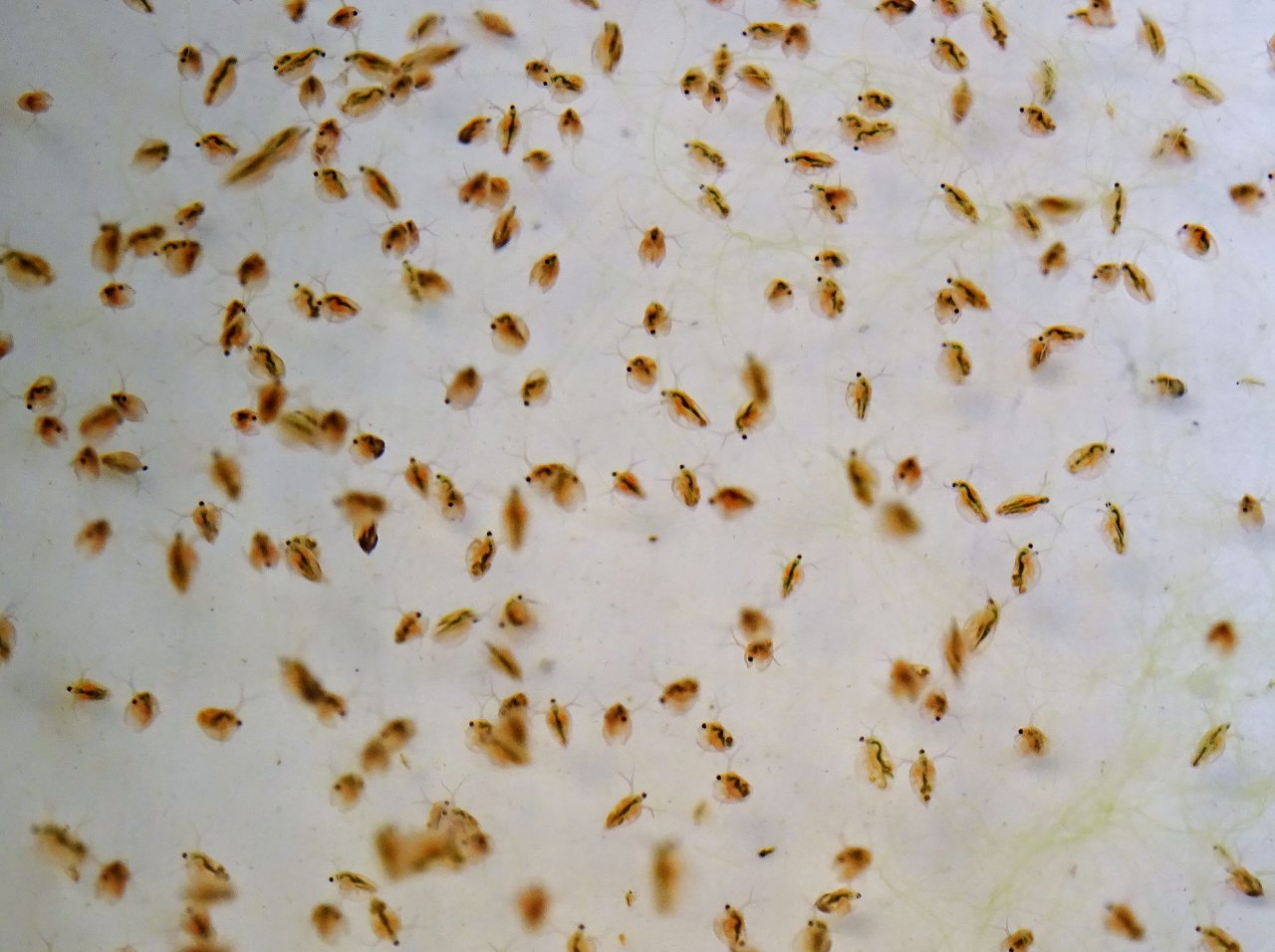
This is when it stops being a jar of dirt. In the Illinois cores, ostracods and bdelloid rotifers were emerging from the first weekly count onward1. Ostracods are the ones you will see unaided: seed-shaped, a millimeter or two, scuttling on the mud. Rotifers need the lens. Meanwhile the invisible layer is turning over fast: flagellate maxima fell between day 4 and day 27 in Woodruff's flasks and Colpoda peaked around days 12 to 157.
Week 3
Green appears, and the glass becomes the interesting surface.
Algae start on the lit side of the jar and on the litter. Crawling hypotrich ciliates were appearing from around day 6 and peaking between days 10 and 167, and they live on surfaces, so hold the lens against the glass rather than pointing it at the open water. Look for green threads, green dust, and specks that move against the glass. Turn the jar and check the dark side too: the difference is data.
Weeks 4 to 6
Crustaceans, if you are getting them.
Copepods, more ostracods, and with luck a cladoceran. The Illinois emergence was still running at the fourth weekly count when the study stopped recording1, so week 4 is not a deadline. Paramecium and Vorticella were often at their peak around days 30 to 507. Vorticella is the best thing a hand lens can find in a jar: a tiny stalked bell that contracts in a snap when disturbed.
Weeks 6 to 12
The jar either settles or turns over.
Bottom sediment may go dark or black. That has an explanation and it is not decay in the alarming sense: sulfate reduction produces hydrogen sulfide, which forms ferrous sulfide with iron and shows as a black colouration5. Green may thicken and then vanish. Populations you had for a month may be gone. Woodruff's zoogloea reached its greatest thickness around day 30 and then either fell or thinned away7. Keep logging. The disappearances are the finding.
Month 3 onward
Where the published work runs out and yours begins.
The sequenced Winogradsky columns were run for 18 weeks5 and Woodruff's daily counts covered three months7. Beyond that, a lit jar can persist for a long time or collapse. Which one, and when, is the subject of the next section. A jar kept for a year with a monthly log is a genuinely unusual record and we would like to see one.
Every visit, whatever week
The four questions.
What color is the water. Does it smell, and of what. What is on the glass, on the surface, and on the bottom. What is new since last time. Answer those four in writing every time and you have a dataset. Answer them in your head and you have an anecdote.
Optics on a budget
How to see something half a millimeter long, with things you already own.
Most of this project is invisible at arm's length and completely visible at fifteen centimeters with the right light. The optics matter less than the lighting, which is the part everybody gets wrong.
Side light, dark background. This is the whole trick and it costs nothing. Put a sheet of black paper or a dark cloth behind the jar. Shine a phone torch or a desk lamp in from the side, level with the water, so the beam passes through the jar rather than toward you. Every transparent animal in the water then scatters light and shows up as a bright moving speck against black. Head on, with a window behind the jar, the same animal is invisible. This is dark field illumination done with household objects, and it is the single biggest improvement available to you.
A 10x hand lens. A jeweller's or stamp collector's loupe, cheap in any stationer or optician. Hold it close to your eye, not close to the jar, and bring your head toward the glass until it focuses. At 10x an ostracod is an animal with legs, a rotifer is a moving translucent tube, and Vorticella on the glass is a bell on a spring.
A phone, close up. Modern phone cameras focus surprisingly close in macro mode. Two upgrades, both cheap: a clip-on macro lens, sold for very little; or the classic trick of holding the hand lens or a drop-shaped bead of water in front of the phone lens and moving the phone until it snaps into focus. Steady the phone against the jar. Shoot video rather than stills, because these animals are defined by how they move, and a still of a speck is a still of a speck.
A white saucer. Take a spoonful of water and the top film of mud out of the jar into a shallow white dish. Now you are looking down through 5 mm of water instead of sideways through 10 cm, and you can move the light freely. Ostracods and copepods show immediately. Pour the sample back into the jar, not down the sink, and wash your hands.
Patience beats magnification. Look at one square centimeter of glass for a full minute without moving. Movement is what your eye detects, and most of what is there will not move until you stop moving.
Rough sizes, so you know what you are hunting
- Bacteria
- Invisible individually. You see them as cloudiness and as the surface film7
- Flagellates
- Invisible without a microscope
- Ciliates
- Paramecium is at the very edge of the naked eye as a white speck. Vorticella colonies show as a fuzz on the glass
- Rotifers
- Hand lens territory. Bdelloids stretch and contract like a worm1
- Ostracods
- Naked eye. Seed-shaped, scuttling1
- Copepods
- Naked eye. Jerky, with long antennae
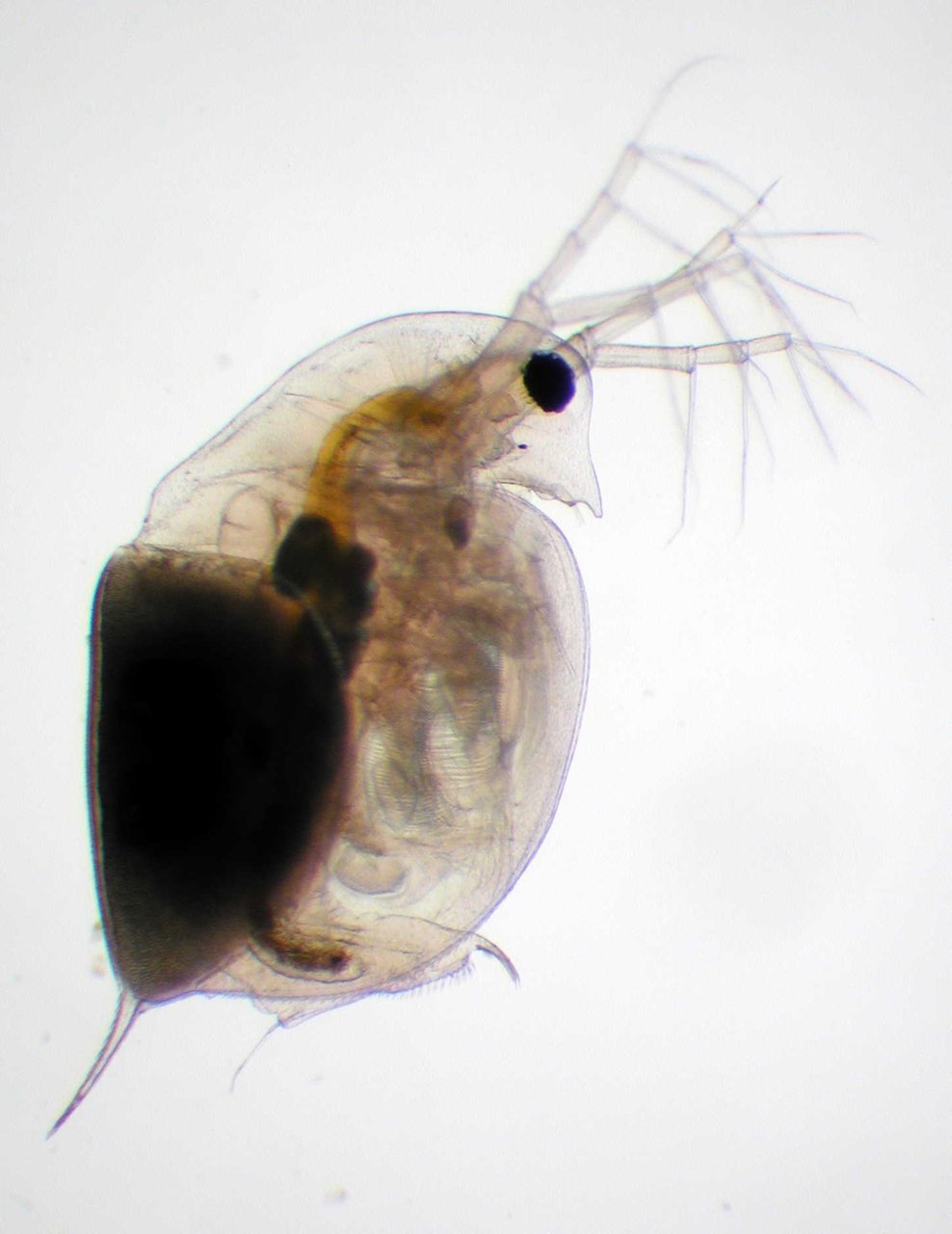
- Daphnia
- Naked eye, and the one where you can watch the heart beat through the shell15
The log
Writing it down is the step that turns a jar into an experiment.
Everything else on this page is preparation for this. A jar you look at is decoration. A jar you record is data, and a child who has kept a dated table for eight weeks has done the thing that scientists actually do, which is mostly not the exciting part and is entirely the part that counts. Woodruff's paper is a hundred and fourteen years old and still useful because he wrote the numbers down7.
Copy this into a notebook, one row per visit. Nine columns, none of which need equipment.
Three habits that make the log worth more than the jar. One, use the same words every time, from a fixed list, so that week 6 is comparable with week 2. Two, count something rather than describing it, even if the count is rough, because a number can go on a graph and an adjective cannot. Three, record the days when nothing happened. A log with gaps on the boring weeks cannot tell you when something started, which is usually the question you end up asking.
Two jars
Two jars, one difference. That is the whole of experimental design.
One jar tells you what happened. Two jars that differ in exactly one thing tell you why. This is not an advanced extension for keen children, it is the actual method, and it is what Woodruff did: his twenty four flasks were split into groups in which the hay was sterilised, or the water was sterilised, or both, or neither, so that the source of the organisms could be isolated rather than guessed7. That design is why his conclusion about where the life comes from is still quoted.
The rules are two. Change one thing between the jars and keep everything else identical, including the same mud, mixed together in a bowl first and then divided. And label them, because you will not remember.
| Jar A | Jar B | What it tests | Prediction, and where it comes from |
|---|---|---|---|
| Sediment, litter and water | Water only, filtered through cloth, no mud | Where the animals come from | A gets animals, B gets very few. Ostracods and rotifers hatched from sediment in the Illinois cores1, and Woodruff found the solid material, not the water and certainly not the air, to be the main source7. Run this one first. It is the best experiment on the page |
| On the windowsill, bright | In a cupboard, dark, same room | Light | A goes green and may persist; B browns, runs the bacterial and protozoan sequence and then stalls. Woodruff described an infusion ending either in sterility, or, in the presence of sunlight, in a practically stable equilibrium in which animals and green plants adjust to each other so that a veritable microcosm exists7 |
| Two or three leaves | No litter, sediment and water only | Whether litter is the fuel | A browns, clouds sooner and carries more life for longer. B does less, for longer. The litter is the allochthonous energy input16 |
| Two or three leaves | Jar packed with leaves | Dose, not presence | Counterintuitive, which is why it is worth doing. A low tannin addition raised decomposition by 1.33 to 12.70 percent and a high one lowered it by 6.21 to 6.82 percent, with high tannin also inhibiting nitrifiers so that ammonium accumulated6. Expect B to be darker, smellier and less alive |
| Mud from pond X | Mud from pond Y | Whether the source pond decides the outcome | In the sequenced columns, community structure was set by a founding population that depended on the sediment source5. Expect two visibly different jars from the same recipe. This is the founder effect, and a child can see it |
| Warm spot | Cool spot, same light | Temperature | Within limits, the higher the temperature the faster the sequence proceeds7. Expect the same events in the same order, earlier in A. Hard to do honestly in a flat, because light and warmth usually travel together; say so in the log if you cannot separate them |
And a third jar, if there is room. Make two identical jars, A1 and A2, with no difference at all. They will not behave identically. That is the most useful lesson available here, because it shows how much of the difference between A and B in any of the pairs above is just noise. A pair of identical jars is the control that almost every school science project omits, and adding it is the cheapest way to make this one better than most.
The honest part
Say at the start that it will crash. A page that implies a jar lasts forever is lying to a child.
A sealed or covered jar is a batch culture. You put a fixed amount of energy in it on day one, in the form of leaf litter and the organic matter in the mud, and after that the only new energy is whatever the light and the algae supply. Something has to give, and Woodruff named both endings in his first paragraph: an infusion runs a kaleidoscopic series of phenomena from its inception until it finally reaches a stage of sterility, or, in the presence of sunlight, of practically stable equilibrium in which animals and green plants become so adjusted that a veritable microcosm exists7. Sterility, or a working microcosm. Light is what decides which.
Every group booms and then busts, in the same order it arrived. Woodruff found the sequence of maximum numbers and of disappearance identical to the sequence of appearance7, and that once a form passes its greatest development its maximum is seldom approached again and its cycle is practically over7. So a population vanishing is not the jar failing. It is the jar working.
The disappearances are fast. In his flasks, the major rise and fall in numbers were usually about equally rapid7, and individual forms went from thousands per cubic centimeter to extinction inside a week or two, some by day 8, some by day 12, some by day 297. If you look weekly you will miss whole populations. That is an argument for looking often, not an argument for despair.
Much of what disappears has not died. Woodruff found numerous abnormal individuals and cysts in great abundance at the bottom immediately after each surface maximum7. The population encysts and goes back into the sediment. Your jar is building its own small egg bank2, which is the same process that filled the pond you took the mud from.
The bottom will probably go dark. Sulfate reduction in the anoxic layer produces hydrogen sulfide, which has a distinctive odour and forms ferrous sulfide with iron, visible as black colouration5. Black mud and a faint rotten-egg smell on a stirred jar mean the anoxic zone has arrived. Expected. A jar that smells strongly of it across the room is telling you it is over.
How long, realistically. The published runs give the shape: Woodruff's daily counts covered three months7 and the sequenced Winogradsky columns ran for 18 weeks and were still stratified communities at the end5. Our own expectation for a lit windowsill jar is that the interesting animal phase runs roughly four to ten weeks, that the jar is still alive but quieter for months after that, and that a jar in the dark, or one packed with litter, is finished much sooner.14 That is an estimate, not a measurement, and the log you keep is worth more than it.
The thing to say to a child, and mean. This jar will change, and some of what you find in it will be gone in a month, and that is not because you did it wrong. Ponds do the same thing. The reason we write down what we see is that nobody can see it twice.
Next
Where this goes next, on this hub.
This jar is the smallest possible version of everything else here. If it worked, each of these is one honest step up, and none of them require throwing anything away.
The rest of the children's section, including what a child can actually do with a tank and how a page is written to be read by one.
Windowsill tankThe same window, the same light problem, a real tank. Read the light and heat sections there before you decide where the jar goes.
Easy setupsSix containers, no heater, no filter. The jar is the zeroth model in that series; the first real one is next.
Find a plantIf the jar grew something green and rooted, this is where to work out what it was, and what would grow in a jar deliberately.
Find a fishNothing in this jar is a fish and nothing should be. When the question does come up, start here, with adult size and temperature.
Sevan scienceThe same questions asked about a whole lake instead of two liters, with Armenian data and Armenian researchers.
ArmeniaWater chemistry by district, what the law says about collecting, and where the protected areas are.
Find a hardscapeThe full river-by-river account of where not to collect anything, with the copper and arsenic measurements behind it.
- Trujillo, J., Schwing, C.D., Muturi, E.J. and Cáceres, C.E. (2023). Heterocypris incongruens maintains an egg bank in stormwater habitats and influences the development of larval mosquito, Culex restuans. Ecology and Evolution 13(8): e10445. Open access. The hatching protocol, the taxa recovered from ditch sediment, the per-gram emergence counts, and the ostracod and mosquito interaction. DOI 10.1002/ece3.10445 open access
- Hairston, N.G. Jr. (1996). Zooplankton egg banks as biotic reservoirs in changing environments. Limnology and Oceanography 41(5): 1087 to 1092. The paper that framed sediment egg banks as reservoirs rather than as debris. DOI 10.4319/lo.1996.41.5.1087
- Brendonck, L. and De Meester, L. (2003). Egg banks in freshwater zooplankton: evolutionary and ecological archives in the sediment. Hydrobiologia 491: 65 to 84. The standard review of the subject. DOI 10.1023/A:1024454905119
- Weider, L.J., Jeyasingh, P.D. and Frisch, D. (2018). Evolutionary aspects of resurrection ecology: progress, scope, and applications. An overview. Evolutionary Applications 11(1): 3 to 10. Open access. The 70 to 100 year practical ceiling on reviving large numbers of dormant propagules, and the inverse relationship between hatching success and the age of the layer. DOI 10.1111/eva.12563 open access
- Rundell, E.A., Banta, L.M., Ward, D.V., Watts, C.D., Birren, B. and Esteban, D.J. (2014). 16S rRNA gene survey of microbial communities in Winogradsky columns. PLoS ONE 9(8): e104134. Open access. The oxic and anoxic stratification, the 18 week incubation under light at room temperature, the depth biomarkers including Cyanobacteria at the soil and water interface and Clostridia at depth, the low diversity of the top layer, the founder effect of sediment source over cellulose source, the hydrogen sulfide and ferrous sulfide explanation for black sediment, the green and purple sulfur bacteria, and the observation that distinct coloured zones were not apparent. DOI 10.1371/journal.pone.0104134 open access
- Li, L. and colleagues (2025). Regulatory mechanisms of tannins on the decomposition rate of mixed leaf litter in submerged environments. Plants 14(19): 3064. Open access. The 140 day submerged experiment: the tannin classification thresholds, the measured tannin content of each litter species, the rise and peak of tannin in the water at day 14, the residual increase at day 140, the dose response on decomposition rate, the enzyme and protein binding mechanisms, and the inhibition of nitrifiers with ammonium accumulation. DOI 10.3390/plants14193064 open access
- Woodruff, L.L. (1912). Observations on the origin and sequence of the protozoan fauna of hay infusions. Journal of Experimental Zoology 12(2): 205 to 264. Sheffield Biological Laboratory, Yale. The 24 flask design, the sterilised-hay and sterilised-water controls, the finding that air is a negligible source, the six-step sequence of appearance, maximum and disappearance, the 48 hour turbidity, the zoogloea, the colour and acidity relationship, the temperature effect, and the day counts quoted in the table. DOI 10.1002/jez.1400120204. Public domain; the full volume is readable at archive.org public domain, full text free
- Our own Armenia research. Used on this page for two things only: the protected area aggravation under RA Criminal Code Article 385(2), and the low sulfate content of Yerevan tap water. Both are cited to their primary sources in that file, the legal one to the national legal register at arlis.am and the water one to Shahinyan (2005), Proceedings of the National Academy of Sciences of Armenia, Earth Sciences LVIII(1) pp. 41 to 45. See Armenia.
- US Centers for Disease Control and Prevention. Life Cycle of Aedes Mosquitoes, last updated 16 April 2024. Eggs laid on the inner walls of water-holding containers above the waterline, eggs sticking to the wall, containers of any kind as nurseries, the small amount of water required, larvae as visible wigglers, and the 7 to 10 day egg to adult development time. cdc.gov/mosquitoes/about/life-cycle-of-aedes-mosquitoes.html
- Arakelyan, M. and others (2024). Invasive alien species of animals in Armenia. BioInvasions Records 13(2): 293 to 303. Open access. Forty invasive animal species of which six are fish, the escape, release and transport contaminant pathways, and the finding that no monitoring or control of animal invasions is carried out in Armenia. DOI 10.3391/bir.2024.13.2.01 open access
- Gevorgyan, G.A. and colleagues (2016). Environmental risk assessment of heavy metal pollution in Armenian river ecosystems. Polish Journal of Environmental Studies 25(6): 2387 to 2399. The 3.00 microgram per litre copper background, the 381 to 788 Akhtala figures, the Alaverdi, Debed and Chochkan copper figures, the Sotk and Masrik arsenic figures, and the upper Pambak and upper Debed background readings. Also cited on our hardscape page. pjoes.com PDF
- US Centers for Disease Control and Prevention. About Harmful Algal Blooms. Cyanobacteria as the commonest cause of freshwater harmful algal blooms, the foam, scum, mat and paint appearance, the colour changes, the warm, slow and nutrient-rich conditions that favour them, and the advice to stay out of water that is discoloured, scummy or smells bad. cdc.gov/harmful-algal-blooms/about/index.html
- World Health Organization. Drowning, fact sheet. Around 300,000 annual drowning deaths worldwide; children under 5 nearly a quarter of them; fourth leading cause of death at ages 1 to 4 and third at ages 5 to 14; and the risk factors of underdeveloped risk assessment and absent adult supervision. who.int/news-room/fact-sheets/detail/drowning
- Our own arrangement and our own estimates. Not a published source. Ours: the grouping of the day counts from sources 1, 6 and 10 into a week-by-week schedule; the statement that the interesting animal phase of a lit windowsill jar runs roughly four to ten weeks and that the jar stays alive but quieter for months afterward; the recommended two or three leaves in two litres, which is an inference from the tannin dose response in source 9 and not a measured optimum; the mass of a full two litre jar; the claim that a Yerevan flat in July runs the mosquito life cycle at its fast end, which follows from source 11 plus ordinary summer indoor temperatures but has not been measured here; and the household dark field lighting method, which is standard practice with no single attributable source. Nobody has published the succession for a jar of Armenian pond sediment on a Yerevan windowsill, and no tannin figure exists for the litter of any Armenian riparian tree that we could find. You could explore either question with your own jar. arrangement and estimate, unverified by a third party
- Ebert, D. (2022). Daphnia as a versatile model system in ecology and evolution. EvoDevo 13: 16. Open access. Cyclic parthenogenesis, the ephippium sinking to the bottom and entering diapause, and the point that each hatchling from a sexually produced resting egg is genetically unique and then reproduces clonally. DOI 10.1186/s13227-022-00199-0 open access
- Abelho, M. (2001). From litterfall to breakdown in streams: a review. TheScientificWorldJournal 1: 656 to 680. Open access. Litterfall as allochthonous organic matter, retention and storage, the mechanisms of leaf breakdown, and the relative roles of fungi and bacteria. DOI 10.1100/tsw.2001.103 open access
Continue
Where to go next.
What is in the mud
The egg bank, the order of appearance, leaf litter as fuel, and the Winogradsky column, which is the same jar stood on end.
For children
Why a jar is the one thing on this hub a child can do this weekend, alone, for nothing.
Easy setups
The next size up, still with no heater, no filter and no air pump.
Succession, the egg bank and Lake Sevan
The adult version of what happens in the jar: succession, the egg bank and the 1912 order of colonisation.
Building it, and what it costs
The next size up, costed and built step by step, in the same window.