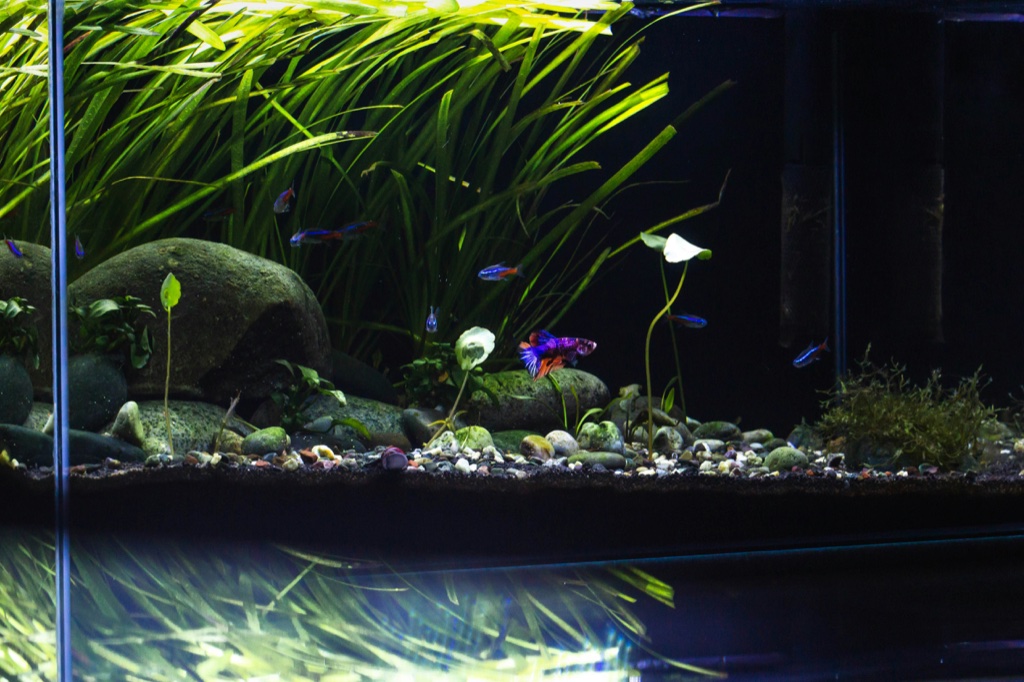
This page continues
The corrections are grouped by subject.
Stone, hard water and the filter
Why the wrong rock is mostly survivable, and why the bacteria named in every beginner guide are not the ones in your filter.
Plants, the room and the pond
What light really does, the four room facts that change your shopping list, and the northern European pond habit that is dangerous in Armenia.
The shape of every entry
Four parts, in the same order, thirty times.
A correction that only tells you the received version is wrong leaves you with less than you had. You now distrust the advice and have nothing to put in its place, and you have learned to distrust the person who gave it to you, which is worse, because next time you will need them.
So every entry carries a test you can run, or a number you can look up, or a substitution you can make this week. Where the origin of the common version is establishable, it is the last line, and it is usually the most interesting one. The advice was rarely invented. It was inherited from a different water, a different climate, or a different decade of microbiology.
Nothing here is settled by our own pages. Where a page on this site is cited it is as a place to read more, never as evidence. The evidence is the numbered list at the foot, and it is other people's work.
- 01
- What is commonly said
- 02
- What the evidence shows, with the source
- 03
- What to do instead, concretely
- 04
- Why the common version exists
- 30
- corrections, plus six of our own errors
At the counter
The three that decide whether a first tank works.
These are the ones we would put in a shop window if we had one. The first is a local finding and it is the sharpest thing on this site: the fish every shop in Yerevan recommends first is the one fish that cannot have the water it is going into.
Correction 01 · the local one
The neon tetra's published hardness range is 1 to 2 dGH, and no district of Yerevan has tap water that soft.
- Commonly said
- Neon tetras are the beginner's fish. Cheap, small, peaceful, colourful, always in stock, sold in tens.
- What the evidence shows
- The published hardness range for Paracheirodon innesi is 1 to 2 dGH1, which is the narrowest range of any common shop fish and describes blackwater and clearwater tributaries of the Solimoes. Yerevan tap water was sampled across the city's districts between 2002 and 2004 and runs from 2.9 dGH in Avan, Kanaker and Nork to 10.9 dGH in Davtashen, at pH 6.01 to 7.302. The lowest district in the city is above the top of the fish's published range. No district falls inside it. The same shop will sell you a molly in the same week, and the molly's published range starts at 11 dGH1, so the two cannot share water either.
- What to do instead
- Do not soften water for a first tank. Choose a fish whose published range contains your district's number, which is what find a fish is for: it filters 110 species against the measured tap range rather than against a wish. If you want the look, the cardinal, the ember and the harlequin all sit in wider bands. If you want neons specifically, they need reverse osmosis water and a reason, and that is an intermediate project, not a first one.
- Why the common version exists
- Because it is half true, and the half that is true is the half the shop sees. Farmed neons are bred for many generations in hatchery water far harder than the Rio Solimoes and they survive in it. The published range describes the wild habitat, not the farm. A shop that has sold neons for twenty years without obvious losses is reporting accurately on survival. Survival is a low bar: it is not color, not breeding, not lifespan, and the difference does not show up inside the two weeks a customer is likely to come back and mention it.
Correction 02
"Keep them in a group of at least six." Nobody can produce the source, and we went looking.
- Commonly said
- Shoaling fish need a minimum of six. Below six they are stressed. It is said as though it were a measurement.
- What the evidence shows
- Three separate lines of search, and not one of them ends at a study. The "in groups of 5 or more individuals" line in the standard database appears identically for the cardinal tetra, the neon, the harlequin, the tiger barb and the gold barb, and traces to a single underlying reference, number 51539, which is aquarium hobby literature and not an experimental study1. The same figure for fish of very different sizes is the signature of a convention being copied. The complete index of the field's own journal, 1,228 articles across 41 years, contains no article whose title or keywords mention Corydoras, Betta, rasbora, danio, Otocinclus, goldfish, gourami, Apistogramma, hillstream loach or white cloud mountain minnow3. Not one, in four decades. And the one attributable published shoal-size number in aquarium keeping is twelve, in a Dutch style guide, which says a dozen or so fish of one main species is the minimum and that single fish of many species fail to read as a school4. That is a composition rule about how a layout looks, it says so, and it does not claim to be a welfare threshold. The number the hobby should have inherited is twelve, and it was about the picture. What has actually been measured points a different way: two studies asked the question directly, in 2010 for four species and in 2011 for mixed assemblages, and both found the effect is species-specific rather than threshold-shaped56, and zebrafish held nine weeks at 1, 4, 8, 12 and 16 fish per liter showed higher free-water cortisol, altered vertical distribution and more aggression at 1 fish per liter than at any higher density, the authors concluding that 4 to 16 per liter does not compromise welfare7. Too few is the measured harm. The tolerated band above it is very wide.
- What to do instead
- Buy more of fewer species. Twelve of one is a better tank than two each of six, and it is also the better picture, which is what the only published number was ever about. Where our species records give a group size they say on the record whether it is measured or convention, and almost all of them are convention. The long version is on the biology page.
- Why the common version exists
- Traceably, from Dutch aquascaping aesthetics by way of a database line that cites a hobby book. Where six came from, rather than twelve, no source we have found establishes. It is a good number for a shop to say: small enough to sell, large enough to be defensible, and it fits in a bag.
Correction 03
"It stays small." Twenty one of the species we catalogued are routinely sold into tanks they will outgrow.
- Commonly said
- The fish in the tank is the size of the fish you are buying, and if it grows, you can upgrade later or the shop will take it back.
- What the evidence shows
- Of the 110 species in our catalog, 21 are flagged as routinely mis-sold, each with its published adult size against the size it is sold at8. The worst is not close: the iridescent shark is sold at 5 to 8 cm and reaches 130 cm and 44 kg18. The red-tailed catfish reaches 135 cm, the silver arowana 90 cm TL, the black ghost knifefish 50 cm TL and the clown loach 30.5 cm TL1, and all four are commonly offered at or under 10 cm8. Two more are conservation cases rather than size cases: the zebra pleco is IUCN Critically Endangered and Brazilian export of wild fish is prohibited, and the Denison barb is Endangered8.
- What to do instead
- Look up the adult length before the bag is tied, not after. Every record in find a fish prints maximum published length with its measurement basis, because standard length and total length are different measurements and mixing them is one reason quoted adult sizes vary so much. There is no rehoming route in Armenia for a 130 cm catfish. That is the whole argument.
- Why the common version exists
- The trade sells by appearance at the size in the tank, and a juvenile pleco genuinely does eat algae, and a juvenile pangasius genuinely is a pretty silver shoaler. The growth curve is the part that is not on the label, and by the time it matters the customer is two years and one shop away. Nothing about this requires anyone to have lied.
What we got wrong
A page correcting other people that cannot correct itself is not worth reading.
Six, dated, with the wrong version printed next to the right one. Each was caught by re-running the arithmetic or by following a citation to its origin, not by anyone noticing that it sounded wrong. That is the lesson worth keeping: comparing conclusions does not find an error that sits upstream of the disagreement.
Old tank syndrome, and the arithmetic that was wrong in two directions. This page and an independent fact-check both modeled the rescue water change by assuming the tank's pH jumps to the tap value regardless of how much water is changed, and drew opposite conclusions from the same bad assumption. The proportional model puts the peak at about 76 percent and cuts the numbers by an order of magnitude, below the damage threshold rather than above it9. Both drafts were withdrawn on 9 September 2026. Correction 15 is the survivor.
"A fifth" of the damage threshold, printed as "two fifths". The same section, a separate arithmetic error against the cited 0.05 mg/L threshold10. Small, and worth listing because it was found by recomputation rather than by review.
The CO2 comparison. We printed the large gap version once, the one correction 27 exists to correct, and only caught it on converting both sides to the same unit. The true ratio is 1.08 to 1.2211.
"19 in 20 of the organisms in your filter." Now at least 6 in 7, and closer to 24 in 25 on the sponges12. The study measured 0.6 to 14.1 percent on beads and 1.6 to 3.8 percent on sponges12, so the headline now quotes the weaker of the two, which holds for every sample taken.
A claim we repeated that traced to a marine seagrass. The 77 percent suppression of root nitrogen uptake, quoted here as though it were an aquarium plant result. Traced on 10 September 2026 to a 1982 study of Zostera marina13. It is now labeled on every page that carries it, and correction 23 is the full account.
The Gyumri oxygen figure, settled at 17 percent. An earlier draft put the Gyumri shortfall at about 16 percent. The altitude table gives 1714, that is the figure the page carries, and 17 is the one to use if you meet both.
- Froese, R. and Pauly, D. (eds.), FishBase, version 2025-2. Published hardness, pH, temperature and maximum length ranges for every species named on this page, including dH 1 to 2 for Paracheirodon innesi and dH 11 to 30 for Poecilia sphenops. Also the identical "in groups of 5 or more individuals" line across the cardinal tetra, neon tetra, harlequin rasbora, tiger barb and gold barb, and its single underlying reference, number 51539, which is aquarium hobby literature rather than an experimental study. Read species by species. fishbase.se
- Shahinyan, H.V. (2005). On the hydrogeochemical characteristics of some drinking waters supplying the city of Yerevan. Proceedings of the National Academy of Sciences of the Republic of Armenia, Earth Sciences LVIII(1): 41 to 45. Sampling 2002 to 2004. Hardness printed in mg-eq/L and converted here at 2.804 dGH per unit: 2.9 dGH in Avan, Kanaker and Nork to 10.9 dGH in Davtashen, pH 6.01 to 7.30 across all districts. The dataset is twenty years old, varies by district and rises in summer, so it is a map of the city rather than a reading of your tap.
- The Aquatic Gardener complete index, 1985 to 2026. Published in full and free to read: 163 issues and 1,228 article entries. The source for the searches that return nothing on every standard aquarium fish. aquatic-gardeners.org
- Kutty, V. (2021). Some Rules for Dutch Style Aquascaping. Aquatic Gardeners Association, 15 pages. The only attributable published shoal-size number in aquarium keeping, and it is honest about being a composition rule rather than a welfare threshold. PDF
- Saxby, A., Adams, L., Snellgrove, D., Wilson, R.W. and Sloman, K.A. (2010). The effect of group size on the behaviour and welfare of four fish species commonly kept in home aquaria. Applied Animal Behaviour Science 125(3 to 4): 195 to 205. Paywalled, and no abstract is published in Crossref, PubMed, Europe PMC or Semantic Scholar. The only located study asking the hobby's question directly; its four species are inferred from its reference list rather than read. DOI 10.1016/j.applanim.2010.04.008
- Sloman, K.A., Baldwin, L., McMahon, S. and Snellgrove, D. (2011). The effects of mixed-species assemblage on the behaviour and welfare of fish held in home aquaria. Applied Animal Behaviour Science 135(1 to 2): 160 to 168. Paywalled. The companion paper, and the second half of the entire published evidence base. DOI 10.1016/j.applanim.2011.08.008
- Andersson, M., Roques, J.A.C., Aliti, G.M., Ademar, K., Sundh, H., Sundell, K., Ericson, M. and Kettunen, P. (2022). Low holding densities increase stress response and aggression in zebrafish. Biology 11: 725. Open access, PMC9139139. The nine week trial at 1, 4, 8, 12 and 16 fish per litre. DOI 10.3390/biology11050725 open access
- Our own species database, . 110 species compiled from sources 11, 14, 17 and the IUCN Red List 2025-2, with every published figure carrying the record it came from and every hub-supplied figure labelled as convention rather than measurement. The count of 21 routinely mis-sold species, and each adult size against its selling size, is generated from that file at build time rather than typed. compiled from the cited primaries; the mis-sold flag is our editorial judgment
- Our own arithmetic on water changes and ammonia speciation. Not a published source. Two models. The evaporation and top-off ceiling: C(n) = C_tap (1 + n e) for topping up only, and C* = C_tap (1 + e (1 - f) / f) for the ceiling under a repeated change. The rescue water change: the fraction as NH3 = 1 / (1 + 10^(pKa - pH)) with pKa 9.25 at 25 degrees, checked against the published fractions in source 23, for a tank at pH 6.0 holding 5 mg N/L of total ammonia and tap at pH 7.8, with pH after a change moving in proportion to the fraction replaced. Returns a peak at about 76 percent, 0.0155 mg N/L un-ionised, and a crossing of the damage threshold only above roughly 13 mg N/L total. calculated, repeatable, unverified by a third party
- Francis-Floyd, R., Watson, C., Petty, D. and Pouder, D.B. Ammonia in Aquatic Systems. University of Florida IFAS Extension, FA031. The hundredfold toxicity difference between the two ammonia forms and the 0.05 mg/L tissue damage threshold. ask.ifas.ufl.edu
- Our own arithmetic on the carbonate and carbon dioxide systems. Not a published source. The calcite ceiling table, solved as the standard calcite-carbonate equilibrium system at 25 degrees C for a fixed dissolved CO2 with charge balance 2[Ca2+] = [HCO3-], using the constants in sources 1 and 2, activity corrections ignored. The uninjected row is solved at 420 ppm, which is 0.63 mg/L dissolved at 25 degrees, and returns 19.4 mg/L calcium, pH 8.2 and 2.7 dGH. Also the cube root sensitivity of hardness to CO2, the 250 to 350 times seawater to river sulfate ratio from source 1, and the air against water molar table computed by the ideal gas law and Henry's law from source 30 at sea level and at 887 hPa, including the 12.5 percent altitude reduction. calculated, repeatable, unverified by a third party
- McKnight, M.M., Szabolcs, N., Graham, A. and Neufeld, J.D. (2025). Microbial community succession of home aquarium biofilters associated with early establishment of comammox Nitrospira. ISME Communications 5(1): ycaf212. Open access. The twelve week succession study in three ordinary home aquariums, the 1.6, 3.1 and 3.8 percent sponge figures and the 0.6 to 14.1 percent bead range. DOI 10.1093/ismeco/ycaf212 open access
- Thursby, G.B. and Harlin, M.M. (1982). Leaf-root interaction in the uptake of ammonia by Zostera marina. Marine Biology 72(2): 109 to 112. Paywalled. The split chamber result: ammonium in the leaf compartment cut root uptake by 77 percent, ammonium at the roots did not reduce leaf uptake at all. Zostera marina is a marine seagrass. bibliographic record only; full text not obtained and no DOI asserted here
- Our own arithmetic on gas exchange, altitude and structure. Not a published source. The two film expression divided by volume to give the depth form, the time constants and the two shape comparison at 200 litres. The barometric correction applied to source 33 using the vapour pressures and station pressures in source 36, giving the 12.5 to 13.0 percent Yerevan shortfall, 17 percent for Gyumri and 7.5 percent for Meghri. The mass and floor pressure table, the household object comparisons, and the bending moments at mid span and at 15 percent of the span from the wall, against the design live load moments computed from sources 31 and 32 at a 3.2 m span. calculated, repeatable, unverified by a third party
Continue
Where to go next.
Forgiving to demanding
Most beginner failure is a mismatch rather than a lack of skill, and here it is scored.
Materials and water
The carbonate chemistry nobody has three minutes at the till to explain, written out properly.
Easy setups
What to do instead: five setups that remove most of the things these myths are about.
Cycling and the bacteria
The cycling story, with the real organisms and the paper that named them.
Shoaling and schooling
Keep them in groups of at least six. We went looking for whoever measured that, and the trail stops before it reaches anybody.