This page continues
The law and the tank build have pages of their own.
The law and the biosecurity
What the national park and Ramsar listing forbid, and why biosecurity at this lake runs in both directions.
Building a Sevan biotope
The cold hard alkaline water chemistry, the arithmetic on carrying lake water home, and a build whose temperature problem is worse than a summer one.
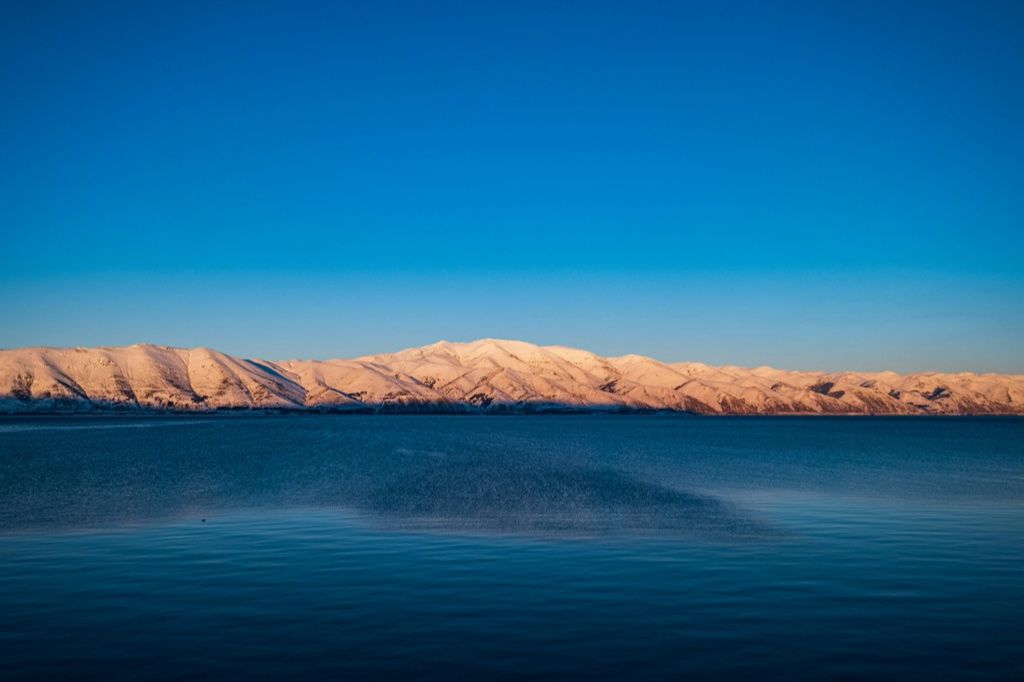
Sevan in winter, with the last of the sun on the ridge that rings it. One horizontal line, one mass, nothing planted and nothing decorated. That is the composition lesson the lake gives away before you have got wet. Photograph Aram
A. The place
The number in the name is the altitude. There is a dive resort on Lake Sevan called Altitude 1900.
Armenia is a landlocked country with no coast, and the idea of a dive center here sounds like a joke until you look at the lake. Sevan sits at about 1,900 meters above sea level8, and that number is where the resort gets its name. It is run by ArmDiving Divers' Club, a registered NGO with a legal address in Yerevan and a dive resort address on the Chambarak highway at kilometre 11, in the Tsovagyugh district of Gegharkunik province9.
That puts it on the north shore of Small Sevan, the deep basin, rather than on the tourist strip at Sevan peninsula. The Google Places record puts the site at 40.6056 north, 45.0657 east, lists the phone as +374 55 190039, gives opening hours of 08:00 to 23:00 seven days a week, and carries a rating of 4.6 from 62 ratings1. The club's own contact page gives a different number, +374 91 40-93-20, marked as Viber and WhatsApp, and the address info@diving.am9. If you are booking, try both.
One thing we could not do is read their live website. The domain diving.am did not resolve from two independent public resolvers on 9 September 202610, so everything below that comes from the operator rather than from a directory is read out of the Internet Archive, and every price, depth and season figure attributed to them should be treated as archived rather than current. The site was still being archived as recently as May 202610, so this is more likely a lapsed domain or a DNS fault than a closed business, and the Places record still says the place is operational1. Phone before you drive out.
What they run. The archived price list is a PADI shop: a trial dive in Sevan, Discover Scuba Diving, Bubblemaker for eight year olds, Junior Open Water, Scuba Diver and Open Water Diver, with a separate freediving track on the Molchanovs Wave system11. Their own FAQ says a full scuba certification is three or four pool dives plus three or four dives in Sevan and runs a minimum of seven days, and a freediving certification eight to twelve12. They also list equipment rental, a tank refill station, boat dives and a diver propulsion vehicle1113.
What the place physically is. ArmDiving's 2018 plan was to build the resort out of shipping containers precisely so that it could be moved if the lake level rose14, which is a very Sevan design constraint and tells you something about the lake before you have got wet. Visitor reviews describe a small container-built hotel at a quiet end of the lake, open since 2018, with changing rooms, hot showers, a cafe, tents, paddleboards and a named resident instructor, and note that instruction was available in German as well as English1. Reviewers consistently say to book the dive by phone several days ahead rather than turning up.
Archived price list, 2022 snapshot11
- 15,000
- AMD, trial dive in Sevan. 1 dive, 15 minutes, to 12 m, age 10 and up
- 20,000
- AMD, PADI Discover Scuba Diving. 1 dive, 35 minutes, to 12 m
- 45,000
- AMD, Bubblemaker. Age 8 and up, 2 m
- 100,000
- AMD, PADI Scuba Diver. 6 dives over about 18 hours
- 120,000
- AMD, PADI Open Water Diver. 6 dives, about 30 hours, to 18 m
Ask when you book
The season, in writing.
Their 2018 page for the lake offers "full season diving" and says the cold season has no thermocline13, which reads as a claim that they dive all year, and the listed opening hours are the same seven days a week in every month. Plan for late spring to autumn and confirm the month you want directly with them.
Ask when you book
Whether the club and the resort are now the same business.
The archived pricing page carries a banner reading "Note! The following services are provided by another organization."11 ArmDiving is an NGO; the resort is a hospitality operation with rooms, a kitchen and paddleboards. Which entity you are actually buying a dive from, and who insures it, is not clear from anything published. Ask.
Ask when you book
One operator on the lake, under three names.
Searching the Places index for dive centers on Sevan in English, Armenian and Russian returns this one operator three times over: Altitude 1900, Высота 1900 and diving.am1. All three are the same people, so book any of them, and take their account of conditions as the one account there is.
A. The place
What it is like under the surface, and what the lake has stopped being.
Two accounts of Sevan exist and they do not match, because they are separated by ninety years. The operator sells the lake it is; the literature records the lake it was. Both are worth having in your head before you get in, because the difference between them is the whole story of the place, and it is also the reason a Sevan biotope tank is a reconstruction rather than a snapshot.
| What | The operator says13 | A visitor measured1 | The literature says |
|---|---|---|---|
| Visibility | 4 to 10 m | not reported | Secchi 4.7 ± 1.5 m in Big Sevan and 5.0 ± 2.2 m in Small Sevan, 2017 to 20192, against about 14 m before the drawdown8 |
| Summer surface temperature | about 21 C average | 22 C, early September | 18 to 19 C in August before the drawdown; 19 to 20 C by the end of July after it8 |
| Temperature at 20 m | not published | 19 C, early September | Bottom water in Big Sevan was 4.2 to 5.0 C before the drawdown and 8 to 12 C by the 1990s8 |
| Depth at the site | average 26 m, deepest point 81 m, less than 250 m from shore | dived to 20 m | Maximum depth 82.8 m and mean depth 29.8 m in 2020, against 97.9 and 41.3 in 19308 |
| Stratification | "absence of thermocline in cold season" | a 3 C gradient over 20 m in September | Stratification now begins at the end of April rather than in May, and in some years the thermocline in Big Sevan reached the bottom with no hypolimnion at all8 |
| Ice | not addressed | not reported | Complete ice cover happened about once in 15 to 20 years before the drawdown and now occurs roughly once in seven years8 |
The single most useful number for a diver is the one nobody advertises. Sevan's water transparency fell from roughly 14 meters to under 582. You are diving in green water with a torch, not in a mountain lake out of a postcard. That is not a complaint. It is the difference you have come to see, and it explains everything below it.
The bottom used to be a meadow. Markosyan mapped stoneworts and mosses growing at 6 to 19 meters in Lake Sevan and published the survey in 195115. Nineteen meters of rooted Chara requires water you can see 14 meters through. When the transparency went, the light went, and the meadow went with it. A benthic invertebrate series running from 1928 to 2004 found the maximum depth of occurrence falling by 2 to 44 meters for at least fifty species, and species richness at the deepest, now anoxic, depths falling from 25 species to three16. Anyone who dives Sevan today is swimming over the top of that.
Late summer is when the lake is least itself. In late summer and autumn a cold dome forms in each basin, and when the thermocline deepens the water beneath it is cut off and becomes a large reservoir of hypoxia, under 2 mg per liter of oxygen8. Cyanobacteria first bloomed in 1964 and have returned repeatedly. During the July 2019 bloom, dissolved oxygen in the surface littoral was measured at 0.4 and 0.5 mg per liter, pH fell to 6.8 in a lake whose surface normally runs 8.2 to 8.5, and both microcystin and anatoxin-a were detected, the first record of cyanotoxins in the lake17. That is a real reason to check conditions before a summer trip, and a real reason not to swallow the lake.
The 1900 in the name is a physiological fact
Every dive here is an altitude dive.
At 1,900 meters the surface pressure is lower than at sea level, so the standard tables and the default settings on a rented computer do not apply, and the operator markets the lake on exactly this: "Sevan is the perfect place to start with altitude diving experience."13 Anyone certified at sea level needs an altitude briefing before the first dive here, and this page is not the place to get it. Ask the instructor.
Things people say are down there
The stromatolites, which we could not verify.
The club published a page titled "Stromatolites"; the English version says only that it is available in Armenian18, and a visitor review reports seeing "fresh water stromatolites"1. We searched Crossref for any peer-reviewed paper on stromatolites or microbialites in Lake Sevan and found none10. There is a documented carbonate feature that would fit, though: the bojak, the deep-spawning race of the Sevan trout, spawned down to 40 meters over flat gravel and travertine at submerged spring vents819. Submerged carbonate-depositing springs are real. Whether what divers are shown is a microbialite is, as far as the published record goes, an open question.
Things people say are down there
The drowned things, and which direction they drowned in.
Sevan's famous archaeology was uncovered by the falling lake, not sunk by it: Lchashen, on the western shore, emerged from the water during the Soviet drawdown20. What is genuinely submerged is more recent. When the level was deliberately raised after 2003, land that had been farmed and planted for twenty years went back under, and the drowned vegetation released organic matter and nutrients into the lake8. So there are flooded trees down there, and they are an ecological problem as well as a sight. The club separately says it dives for archaeologists and films items for specialists to assess, and its own site page mentions sunken boats and artificial reefs it installed1321. We could not verify any specific wreck, structure or submerged village by name and this page will not name one.
B. The lake as a biotope
Thirteen flowering plants, five stoneworts, three mosses, three endemic fish, and a century of things put in on purpose.
The operator's site says the lake has "approximately 250 types of plants under the water"13. The only specialist botanical survey of the lake says something quite different, and it is worth knowing which one to believe.
Barseghyan opens his 1975 survey by stating that until then nobody had studied the higher plants of Lake Sevan as a specialist; they had only been noted in passing by hydrobiologists, zoologists and algologists, and a distorted picture had taken hold in the Sevan Hydrobiological Station's own publications3. He names an example: a previous author had reported continuous Butomus beds below 5 to 6 meters, Butomus with Ceratophyllum at 30 meters, and duckweeds at 18 to 21 meters. Duckweed floats. Barseghyan's own survey put the lower limit of flowering plants at 5 to 6 meters3.
| Belt | Depth | What grows there | In the hobby |
|---|---|---|---|
| Macrophyte belt | 1 to 6 m | Potamogeton pectinatus, P. perfoliatus, P. crispus, P. natans, Ceratophyllum demersum, C. submersum, Myriophyllum spicatum, M. verticillatum, Ranunculus divaricatus, Zannichellia pedunculata, Lemna minor, L. trisulca, Spirodela polyrhiza | Ceratophyllum demersum is hornwort, sold everywhere. The duckweeds are the duckweeds. Myriophyllum and Potamogeton are pond trade |
| Macroalgae and moss belt | 6 to 16 m | Stoneworts Chara fragilis, C. vulgaris, C. intermedia, C. crinata; mosses Hygroamblystegium tenax, Fontinalis antipyretica, Drepanocladus aduncus | Fontinalis antipyretica is willow moss, sold across Europe as a coldwater aquarium moss. It grows wild in Lake Sevan |
| Below the light | under about 16 m | Phytoplankton, bacterioplankton and zooplankton | Nothing to collect and nothing to grow |
Thirteen species is not many for a lake of 1,250 square kilometres, and Barseghyan says so. He blames the lake's size, its depth and constant wind-driven wave action, which mechanically tears plants out; several tonnes of aquatic plants are thrown onto the beaches every year in storms3. Potamogeton pectinatus is the most wave-resistant of the thirteen, which is why it holds the surf zone where the others cannot3. And the stoneworts and mosses grow all year round, under the ice included3. If you are looking for a design idea, that is one: a plant that does not stop in winter.
The counter-intuitive finding, which matters for the tank. The lake was drawn down about 19 meters, and the obvious expectation is that this destroyed the plant community. Barseghyan concluded that it did not change the species composition at all: the belts simply followed the water down the slope and re-established at their usual depths, because the water itself did not change, only the bottom did, and the 28 inflowing rivers continuously deliver propagules3. But the same paper carries the other half. The lowering of Sevan destroyed Lake Gilli outright, and the entire aquatic vegetation of that satellite lake disappeared3. The deep lake's plants migrated; a whole wetland was wiped out. Both are true, and the second one is why the stonewort beds have still not come back: stoneworts once grew to 19 meters in water you could see 14 meters through815, and today the Secchi depth is under five2.
The fish
Three endemics, and you cannot keep any of them.
Armenia has exactly three endemic freshwater fish and all three are in the Lake Sevan basin2223. Write their Armenian names down, because they are the reason this lake is famous and the reason a Sevan tank is a plant and invertebrate tank.
| Armenian | Scientific | What it is | Status |
|---|---|---|---|
| Իշխան, ishkhan | Salmo ischchan Kessler, 1877 | The Sevan trout. The word means prince Armenia's national fish, and a species flock rather than a fish: four named legal forms in the Red Book, five genetically supported ecomorphs in the 2022 genomics19 | Two forms, the winter ishkhan and the bojak, are recorded as extinct worldwide, last seen in 1982 and 198623. IUCN 2026-1 assesses the species as Extinct; Armenian law still protects it |
| Սևանի կողակ, Sevani koghak | Capoeta capoeta sevangi | Sevan khramulya, a detritivorous cyprinid. Catch was once 300 to 500 tonnes a year | Red Book VU A1cd. Catching it in Lake Sevan has been banned since 199523 |
| Սևանի բեղլու, Sevani beghlu | Barbus goktschaicus Kessler, 1877 | Sevan barbel, a benthivore. Catch never exceeded 20 to 25 tonnes a year | Red Book VU A2cd. Banned since 1981, and no artificial propagation method has ever been developed23 |
A warning about names. Three current authorities treat the trout three different ways: one species with four subspecies, four full species, or one species flock with five ecomorphs1923. None is wrong; they answer different questions. Any page that silently picks one is misleading you. Likewise the barbel: GBIF treats Barbus goktschaicus as a synonym of Barbus cyri, while Armenian law and the Red Book use goktschaicus23. Use the legal name in Armenia and note the synonymy.
The introduction that became the fishery
Whitefish, 1924 to now.
Two whitefish taxa from Lake Ladoga were acclimatised into Sevan between 1924 and 1927 on the reasoning that the pelagic consumer niche was empty. They hybridised into a local form, reached about 30,000 tonnes of biomass by 1988, collapsed to under 5,000 t in the early 2000s, and stood at about 2,000 t in 20198. On the way it inverted the plankton: when whitefish were abundant the zooplankton crashed and the algae rose, and when the whitefish went, large Daphnia came back8. An introduced fish filled an empty niche, became the entire fishery, was fished out inside two generations, and made the algae problem worse doing it.
The introduction that took a native's job
The narrow-clawed crayfish, arrived accidentally in the 1980s.
Commercial stock ran 1,528 t in 2013 and 4,580 t in 2016, then collapsed to 105 t in 20208. The 2023 study of the collapse states that the crayfish "successfully replaced the endemic fish subspecies Sevan khramulya in the chain of detritivores", and attributes the crash to burn-spot disease plus heavy fishing24. Thirty-two years from accident to peak to two per cent of peak, all measured. If a visitor points out crayfish on the bottom, that is what you are looking at.
And the rest
Prussian carp, rainbow trout, topmouth gudgeon.
Prussian carp appeared in catches in 1981 to 1983 and passed 200 tonnes by 2005; rainbow trout escape from fish farms and eat native juveniles; topmouth gudgeon arrived around 2010 or 2011 and is in the Small Sevan littoral8. A 2022 risk screening of 32 non-native fish for the South Caucasus put gibel carp and topmouth gudgeon at the highest risk under both current and projected climate25. Two of the four highest-risk species are already in the basin. This is a lake with no remaining tolerance for one more introduction, which is the whole reason the biosecurity section below is not boilerplate.
-
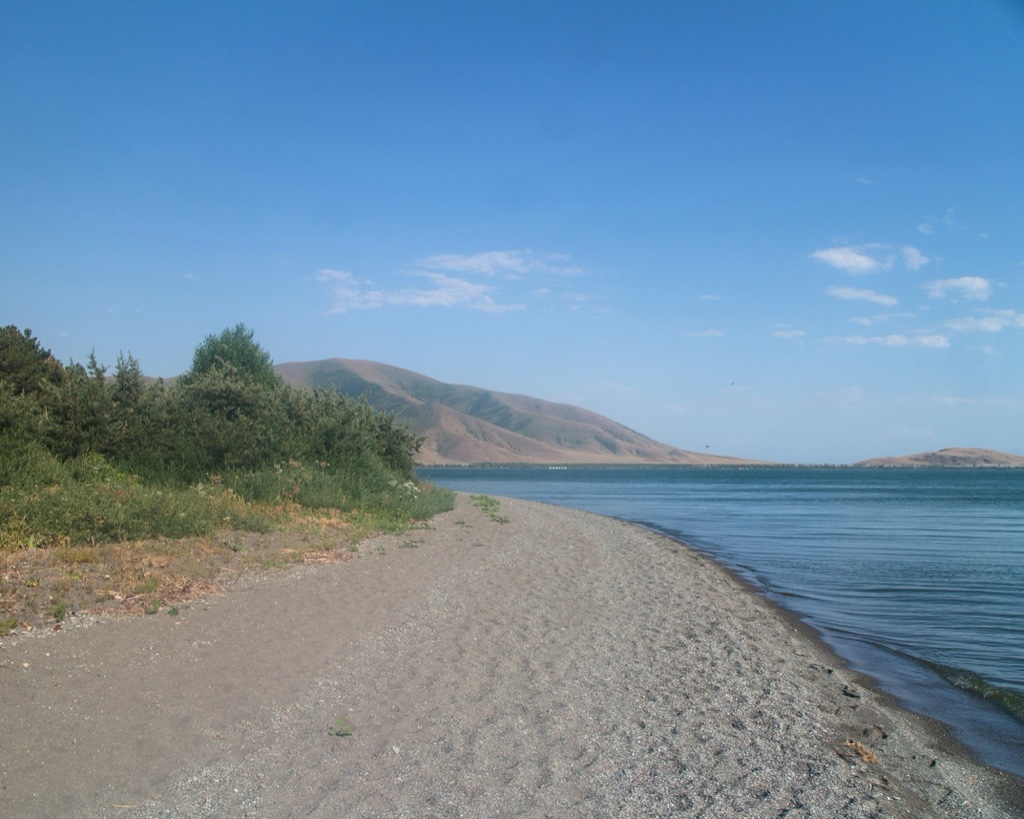
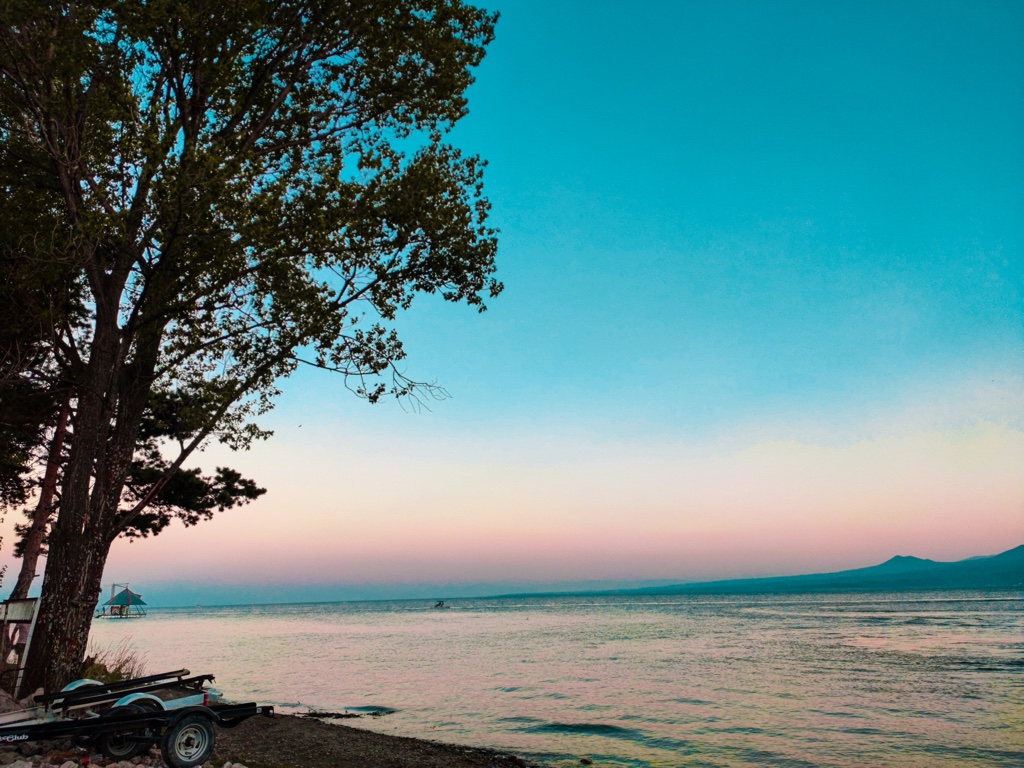
Shingle, not sand Photograph Misha Yurov -

Villages sit right on the water Photograph Artem Chernykh -
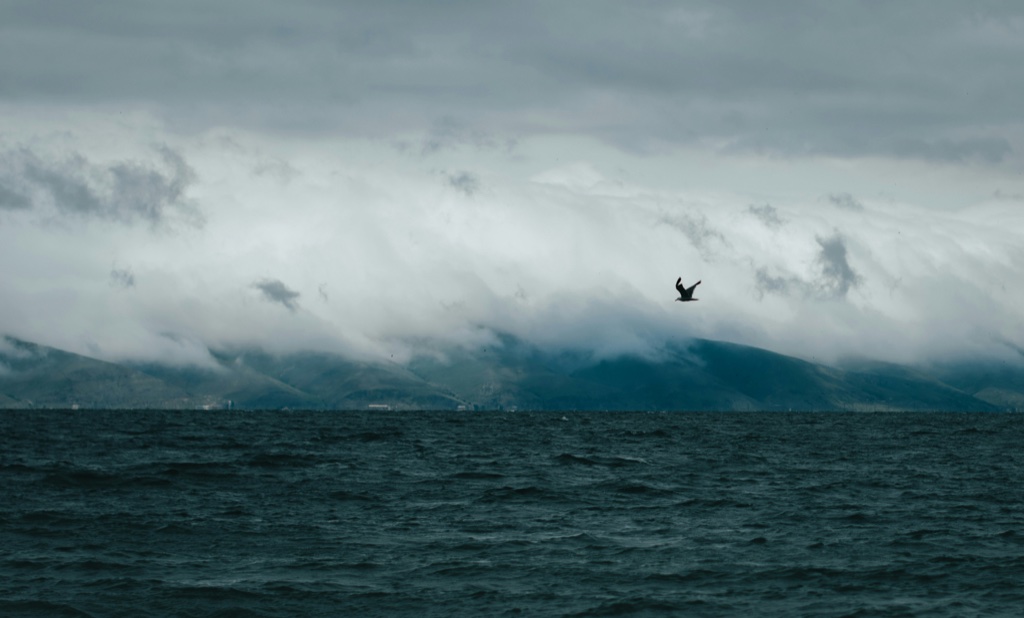
Weather arrives over the ridge Photograph Artur Matosyan
The photographs on this page were taken by other people and shared on Unsplash. Every one of them is named, with thanks, on the credits page.
- Google Places record for "Altitude 1900", place ID ChIJ0WJs5CCXakARGbf5EjxCB_4. Queried 9 September 2026. Coordinates, formatted address, phone +374 55 190039, opening hours, business status OPERATIONAL, rating 4.6 from 62 ratings, and the five most helpful visitor reviews, which are the source of the "open since 2018", container-built, German and English instruction and named instructor details. Also searched in Armenian and Russian, which return the same single record. Google Maps entry
- Shikhani, M., Mi, C., Gevorgyan, A., Gevorgyan, G., Misakyan, A., Azizyan, L., Barfus, K., Schultze, M., Shatwell, T. and Rinke, K. (2021). Simulating thermal dynamics of the largest lake in the Caucasus region: the mountain Lake Sevan. Journal of Limnology 81(s1): 2024. Open access. Secchi depths for both basins 2017 to 2019, the light extinction coefficient, the water budget and the residence times. DOI 10.4081/jlimnol.2021.2024 open access
- Barseghyan, A.M. (1975). The aquatic vegetation of the Lake Sevan basin. In Flora, Vegetation and Plant Resources of Armenia (Takhtajania), vol. 6: 73 to 87. Botanical Society, Yerevan. In Russian with an Armenian summary. The only specialist survey of the higher plants of Lake Sevan: the two depth belts, the thirteen flowering species, the five stoneworts and three mosses, the pH of 8.8 to 9.2, the Secchi disc at 21 m, and the conclusion that the drawdown moved the plant belts rather than destroying them. Scanned, no text layer. arar.sci.am PDF open access, Russian
- Armenia's Fifth National Report to the Convention on Biological Diversity. Protected areas totalling about 387,054 ha, 13.1 percent of the country, across 3 state reserves, 4 national parks, 27 sanctuaries and 232 natural monuments; Sevan National Park with 124,759 ha of water and wetland. The park's founding year is given as 1978 in the Armenian literature; the domain sevanpark.am is now parked for sale and mnp.am no longer resolves, so the administering ministry is environment.gov.am. cbd.int PDF open access
- Ramsar Sites Information Service, annotated summary for Armenia. Three wetlands in force since 6 November 1993 totalling 493,511 ha: Lake Sevan, site 620, at 490,231 ha; Lake Arpi, site 621; and Khor Virap Marsh, site 1989. rsis.ramsar.org PDF
- RA Law on Fauna (Կենդանական աշխարհի մասին), HO-52, adopted 3 April 2000, rewritten in 2022, in force since 14 April 2023. Article 21 on keeping wild animals in confinement, Article 23 on the closed list of permitted uses, Article 19(a) on transfer into a different habitat and acclimatisation, Article 27 on Red Book species. arlis.am open access, Armenian
- RA Code of Administrative Offences, Article 88.1, added 23 March 2022 by HO-75-N. Keeping wild animals, including Red Book animals, in captive or semi-captive conditions without the appropriate permission: citizens 150,000 to 200,000 AMD, legal persons 170,000 to 250,000, a further 100,000 for a repeat within a year. Articles 88, 89, 90 and 91 in the same code cover fishing rule breaches, illegal catching, unauthorised resettlement and destruction of Red Book animals. arlis.am open access, Armenian
- Gabrielyan, B., Khosrovyan, A. and Schultze, M. (2022). A review of the anthropogenic stress on Lake Sevan and the current state of the ecosystem. Journal of Limnology 81(s1): 2061. Open access. The level, volume, area, depth, temperature and transparency series used throughout this page. DOI 10.4081/jlimnol.2022.2061 open access
- ArmDiving Divers' Club, contact page. The NGO's own listing of the "Altitude 1900" dive resort address at Chambarak highway 11 km, Tsovagyugh, 1301, Gegharkunik, its Yerevan legal address at 105 Gusan Sheram Street, the phone +374 91 40-93-20 and info@diving.am. Archived 1 October 2022. Internet Archive copy
- Our own checks, 9 September 2026. Not a published source. The domain: diving.am returned NXDOMAIN from both 8.8.8.8 and 1.1.1.1. The archive: the Wayback CDX index for diving.am lists captures through May 2026, so the site was live recently. checked by us, repeatable, not third-party verified
- ArmDiving, Pricing. The PADI and Molchanovs course list with prices in AMD, dive counts, durations, maximum depths and minimum ages, and the banner reading "Note! The following services are provided by another organization." Archived 2 October 2022. Internet Archive copy
- ArmDiving, Frequently Asked Questions. Course structure and duration: three or four pool dives plus three or four Sevan dives, minimum seven days for scuba; eight to twelve days for freediving. Archived 1 April 2018. Internet Archive copy
- ArmDiving, Diving in Lake Sevan. The operator's own technical description of the dive site: volcanic lake, visibility 4 to 10 m, average summer surface temperature 21 C, average depth 26 m, deepest point 81 m within 250 m of the shore, no strong currents, no large waves, no thermocline in the cold season, "full season diving", plus the 2018 price list and the claims about plants, endemic fish, natural and artificial reefs and sunken boats. Archived 30 March 2018. Internet Archive copy
- ArmDiving, Dive Resort. The container construction rationale, the planned facilities including equipment rental and a tank refill station, and the club's own account of its size and experience. Archived 30 March 2018. Internet Archive copy
- Markosyan, A. (1951). Distribution and biomass of stoneworts (Chara) and mosses in Lake Sevan. Transactions of the Sevan Hydrobiological Station 12: 29 to 34. In Russian. The baseline for every statement about macrophyte loss in the lake: stoneworts at 6 to 19 metres. Free PDF from the Armenian National Academy of Sciences repository. arar.sci.am PDF open access, Russian
- Jenderedjian, K., Hakobyan, S. and Stapanian, M.A. (2012). Trends in benthic macroinvertebrate community biomass and energy budgets in Lake Sevan, 1928 to 2004. Environmental Monitoring and Assessment 184(11): 6647 to 6671. A 76 year benthic series. Maximum depth of occurrence fell by 2 to 44 m for at least 50 species; richness at the anoxic depths fell from 25 species to three. DOI 10.1007/s10661-011-2449-0 paywalled
- Hambaryan, L. and others (2020). The July 2019 cyanobacterial bloom in Lake Sevan: the first record of cyanotoxins in the lake, with dissolved oxygen at 0.4 and 0.5 mg/L in the littoral, pH at 6.8 and anatoxin-a at 0.147 micrograms per litre. Recorded in our survey of the Sevan literature; the figures are the authors', not ours. See the Sevan science database for the record and the PDF link.
- ArmDiving, Stromatolites. The club's own page. The English edition carries only the note that the page is available in Armenian. Archived 17 September 2019. Internet Archive copy
- Levin, B.A., Simonov, E., Gabrielyan, B.K., Mayden, R.L., Rastorguev, S.M., Roubenyan, H.R., Sharko, F.S. and Nedoluzhko, A.V. (2022). Caucasian treasure: genomics sheds light on the evolution of half-extinct Salmo ischchan species flock from Lake Sevan. Molecular Phylogenetics and Evolution 167: 107346. Five genetically supported ecomorphs against the four named in Armenian law, and the spawning ecology of the extinct forms. DOI 10.1016/j.ympev.2021.107346 paywalled, abstract open via Europe PMC
- Lchashen. Entry in the Encyclopedic Dictionary of Archaeology, Springer, 2021. The Bronze Age site on the western shore of Lake Sevan exposed by the lowering of the lake. DOI 10.1007/978-3-030-58292-0_120201
- ArmDiving, Archaeological Underwater Excavations. The club's own statement that it dives at locations named by archaeologists and records video for specialists. Archived 1 October 2022. Internet Archive copy
- Pipoyan, S. and Arakelyan, A. (2018). The freshwater fish fauna of Armenia and the East Transcaucasian district: 27 endemic species and subspecies out of 73 native taxa for the district, of which Armenia's three endemics are a subset, all in the Lake Sevan basin. Recorded in our survey of the Armenian science literature; see the Sevan science database and the Armenia page for the full citation trail.
- Red Book of Animals of the Republic of Armenia (2010). Annex to Government Decision N 71-N of 29 January 2010. The legal statuses of the Sevan trout and its four named forms, the Sevan khramulya and the Sevan barbel, the last-record dates, the ban dates, and the species names used in Armenian law. The ARLIS amendment history is empty: the Red Book has never been amended. arlis.am, text at environment.gov.am open access, Armenian
- Ghukasyan, G., Asatryan, A., Melkonyan, H., Badalyan, A., Shahnazaryan, G. and Gabrielyan, B. (2023). A study of the narrow-clawed crayfish collapse in Lake Sevan, with oxidative stress biomarkers in healthy and burn-spot-infected animals. Environmental Monitoring and Assessment 195: 1278. DOI 10.1007/s10661-023-11921-3 paywalled, abstract open, PMID 37801148
- Mumladze, L., Kuljanishvili, T., Japoshvili, B., Epitashvili, G., Kalous, L., Vilizzi, L. and Piria, M. (2022). Risk screening of 32 non-native and horizon freshwater fish species for the South Caucasus under current and projected climate. NeoBiota 76: 109 to 133. Open access. Very high risk species rise from 4 to 12 under projected climate; gibel carp and topmouth gudgeon top both lists. DOI 10.3897/neobiota.76.82776 open access
Continue
Where to go next.
The law and the biosecurity
What the national park and Ramsar listing forbid, and why biosecurity at this lake runs both ways.
Building a Sevan biotope
The cold hard alkaline tank the lake teaches, and the arithmetic on carrying its water home.
The Sevan archive
A hundred years of published work on this lake, indexed and free to read.
Succession, the egg bank and Lake Sevan
What happened here, as an instance of mechanisms that also run in a tank.