This page continues
Four parts of this argument are pages of their own.
The purple castle, and who owns the tank
Why the castle is not a failure of taste, where your own preference actually came from, and why ownership is the whole argument.
What a tank actually teaches
The responsibility claim checked rather than repeated, and what the evidence says really predicts an adult who cares.
Safety, and fishing in the tank
Which refusals are really about safety rather than taste, and how to let a child fish in the tank without a dead guppy.
Science, and fifty-three problems to work out
Chemistry, physics, biology and maths as they happen in the tank, each one pointing at the pages that teach it, then setting exercises that cannot be done without going and reading them.
Read together
Four short passages that help a child understand what fish need and how a healthy tank works.
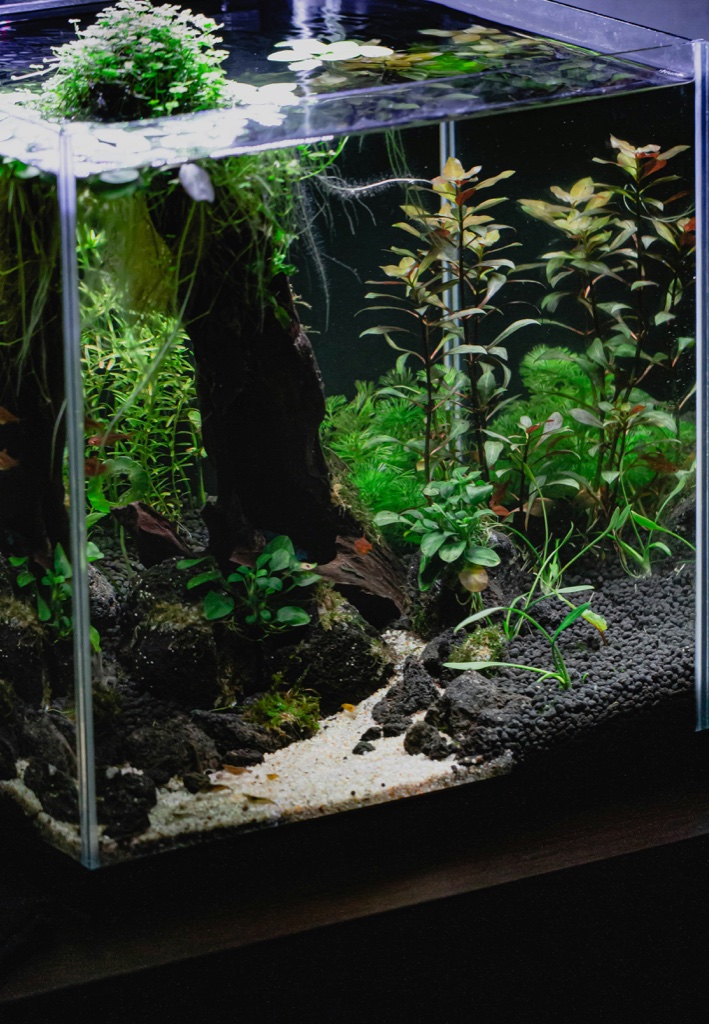
The project
A jar from a pond. The one thing on this hub a child can do this weekend, alone, for nothing.
Two spoons of mud, a few dead leaves and some water from a river, a lake or a pond. Into a two liter glass jar. A square of cotton over the top with an elastic band. Stand it on a windowsill, and watch what happens for the next few weeks.
Here is the part that gets a child by the collar. The animals that appear were already in the mud. Not in the water. Not flown in through the window. Rotifers, ostracods, water fleas and their relatives get through winter and drought as a resting egg with a hard shell, which sinks into the sediment and waits, sometimes for years. The buried layer of those eggs is called an egg bank, and it is what restocks a pond when the water comes back1. Do the same thing in a laboratory and you get the same result: cores of ditch soil, kept cold for four weeks, then warmed and flooded, hatched ostracods and rotifers that were still emerging at the fourth weekly count2. Your daughter's jar is that experiment, on a windowsill, for nothing.
It is safe when a child does it, as long as an adult is the one who goes to the water. The cotton cover is not decoration: it keeps mosquitoes out and keeps any that hatch in. And there is nothing to buy.
A jar of mud
Band A · read aloud · ages 4 to 6
Get a big glass jar. Ask a grown-up to come with you to a river.
Put some mud in the jar. Just a little. Two big spoons is enough.
Put in some old wet leaves too. Three is enough.
Then fill the jar with the water from the river.
Now go home. Put a cloth on the top of the jar. Not a lid. A cloth.
Tie it on with a rubber band.
Put the jar in the window. Then wait.
Look at the jar each day. Do not shake it. Do not feed it.
At first the water goes cloudy. That is fine. That is meant to happen.
Then the water goes brown. That is fine too.
Then, one day, you will see something move.
It will be very small. It will be white or grey.
It came out of the mud. It was in there all the time.
Draw what you see. Write the day on your page.
Keep the jar for many weeks. It will keep changing.
171 words · 32 sentences · 5.34 words per sentence · 1.11 syllables per word · Flesch-Kincaid grade -0.46 · Reading Ease 107.9 · longest sentence 11 words · 88 percent of sentences 7 words or shorter · 0.6 three-syllable words per 100 · no word of four syllables or more
The eggs that wait
Band B · ages 8 to 9
Fill a jar with mud, leaves and water from a pond. In a few weeks the jar is full of tiny life. Where did it all come from?
Not from the air. Not from your hands. Nearly all of it came out of the mud.
Here is the trick. A pond gets cold in winter. Some ponds dry up. The tiny creatures in them do not just die. Many of them lay a special egg first. The egg has a hard shell. Inside it, the young one waits.
The egg sinks. Mud falls on top of it. Now it is buried, and it waits some more.
It can wait a very long time. Not weeks. Years. Often more years than you have been alive.
Then water comes back. It gets warm. Light gets in. That is the signal, and the egg hatches.
This is why the mud is the best part of the jar. A jar of clear water gives you almost nothing. A jar with mud in it gives you a small pond.
So take your two spoons of mud from the top. That is where the newest eggs are. Take mud from two or three spots, not one. Each spot holds a different set of eggs.
Then wait, and see who wakes up.
215 words · 32 sentences · 6.72 words per sentence · 1.13 syllables per word · Flesch-Kincaid grade 0.37 · Reading Ease 104.4 · longest sentence 12 words · 56 percent of sentences 7 words or shorter · 0.9 three-syllable words per 100 · no word of four syllables or more
What the adult reads instead
Those two passages are hers. Yours is the full project page: the order things appear in and why, the leaf litter and tannin chemistry, the Winogradsky column as a second jar, a week by week schedule, an observation log you can copy, and six paired experiments that each change one variable. It also carries the safety, which is short. Cover the jar. Never pour it back into a natural water body. Know where in Armenia not to collect, and what a bloom looks like. And at the lake itself, the real risk is drowning, not microbes. Hold the hand, not the jar.
What to say
Nine sentences, because the hard part is standing in front of the castle with your face doing something.
A position you cannot say out loud at half past seven on a Tuesday is not much use to anybody. So here is the script. Three findings shape it, and the third is a warning about the first two.
Praise the thing done, not the person
Process over person
Praise the child and she plays it safe next time. Praise the work and she pushes. In the original experiments, children told they were clever went on to choose easier tasks, gave up sooner and did worse after a setback than children told they had worked hard.3 It holds outside the laboratory too: praise recorded in real homes with one to three year olds predicted what those children believed about their own effort five years later, and it was the praise for effort that did the predicting.4 That second one is the more convincing, and it is a correlation.
Do not inflate it
“Incredibly beautiful” backfires
Turn the praise up and the shy child takes fewer risks, not more. Adults hand out the most inflated praise to exactly the children with the lowest self esteem, and in those children it cuts the appetite for a challenge. In confident children it does the opposite.5 So the parent who does not really like the castle and covers it with enthusiasm has picked the worst option on the menu. Describe it instead. A description does not have to be sincere about quality, because it is not a verdict.
And the honest caveat
Do not build a philosophy on this
The whole mindset industry that grew out of that praise research has not held up. Pool 273 studies and 365,915 people, then 43 interventions and 57,155 people, and the effects come out weak, with the clearest benefit going to students who were already struggling.6 Which is why what follows is a handful of sentences rather than a theory of your child. The sentences are cheap. The theory is still being fought over.
You changed the water on Saturday when you did not feel like it. That is the hard part and you did it.
Process, specific, and about a thing that actually happened. Compare with “you are so responsible”, which is a claim about her character that she now has to defend.
You put the tall plants at the back and the short ones at the front. Look, they are all using that gap in the middle.
Describe, do not judge. You said nothing about whether it is good, and she still knows you looked properly, which is what she was asking for. This one comes from decades of parenting practice rather than from a trial. Nobody has tested it on its own.
Tell me about this bit.
The single most useful sentence on this page. It is a question with no correct answer, it costs you nothing, and it usually produces a plot involving a shark.
What are you going to change next?
Assumes the tank is hers and is ongoing. Compare with “do you think the castle might look better over there”, which is not a question. Children hear the difference instantly and it costs you their trust in every real question afterwards.
It is not what I would have done. It is your tank, and I like watching you run it.
For when she asks whether you like it. Do not lie and do not inflate. Splitting the answer in two is honest, and the second half is the part that is true and the part she will remember.
That one is out because it has a sharp edge. Everything that passes the test is yours to pick.
The safety veto with its reason attached and its boundary stated in the same breath. From unsafe is not the same as ugly. Say the boundary every time, or the veto quietly expands.
You noticed that before I did.
For the day she reports a fish behaving oddly. It is true more often than parents expect, it is specific, and it hands her the observer role permanently.
What do you think went wrong?
For when something dies. Ask before you explain. She usually has a theory, the theory is usually half right, and the alternative is a lecture delivered to a crying child. There is a Band A passage for this moment in the passages written to be read aloud.
Nothing. Say nothing.
When you walk past and see that the gravel is now in stripes. This is a real option and it is the one most often forgotten.
Two solid findings, stretched Real research, one contested field, and our own extrapolation on top
The praise findings are real, and the inflated praise result is a clean experiment. Everything after that is us pointing them at a fish tank, which nobody has studied, and we are not dressing it up as more than reasoned advice. Use the sentences because they are specific and they cost nothing, not because a study promises they will produce an aquascaper.
Over ten years
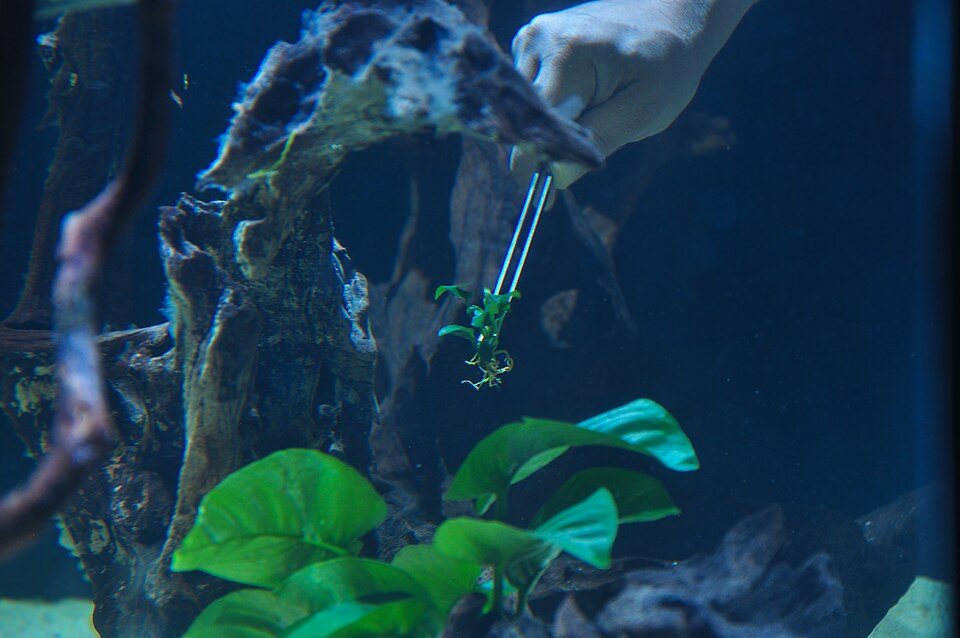
Hand it over in pieces, and take your hands off each piece for good.
There is another age table further down, in what the adult still owns, and it answers a different question: what a child can safely do. This one is about who decides, which is the thing whose tank it is says actually matters.
There is an old idea here that holds up well as a way of organising the job, even though it is a theory rather than a measured effect. Between what a learner can do alone and what she can do with help there is a band, and an adult's job is to hold up the parts of the task she cannot manage yet, then let go of each part as she takes it.7 Letting go is the part everyone skips. A scaffold that never comes down is not a scaffold. It is a cage with a nicer name.
| Age | What is genuinely hers to decide | What you are doing while she does it | The handover that happens next |
|---|---|---|---|
| About 4 | The names. Which ornament goes in. Where it goes. Which fish is her favorite and why. | Everything else, visibly, out loud, narrating as you go. She is learning that this is a thing adults are careful about. | The daily count and the daily feed from a prepared box. |
| About 7 | The whole appearance of the tank. The feeding, from a portioned week. What goes in the log and what it says. Which plant is hers. | Water, chemistry, electricity, purchases, and the judgement calls. You test, she reads the color out loud and writes it down. | Reading the test result and saying what it means, with you checking. Choosing the next plant from a shortlist you did not pick. |
| About 11 | Stocking proposals with a written case. The weekly test and what it means. The maintenance schedule. Whether to enter a photograph anywhere. | Vetoing on animal welfare and on money, and nothing else. Being the person she argues with, not the person who decides. | The whole tank, except the mains electricity and the final word on buying an animal. |
Three ways the handover fails, all of them normal
The silent takeover. You fix it at night. She notices within a week, says nothing, and stops doing the job because it is evidently being done. If you have to intervene, say so: “I moved the filter back on Thursday, it was blocked, I should have waited and shown you.”
The handover with a rope on it. “It is completely up to you” followed by a week of asking whether she has thought about it. Give away less, and give it away properly.
The cliff. Nothing for six years and then the whole tank at twelve. The pieces are the method. There is no version of this where a child who was never allowed to choose a rock is suddenly interested in a scoring rubric.
Where this ends, which is the reason the page exists
She may well end up where you are. Plenty of them do. The gravel goes out around eleven, the castle survives another year on grounds of sentiment, and at fifteen she is arguing with you about whether a third stone breaks the composition. If that happens it will be because she chose it, and the choosing is the only part with any evidence behind it. An interest becomes a person's own when they were free to take it up.8
And she may not. She may keep a tank of guppies and coloured gravel for the rest of her life, perfectly happy, and kind to it. That is a good ending too, and any page that cannot say so is selling something. There is only one ending worth working to avoid, and it is avoidable: the one where a grown woman remembers fish as a thing that used to belong to her mother.
If she does end up in front of a judging panel one day, the competitions page will be here. It will still be a school with rules. She will be allowed to break them.
A frame, not a finding Enormously influential in teaching, thin on clean numbers
Scaffolding has shaped how a century of teachers work and it has very few clean effect sizes behind it. The age columns above are ours, built from the capability table in what the adult still owns and the autonomy argument in whose tank it is. They are not a developmental norm. Treat them as a shape to argue with, and move the lines to fit the child actually in front of you.
For the adult
The child observes and records. The adult decides and acts.
Hand over the tank. Do not hand over the animal's life. Here is where the line sits. It is an honest split: she gets real work that genuinely matters, and a living thing stays out of the hands of somebody who cannot yet reliably read a number off a card.
| Task | Why it cannot pass to the child |
|---|---|
| Deciding the amount of food | Judgement of quantity against fish size and number |
| Anything electrical | An aquarium is a large open container of conductive water with mains powered devices in it, in a room where a child plays |
| Putting hands in the tank | Broken skin and tank water is the actual risk case |
| Handling test kit reagents | Harmful if swallowed |
| Adding water conditioner and doing water changes | Dosing by volume, and lifting |
| Choosing and buying fish | A decision with an animal's life in it |
| Deciding when a fish is suffering and what to do | A judgement, not an observation |
| Reading the water test result and deciding what it means | The child reads the color. The adult decides the action |
| Age | What the child can genuinely do |
|---|---|
| 3 to 4 | Watch. Name fish. Draw the tank. Help count. |
| 5 to 6 | Feed from a prepared weekly box. Keep a one line daily journal. Count fish daily. Color the waiting chart. |
| 7 to 8 | Journal alone. Read water test colors with an adult. Notice and report signs of illness. Choose a plant and look after it. |
| 9 to 11 | Run the weekly test with an adult in the room. Help with water changes, no hands in the tank. Research a species before it is bought. |
| 12 and up | Most of the tank, with the electrical work and the buying decisions still with an adult. |
Hand washing, with the real reason
Not a ritual. A child follows a rule with a reason far better than a rule without one. The US disease control agency lists what can pass from pet fish to people, and says to wash with soap and running water before and after touching or caring for fish, after feeding, after handling equipment, after cleaning the tank, and before eating or drinking.9 Three points from that guidance are directly about children: those under five, adults over 65 and people with weakened immune systems are more likely to get severe illness; children under five should not clean or handle aquarium items; and tank water and equipment should be emptied and cleaned in a bathtub, laundry sink or outside rather than in a kitchen sink, with the sink cleaned afterwards. A medical review adds that gloves should be worn to clean aquariums and that tank water should never be disposed of in a sink used for food preparation, and identifies Mycobacterium marinum as the main bacterial concern while noting the infection is rare and generally of low severity.9
How to say it to her without frightening her. Fish are not dirty and the tank is not dangerous. Water that animals live in always has tiny living things in it. Nearly all of them are harmless. A few can make a person ill, and nearly always through a cut. So wash your hands after. Wash them before as well, so you do not put anything into the tank. And if you have a cut on your hand, keep it out of the water today. That last one matters more than the rest of the paragraph, because Mycobacterium marinum gets in through broken skin, and a child with a grazed knuckle is the case that actually happens.
Where the rule goes. On a card next to the tank, not buried in a page. Both bands get it, in five words: wash your hands, every time.
The one sentence to give parents
Get the tank. Wait a month. Then decide about the fish.
It is the one recommendation here that improves every possible ending. If the family loses interest in three weeks, no animal was harmed. If it does not, the fish arrive into water that is genuinely ready for them, which is the single biggest thing separating a first tank that works from one that does not.
- Hairston, N.G. Jr. (1996). Zooplankton egg banks as biotic reservoirs in changing environments. Limnology and Oceanography 41(5), 1087 to 1092. doi.org/10.4319/lo.1996.41.5.1087. And Brendonck, L. and De Meester, L. (2003), Egg banks in freshwater zooplankton, Hydrobiologia 491, 65 to 84, doi.org/10.1023/A:1024454905119, the standard review.
- Trujillo, J., Schwing, C.D., Muturi, E.J. and Cáceres, C.E. (2023). Heterocypris incongruens maintains an egg bank in stormwater habitats and influences the development of larval mosquito, Culex restuans. Ecology and Evolution 13(8), e10445. doi.org/10.1002/ece3.10445. Open access. The cold period, the rewarming, and the ostracods and rotifers that hatched from ditch sediment.
- Mueller, C.M. and Dweck, C.S. (1998). Praise for intelligence can undermine children’s motivation and performance. Journal of Personality and Social Psychology 75(1), 33 to 52. doi.org/10.1037/0022-3514.75.1.33. The original person versus process praise experiments. Laboratory, single sessions, and the starting point rather than the settled answer. paywalled
- Gunderson, E.A., Gripshover, S.J., Romero, C., Dweck, C.S., Goldin-Meadow, S. and Levine, S.C. (2013). Parent praise to 1- to 3-year-olds predicts children’s motivational frameworks 5 years later. Child Development 84(5), 1526 to 1541. doi.org/10.1111/cdev.12064. Naturalistic observation of praise in real homes, followed up five years on. Longitudinal and correlational. paywalled
- Brummelman, E., Thomaes, S., Orobio de Castro, B., Overbeek, G. and Bushman, B.J. (2014). “That’s not just beautiful, that’s incredibly beautiful!”: the adverse impact of inflated praise on children with low self-esteem. Psychological Science 25(3), 728 to 735. doi.org/10.1177/0956797613514251. Adults give the most inflated praise to the children it harms most, and inflated praise reduced challenge seeking in children with lower self-esteem. paywalled
- Sisk, V.F., Burgoyne, A.P., Sun, J., Butler, J.L. and Macnamara, B.N. (2018). To what extent and under which circumstances are growth mind-sets important to academic achievement? Two meta-analyses. Psychological Science 29(4), 549 to 571. doi.org/10.1177/0956797617739704. First meta-analysis k equals 273, N equals 365,915; second k equals 43, N equals 57,155. Both found weak overall effects, with possible benefit for students who are academically at risk or of low socioeconomic status. Cited on this page as the reason the mindset framing is kept out of it. paywalled
- Wood, D., Bruner, J.S. and Ross, G. (1976). The role of tutoring in problem solving. Journal of Child Psychology and Psychiatry 17(2), 89 to 100. doi.org/10.1111/j.1469-7610.1976.tb00381.x. The paper that introduced scaffolding as a term, with the tutor doing the parts of the task the child cannot yet manage and withdrawing as the child takes them over. With Vygotsky, L.S. (1978), Mind in Society: The Development of Higher Psychological Processes, Harvard University Press, the source of the zone of proximal development. A theoretical frame rather than a measured effect, and treated as one. paywalled
- Ryan, R.M. and Deci, E.L. (2000). Self-determination theory and the facilitation of intrinsic motivation, social development, and well-being. American Psychologist 55(1), 68 to 78. doi.org/10.1037/0003-066X.55.1.68. The statement of the three basic needs. paywalled
- US Centers for Disease Control and Prevention. Fish: Healthy Pets, Healthy People, last updated 11 April 2024. cdc.gov/healthy-pets/about/fish.html. And Stull, J.W., Brophy, J. and Weese, J.S. (2015), Reducing the risk of pet-associated zoonotic infections, CMAJ, doi.org/10.1503/cmaj.141020, open access, PMC4500695.
Continue
Where to go next.
A jar from a pond
The full project page. Mud, leaves and water in a two litre jar on a windowsill, what appears in it and in what order, how to see it, and how to write it down.
The psychology of the aquarium
The grown-up version of the same argument. Thirty reasons people give for keeping a tank, and the eighteen that did not survive being checked.
Find a fish
One hundred and ten species with real minimum volumes, and the twenty one flagged as routinely mis-sold. The page to hand a child who wants to make a case for a new fish.
Easy setups
A tank a child can actually run. Four of the five setups here need no heater, no filter and no air pump.
The Armenian glossary
Ninety terms, and the twenty two we had to invent. A five year old will not accept a word that does not mean anything, which makes this the hardest test the vocabulary faces.