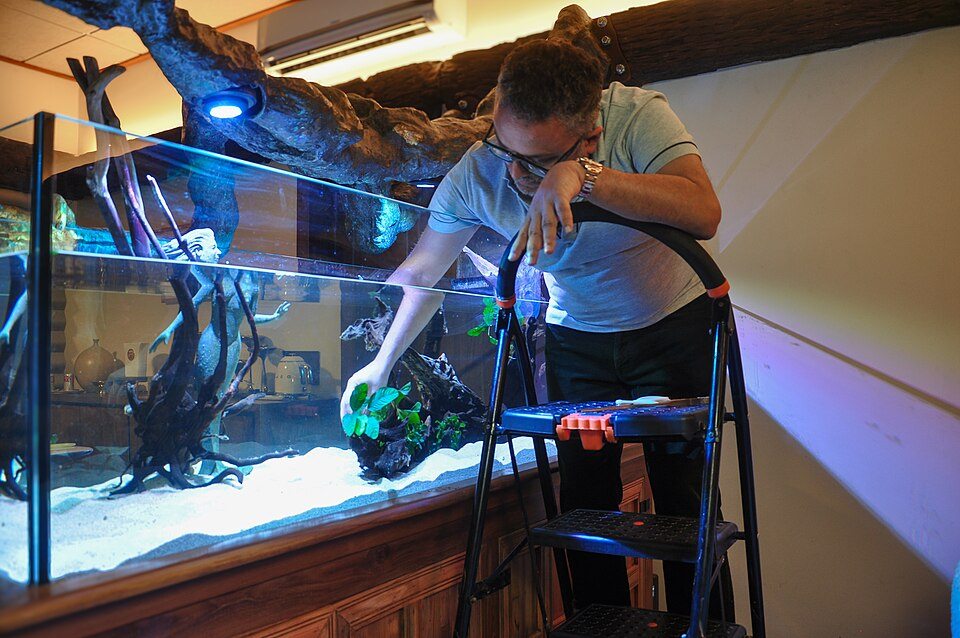
The distinction
Unsafe and ugly are two different words. Adults say no to both and then call it fishkeeping.
Keep one line bright and everything else on this page gets easier. You have a real veto and you should use it without apologising for it. It covers anything that can cut, poison, trap or choke. It does not cover taste. The moment taste sneaks into it, she stops believing the safety rule, because she can tell.
Children are brilliant at spotting a preference wearing a lab coat. Spend your authority on the first list and you will still have it on the day you need it.
Say no, and give the reason
Sharp, rough or thin-edged anything
A scratch on a fish is not a scratch, it is a door. Its skin and the mucus layer over it are the barrier against infection and against losing water to the outside, so once that is scraped open the fish is exposed.1 Run a finger, then a pair of tights, over every edge of a new ornament. Long-finned fish, bettas and fancy goldfish above all, are the ones this actually happens to. A snagged edge that would not mark your hand will still shred a veiltail.
Say no
Metal, and anything painted or plated
Copper is the one to know about. Half the water fleas in a tank die at 9.50 micrograms of copper per liter.2 Micrograms. Invertebrates are far more sensitive than fish, so a shrimp tank is where a plated ornament or a corroding weight does its damage first, and quietly. How much of that copper is actually available depends on your water, so read the figure as an order of magnitude rather than a line. The rule is simpler than the chemistry anyway: no metal, no paint, nothing plated, nothing rusty.
Say no
Anything that can hold a fish
Narrowing tubes, one-way slots, hollow ornaments with a hole a curious fish enters and a body that flares behind the gills. Loaches and small catfish are the usual casualties. The test is whether the widest part of the fish can get back out of every opening, and whether you could get your own hand in to help. Nobody has counted how often this happens, so treat this as a mechanical argument rather than a statistic.
Say no, and this one is about the child
Small parts, if a toddler is in the house
Toys for the under threes have to pass a small parts test. If the object fits entirely inside a cylinder of a set size, it fails.3 An aquarium ornament is not a toy, so nobody ever put it in that cylinder. And it is a small, brightly coloured, wet object sitting at exactly the height of a two year old. If there is a toddler in the house, the ornaments go in the tank and the spares go in a closed box on a high shelf.
Say no until you have checked
Stone and wood that change the water
This is the one case where the decor is chemically active rather than inert, and it is already covered properly elsewhere on this site. The hardscape page has the vinegar test for carbonate stone, what each rock type does to hardness, and which materials are safe as bought. Do that test before it goes in, not after the pH moves. A child can do the vinegar test herself and it fizzes, which makes it the single best science demonstration in the hobby.
Say no, briefly
Anything genuinely untested in water
Modeling clay, most 3D printed parts, glazed pottery of unknown origin, painted figurines, glued assemblies, anything scented, anything from a craft shop that was not sold for aquariums. Not because any of it is certainly harmful. Because a tank is a closed volume and there is no way to find out. The workaround is easy and she will accept it: the same object lives on the shelf beside the tank, just as visible, leaching into nothing.
Say yes to all of this, cheerfully, out loud
Blue gravel. Pink gravel. Gravel in stripes. A castle. Two castles. A skull. A treasure chest with a hinged lid that opens when the air stone runs. A plastic plant in a color no plant has ever been. A dinosaur. A named rock. A layout with no negative space anywhere in it. A theme. A theme that changes every three weeks. Glow in the dark anything, provided it is aquarium safe and nobody has painted it. Fish named after cartoon characters. A sign.
Not one item on that list harms a fish. Several of them would cost a contest entry dearly, and your child is not entering a contest this year.
The sentence that keeps the two lists apart
Say the reason every single time, and make sure the reason is never aesthetic. “That one is out because it has a sharp edge and it would tear his fins. Anything that passes the tights test is your call.” Then hand her the tights and let her test the next one. Now the veto is a procedure she can run rather than an opinion she has to accept, and you have given away the part of the job that was making you the enemy.
We know how, not how often The mechanism is established; nobody counts the injuries
Fish skin as a barrier, and copper as a poison to invertebrates, are both settled. The small parts test is a published regulation. How often ornaments actually injure fish in home tanks is nobody's number, because nobody collects it. So the list above is built from how things work, and from what handling and confinement are known to do to fish generally, which is well described in the ornamental trade in particular.4 That is a sound basis for a household rule. It is not a statistic, and we are not going to invent one.
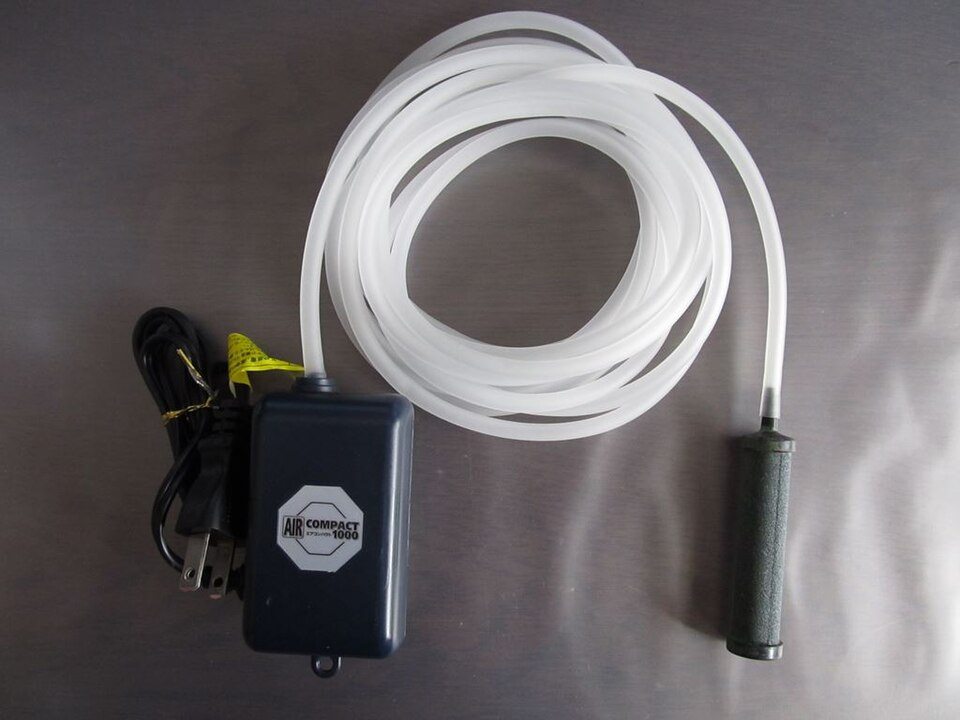
The main practical section
She wants to go fishing in the tank. Here is how to let her, without a dead guppy.
Every child who has ever stood in front of an aquarium has wanted to put a hand in it. Then a net. She wants to catch it, hold it, make it respond to her. Telling her the wish is wrong does not remove the wish. It moves it to the moments when you are out of the room. The job is to give it somewhere to go.
First, why the net is the wrong answer. Then five better ones, in the order to try them.
| What happens | Why it matters |
|---|---|
| The stress response starts before you catch anything | Confinement, chasing and handling trigger the primary stress response in fish, a rapid release of catecholamines and corticosteroids, followed by secondary changes in blood chemistry and, if it repeats, tertiary effects on growth, immunity and reproduction.5 A chase you abandon still happened. |
| The net scrapes off the mucus, and the skin under it | That slime is a working organ. It blocks pathogens, controls what crosses the skin, and helps the fish slip through water.1 Which mesh you use changes how much injury and death follows, and that has been tested directly.6 The test was on largemouth bass in a fishery, so take the direction and leave the numbers. |
| Air exposure is the worst part, and it is the part children do | Air exposure causes acute hypoxia and physical damage to the gill lamellae, the effect worsens with time out of water, and the published guidance to anglers on how long is acceptable is vague.7 Gill filaments need water to hold them apart. In air they collapse together and the exchange surface is gone. |
| This is the known problem in this exact trade | Handling, transport, confinement and a poor physical environment are the four stressors that keep coming up in ornamental fish welfare, and remarkably little research has been done on the species people actually keep at home.4 |
| And she is not indifferent to any of it | Fish perception and cognition often match or beat other vertebrates, and the evidence on pain is strong enough that best practice is to give fish the same protection.8 The same paper is why training works at all. Both are true for one reason: the fish is paying attention. |
One. Target training, which is the real answer
She wants the fish to respond to her. Do not offer her a substitute for that. Give her the real thing, because fish learn, and they learn fast. The same technique that gets a shark to swim into a stretcher for a vet will get a betta to follow a stick across a tank. Public aquariums do it every day, it is called target and station training, and it has a published clinical literature behind it.9 And the exact animal most children want to train has been learning tricks for researchers since 1963, when a betta was shown to work for nothing but something interesting to look at.10
Make the target, and keep it out of the water
A circle of red card the size of a coin, taped to the outside of the glass at one end. Nothing enters the tank, so nothing can leach, snag or be swallowed. This is station training: the fish learns a place, not an object.
Pair it with food, within a second
Target goes on. One pellet drops at that spot immediately. Target comes off. That is the whole loop. Use the fish’s normal daily ration, split into pieces, so training does not become overfeeding. Two sessions a day of about 30 seconds.
Wait for the fish to arrive first
After a few days the fish comes to the spot when the card appears, before the food. That is the moment the child has been waiting for her whole life and she should be allowed to shout about it. Write the date down.
Then move the target
Slide the card slowly along the outside of the glass. Feed on arrival. Now the fish follows. From here a child can invent her own next step, which is the point: a hoop of airline tubing, a figure of eight, a second target for a second fish.
Which fish. Pick one that recognises faces and eats boldly, which means the cichlids and the labyrinth fish. On the fish finder that is Betta splendens, Apistogramma cacatuoides, Mikrogeophagus ramirezi, Pelvicachromis pulcher, Trichogaster chuna and Macropodus opercularis, each with its real minimum tank size on the same page. Tetras and rasboras learn the station too, but as a shoal rather than as individuals, and a child finds that much less satisfying. Goldfish are famously trainable and flagged mis-sold on that page for a reason: check the volume before you fall in love.
How to say hello to a fish
Band A · read aloud · ages 4 to 6
You want to play with your fish. That is a good thing to want.
But a fish is not like a cat. You must not lift it.
A fish has a coat. You cannot see it. It is like slime.
The coat keeps the fish well. If you touch the fish, you rub the coat.
Then the fish can get sick.
So we play a new way. We play with food.
Get a stick. Put a red dot on the end.
Hold the stick by the glass. Then wait.
When the fish comes, give it one bit of food.
Do that each day. Just for a bit. Not for long.
Soon the fish sees the stick. It swims to the stick.
Then you move the stick. The fish comes too.
Now you make the fish go left. Or go right. Or go up.
You do not touch it. You do not chase it.
It comes to you. It wants to.
That is the best game there is.
167 words · 32 sentences · 5.22 words per sentence · 1.02 syllables per word · Flesch-Kincaid grade -1.47 · Reading Ease 114.9 · longest sentence 10 words · 91 percent of sentences 7 words or shorter · no three-syllable words · no word of four syllables or more
Two. A culture she is allowed to net as much as she likes
The wish to catch something with a net is not a wish to hurt a fish. It is a wish to catch something with a net. So give her something where catching is the entire point and there is more of it next week. A tub or a wide jar of Daphnia or Moina, on a windowsill, fed on green water, is exactly that: she nets them, she looks at them in a glass, and then she feeds them to the fish, which is the most satisfying possible ending. Nothing is wasted and nothing is harmed that was not going to be eaten anyway.
This is the same apparatus as the pond jar and it can literally be the same jar, a few weeks on. Keep two containers, always, because cultures crash and a child who loses her only one learns the wrong lesson. The windowsill page covers the light and temperature side of standing a container in a window.
Three. Feeding, made into a real interaction
Tools, not hands
A baster and a pair of tongs
A turkey baster delivers frozen or live food to one spot, which lets a child feed a specific fish rather than the tank. Long soft tongs let her offer a single pellet to a betta or a gourami at the surface. Both keep her hands out of the water, which what the adult still owns keeps with the adult for a reason that has nothing to do with the fish.
Portioning
The weekly box
A seven compartment pill box, filled by an adult on Sunday, is the single best piece of equipment in this whole section. The adult keeps the judgement of how much, which is the part that kills fish. The child gets to do the feeding, unsupervised, every day, and cannot overfeed. Autonomy and safety at the same time, for the price of a pill box.
The bit that feels like magic
Surface feeding by hand, later
Some species will take food from fingers at the surface. Save it. It is the reward at the end of the training sequence, it belongs to an older child with intact skin on her hands, and it is far more impressive after three weeks of target work than it is on day one.
Four. Netting practice, on things that are not alive
A child will one day be in a room where a fish has to be moved. A child who has practised will do it better than a panicking adult, and every keeper knows an adult who has chased one tetra around a planted tank for twenty minutes and wrecked the scape doing it. So teach it, as a skill, with a score.
Fill a washing up bowl. Add a few grapes, a cork and a couple of frozen peas, which sink at different rates. The game is not speed. The score is the number of passes, lowest wins, and there is an instant disqualification for lifting the net out of the water. Then teach the real technique, which is almost the opposite of what a child expects.
- Do not chase. Put the net in the water and leave it still. Move the fish towards it with a slow flat hand or a second net. Fish will not swim into a moving object and will swim past a stationary one.
- Prefer a cup to a net. A jar or a small container lowered into the water, with the fish guided in, never touches the fish at all. For anything long-finned this is the only method we would teach a child.
- Keep the fish under water the whole way. Move a submerged container, not a dripping net. Air exposure is the part with the clearest published harm and the least excuse.7
- If it must be a net, use soft knotless mesh and the largest one that fits, so the fish does not press into the mesh. Mesh type is the one variable in this whole procedure that has actually been tested against injury.6
- Have the destination ready before you start. Nine tenths of the damage comes from the fish being caught before anyone has decided where it is going.
- Turn the light off and wait five minutes. A settled fish is easier to move than a hunted one, and this single step removes most of the chase.
Why should I not catch my fish with a net?
Band B · ages 8 to 9
Nearly every child wants to catch the fish. Do not feel bad about that. It is a very old wish. It is the same wish that sends people to a river with a rod.
But a net is hard on a fish. Here is why.
A fish has slime on its skin. The slime is not dirt. It is a coat, and the coat does 3 jobs. It blocks germs. It stops the fish from taking in too much water. It helps the fish slip through the water.
A net scrapes the coat. Where the coat is gone, germs can enter.
Chasing is bad too, even if you never catch the fish. The fish thinks a hunter is after it. In a few seconds its body fills with a stress chemical. The same thing happens in you when a big dog runs at you.
Lifting a fish into the air is the worst part. A fish breathes with gills. Gills need water to hold them apart. In dry air they close, and the fish gets no air at all. Every second out of the water counts.
So do it another way. You keep the wish. You aim it somewhere better.
Grow a jar of water fleas. They are tiny. They breed fast. You can net them all day, and next week there are more.
Teach your fish to follow a stick. That is real training. It is harder than catching.
Then learn to use a net well, for the day a fish must be moved. Go slow. Use a cup, not a net, if you can. Never lift a fish into the air.
Moving a fish without scaring it is harder than catching one. It is also worth more.
288 words · 39 sentences · 7.38 words per sentence · 1.18 syllables per word · Flesch-Kincaid grade 1.18 · Reading Ease 99.8 · longest sentence 15 words · 56 percent of sentences 7 words or shorter · 1.7 three-syllable words per 100 · no word of four syllables or more
Five. Watching, but with a job attached
Told to watch the fish, a child watches for ninety seconds. Given a question she does not know the answer to, she watches for a year. Writing it down is what turns looking into an experiment, and the jar project makes the same case at length. Five that work.
The one minute count
How many, every day, same time
Trivial, and it is the most valuable habit in the hobby, because a missing fish found on day one is a different problem from a missing fish found on day nine. It also happens to be arithmetic practice that nobody has called arithmetic practice.
The named fish
Pick one. Follow it for a week
Where does it sleep. Who does it avoid. Is it first or last to the food. A child who has named a fish and tracked it has done ethology, and she will notice that it is ill about three days before you do.
The timer
Turn the training into a measurement
How many seconds from the target appearing to the fish arriving. Write the number down each day. The line goes down, and the child can see her own effect on another animal plotted on a page, which is not a small thing to hand an eight year old.
The weekly photograph
Same spot, same lens, Sunday
Plants grow too slowly to notice and very fast to compare. Twelve weeks of Sunday photographs is a time lapse and a real record, and it is a better argument for patience than any sentence an adult can say.
The question with no answer yet
Something nobody in the house knows
Does he come faster in the morning or the evening. Does he prefer the red target or the blue one. Change one thing, keep everything else the same, and write down what happened. That is the whole of experimental method and a nine year old can run it before dinner.
And the one that closes the loop
Let her teach somebody
A cousin, a grandparent, a class. Explaining the target trick to another person is the point at which a child stops being someone who has a fish and becomes someone who keeps fish. It also supplies the third need in whose tank it is, which is the one parents forget.
Good evidence for the how The mechanism is solid; nobody has tested the outcome on a pet fish
Settled: chasing, netting and air exposure do harm, and fish learn tasks for a reward. Documented as professional practice: target and station training. Mixed but promising: giving captive fish more to live in improves several welfare measures, and across 1,786 cases in 107 studies the enriched fish coped better with stress. The reviews are clear that it varies by species and by life stage, and that most of it is about physical structure rather than training.11 Not established at all: that target training makes a pet betta's life better, or that any of it changes a child. We recommend it because the mechanism is sound, the alternative is a net, and the worst case is a fish that comes when called.
- Shephard, K.L. (1994). Functions for fish mucus. Reviews in Fish Biology and Fisheries 4(4), 401 to 429. doi.org/10.1007/BF00042888. The review of what the mucus layer does, which is why abrading it matters. paywalled
- Dahlberg, A.D., Waller, D.L., Severson, T.J., Barbour, M.T., Meulemans, M., Wise, J.K., Bajcz, A.W., Jankowski, M. and Phelps, N.B.D. (2025). Using bioavailability modeling to refine copper treatments for zebra mussel control and better understanding risks to non-target species. Scientific Reports 15, 29333. doi.org/10.1038/s41598-025-09231-4. PMID 40790304. The source of the Daphnia magna figure: a 50 percent chance of survival at 9.50 micrograms of copper per litre. Cited as an order of magnitude for invertebrate sensitivity to dissolved copper, not as a limit for an aquarium, because bioavailability depends heavily on the water. open access
- US Consumer Product Safety Commission. 16 CFR part 1501, Method for identifying toys and other articles intended for use by children under 3 years of age which present choking, aspiration, or ingestion hazards because of small parts. ecfr.gov, title 16 part 1501. Section 1501.2 sets the scope at children under 3 years, 36 months. Section 1501.4 states that no article subject to the part shall be small enough to fit entirely within a cylinder with the dimensions shown in its Figure 1. The dimensions are given as a figure in the regulation and are not reproduced here. free
- Stevens, C.H., Croft, D.P., Paull, G.C. and Tyler, C.R. (2017). Stress and welfare in ornamental fishes: what can be learned from aquaculture? Journal of Fish Biology 91(2), 409 to 428. doi.org/10.1111/jfb.13377. PMID 28691234. Handling, transport and confinement as stressors in the ornamental trade specifically, and the state of the research on welfare indicators. paywalled
- Barton, B.A. (2002). Stress in fishes: a diversity of responses with particular reference to changes in circulating corticosteroids. Integrative and Comparative Biology 42(3), 517 to 525. doi.org/10.1093/icb/42.3.517. The standard account of the primary, secondary and tertiary stress response in fish, and of how fast the primary one starts. open access
- Barthel, B.L., Cooke, S.J., Suski, C.D. and Philipp, D.P. (2003). Effects of landing net mesh type on injury and mortality in a freshwater recreational fishery. Fisheries Research 63(2), 275 to 282. doi.org/10.1016/S0165-7836(03)00059-6. Net mesh type, compared experimentally against injury and mortality. Largemouth bass in a fishery rather than tetras in a tank, which is why the page says the direction transfers and the numbers do not. paywalled
- Cook, K.V., Lennox, R.J., Hinch, S.G. and Cooke, S.J. (2015). Fish out of water: how much air is too much? Fisheries 40(9), 452 to 461. doi.org/10.1080/03632415.2015.1074570. The review of air exposure, which describes acute hypoxia and physical damage to the gill lamellae, and notes that existing guidance to anglers is vague. paywalled
- Brown, C. (2015). Fish intelligence, sentience and ethics. Animal Cognition 18(1), 1 to 17. doi.org/10.1007/s10071-014-0761-0. PMID 24942105. The review concluding that fish perception and cognition often match or exceed other vertebrates, and that the evidence on pain perception supports giving fish the same protection as other vertebrates. Cited in both directions on this page: it is why training works and why chasing is not harmless. paywalled
- Corwin, A.L. (2012). Training fish and aquatic invertebrates for husbandry and medical behaviors. Veterinary Clinics of North America: Exotic Animal Practice 15(3), 455 to 467. doi.org/10.1016/j.cvex.2012.06.009. Target training and station training in aquarium and veterinary practice. The closest thing to a professional manual for what this page recommends. paywalled
- Thompson, T.I. (1963). Visual reinforcement in Siamese fighting fish. Science 141(3575), 55 to 57. doi.org/10.1126/science.141.3575.55. Betta splendens learning an operant response for a purely visual reward. With Grabowski, J.G. and Thompson, T. (1968), Effects of visual reinforcer brightness and color on operant behavior of Siamese fighting fish, Psychonomic Science 11(3), 111 to 112, doi.org/10.3758/BF03328161. paywalled
- Näslund, J. and Johnsson, J.I. (2016). Environmental enrichment for fish in captive environments: effects of physical structures and substrates. Fish and Fisheries 17(1), 1 to 30. doi.org/10.1111/faf.12088. Effects on aggression, stress, energy expenditure, injury and disease susceptibility, and the review’s own warning that outcomes vary and each species and life stage needs separate consideration. With Zhang, Z., He, Y., Wang, J., Zheng, Y., Mo, J., Zhang, X. and Liu, W. (2025), A global synthesis of environmental enrichment effect on fish stress, Fish and Fisheries 26(1), 131 to 154, doi.org/10.1111/faf.12870, a meta-analysis of 1,786 cases across 107 studies. paywalled
Continue
Where to go next.
Find a fish
Which fish can take being looked at closely by a child, with real minimum volumes and the twenty one that are routinely mis-sold.
Find a hardscape
The four materials in the catalogue that must never go in a tank, which is the chemistry half of the unsafe list.
For children
The whole argument about handing a tank to a child, and where safety fits in it.
A jar from a pond
A project with no animal in it that anyone can hold and nobody can hurt.