This page continues
Read the behavior here, then choose the group and the room it needs.
Two words for two different things
Together is a shoal. Together and pointing the same way is a school.
Ten cardinals hanging over a stone, pointing in ten directions, are a shoal. The same ten swinging round as one body and running the length of the tank are a school. A shoal is any group of fish that remain together for social reasons. A school is a shoal that is polarised and coordinated12.
Both phrases are Tony Pitcher's, from a two page note in Animal Behavior in 19833, restated with Julia Parrish ten years later in the chapter that everybody still cites for why fish do this at all4. Pitcher's own two pages sit behind a paywall. The sentence above is quoted word for word inside two independent open papers12, and a third paraphrases it the same way5.
The hobby kept the first half of that idea and dropped the rest. Four things sit in the other half, and every one of them changes something you would actually do with a tank.
Polarisation, measured in rummynose tetras5
- 94.5 to 98%
- of undisturbed fish pointing within 90 degrees of the group heading, held over three weeks5
- 63%
- the same measure once the lateral line was switched off5
- 15 cm
- radius of the shoal, untouched fish5
- 26 cm
- radius with the lateral line gone, and the fish no longer holding a shoal at all5
- 1.45
- body lengths to the nearest neighbor, undisturbed5
Pitcher called his definitions heuristic on purpose. They are tools for observers, picked so that two people watching the same tank score the same thing3. They were never labels for two kinds of fish. An article that sorts species into shoalers and schoolers has turned the paper it is citing upside down.
The fish have to be holding station on each other. Fifty of them under a feeding ring, or packed at the warm end, or all behind the same rock, are an aggregation1. The cause is the food or the heat, not the neighbors. Most of what you watch at feeding time says nothing about whether the group works.
Every school is a shoal, and a group crosses between the loose state and the lined up state continuously5. A settled group of rasboras spends most of the day drifting and snaps into formation for a few seconds when something moves in the room. Both are the same fish having a normal day.
Count the fish pointing within 90 degrees of where the group is heading and divide. Undisturbed rummynose tetras sit between 94.5 and 98 per cent5. That is what coordinated means when it is measured rather than admired, and it is the number that falls over when something is wrong.

Photographs on this page come from the shared library. Every photographer is named at credits.
What makes a group line up
Schooling is a response; a comfortable group also knows when to loosen.
No fish in a school can see the school. Each one is following three short rules about whichever neighbors are closest, and the shape you admire from the sofa is what those rules add up to.
- Do not crash. Back away from any neighbor that gets too close, and this outranks everything else: alignment and attraction are ignored for that instant6.
- Point where they point. Match the heading of the neighbors in the middle band.
- Do not be left behind. Move towards the ones further out.
Couzin and colleagues put those rules into the form everyone now uses, and found the thing that matters most for anybody watching a tank: a tiny change in one fish's behavior flips the whole group from a milling swarm to a rotating ring to a polarised school, with no fish deciding anything6. The same model gives each fish a blind cone behind it and runs on a tenth of a second, taken from how fast a real fish actually reacts67. Coordination is happening ten times a second, and the group carries a memory of the state it was just in6.
So a shoal can look like a different animal at four in the afternoon than it did at two, with nothing whatever having changed in the tank. And a group that snaps tight and stays tight has been given a reason.
Two senses, pulling the spacing in opposite directions
Schooling runs on eyes and on the lateral line, the row of flow detectors down the flank, and they are not two names for one job. The classic saithe experiments separated them. Blind the fish and they hold the school but drift further apart. Cut the lateral line and they hold it but crowd in closer. Take both and schooling stops75. Vision supplies the pull and the alignment, flow supplies the spacing, and normal distance is the balance between them.
Faucher and colleagues redid that work properly on rummynose tetras, using antibiotics to disable the whole lateral system rather than only the trunk. Those fish could not hold a shoal at all: polarisation fell from between 94.5 and 98 per cent to 63, the group spread from a 15 cm radius to 26, the distribution in the tank went from clumped to random, and fish that had never once collided began hitting each other about three times a minute, sometimes hard enough to stun themselves5.
Recovery tracked the hair cells growing back. Shoaling reappeared between days 11 and 16, collisions stopped at day 25, and polarisation matched the control fish at day 295. Roughly a month, from a chemical exposure that left the fish looking perfectly healthy the whole time.
Worth knowing before you medicate
The lateral line is on the outside of the fish
It is a surface organ of exposed hair cells, and aminoglycoside antibiotics are exactly what was used to switch it off in the laboratory5. A tank dosed with one of those, or a shoal that has just been netted, bagged and driven across town, can be swimming badly for weeks while looking fine. Give a newly moved group time before you conclude anything about it.
And the recovery is not instant either
New hair cells arrive before the fish knows how to use them
Giant danios with an ablated lateral line schooled normally straight afterwards and then had trouble one to two weeks later, once the hair cells had fully regrown8. The hardware comes back before the calibration does. A fish that starts swimming oddly a fortnight after a treatment is not necessarily a sick fish.
At night they come apart, and that is the point
Vision supplies the attraction and the alignment, and the lateral line is a short range sense, good over roughly a body length9. Take the light away and most species lose polarisation, spread out and stop, then re-form at dawn. Herring in the dark were the reference work for what a fish can and cannot do on the flow sense alone10.
Two things follow. A dispersed, motionless, oddly pale shoal at eleven at night is a shoal asleep, so do not judge the group by what the torch finds. And switching a bright light on over a dispersed group is a startle delivered to fish whose collision avoidance is running on one sense. A dawn and dusk ramp on the timer is worth having for that reason alone, which is a better argument than the one about how it looks.
Two photographs at a time
Set two frames next to each other and the difference argues itself.
One photograph of a group of fish settles nothing. Put two of them side by side and you see it before anybody writes a caption.
Search a photo library for a school of fish and almost everything comes back labeled that way, loose aggregations included, because in ordinary use school just means a lot of fish. Some of the frames below are open ocean rather than aquarium, and they earn their place: open water shows polarisation at a scale no tank can reach, which is why it is the textbook picture of it.
What to look for: the heading of each fish, not the gap between them. Undisturbed rummynose tetras keep between 94.5 and 98 per cent of the group pointing within 90 degrees of one line5, and that is what the right hand frame is showing you.
What to look for: whether the group still reads as one thing when you halve it. That is a question about how the tank looks, and it is the part of the six against twelve argument that somebody has actually answered.
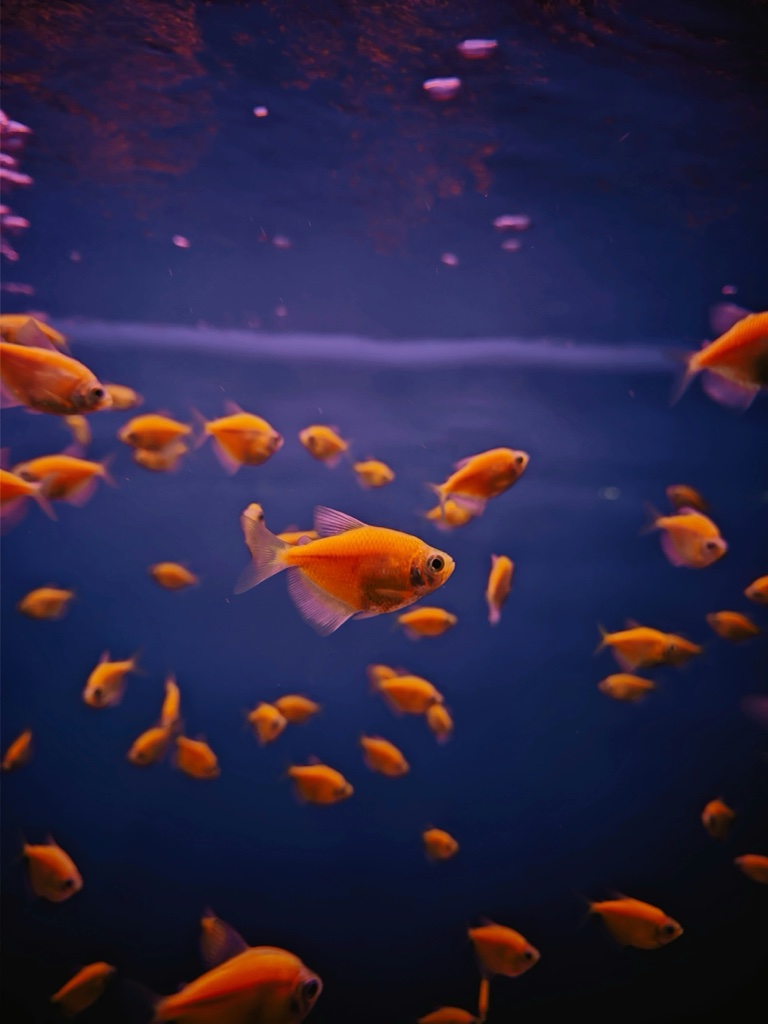
What to look for: how long it lasts. A few seconds of this is an ordinary afternoon. All day and every day, and the tight shoal is the symptom rather than the trophy.
- Miller, N. and Gerlai, R. (2012). From schooling to shoaling: patterns of collective motion in zebrafish. PLoS ONE 7(11): e48865. Reproduces Pitcher and Parrish's two phrases verbatim and attributes them. DOI 10.1371/journal.pone.0048865 open access
- Ogi, A., Licitra, R., Naef, V., Marchese, M., Fronte, B., Gazzano, A. and Santorelli, F. M. (2020). Social preference tests in zebrafish: a systematic review. Frontiers in Veterinary Science 7: 590057. An independent second reproduction of the same quoted definition. DOI 10.3389/fvets.2020.590057 open access
- Pitcher, T. J. (1983). Heuristic definitions of fish shoaling behaviour. Animal Behaviour 31(2): 611 to 613. The origin of the shoal and school distinction, and the paper whose title carries the word heuristic. DOI 10.1016/S0003-3472(83)80087-6 paywalled; the definition is quoted here through sources 3, 4 and 5, which reproduce it
- Pitcher, T. J. and Parrish, J. K. (1993). Functions of shoaling behaviour in teleosts. In: Pitcher, T. J. (ed.) Behaviour of Teleost Fishes, 2nd edition. London: Chapman and Hall, 363 to 439. The standard citation for why shoaling evolved, and where the 1983 definition was restated. DOI 10.1007/978-1-4684-8261-4_12 paywalled; the 1986 first edition is on the Internet Archive under lending restriction
- Faucher, K., Parmentier, E., Becco, C., Vandewalle, N. and Vandewalle, P. (2010). Fish lateral system is required for accurate control of shoaling behaviour. Animal Behaviour 79(3): 679 to 687. The rummynose tetra experiment: polarisation of 94.5 to 98 per cent in undisturbed fish, the fall to 63 per cent, the shoal radius, the collisions and the month long recovery. Also the paraphrase that there is no clear dichotomy between shoaling and schooling. DOI 10.1016/j.anbehav.2009.12.020 author version read in full from the University of Liege repository, handle 2268/31748
- Couzin, I. D., Krause, J., James, R., Ruxton, G. D. and Franks, N. R. (2002). Collective memory and spatial sorting in animal groups. Journal of Theoretical Biology 218: 1 to 11. The three nested zones, repulsion outranking everything, the blind cone behind the fish, the abrupt group level transitions and the collective memory. DOI 10.1006/jtbi.2002.3065 full text read
- Partridge, B. L. and Pitcher, T. J. (1980). The sensory basis of fish schools: relative roles of lateral line and vision. Journal of Comparative Physiology A 135: 315 to 325. The saithe ablations: blinded fish spread out, lateral line cut fish crowd, both gone and schooling stops. Also the response latency behind the tenth of a second time step. DOI 10.1007/BF00657647 paywalled; read through the detailed account in source 5
- Mekdara, P. J., Schwalbe, M. A. B., Coughlin, L. L. and Tytell, E. D. (2018). The effects of lateral line ablation and regeneration in schooling giant danios. Journal of Experimental Biology 221: jeb175166. Fish schooled normally straight after ablation and had trouble one to two weeks later, once the hair cells had regrown. DOI 10.1242/jeb.175166 paywalled; abstract read in full
- Larsson, M. (2024). Schooling fish from a new, multimodal sensory perspective. Animals 14: 1984. Average neighbour distance about 70 per cent of a body length, and roughly one body length cubed of water per fish. DOI 10.3390/ani14131984 open access
- Blaxter, J. H. S. and Batty, R. S. (1987). Comparisons of herring behaviour in the light and dark. Journal of the Marine Biological Association of the UK 67: 849 to 859. The reference work for what a schooling fish can and cannot do on the flow sense alone. DOI 10.1017/S0025315400057088 paywalled
- Our own trace of the group size rule. , 8.2 and 8.3. The identical FishBase group line across the cardinal tetra, neon, harlequin rasbora, tiger barb and gold barb, and its single common reference, number 51539, which is aquarium hobby literature. Also the complete 41 year index of The Aquatic Gardener, 163 issues and 1,228 article entries from 1985 to 2026, searched for Corydoras, Betta, rasbora, danio, Otocinclus, goldfish, gourami, Apistogramma, hillstream loach and white cloud mountain minnow, with no article title or keyword matching any of them. our own search of published indexes, repeatable, unverified by a third party
- Kutty, V. Dutch style aquascaping guide, hosted by the Aquatic Gardeners Association. A dozen or so fish of one main species, with single fish of many species failing to read as a school across a layout. The one attributable published shoal size figure in aquarium keeping, and it is a composition rule rather than a welfare threshold. Via
Continue
Where to go next.
The whole fish table
Every species with its group size and, beside it, what that number actually rests on. Sixty one of the hundred and ten rows say convention in their own words.
Find a fish
Filter the hundred and ten on the three numbers that decide a first tank, then read the group line before you pay for anything.
Livestock
Where these fish come from, what an unheated flat in Yerevan will hold, and why the tropical label on the tank is doing less work than it looks.
What nobody tells you
The other rules repeated at the till, each one followed back to whoever first said it.
Forgiving to demanding
Which species forgive a beginner and which do not, weighed on the same evidence footing as this page.