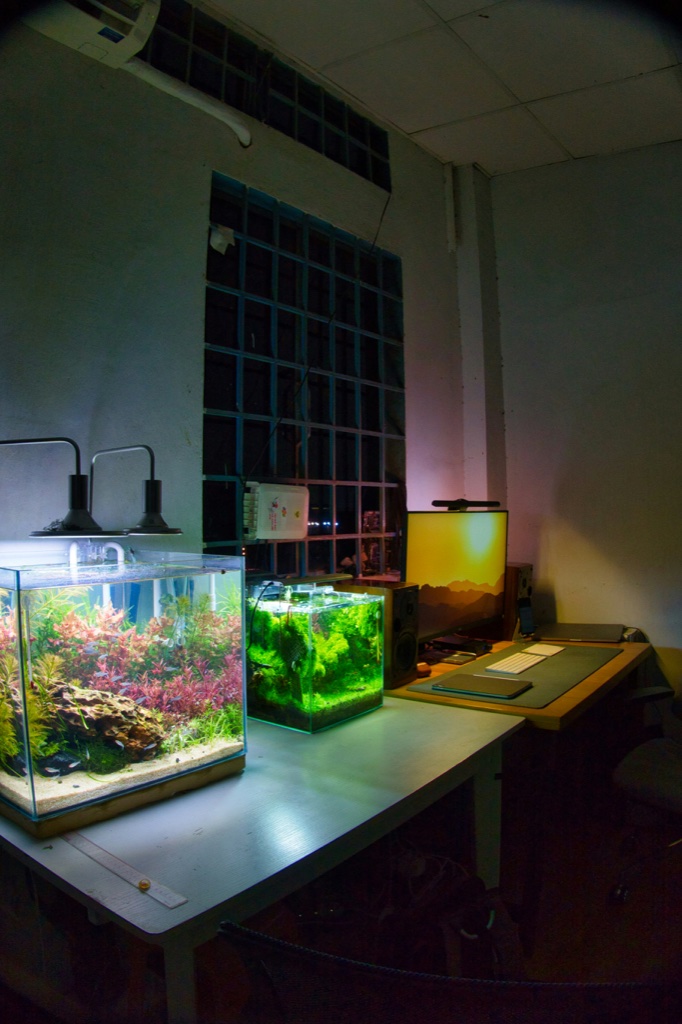
The list
Thirty reasons to keep a tank, with the evidence for each one printed beside it.
Here are thirty reasons people enjoy keeping aquariums, from the atmosphere they create to the craft, learning, and community around them. The evidence label keeps measured effects distinct from everyday pleasures that are easy to observe for yourself.
Group one, and it is the smallest
Physiological
Three. All measured, all small, and each one carries the study that undercuts it.
| Reason | Evidence | Kind | What is behind it |
|---|---|---|---|
| Ten minutes in front of a stocked tank is followed by a small fall in heart rate | Supported | Measured | About 6 beats per minute fully stocked against 2.2 with an empty tank, p equals .039, a small effect, one study of 84 students, never repeated.1 In the larger dental study, where patients sat for twenty minutes rather than ten, the group with no tank fell the most.2 |
| Felt arousal drops while you watch, and it dropped most with the empty tank | Supported | Measured | Arousal fell in all three conditions at Plymouth and the largest effect was the tank with no fish in it.1 The authors describe the fully stocked exhibit as less calming and more energising. The water and the glass appear to do most of this. |
| Pain threshold rose in one small pilot and stayed raised afterwards | Open | Measured | 69 viewers against 12 controls, not randomised, compared against a blank white wall, and the participants worked in the department running the study.3 It is the only positive physiological result in this field that is not heart rate. |
Group two
Psychological
Six. Two of them are the strongest findings on this page and two of them are honest guesses.
| Reason | Evidence | Kind | What is behind it |
|---|---|---|---|
| People rate a room with a stocked tank more highly than the same room without one | Direct | Measured | 392 patients, p below 0.001, in the one properly powered study in the field, and it is the only thing that study found.2 Backed independently by all five rating questions at Plymouth and by a care home staff survey.14 |
| Mood improved while students watched a tank, and did not move at all in 392 dental patients | Supported | Measured | Large within condition effects at Plymouth, but the comparison between conditions was only marginal at p equals .076,1 and the bigger study found nothing at p equals .32.2 The sentence has to carry both halves or it is false. |
| People report feeling calmer watching live fish than watching the same tank with only plants, or empty | Supported | Measured | Gee 2019, within subject, across two experiments, and the cleanest design anyone has used because it controls the tank itself.5 Reported feeling only. The same study looked for it in heart rate with working instruments and did not find it. |
| A small daily task with a fixed shape: feed, look, top up | Open | Simply true, effect untested | The task is real and takes two minutes. Whether having it does anything for a person has never been tested with an aquarium, in anybody.6 Some keepers describe it as the part they would miss. |
| Something in the room changes slowly enough that you notice the change | Direct | Simply true | A stem plant puts on visible growth in a week. This describes the object and makes no claim about you. |
| You have kept something alive, and you can see that you have | Open | Simply true, effect untested | The nearest evidence is a famous 1976 study about responsibility and a houseplant.7 None of it is about fish. True of any absorbing hobby that involves a living thing. |
Group three
Cognitive
Four, and the honest one first: nobody has ever measured attention objectively in an aquarium study.
| Reason | Evidence | Kind | What is behind it |
|---|---|---|---|
| It holds attention. People looked at a stocked tank about twice as long as an empty one | Supported | Measured | 3.01 minutes empty, 5.94 minutes fully stocked, 112 visitors timed without their knowledge.1 The biggest effect in the whole literature. One exhibit, one city, so the generalisation is graded B even though the measurement itself is solid. |
| It is the kind of thing Attention Restoration Theory calls soft fascination | Open | A label, not a benefit | The aquarium data fits this theory better than the stress reduction one, largely because nobody has managed to stress participants first.89 This names the kind of thing a tank is. It is not a claim that it restores your concentration, which is a claim we deleted. |
| You will end up learning some chemistry and some biology whether you meant to or not | Direct | Simply true, and true of any absorbing hobby | Anyone who keeps a tank for a year learns what nitrite is. This describes what the hobby requires. It is not a claim that the hobby improves your cognition. |
| It is a constrained design problem, and your tap water sets the constraint before you choose anything | Direct | Simply true | Hardness and pH decide your plant and species list. In Armenia those numbers are published. See reason 19. |
Group four
Social
Four. The two measured ones come from care homes rather than from households, and that limit is printed with them.
| Reason | Evidence | Kind | What is behind it |
|---|---|---|---|
| An aquarium in a care home dining room is associated with residents eating more | Open | Measured | Food intake reported up 21 and 25 percent and weight up one to two pounds, and it beat a scenic picture of the ocean, which is the most consequential result in this field.4 But it is three studies from one research team, two of them without a control group, nobody outside that team has repeated it, and measuring how much a resident eats may itself change how much they eat. |
| Care staff reported higher job satisfaction after tanks were installed | Open | Measured | Scores moved from 149.4 to 157.9 across 71 staff, p below .001.4 Before and after, with no control group. Interesting, and worth exactly one sentence. |
| Armenia already has a hobby to join | Direct | Local | In Armenia: Gazanik in Yerevan has an Armenian-language catalog, alongside the planted-tank specialist Կանաչ Ակվարիում, the Haf-Haf chain across four Yerevan branches, and a fabricator who will build you a custom tank frame.10 |
| Plants multiply, so keepers give the surplus away, and that is how stock circulates locally | Direct | Simply true | Stem plants and floaters double on a scale of weeks. Botanically certain. It matters more in a small market than a large one, because it is often the only way to get a species at all. |
Group five, and the longest
Household and practical
Eight. None of these needs a study to be true, and two of them are specific to Armenia.
| Reason | Evidence | Kind | What is behind it |
|---|---|---|---|
| It is quiet, and it goes where a cat or a dog cannot: rented flats, small rooms, buildings with rules | Direct | Simply true | The filter is the only noise and a good one is close to silent. |
| Yerevan tap water is usable straight from the tap, so you do not need a reverse osmosis unit | Supported | Local | A hydrogeochemistry paper sampled tap water by Yerevan district: total hardness 2.8 to 11.2 dGH, pH 6.25 to 7.30, bicarbonate dominated.11 That is good aquarium water. One paper, sampling from 2002 to 2004, and it varies by district and by season, so test yours. |
| Fish do not shed the dander that causes most pet allergy, and there is one real exception | Direct | Simply true | Cat and dog allergy is driven by dander and saliva proteins that fish do not make. The exception is not decorative: allergy to bloodworm, the frozen or dried midge larvae sold as fish food, is documented in hobbyists specifically, including cases of asthma.12 If anyone in the house is asthmatic, feed pellets. |
| A settled tank tolerates a weekend without you | Supported | Simply true | Established adult fish routinely go two or three days unfed without harm and a planted tank buffers itself. This is standard husbandry rather than a trial result, and it is not true of a tank you set up last week. |
| A low tech planted tank needs no injected CO2 and few water changes | Supported | Simply true | The Walstad method, which we cover in depth elsewhere. Real and workable, and slower and less controllable than the injected alternative. |
| Running cost is two small continuous electrical loads and very little else | Direct | Simply true | Arithmetic. A light for six to eight hours a day and a small pump running all the time. Everything else is occasional. You can check this against your own bill, which is the point of putting it here. |
| The hardscape can come out of Armenia | Supported | Local | Armenian volcanic tuff is, as a class, silicate and chemically inert in an aquarium and will not raise your hardness, and scoria is abundant around Yerevan and in four provinces.13 Two cautions travel with that: tuff is soft and can shed fines that cloud water for a long time, and some material sold as tuff is calcareous travertine, which is not inert. Test it with acid first. |
| Plants grow back, so a mistake costs weeks rather than money | Direct | Simply true | A ruined scape is replanted from its own trimmings. True for plants and not for livestock, and that distinction is the whole ethics of this hobby. |
Group six
Creative
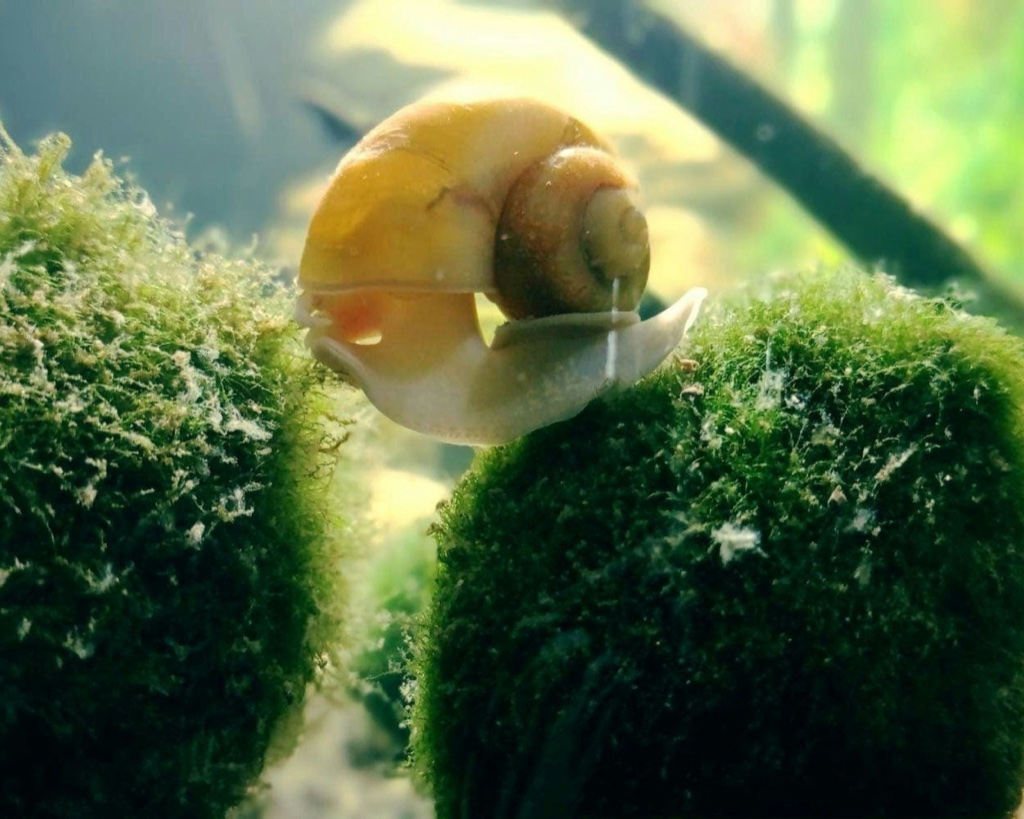
Five. Nothing here pretends to be evidence, because none of it needs to be.
| Reason | Evidence | Kind | What is behind it |
|---|---|---|---|
| It is a composition and every piece of it can be moved | Direct | Simply true | Which is more than can be said for most things you put in a room. |
| There are named styles with real rules to learn or to break | Direct | Simply true | Iwagumi, Nature Aquarium, Dutch, biotope, jungle, Walstad and Wabi-Kusa are documented styles with published conventions. |
| The competitions are open to anyone who can photograph a tank | Direct | Simply true | IAPLC, the Aquatic Gardeners Association contest and CIPS all accept entries from any country. The photograph is the entry, so photography becomes a second craft attached to the first. |
| The material is alive, so the work is slow and it is never finished | Direct | Simply true | Three months before a scape reads as finished, and it keeps moving afterwards. A biotope entry is judged partly on whether the species and the stone genuinely occur together somewhere in the world, which makes it a reading task as much as a design one. |
| In Armenian, the vocabulary for this is still being made | Direct | Local | The Armenian word for aquascaping is still being chosen, with the Language Committee, Nayiri and Bararan all yet to rule.14 Three candidates are live: the descriptive Ջրային լանդշաֆտ ձևավորում, the colloquial ակվարիումի ձևավորում, and the loanword Ակվասկեյփինգ. An Armenian aquascaper gets to help decide which one sticks. |
- Cracknell, D., White, M.P., Pahl, S., Nichols, W.J. and Depledge, M.H. (2016). Marine biota and psychological well-being: a preliminary examination of dose-response effects in an aquarium setting. Environment and Behavior 48(10):1242–1269. PMID 27818525, PMCID PMC5081108. doi.org/10.1177/0013916515597512. Full text read. Source of every dwell time, heart rate, arousal, mood and rating figure attributed to Plymouth. Quasi-experiment, 84 students and 112 observed visitors, one exhibit, one city, never repeated: grade B open access
- Lundberg, A. and Srinivasan, M. (2021). Effect of the presence of an aquarium in the waiting area on the stress, anxiety and mood of adult dental patients: a controlled clinical trial. PLoS ONE 16(10):e0258118. PMID 34637458, PMCID PMC8509982. doi.org/10.1371/journal.pone.0258118. The first author is A. Lundberg, not P. Lundberg; earlier drafts of this page had the initial wrong and it is corrected here. A second correction from the same record: the trial ran a 20 minute wait before the second set of readings, not the 10 minutes it is usually described with. 392 patients, geriatric dental clinic, mean age 65.1. The best powered study in the field. Source of the null results on blood pressure, heart rate, anxiety and mood, of the room-rating finding at p below 0.001 (grade A), and of the power calculation of 1,969 to 12,253 people per group. open access
- Sanchez, M., Delpont, M., Bachy, M., Kabbaj, R., Annequin, D. and Vialle, R. (2015). How can surgeonfish help pediatric surgeons? A pilot study investigating the antinociceptive effect of fish aquariums in adult volunteers. Pain Research and Management 20(1):e28–32. PMID 25222572, PMCID PMC4325897. doi.org/10.1155/2015/419412. 69 viewers against 12 controls, unrandomised, blank-wall comparator, participants drawn from the department running the study: grade C open access
- The care home series, one research team. Edwards, N.E. and Beck, A.M. (2002), Animal-assisted therapy and nutrition in Alzheimer’s disease, Western Journal of Nursing Research 24(6):697–712, doi.org/10.1177/019394502320555430 (+21.1 percent intake, +1.65 lb, control arm 17 people over two weeks); Edwards and Beck (2013), Alzheimer Disease and Associated Disorders 27(4):379–383, doi.org/10.1097/WAD.0b013e3182769b34 (+25.0 percent, +2.2 lb); Edwards, N.E., Beck, A.M. and Lim, E. (2014), Western Journal of Nursing Research 36(10):1309–1322, doi.org/10.1177/0193945914526647 (staff job satisfaction 149.4 to 157.9, F equals 35.34, p below .001, 71 staff). Two of the three have no control group and nobody outside the team has replicated any of them: grade C Read through source 1. paywalled
- Gee, N.R., Reed, T., Whiting, A., Friedmann, E., Snellgrove, D. and Sloman, K.A. (2019). Observing live fish improves perceptions of mood, relaxation and anxiety, but does not consistently alter heart rate or heart rate variability. International Journal of Environmental Research and Public Health 16(17):3113. PMID 31461881, PMCID PMC6747257. doi.org/10.3390/ijerph16173113. Within-subject, two experiments, the tank itself controlled. Reported feeling only: grade B open access
- Clements, H., Valentin, S., Jenkins, N., Rankin, J., Baker, J.S., Gee, N., Snellgrove, D. and Sloman, K. (2019). The effects of interacting with fish in aquariums on human health and well-being: a systematic review. PLoS ONE 14(7):e0220524. PMID 31356652, PMCID PMC6663029. doi.org/10.1371/journal.pone.0220524. Registered in advance on PROSPERO. Nineteen studies, none at low risk of bias, twelve at high risk. Also the source for every “never measured” and “never tested” statement on this page, and for the null loneliness result named in its own abstract. Supports the grade A method claims and the grade D deletions. open access
- Langer, E.J. and Rodin, J. (1976). The effects of choice and enhanced personal responsibility for the aged: a field experiment in an institutional setting. Journal of Personality and Social Psychology 34(2):191–198. doi.org/10.1037/0022-3514.34.2.191. The famous responsibility study. Its living thing is a houseplant, not a fish, which is why reason 9 is grade C paywalled
- Kaplan, S. (1995). The restorative benefits of nature: toward an integrative framework. Journal of Environmental Psychology 15(3):169–182. doi.org/10.1016/0272-4944(95)90001-2. The origin of “soft fascination”. Cited as a label for the kind of thing an aquarium is, grade C, not as evidence that a tank restores attention. paywalled
- Cracknell, D., White, M.P., Pahl, S. and Depledge, M.H. (2017). A preliminary investigation into the restorative potential of public aquaria exhibits: a UK student-based study. Landscape Research 42(1):18–32. doi.org/10.1080/01426397.2016.1243236. Aquarium images scored below coastal images on perceived restorativeness, which is why the blue-space claim is graded D and deleted. paywalled
- The Armenian shops and makers themselves. gazanik.am and its published product categories, the planted-tank maker Կանաչ Ակվարիում, the Haf-Haf chain’s four Yerevan branches and the custom tank fabricator, each found and checked directly for the Armenian scene page and the community page. checked 9 September 2026
- Shahinyan, H.V. (2005). On the hydrogeochemical characteristics of some drinking waters supplying the city of Yerevan. Proceedings of NAS RA, Earth Sciences LVIII(1):41–45. arar.sci.am, full PDF. Free. Sampling 2002 to 2004, by district. Source of the 2.8 to 11.2 dGH and pH 6.25 to 7.30 figures. One paper, two decades old: grade B, and test your own tap. free PDF
- Rodriguez, D., et al. (2006). Allergy to chironomid larvae (bloodworm) in non-professional handlers of fish food. Journal of Investigational Allergology and Clinical Immunology 16(1). PMID 16599251. And bloodworm-induced asthma, Allergy, Asthma and Clinical Immunology (2005) 1(2):58, doi.org/10.1186/1710-1492-1-2-58, open access. paywalled
- Armenian rock. Armenian Wikipedia, Հրաբխային խարամ (volcanic scoria), hy.wikipedia.org, for the scoria distribution; the tuff and travertine cautions are set out in full, with the acid test, on the Armenian scene page. checked 9 September 2026
- The absence of an Armenian term. Checked against the Language Committee of the Republic of Armenia term base, the Nayiri dictionary corpus and the Bararan lexicon: no entry for aquascaping in any of them. Recorded in full on the Armenian glossary, where the invented terms are labelled as invented. checked 9 September 2026
Continue
Where to go next.
The psychology of the aquarium
The grading system the thirty reasons are scored against, and the eighteen claims that were cut.
What a tank actually teaches
What a tank teaches a child, held to the same standard.
Reading
The literature behind the strongest three claims, with open access marked.
The library home
Everything else the hobby is, for the reasons that survived.