Optics
Refraction, the mirror on the underside of the surface, and the honest answer about dispersion.
A tank is an optical instrument that the aquascaper is composing inside. Light crosses two interfaces to get in, is absorbed on the way down at a rate that depends strongly on its color, and crosses two more to get to the eye. Almost every visual surprise in a tank comes from one of four effects, and all four follow from one number.
n1 sin θ1 = n2 sin θ2
- n air
- 1.000 by definition at this precision
- n water
- 1.3334 at 589 nm and 20 C, falling to 1.3329 at 25 C12
- n glass
- about 1.52 for ordinary soda lime float glass, which the tank is made of
Every refractive index for water on this page is computed from the IAPWS formulation, which is fitted to measurement1 and agrees with the modern direct measurement of distilled water2. The computation is ours3.
Looking straight down, the apparent depth is the real depth divided by the refractive index. That factor is 0.750, so a 40 cm tank looks 30 cm deep and a 50 cm tank looks 37.5 cm3. Substrate contouring designed by eye from above is a quarter shallower than the designer thinks it is.
Viewed at an angle, a fish is displaced sideways as well as upwards, and the displacement grows with the viewing angle. A ray arriving at the surface at 45 degrees from the vertical continues down at 32.0 degrees from the vertical3, so a shrimp seen from the end of the tank is not where the eye reports.
Its two faces are parallel, so the middle layer cancels out of Snell's law and only the first and last media count. The glass shifts the image sideways and it does not change the angle. This is why front glass thickness affects distortion at the corners and not in the middle.
A bowfront, a corner seen obliquely and any rimless tank viewed from off axis put a non-parallel path through the glass, and there the deviation is real. It is the reason photographs of aquascapes are shot square on.
Total internal reflection
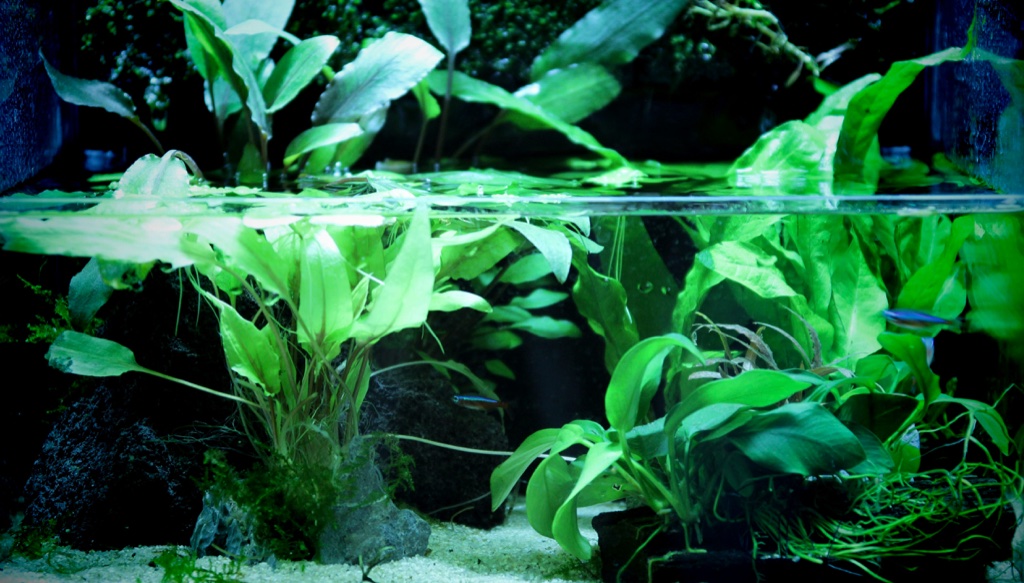
The underside of the water surface is a mirror over most of its area.
Going from water into air the ray bends away from the normal, and past a certain angle there is no solution to Snell's law at all. The refracted ray would have to leave at more than 90 degrees, which is to say it does not leave. All the light is reflected back down.
θc = arcsin(nair / nwater) = arcsin(1 / 1.333) = 48.6°
Measured from the vertical. Rays hitting the surface from below at less than 48.6 degrees from vertical escape into the room. Rays steeper than that are totally reflected back into the tank3.
Two consequences, and both are things people notice without knowing the name.
Snell's window. Looking up from inside the tank, the entire hemisphere above the water is compressed into a circular cone 97.2 degrees wide3. Outside that circle you do not see the room. You see the tank floor, reflected. That mirrored ring around the edge of the surface is not a coating and not dirty glass.
Light that goes up mostly comes back. A submerged light, an air stone's bubble stream lit from the side, or the specular glint off a fish all send light upward at steep angles, and most of it never leaves. It is why an aquascape lit from within looks brighter than the same fixture pointed at it from outside, and it is part of why surface agitation reads as loss of clarity: a rippled surface constantly changes the local angle, so the boundary of the window shimmers rather than sitting still.
Coming the other way, the surface reflects too, and steeply. At normal incidence a clean air to water surface reflects 2.0 percent of the light. At 60 degrees from vertical it reflects 6.0 percent, and at 80 degrees, 34.8 percent3. So a low winter sun through a window puts a third of its energy straight back off the surface, while a light fixture directly overhead loses only two percent at the surface. The front pane loses about 4.7 percent at normal incidence, nearly all of it at the air to glass face rather than the glass to water face3.
Dispersion
Water disperses light. At the size of an aquarium it does not matter, and attenuation does.
Dispersion is the fact that the refractive index depends on wavelength, which is what makes a prism a prism and a raindrop a rainbow. Water has it. Here is how much.
| Wavelength | Color | n12 | Critical angle3 | Refracted angle for a 45 degree beam3 |
|---|---|---|---|---|
| 400 nm | Violet | 1.34303 | 48.12° | 31.77° |
| 450 nm | Blue | 1.33909 | 48.31° | 31.87° |
| 550 nm | Green | 1.33417 | 48.55° | 32.01° |
| 650 nm | Red | 1.33117 | 48.70° | 32.09° |
| 700 nm | Deep red | 1.33002 | 48.75° | 32.12° |
| Spread across the visible | 0.0130 | 0.63° | 0.35° |
Now put a number on what that does inside a tank. A single beam entering the water at 45 degrees splits into a violet ray and a deep red ray separated by 0.35 degrees. Over a 50 cm path through the water that is a lateral separation of about 3 mm3. Three millimeters, from a perfectly collimated beam, at the most favourable geometry, in the largest tank most people own. Real aquarium light is not collimated, it arrives from a diffuse source over a wide range of angles, and the 3 mm of color separation is buried under several centimeters of ordinary angular spread from the fixture itself.
So the honest verdict is that dispersion is real, measurable and irrelevant at aquarium scale. You will see it in exactly one place: the thin coloured fringe at the edge of a bright caustic on the substrate, where a wave has acted as a lens and focused a beam sharply enough for 0.35 degrees to show. That fringe is the same physics as a rainbow and it is the whole of the dispersion story in a tank. Anyone who tells you their light is being split into a spectrum by the water is describing something that happens at three millimeters.
What actually removes color from an aquarium is not dispersion. It is absorption, and absorption is enormously wavelength dependent. That is the effect worth understanding, and it is the subject of the rest of this section.
Attenuation with depth
Red is gone first, and pure water is the reason.
I(z) = I0 e−a(λ) z
z1/2 = ln 2 / a(λ)
- I0
- irradiance just under the surface, after the surface reflection above
- a(λ)
- absorption coefficient of the water at that wavelength, per meter
- z
- depth, meters
- z1/2
- the depth at which half the light of that color is left
Beer and Lambert. In real water the coefficient is a total attenuation coefficient that includes scattering by particles and absorption by dissolved organic matter, and it is much larger than the pure water figure. The table below is pure water only, which is the floor nobody can get under.
| Wavelength | a, per meter4 | Half depth3 | Left after 0.5 m, a deep tank3 | Left after 5 m3 | Left after 20 m3 |
|---|---|---|---|---|---|
| 400 nm violet | 0.00663 | 104 m | 99.7 percent | 96.7 percent | 87.6 percent |
| 420 nm blue, the minimum | 0.00454 | 153 m | 99.8 percent | 97.8 percent | 91.3 percent |
| 500 nm blue green | 0.0204 | 34 m | 99.0 percent | 90.3 percent | 66.5 percent |
| 550 nm green | 0.0565 | 12.3 m | 97.2 percent | 75.4 percent | 32.3 percent |
| 600 nm orange | 0.2224 | 3.1 m | 89.5 percent | 32.9 percent | 1.2 percent |
| 650 nm red | 0.340 | 2.0 m | 84.4 percent | 18.3 percent | 0.1 percent |
| 700 nm deep red | 0.624 | 1.1 m | 73.2 percent | 4.4 percent | 0.0 percent |
Pure water is blue because it absorbs red, not because it reflects sky. The absorption minimum sits at 420 nm and the coefficient rises by a factor of 137 between there and 700 nm43. Deep red light has a half depth of about a meter in water that contains nothing at all.
At tank scale this is a small but not zero effect. Over 50 cm of clean water you lose 27 percent of the deep red and essentially none of the blue43. That is enough to shift the color of a red stem plant at the substrate against the same plant at the surface, and it is one real reason red plants are hard to photograph in a deep tank. It is not enough to be a growth limitation, because chlorophyll absorption in the red band is far stronger than water's.
At lake scale it decides everything, and in Sevan the water is not pure. The light extinction coefficient used in the published thermal model of Lake Sevan is 0.35 per meter5, which is 38 times the pure water figure at 450 nm3. Dissolved organic matter and suspended algae, not water molecules, are doing the absorbing. That puts one percent of surface light at about 13 meters3. Secchi depth in Big Sevan measured 4.7 plus or minus 1.5 m over 2017 to 20195, against roughly 14 m before the drawdown6. Stoneworts once grew at 19 meters in that lake. They cannot now, and this equation is why. The Sevan page has the ecology.
The pure water coefficients above are the Pope and Fry integrating cavity measurements4, which revised the older values downward and moved the absorption minimum from the green to about 420 nm. The earlier Smith and Baker compilation7 is still widely quoted and gives higher numbers in the blue; where the two disagree we use the later measurement.
Measuring light
Two things this site will not do.
No universal lux to PPFD factor
Lux is weighted by the human eye. Plants are not eyes.
The lumen is defined against a sensitivity curve peaking in the green at 555 nm. Chlorophyll absorbs strongly in blue and red and comparatively poorly in green, which is exactly where the lumen puts most of its weight. So the ratio between lux and photon flux depends entirely on the spectrum of the lamp, and the conversion divisor ranges from about 50 for incandescent to about 82 for high pressure sodium in the conventional published tables. A 2023 review states the conclusion directly: photometric quantities are incorrect for describing lighting for photosynthetic organisms, and luxmeters should be avoided8. Our light tool therefore requires you to name the source before it will convert anything, and it publishes no single number.
No inverse square over a tank
The inverse square law applies to a point source. A 90 cm tube is not one.
Irradiance falls as the inverse square of distance only when the source is small compared with the distance. Directly under a long bar fixture the geometry is closer to a line source, where irradiance falls roughly as one over distance rather than one over distance squared, and under a broad panel close to the surface it barely falls at all until you get past the edge of the panel. The rule is safe at the far end of a room and wrong at the near end of a tank. It is why a fixture rated at a headline photon flux figure means nothing without a stated depth and a stated horizontal position, and why the honest way to publish light is at the substrate, in the center, and at the corners.
What this page does not know about light. The hobby's low, medium and high bands, at 15 to 30, 30 to 60 and 60 to 120 or more micromoles per square meter per second at the substrate, are conventions repeated throughout the hobby for which we could not find a published measurement study. They are used elsewhere on this site because there is nothing better, and they are labeled the same way there.
- Harvey, A.H., Gallagher, J.S. and Levelt Sengers, J.M.H. (1998). Revised formulation for the refractive index of water and steam as a function of wavelength, temperature and density. Journal of Physical and Chemical Reference Data 27(4): 761 to 774. Adopted as IAPWS release R9-97, valid over 0.2 to 1.1 micrometres. Every refractive index, critical angle and dispersion figure on this page is computed from it. DOI 10.1063/1.556029, release at iapws.org
- Daimon, M. and Masumura, A. (2007). Measurement of the refractive index of distilled water from the near-infrared region to the ultraviolet region. Applied Optics 46(18): 3811 to 3820. An independent modern measurement, used as a check. Its Sellmeier fit at 20 C and the IAPWS formulation agree to five decimal places at 589 nm, both giving 1.33336. DOI 10.1364/AO.46.003811
- Our own arithmetic and our own estimates. Not a published source. Gas exchange: the two film expression divided by volume to give the depth form, the time constant table, the two-shape comparison at 200 litres, and the 40 cm and 70 cm working rules. Altitude: the pressure correction applied to source 3 using vapour pressures from source 4 at the station pressures in source 5, the percentage shortfalls, the 12.5 percent carbon dioxide reduction, and the demand to supply ratio at a temperature quotient of 2. Diffusion: the Schmidt number of 465 from sources 6 and 15, the Blasius boundary layer thicknesses at 3 cm from the leading edge, the cube root of Schmidt scaling to the concentration layer, and the relative flux column. Optics: every refractive index, critical angle, Snell's window, apparent depth factor, refracted angle and dispersion spread, computed from source 10; the 3 mm ray separation over a 0.5 m path; the Fresnel reflectances at the air to water and air to glass faces; the transmission and half depth columns computed from source 12; the ratio of the Sevan extinction coefficient to the pure water value; and the 13 m one percent depth. Flow: every Reynolds number, at the viscosity in source 15. Heat: the whole surface energy balance and all eight scenario temperatures, the diurnal swings, the wet bulb depressions, the fan table and the evaporation figures. Structure: the mass and pressure table, the household object comparisons, the bending moments at mid span and near the wall, the span sensitivity, the whole-room sanity check, and the glass thickness and pane force tables using the coefficients in source 19. calculated, repeatable, unverified by a third party
- Pope, R.M. and Fry, E.S. (1997). Absorption spectrum (380 to 700 nm) of pure water. II. Integrating cavity measurements. Applied Optics 36(33): 8710 to 8723. Every pure water absorption coefficient in the attenuation table. This work revised the older values downward and moved the absorption minimum to about 420 nm. DOI 10.1364/AO.36.008710. Tabulated data mirrored by the Oregon Medical Laser Center at omlc.org
- Shikhani, M., Mi, C., Gevorgyan, A., Gevorgyan, G., Misakyan, A., Azizyan, L., Barfus, K., Schultze, M., Shatwell, T. and Rinke, K. (2021). Simulating thermal dynamics of the largest lake in the Caucasus region: the mountain Lake Sevan. Journal of Limnology 81(s1): 2024. The light extinction coefficient of 0.35 per metre and the Secchi depths for both basins, 2017 to 2019. DOI 10.4081/jlimnol.2021.2024 open access
- Gabrielyan, B., Khosrovyan, A. and Schultze, M. (2022). A review of anthropogenic stressors on Lake Sevan, Armenia. Journal of Limnology 81(s1): 2061. The transparency series, including the roughly 14 m Secchi depth before the drawdown. DOI 10.4081/jlimnol.2022.2061 open access
- Smith, R.C. and Baker, K.S. (1981). Optical properties of the clearest natural waters (200 to 800 nm). Applied Optics 20(2): 177 to 184. The earlier compilation, still widely quoted, which gives higher absorption in the blue. Where the two disagree this page uses the later measurement. DOI 10.1364/AO.20.000177
- Walter, A. and Schobel, H. (2023). Shed light on photosynthetic organisms: a physical perspective to correct light measurements. Photosynthesis Research 156(3): 325 to 336. The statement that photometric quantities are incorrect for photosynthetic organisms and that luxmeters should be avoided. DOI 10.1007/s11120-023-01001-5
Continue
Where to go next.
Physics
Gas transfer, altitude, flow, heat and the rest of the physics.
Styles and history
What the optics are in service of: the schools that decide where the eye is meant to go.
The world competitions
Where a photograph of a tank is judged rather than looked at, and on what.
The windowsill tank
A tank with light coming through it from one side, which is where refraction stops being theoretical.