B. The lake as a biotope
A Sevan tank is a cold, hard, alkaline tank, which is the opposite of everything else on this site.
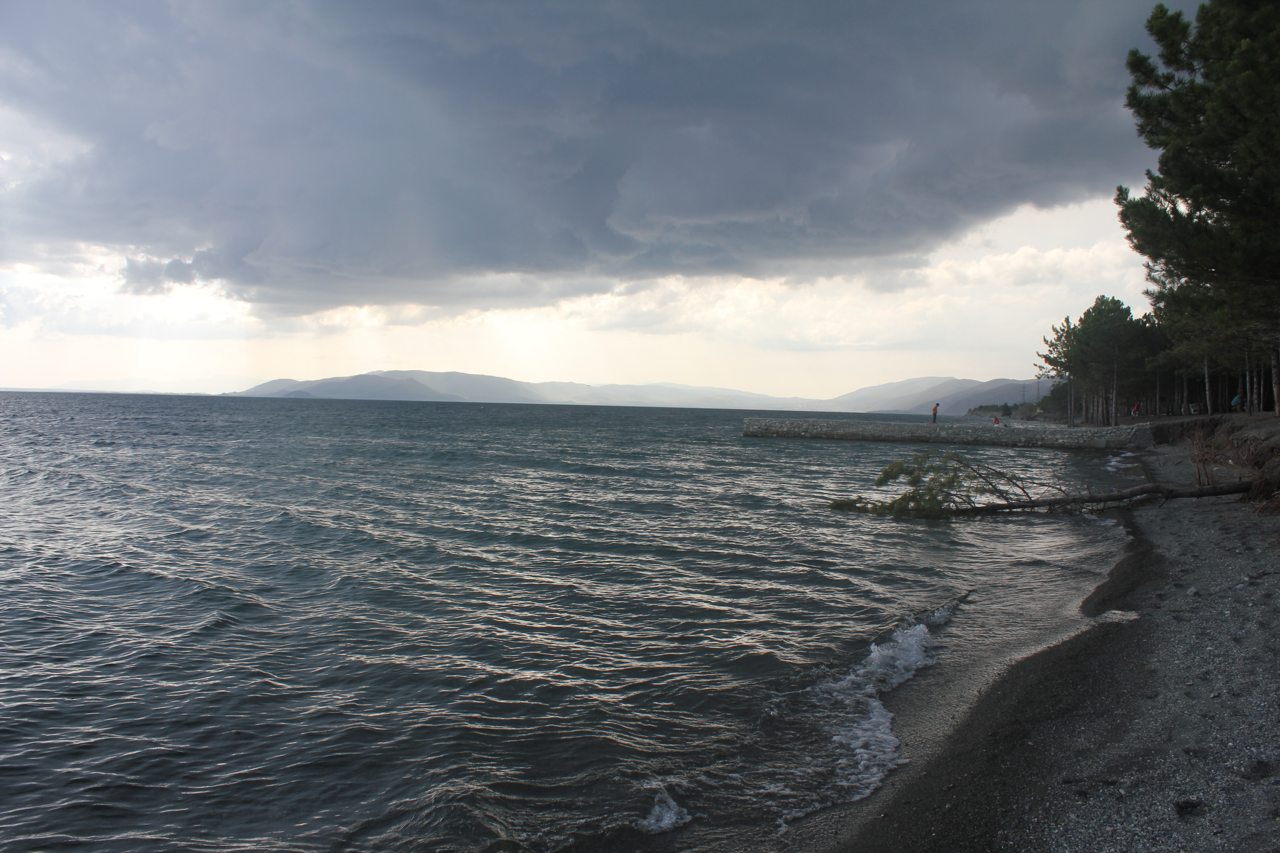
Almost all of aquascaping is a soft-water argument. Blackwater, low pH, low mineral, RO water and remineralising salts, Caridina in 4 dGH. Sevan is none of that. It is a high-altitude closed-basin lake in a volcanic catchment with an outflow-based residence time of about 180 years and annual evaporation larger than its entire inflow1. Water that evaporates leaves its salts behind. The result is bicarbonate water at pH well above 8, and a tank built to match it is a different machine from a Nature Aquarium.
The one direct measurement we could find is a botanist's aside, and it is higher than you expect. Barseghyan, surveying the aquatic vegetation of the Lake Sevan basin in 1975, describes the water as strongly magnesian, with a pH of 8.8 to 9.22. That is not a typo and it is not brackish-water exotica. It is a soda-leaning mountain lake. For scale, a reef tank runs about 8.2 and most freshwater fishkeepers have never seen 9.0 on a test kit.
Here is the honest state of the evidence on hardness, and it is worse than it should be. Lake Sevan has been studied continuously since the 1920s and we could not find a published general hardness or carbonate hardness figure for the lake itself in any language we could reach. What exists is a measurement of water drawn out of the lake. Sahakyan, Yedoyan and Bagdagyulyan sampled the Arzni-Shamiram canal, a 92 km irrigation canal fed by Lake Sevan and the Hrazdan, at three points, and reported total dissolved solids of 0.379 to 0.424 g/L, conductivity 470 to 520 microsiemens per centimeter, pH 8.2 to 8.5, and a bicarbonate water in which magnesium and sodium dominate3. Their ionic table is in milliequivalents, so the aquarium numbers can be calculated from it directly.
| Sampling point | pH | TDS, g/L | HCO3, meq/L | Ca + Mg, meq/L | dKH, ours | dGH, ours |
|---|---|---|---|---|---|---|
| Nor Hachn to Yeghvard | 8.5 | 0.393 | 3.56 | 3.68 | 10.0 | 10.3 |
| Byurakan | 8.4 | 0.381 | 3.64 | 3.88 | 10.2 | 10.9 |
| Kosh | 8.2 | 0.400 | 3.64 | 4.08 | 10.2 | 11.4 |
Read that table with the caveat attached. This is not lake water. It is canal water sampled tens of kilometres downstream of the lake, after the Hrazdan and after a hydroelectric station. It is the closest published proxy we could find and it is labeled as a proxy. Anyone who takes a GH and KH test kit to the shore at Tsovagyugh and posts the reading will have produced the first publicly available hardness figure for Lake Sevan that we are aware of. That is a genuinely useful thing to do and it costs about the price of a coffee.
Two features of that water are worth naming, because they are unusual.
Magnesium outweighs calcium. At every canal point the magnesium is roughly twice the calcium in milliequivalents3, and Barseghyan calls the lake water "strongly magnesian" outright2. Most aquarium remineralising salts are built the other way round, calcium-heavy, on the assumption of a limestone catchment. Sevan drains volcanic rock. If you are mixing a Sevan-like water from scratch, magnesium sulphate deserves more of the recipe than a general-hardness product will give it.
A pH between 8.2 and 9.2 is not an accident and cannot be argued down. It sits on a bicarbonate buffer at around 10 dKH. Adding peat or catappa to a tank like this achieves nothing except brown water. If you want the biotope, you keep the buffer. If you want soft water, build a different tank.
Cold: surface 19 to 20 C at the height of summer, bottom 8 to 12 C, complete ice cover about one winter in seven5. Hard and alkaline: pH 8.8 to 9.2 measured in the lake in 19752, pH 8.2 to 8.5 and about 10 dKH in canal water drawn from it34. Turbid: under 5 m Secchi1. Bicarbonate, magnesium-dominant.
Warm at 24 to 27 C. pH 6.0 to 7.0. GH 2 to 6, KH 0 to 3. Injected CO2 pulling pH down another point in the day. Water so clear the whole aesthetic depends on it. Everything on the water page and most of the plant list assumes this.
Measured across four Yerevan districts at 2.9 to 10.9 dGH and pH 6.01 to 7.306, because the city drinks Gegham mountain spring water, not lake water. So Yerevan tap is generally softer and less alkaline than Sevan A Sevan biotope in Yerevan is one of the rare tanks where you may have to add hardness rather than strip it.
A hard alkaline coldwater tank is a legitimate and under-built biotope, and Armenia has the only one of its kind on its doorstep. It is not a compromised tropical tank. It is a different discipline, closer to a Rift Valley setup in chemistry and to a temperate lake in temperature, and nobody in the hobby is doing it.
C. The take-home tank
Stone, sand and water. Which of it is worth carrying, and the arithmetic on the water.
Assume for this section that you have established what the park permits, because the section above says you must. What follows is the physical question: of the things on that shore, which ones actually do anything useful in a glass box.
Stone, and the inversion that makes Sevan easy.
On the hardscape page a carbonate rock is a hazard, because almost everything the hobby wants to build needs soft water and a limestone boulder wrecks it. In a Sevan tank that reverses. The lake runs at pH 8.8 to 9.22 on a bicarbonate buffer. A rock that raises KH is not contamination here. It is the biotope.
That does not mean stop testing. It means the test tells you something different. Vinegar-test every piece anyway, exactly as the hardscape page teaches, and record which pieces fizzed, because you need to know what your buffer is coming from before you can control it. Note the two blind spots that page names: solid dolomite barely reacts to cold acid, so file a corner and test the dust; and gypsum never fizzes at all because there is no carbonate in it, while still putting calcium into the water7.
What you will actually find. The catchment is mostly volcanic and mostly inert. Basalt is plagioclase, pyroxene, olivine and magnetite, documented as stable against acids and alkalis, and abundant in Gegharkunik among other provinces7; vesicular scoria and pumice are silicate volcanic glass with essentially no carbonate7. But carbonate is genuinely present too. Carbonate rocks of Devonian, Carboniferous, Cretaceous and Eocene age outcrop in the Argichi basin, which drains into Lake Sevan, so carbonate pebbles occur in the same gravel as the volcanics7. And the deep-spawning bojak used travertine at submerged spring vents58, which is freshwater limestone, in the lake, by definition.
The one to avoid is anything from the north-eastern shore that looks metallic or sulphidic. The Sevan ophiolite belt runs along that shore and there are numerous small metal ore deposits in the catchment, and a lake-wide survey found elevated titanium, chromium, copper, cadmium and lead in the water and molybdenum, mercury and cadmium carrying the highest sediment risk9. That is a reason to leave ore-looking rock where it is, not a reason to panic about a basalt cobble.
Sand and substrate, in four lines
- Test it
- A spoonful in a glass of vinegar. Sustained fine fizzing means carbonate sand, which in this tank is acceptable and in most others is not
- Rinse it
- Beach sand carries organics and fines. Rinse until the water runs clear, then rinse again
- Do not aim deep
- Sevan's own hypolimnion goes sulfidic in late summer10. That is the same chemistry as a black pocket in a deep sand bed, at the scale of a lake. Keep the bed shallow
- 0
- Aqua soil in this build. An acidic ammonia-releasing soil fights the whole point of an alkaline tank
The water
Carrying lake water home is romantic and, past about ten liters, pointless. Here is the arithmetic.
First, the mass. Water is a kilogram a liter. A 30 liter tank is 30 kilograms of water, which is thirty one-liter bottles or six five-liter containers, carried from a beach to a car and then two hours to Yerevan. A 5 liter jar is one container and a nice afternoon. That alone sets the honest ceiling on this idea.
Second, the decay. Lake water in a tank does not stay lake water. A water change of fraction f leaves (1 minus f) of the original behind each time, so after n changes the original fraction remaining is (1 minus f) to the power n4. At a modest 25 percent weekly, the Sevan water you carried is down to 32 percent after four weeks, 10 percent after eight and 3 percent after twelve4. Within two months the tank is running on whatever you top up with. So the thing that has to be Sevan-like is your tap water recipe, not the bottle in the boot.
Third, what happens to it in the car. A sealed bottle of lake water in a warm boot goes anoxic and the plankton in it dies and decomposes. It arrives as a bottle of nutrient. If you carry water at all, carry it cool, dark and loosely capped, use it the same day, and do not use it as the whole volume of a tank you care about. The genuinely good uses are small: seeding a jar, running a side-by-side, or having a liter to test with a GH and KH kit so that somebody finally publishes a number for this lake.
| Add | Amount | What it gives | Honest deviation from the lake |
|---|---|---|---|
| Sodium bicarbonate, baking soda | 3.0 g | about 10 dKH | Puts sodium at roughly twice the canal figure. Sevan is genuinely a sodium and magnesium bicarbonate water32, so this is the right salt, just heavy-handed |
| Magnesium sulphate heptahydrate, Epsom salt | 3.0 g | about 6.8 dGH of magnesium | Sulphate ends up around eight times the canal level. Substitute magnesium chloride hexahydrate at 0.36 g per dGH per 10 L if that bothers you |
| Calcium chloride dihydrate | 0.9 g | about 3.4 dGH of calcium | Chloride lands close to the measured value. Keeps the magnesium to calcium ratio at about 2 to 1, which is the lake's3 |
| Result | about 10 dGH, 10 dKH | pH will settle in the high 8s | A hardness and pH match, not an ionic replica. For plants and invertebrates that is the part that matters |
And you may not need RO at all. Yerevan tap measured 2.9 to 10.9 dGH across four districts, with the hardest at Davtashen6. A hard-district tap is already close to Sevan on general hardness and needs only bicarbonate to lift the KH and the pH. A soft-district tap needs the full recipe. Nobody can tell you which you have without a test kit, and the published figures are twenty years old, so measure your own tap before buying salts. From 2027 the new sanitary rules oblige the water operator to publish hardness and dissolved mineral data to consumers for the first time11, which will make this paragraph obsolete and should.
C. The take-home tank
The build, and the temperature problem, which is worse than the summer version of it.
Everyone frames this as a summer question. It is not. Lake Sevan's surface reaches 19 to 20 C at the very height of summer, and 18 to 19 C was the August figure before the drawdown5. A tank in a normally heated Yerevan apartment sits at roughly 19 to 23 C through the winter12. So a room-temperature tank in Yerevan is at or above Sevan's hottest week, in January There is no season in which an unmanaged indoor tank is a cold lake. That is the honest starting point and most of what follows is a response to it.
What fans buy, and where they stop.
Evaporative cooling works unusually well here, because the Ararat plain is semi-arid. A Yerevan room in July at 30 C and 39 percent relative humidity has a wet bulb of 19.5 C, which is 10.5 kelvin of theoretical headroom13. Nobody reaches the wet bulb, but the model in the hub's siting research gives concrete numbers for a 100 liter tank in that room: 26.0 C open with no fan, 23.4 C with a small clip fan, 22.2 C with a fan aimed across the surface, 21.3 C with two strong fans, and about 5 kelvin of real gain once realistic light and pump heat are added back13.
Read that against the lake. Two strong fans in a hot Yerevan room land you at about 21 C, which is one to two degrees above Sevan's summer surface and nine to thirteen degrees above its bottom. You have got close to the top of the lake and nowhere near the rest of it.
And the fans have a cost that is specific to this build. A clip fan on a 100 liter tank evaporates roughly 3 liters a day, about 90 liters over a 30 day hot spell13. Evaporation removes water and leaves every dissolved mineral behind. In a soft-water scape that is an annoyance. In a hard alkaline tank you are running an evaporative concentrator on water that is already at 10 dGH, and if you top up with tap you will climb. Top up with distilled or rain water, change water with the mix.
There is a pleasing symmetry in that, and it is not a coincidence. Lake Sevan loses more water to evaporation each year, 976 million cubic meters, than its entire inflow delivers, which is precisely why it is a mineral-rich alkaline lake in the first place1. Your tank, with a fan on it, will try to do the same thing on a windowsill, and for the same reason.
What a chiller has to remove. Our own calculation4
- 60 L
- tank, 60 by 30 by 35 cm, held at 19 C in a 30 C room
- 11 K
- the gradient the chiller fights
- ~49 W
- in through the glass, at 5.5 W per square meter per kelvin over 0.81 square meters
- ~7 W
- in across the surface by convection, plus about 15 W from light and pump
- ~70 W
- of continuous heat to remove, before crediting evaporation, which still runs and helps
So, the verdict on the chiller, stated plainly. If your target is Sevan's summer surface, 19 to 20 C, you can approach it in Yerevan without a chiller only by combining the coolest room in the flat, no direct sun, an open top, and two fans running through July, and you will still sit a degree or two high and lose three liters a day. You cannot hold it in a heatwave and you cannot hold it in a heated flat in January without opening a window. If your target is the lake below the thermocline, 8 to 12 C, you need refrigeration and there is no argument. An air-conditioned room is a better chiller than a chiller, because it fixes the room rather than fighting it, and because it also fixes the January problem by giving you a room you can let get cold.
The thing nobody warns you about
At pH 9, ammonia is a hundred times more dangerous than at pH 7.
Total ammonia splits between ammonium, which is relatively harmless, and free ammonia, which is not, and the split is set by pH and temperature. Using the standard aqueous ammonia equilibrium with a pKa of 9.40 at 20 C14, the free ammonia fraction is 0.4 percent at pH 7.0, 11 percent at pH 8.5, 20 percent at pH 8.8 and 39 percent at pH 9.24. The same test-kit reading of total ammonia is roughly a hundred times more toxic in a Sevan tank than in a typical soft-water scape.
What that means in practice. Cycle this tank properly and completely before anything goes in it, keep the stocking light, do not overfeed, and treat any ammonia reading above zero as an emergency rather than a phase. See the cycling page. It also means the plants matter: a heavily planted tank at low light with slow-growing mosses is not a fast ammonia sink, so the biofilter has to be real.
Light, flow and filtration
Low light is not a compromise here. It is the biotope.
Secchi depth in Sevan today is under 5 meters1 and even in the clear era the flowering plants stopped at 5 to 6 meters and the mosses at 162. Run a modest light on a short photoperiod and accept green water as characteristic rather than as failure. No CO2. Injecting CO2 into a 10 dKH tank is fighting the buffer and destroying the one thing that makes it a Sevan tank.
Flow should be rough. Sevan is constantly worked by wind-driven waves; several tonnes of aquatic plants are torn out and thrown onto the beaches every year, and Potamogeton pectinatus holds the surf zone because it is the most wave-resistant of the thirteen2. Point the return at the surface. It suits the biotope and it also does the oxygen work, which matters more in warm alkaline water than in cool acidic water.
The honest stocking answer
Plants and nothing else, or admit it is Sevan-inspired.
A strict Lake Sevan biotope has no animals you can lawfully and ethically keep The three endemics are Red Book listed, protected and in two cases already extinct as named forms15. The animals you could legally buy that suit hard alkaline water, Neocaridina davidi, ramshorn and Malaysian trumpet snails, are not from Sevan and never have been. Putting them in is a legitimate choice and makes a good tank. It does not make a biotope, and this hub says the same thing about a planted Amazon tank on the livestock page. Call it what it is.
| Decision | The answer | Why |
|---|---|---|
| Volume | 20 to 40 L | Small enough that carrying real lake water for the first fill is honest, and small enough to sit in the coolest room |
| Temperature | 19 to 22 C, no heater | Sevan's summer surface is 19 to 205. Below 19 needs refrigeration. Above 23 the willow moss suffers |
| Water | 10 dGH, 10 dKH, pH high 8s | Recipe above4. Top up with distilled, change with the mix |
| Substrate | Inert sand and grit over pumice. Shallow | No aqua soil. Shallow because deep beds go sulfidic, which is what the lake itself does every autumn10 |
| Hardscape | Rounded volcanic cobbles, vinegar-tested and recorded | Carbonate is not a fault in this tank, but you need to know which pieces are supplying the buffer7 |
| Light | Low, short photoperiod | The lake is turbid1. Also the cheapest way to keep the water cool13 |
| CO2 | None | The buffer is the biotope |
| Filtration and flow | Simple sponge or small internal, return breaking the surface | Wave-worked lake2, and free ammonia is 20 to 39 percent of total at this pH414 |
| Plants, first choice | Fontinalis antipyretica, willow moss | Native to Lake Sevan at 6 to 16 m, grows year round including under ice, and is sold across Europe as a coldwater aquarium moss2. Buy it, do not dig it |
| Plants, second | Ceratophyllum demersum, hornwort | Native to the lake2, needs no substrate, roots, fertiliser or CO2, and floats at any depth |
| Plants, if you can get them | Potamogeton crispus, P. perfoliatus, Myriophyllum spicatum, Lemna minor | All on Barseghyan's list of thirteen2. Pond trade rather than aquarium trade, and they will want the surface |
| Animals | None, for a true biotope | Every native option is protected1516. If you add shrimp, the tank is Sevan-inspired and you say so |
Two smaller versions that are better first attempts than the tank. A five liter jar filled entirely with real lake water, one stone and a handful of hornwort, on a windowsill that does not get direct sun, is the whole idea at a scale where carrying the water is trivial and nothing is lost if it fails. That is the pond jar approach applied to a specific lake. And a bucket on a north-facing balcony, unheated through an Armenian winter, gets closer to Sevan's actual thermal range than any indoor tank will, which is the point the windowsill page keeps making from the other direction. The easy setups page is where to start if this is your first tank rather than your fifth.
And the thing worth doing that nobody has done. Sevan has a continuous instrumental and biological record running from 1927 to 2023 and 356 papers we have catalogued from one Armenian archive alone, each with a free PDF17, and not one published general hardness figure a fishkeeper can use. Take a test kit to the shore. Post the numbers. The community page is where to put them, and the science database is where the rest of the reading is.
- Shikhani, M., Mi, C., Gevorgyan, A., Gevorgyan, G., Misakyan, A., Azizyan, L., Barfus, K., Schultze, M., Shatwell, T. and Rinke, K. (2021). Simulating thermal dynamics of the largest lake in the Caucasus region: the mountain Lake Sevan. Journal of Limnology 81(s1): 2024. Open access. Secchi depths for both basins 2017 to 2019, the light extinction coefficient, the water budget and the residence times. DOI 10.4081/jlimnol.2021.2024 open access
- Barseghyan, A.M. (1975). The aquatic vegetation of the Lake Sevan basin. In Flora, Vegetation and Plant Resources of Armenia (Takhtajania), vol. 6: 73 to 87. Botanical Society, Yerevan. In Russian with an Armenian summary. The only specialist survey of the higher plants of Lake Sevan: the two depth belts, the thirteen flowering species, the five stoneworts and three mosses, the pH of 8.8 to 9.2, the Secchi disc at 21 m, and the conclusion that the drawdown moved the plant belts rather than destroying them. Scanned, no text layer. arar.sci.am PDF open access, Russian
- Sahakyan, S.V., Yedoyan, T.V. and Bagdagyulyan, A.S. (2022). Assessment of water quality and irrigation suitability of the Hrazdan River and several canals fed from it. Biological Journal of Armenia 2(74): 11 to 16. Table 1 gives TDS, conductivity, pH and the major ions in milliequivalents per litre for three points on the Arzni-Shamiram canal, which the paper states is fed by the waters of Lake Sevan and the Hrazdan River, and four on the Lower Hrazdan canal. DOI 10.54503/0366-5119-2022.74.2-11, free PDF open access
- Our own arithmetic. Not a published source. The hardness conversion: one degree of German hardness equals 17.86 mg/L as calcium carbonate, which is 0.357 milliequivalents per litre, so dKH is the bicarbonate figure in meq/L divided by 0.357 and dGH is the sum of calcium and magnesium in meq/L divided by 0.357. Applied to source 17 this gives 10.0 to 10.2 dKH and 10.3 to 11.4 dGH. The authors' own ion table balances to three significant figures, which is why we trust it enough to convert it. Also ours: the water-change decay series, where a change of fraction f leaves (1 minus f) to the power n of the original after n changes, so at 25 percent weekly 0.75 to the fourth is 31.6 percent, to the eighth is 10.0 percent and to the twelfth is 3.2 percent; the remineralising recipe, from the molar masses MgSO4.7H2O 246.5, CaCl2.2H2O 147.0 and NaHCO3 84.0, with 1 dGH taken as 7.14 mg/L calcium or 4.34 mg/L magnesium and 1 dKH as 30.0 mg/L sodium bicarbonate; the summer heat-load calculation, where a 60 by 30 by 35 cm tank has 0.81 square metres of glass and 0.18 of surface, giving 0.81 x 5.5 x 11 = 49 W through the glass and 0.18 x 3.5 x 11 = 7 W across the surface at an 11 K gradient, plus about 15 W of equipment heat, for roughly 70 W before crediting evaporation, and 25 to 35 W of electricity at an assumed compressor coefficient of performance of 2 to 3; and the free ammonia fractions, from 1 divided by (1 plus 10 to the power (pKa minus pH)) with the pKa of source 43. calculated, repeatable, unverified by a third party
- Gabrielyan, B., Khosrovyan, A. and Schultze, M. (2022). A review of the anthropogenic stress on Lake Sevan and the current state of the ecosystem. Journal of Limnology 81(s1): 2061. Open access. The level, volume, area, depth, temperature and transparency series used throughout this page. DOI 10.4081/jlimnol.2022.2061 open access
- Shahinyan, H.V. (2005). On the hydrogeochemical characteristics of some drinking waters supplying the city of Yerevan. Proceedings of NAS RA, Earth Sciences LVIII(1): 41 to 45. Sampling 2002 to 2004 across four Yerevan districts and the source springs: GH 2.9 to 10.9 and pH 6.01 to 7.30. arar.sci.am PDF open access
- This hub's own hardscape research and catalogue. The vinegar test and its two blind spots, dolomite and gypsum, and the composition entries for Armenian basalt, volcanic scoria, pumice, tuff, travertine, limestone and river stone, including the carbonate outcrops in the Argichi, Vedi and Hrazdan basins. Each entry there carries its own primary geological sources. Find a hardscape and the materials catalogue
- Levin, B.A., Simonov, E., Gabrielyan, B.K., Mayden, R.L., Rastorguev, S.M., Roubenyan, H.R., Sharko, F.S. and Nedoluzhko, A.V. (2022). Caucasian treasure: genomics sheds light on the evolution of half-extinct Salmo ischchan species flock from Lake Sevan. Molecular Phylogenetics and Evolution 167: 107346. Five genetically supported ecomorphs against the four named in Armenian law, and the spawning ecology of the extinct forms. DOI 10.1016/j.ympev.2021.107346 paywalled, abstract open via Europe PMC
- Gevorgyan, G., von Tuempling, W., Shahnazaryan, G., Friese, K. and Schultze, M. (2023). The first lake-wide trace element survey of Lake Sevan sediment and water. Journal of Limnology 81(s1): 2096. Open access. Elevated titanium, chromium, copper, cadmium and lead in water and boron in nearly all samples; molybdenum, mercury and cadmium carrying the highest sediment risk; sediment concentrations higher in Big Sevan than in Small Sevan; and the Sevan ophiolite belt along the north-eastern shore as a partly natural source. DOI 10.4081/jlimnol.2022.2096 open access
- Avetisyan, K., Mirzoyan, N., Payne, M., Hayrapetyan, A. and Kamyshny, A. (2021). Sulfur cycling in Lake Sevan: hydrogen sulfide in the late-summer hypolimnion reaching 9 micromolar in Big Sevan and 39 in Small Sevan, with 66 percent of the lake bottom covered by sulfidic water and 19 percent of lake volume sulfidic in October 2019. Isotopes in Environmental and Health Studies 57(5): 535 to 552. DOI 10.1080/10256016.2021.1970548 paywalled, abstract open, PMID 34519245
- Sanitary Rules and Hygienic Norms 2.1.4.001-23, brought in by RA Ministry of Health Order N 53-N of 16 November 2023 and modelled on EU Directive 2020/2184. No hardness limit; conductivity 2500 microsiemens per centimetre, pH 6.5 to 9.5; and an obligation on the operator to publish hardness and dissolved mineral, anion and cation information to consumers. The operator states these take effect in 2027. arlis.am open access, Armenian
- This hub's own indoor temperature reasoning, on the livestock page. An unheated tank in a normally heated Yerevan apartment at roughly 19 to 23 C in winter, 12 to 15 C or lower if the heating fails, and above 30 C in an un-airconditioned room in summer. These are inference from published outdoor climate normals plus ordinary apartment heating, not measurements: nobody has logged tank temperatures in Armenian apartments across a winter. Livestock and biogeography our own estimate, labelled as such there
- This hub's own siting and environment research, and the steady-state model behind it. A 100 L tank of 80 by 35 by 40 cm, glass at 5.5 W per square metre per kelvin, surface convection at 3.5, evaporative mass transfer from the Lewis relation, latent heat 2,440 kJ/kg, barometric pressure 887 hPa for Yerevan, saturation vapour pressure after Buck (1981). Yields the July wet bulb of 19.5 C at 30 C and 39 percent relative humidity, the fan table from 26.0 C down to 21.3 C, and the roughly 3 litres a day of evaporation. It is a model, not a measurement. The underlying Yerevan climate normals and the Buck equation are cited in that file. Materials and water
- Emerson, K., Russo, R.C., Lund, R.E. and Thurston, R.V. (1975). Aqueous ammonia equilibrium calculations: effect of pH and temperature. Journal of the Fisheries Research Board of Canada 32(12): 2379 to 2383. The standard reference for the ammonia and ammonium split, and the source of the pKa used here. DOI 10.1139/f75-274
- Red Book of Animals of the Republic of Armenia (2010). Annex to Government Decision N 71-N of 29 January 2010. The legal statuses of the Sevan trout and its four named forms, the Sevan khramulya and the Sevan barbel, the last-record dates, the ban dates, and the species names used in Armenian law. The ARLIS amendment history is empty: the Red Book has never been amended. arlis.am, text at environment.gov.am open access, Armenian
- RA Law on Fauna (Կենդանական աշխարհի մասին), HO-52, adopted 3 April 2000, rewritten in 2022, in force since 14 April 2023. Article 21 on keeping wild animals in confinement, Article 23 on the closed list of permitted uses, Article 19(a) on transfer into a different habitat and acclimatisation, Article 27 on Red Book species. arlis.am open access, Armenian
- This hub's Lake Sevan literature database. A list of 356 articles on Lake Sevan held on arar.sci.am, the Pan-Armenian Digital Library run by the Fundamental Scientific Library of the National Academy of Sciences of Armenia, spanning 1927 to 2023, in Russian, Armenian and English, each with a direct PDF link. 324 are in Russian and 27 in Armenian. It is a catalogue we built, not a source in itself; every paper in it is its own source. Sevan science
Continue
Where to go next.
The law and the biosecurity
Read before collecting anything: the park, the Ramsar listing and the biosecurity.
Materials and water
The hardness and alkalinity arithmetic the build depends on.
Find a hardscape
What the stone does once it is in the tank, material by material.
Heat, cooling and the winter heater
The cooling problem, which is harder here than the ordinary summer version.