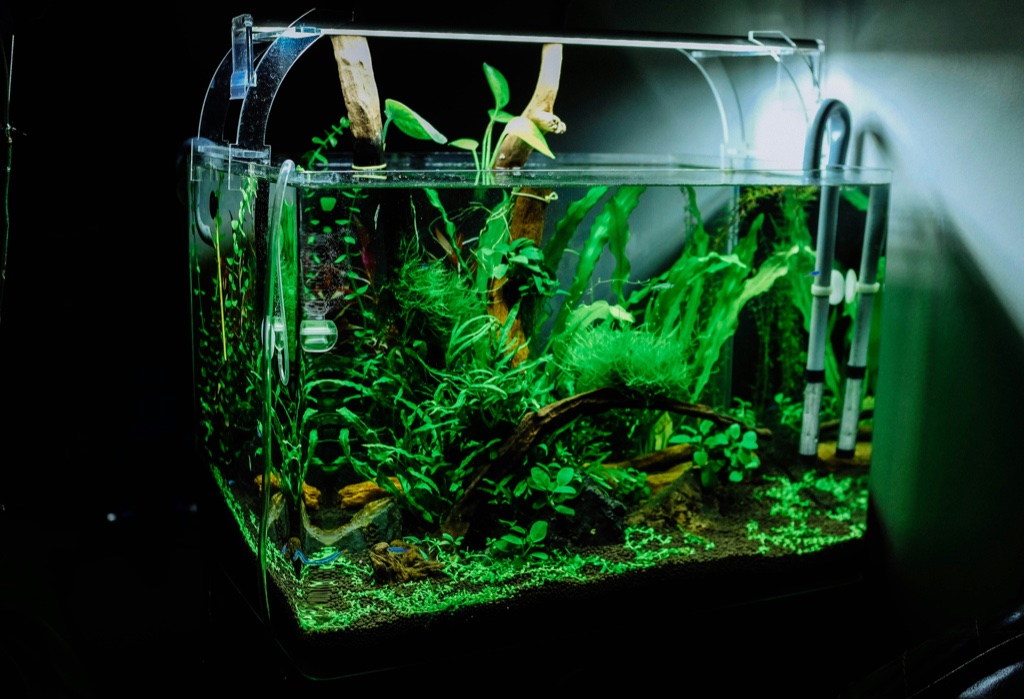
Heat, and it is the serious one here
Warm water holds less oxygen at exactly the moment the fish need more of it.
Yerevan has 82 days a year when the maximum passes 30 C. Armavir has 90, the Yerevan plain station has 90, and Meghri has 911. That is roughly a quarter of the year. The national record is 43 C, set in Yerevan and tied by Meghri on 1 August 20111. Gyumri and Dilijan are a different country for this purpose, and advice written for one is wrong for the other.
| Station | July mean | July mean daily max | Days a year at or above 30 C | January mean |
|---|---|---|---|---|
| Yerevan, Arabkir, 1113 m1 | 25.6 C | 34.5 C | 82 | -2.4 C |
| Yerevan, Agro plain, 942 m1 | 26.4 C | not published | 90 | -3.6 C |
| Armavir, 861 m1 | 25.9 C | not published | 90 | -3.3 C |
| Meghri, 627 m1 | 27.2 C | 32.2 C | 91 | +2.4 C |
| Gyumri, 1513 m1 | 20.3 C | 27.1 C | not published | -7.8 C |
| Dilijan, 1256 m1 | 19.2 C | 24.4 C | 13 | -0.9 C |
The oxygen curve, with an Armenian correction that nobody makes
Oxygen dissolves less readily in warm water, and the numbers for that are standard. What is not standard, and what changes every stocking recommendation you will read, is altitude Gas dissolves in proportion to its partial pressure above the water, and partial pressure falls with barometric pressure. Yerevan sits at about 887 hPa and Gyumri at about 846, against 1013 at sea level1.
The table below is computed by us2 from the Benson and Krause saturation equation as published in Standard Methods3, corrected for barometric pressure in the usual way.
| Water temperature | Sea level | Yerevan, 887 hPa | Gyumri, 846 hPa | Yerevan shortfall |
|---|---|---|---|---|
| 20 C | 9.093 | 7.932 | 7.562 | 12.8 %2 |
| 22 C | 8.743 | 7.632 | 7.262 | 12.8 %2 |
| 24 C | 8.423 | 7.342 | 6.992 | 12.8 %2 |
| 26 C | 8.113 | 7.072 | 6.732 | 12.9 %2 |
| 28 C | 7.833 | 6.812 | 6.492 | 12.9 %2 |
| 30 C | 7.563 | 6.582 | 6.262 | 13.0 %2 |
| 32 C | 7.303 | 6.352 | 6.042 | 13.1 %2 |
| 34 C | 7.063 | 6.142 | 5.832 | 13.2 %2 |
Read the last column. A tank in Yerevan holds about 13 percent less oxygen than the identical tank at sea level, at every temperature. Gyumri loses about 17 percent2. Every stocking table in every English or Russian aquarium book is written for sea level, so in Armenia they are all optimistic by roughly an eighth. Nobody mentions this, and it applies to every tank in the country.
The squeeze, in two numbers
Supply falls with temperature, as above. Demand rises with temperature, because a fish is an ectotherm and its metabolism follows the water. This has been measured on an aquarium fish. Cooper, Mueller and Eme acclimated neon tetra and black neon tetra at 26, 29 and 31 C and measured oxygen consumption. The temperature quotient across 26 to 31 C was 1.92 for neon tetra4, which means a ten degree rise very nearly doubles the oxygen the fish needs2.
Take a Yerevan tank from 24 C to 30 C and put the two together.
Supply
Down about 10 percent2
Saturation falls from 7.34 to 6.58 mg/L at Yerevan pressure2. That is before anything in the tank has consumed a single milligram of it.
Demand
Up about 47 percent2
At a measured temperature quotient of 1.924, a six degree rise multiplies the fish's oxygen requirement by roughly 1.472.
And the third term
The filter is breathing too
Our own research on what actually lives in a biofilter found ammonia oxidisers making up only 1.6, 3.1 and 3.8 percent of the community on three home filter sponges5. The overwhelming majority are fast-growing heterotrophs, and in a warm well-fed tank they are competing with the fish for the same gas.
That is the whole summer problem in one line. The fish needs about half as much again, and the water can hold about a tenth less. Nothing else about an Armenian summer needs explaining once that sentence is understood.
Lethal thresholds
Two different numbers get quoted for how hot a fish can survive, and the forum always quotes the wrong one.
CTMax, the critical thermal maximum, is measured by warming the water at a steady rate over minutes and recording where the fish loses equilibrium. It is an acute, short-exposure figure. CLMax or CLT, the chronic lethal maximum, is the temperature at which the fish is held for a long period and cannot live. The gap between the two is large, and the number that circulates in the hobby is almost always the acute one.
| Species | Chronic lethal, measured | Acute CTMax, measured | Study |
|---|---|---|---|
| Neon tetra, Paracheirodon innesi | 33.5 C4 | 38.5 to 39.6 C4 | Cooper, Mueller and Eme, 20194 |
| Black neon tetra, Hyphessobrycon herbertaxelrodi | 35.9 C4 | 39.5 to 41.0 C4 | Cooper, Mueller and Eme, 20194 |
| Peppered cory, Corydoras paleatus | 34.9 C plus or minus 0.526 | 38.4 C6 | Conte, de Campos and Eme, 20236 |
A neon tetra that survives a five minute ramp to 39 C cannot live at 33.5 C. The authors state the conclusion plainly: neither tetra can survive temperatures four to five degrees above their natural averages4. Peppered cory gain 0.55 C of upper tolerance for every degree of acclimation temperature6, which is the measured version of the true but limited idea that fish get used to things.
Caution one
A lethal temperature is not a target
It is the temperature at which the animal dies. Long before it, growth stops, the immune system falters and nothing breeds. A chronic lethal figure is a wall, not a ceiling to aim for.
Caution two
These are laboratory fish in clean saturated water
A home tank at 33 C with a heavy stock and a rich substrate is not the same experiment. Every stressor stacks, and heat is the one that makes all the others worse.
Caution three
Most species have no published number at all
Three species are listed above because three species have been measured properly. The absence of a figure is not evidence of tolerance, and most of the hobby's temperature advice is not built on measurements of this kind.
Air breathers are a real exception, and there is a mechanism
De Lima and colleagues tested two Amazonian loricariid catfishes under low oxygen in 2025. In Pterygoplichthys pardalis, the sailfin pleco, thermal tolerance was unaffected by the oxygen in the water so long as the fish could reach the surface, and dropped only when surface access was blocked. In Ancistrus dolichopterus, the bristlenose, whose air-breathing stomach is less capable, thermal tolerance fell away below the critical oxygen pressure even with air available7.
That is a published, mechanistic reason why plecos are hardy in hot water. It also says something more useful: "pleco" is not one animal. A sailfin is tougher than a bristlenose, and it is tougher for an anatomical reason you can point at. Bettas and gouramis do something related. Le, Burggren and Martinez-Bautista found adults of both Betta splendens and the blue gourami shifting from gill ventilation towards their air-breathing organ as the temperature climbed8. A labyrinth fish in hot water solves the oxygen problem by leaving the water for it.
The remedies, ranked honestly
Five ways to cool a tank, in order of what they buy for what they cost.
Every temperature figure below marked computed comes from one steady-state energy balance, stated here once so that it can be checked or argued with. A 100 L tank of 80 by 35 by 40 cm. Heat crosses the glass at an overall 5.5 watts per square meter per kelvin. The open surface loses heat by convection at 3.5 watts per square meter per kelvin and by evaporation, with the evaporation coefficient taken from the Lewis relation. Latent heat 2,440 kJ per kilogram. Barometric pressure 887 hPa, which is Yerevan1. Saturation vapour pressure from Buck9. This is a model, presented as an order of magnitude, not a measurement10.
Do not create the heat. Siting and shading.
Free. Permanent. Larger than everything below it.
No direct sun at any hour in any month, away from the window, away from the radiator, off the top of an appliance. A sunlit tank can pick up several degrees in an afternoon and no fan wins that argument.
In a heatwave, shorten the lighting period and lift the fixture off the glass so its waste heat goes into the room instead of the water. An LED sitting on a cover glass is a heater with a pleasant spectrum.
Surface agitation, which is where the aeration question gets answered properly.
Nearly free. Helps oxygen more than it helps temperature, and oxygen is the actual problem.
The claim to test: an airstone oxygenates the water by delivering oxygen out of the bubbles. That is not really what happens, and the difference changes what you should buy.
Computed, assumptions stated. A 3 mm bubble rising 40 cm at 25 cm per second is in the water for 1.6 seconds With an ordinary bubble film coefficient, and water at 85 percent of saturation at 27 C in Yerevan so a deficit of about 1.04 mg/L, that bubble gives up roughly 0.4 percent of the oxygen it is carrying before it reaches the top and bursts. An air pump moving 100 liters of air an hour carries about 24 grams of oxygen past the fish and hands over something on the order of 100 milligrams of it2.
Now the surface. A still water surface is a poor exchanger. Cole and Caraco measured gas transfer across a lake at zero wind and found a transfer velocity of about 2.07 cm per hour11. Applied to the 0.28 square meter surface of the same tank at the same deficit, a still surface takes up about 6 milligrams of oxygen an hour Give that surface a strong continuous ripple and the transfer velocity rises by roughly an order of magnitude, and the same surface takes up 60 to 70 milligrams an hour2.
So the mechanism, stated correctly. The rising bubble column drags a column of water from the bottom of the tank to the top and spreads it out. That constantly replaces the thin film at the surface with water from below. It is the surface renewal, not the bubble wall, that does the work. The airstone is a way of stirring the surface, not a device that injects oxygen.
And the consequence is liberating. If surface renewal is the mechanism, an air pump is only one way to buy it. Angle the filter return so it breaks the surface. Fit a spray bar just below the water line. Point a small circulation pump upwards. Any of these does the same job with no air pump, no hum and no salt spray on the furniture. Buy the surface movement, not the bubbles.
Keep one air pump anyway, for one specific reason: it is the only piece of this that will run off a battery when the mains fails. That is the power cut section further down.
One caution. Vigorous surface movement also drives carbon dioxide out. A tank with injected CO2 and a hard-running airstone is spending money to fight itself.
A fan across the surface. Evaporative cooling, and Armenia is unusually good ground for it.
Cheap, quiet, effective. Costs water, and therefore costs minerals.
Evaporating a kilogram of water carries away 2,440 kJ10. The limit of what evaporation can achieve is the wet bulb temperature, the temperature air reaches if it is cooled to saturation with no heat added or removed. The drier the air, the lower the wet bulb, and the more cooling is on the table. The Ararat plain is semi-arid: Yerevan's plain station averages 41 percent relative humidity in August and Armavir 461.
| Situation | Air | Vapour pressure | Relative humidity | Wet bulb | Available depression |
|---|---|---|---|---|---|
| Yerevan room, July1 | 30 C | 16.6 hPa1 | 39 %9 | 19.5 C10 | 10.5 K10 |
| Yerevan heatwave room1 | 32 C | 16.6 hPa1 | 35 %9 | 20.1 C10 | 11.9 K10 |
| Yerevan plain air1 | 28 C | 13.6 hPa1 | 36 %9 | 17.4 C10 | 10.6 K10 |
| Dilijan room, July1 | 26 C | 16.5 hPa1 | 49 %9 | 18.3 C10 | 7.7 K10 |
| Arrangement | Water settles at | Below the room | Share of the wet bulb depression reached | Water evaporated |
|---|---|---|---|---|
| Open tank, no fan10 | 26.0 C | 4.0 K | 38 %10 | 1.07 L per day10 |
| Small clip fan, gentle10 | 23.4 C | 6.6 K | 63 %10 | 2.18 L per day10 |
| Clip fan aimed across the surface10 | 22.2 C | 7.8 K | 75 %10 | 3.23 L per day10 |
| Two fans, strong10 | 21.3 C | 8.7 K | 83 %10 | 4.63 L per day10 |
Add 25 watts of light and pump heat, which is realistic, and the no-fan case rises to 28.2 C and the clip fan case to 23.1 C. So in a working tank the fan is worth about five degrees.10 Two honest notes on that. The hobby figure of "a fan buys two to four degrees" is the marginal gain over an already-evaporating open tank, and it is entirely compatible with this model. And an open tank is already four degrees below the room before you do anything at all, which is why a cover glass is a handicap in July and a saving in January.
What the fan costs, and this is the part that gets left out. A clip fan on a 100 L tank evaporates about 3 liters a day, three percent of the tank, every day, for as long as the heat lasts. Over a thirty day hot spell that is roughly ninety liters, close to a whole tank volume10.
Evaporation removes water and leaves everything dissolved in it behind. Top up with tap water and every liter adds its full mineral load, and none of it ever leaves. Ninety liters of tap water topped into a 100 L tank over a month roughly doubles the dissolved solids if no water is changed in between10. Top up with rain, distilled or reverse osmosis water. Change water with tap water. Topping up and changing water are two different operations with two different liquids, and a fan in an Armenian August is how most people find that out the hard way.
A chiller. It works, it is expensive, and it heats the room it stands in.
The right answer to a narrow question.
A chiller is a refrigeration loop. It holds a set temperature to a fraction of a degree and it evaporates nothing, so the mineral problem disappears entirely. Three costs.
Purchase. A compressor, a heat exchanger, a pump loop and a controller. On a freshwater tank it is normally the single most expensive item, comfortably more than the tank.
Running. A refrigeration cycle moves heat; it does not destroy it. To hold that 100 L tank five degrees below a 30 C room, the chiller continuously removes roughly the same tens of watts as the fan10, while its compressor draws several times that in electricity. Use the energy figure here with the rate on your current electricity bill.12
The room gets warmer. All the heat taken out of the tank, plus all the electricity the compressor used, is dumped into the room the tank is in. In a Yerevan flat with no air conditioning the chiller and the room are having an argument that the chiller only wins locally.
A chiller is right in one situation: a species that genuinely cannot survive your summer, in a place that genuinely reaches those temperatures, where the species has already been chosen and cannot be changed. It is the wrong answer to a fish choice that has not been made yet.
Ice bottles, which are a bad habit rather than bad physics.
Fine as an emergency. Poison as a plan.
The physics is real. Melting a kilogram of ice absorbs 334 kJ, which drops 100 liters by about 0.8 of a degree10. The objection is not to the arithmetic, it is to the shape of the intervention.
It is a sawtooth. In goes the bottle, down goes the temperature over an hour, the bottle melts, back up it climbs. Fish are harmed more by instability than by a steady temperature a degree or two high.
It requires you to be there. The hottest hours are the working day. A remedy that only works when someone is home fails on the day it is most needed.
It scales badly. Holding that tank three degrees below the room means removing about 22 watts continuously, which is roughly 1.9 megajoules a day, which is about 5.7 kilograms of ice a day, hand delivered10.
And it teaches you that the problem is handled. That is the real objection. An ice bottle is a visible action that feels like a fix and quietly prevents the permanent fix from being made. Use it the afternoon a heater sticks on. Then buy the fan.
The summer answer, in one paragraph. In Yerevan, plan for a room in the low thirties for about a quarter of the year. Site the tank out of the sun first, because that is free and it is the biggest single term. Take the lid off, because an open tank is already several degrees below the room. Put a fan across the surface, accept that it costs about three percent of the volume in evaporation every day, and top that up with mineral-free water rather than tap. Keep the surface moving all summer, because at 30 C the fish need about half as much oxygen again as at 24 and the water holds about a tenth less, before the thirteen percent Yerevan altitude penalty is even counted2. And choose the fish for the room you actually have, rather than buying a chiller for the fish you wanted. If the honest answer is that this species cannot live in your flat in August, that is a real answer and it is much cheaper to hear it now.
Winter
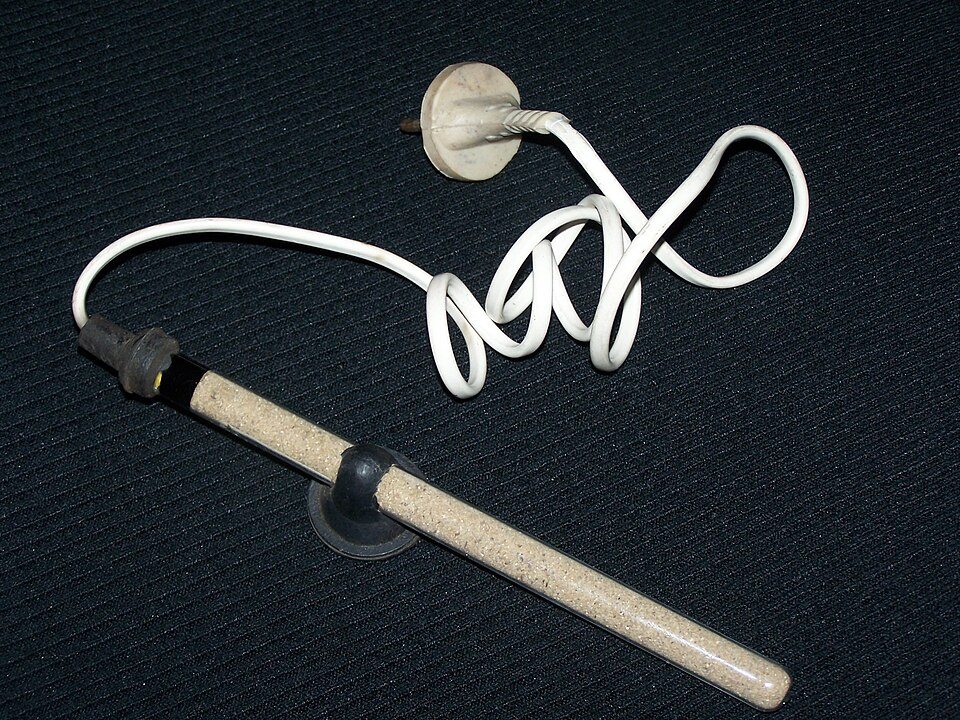
How big a heater, and why the way it fails matters more than the way it works.
The hobby rule is one watt per liter. That is roughly right for a mid-sized tank in a cool room and wrong at both ends of the range, because heat loss follows surface area while volume follows the cube of length. A small tank needs more watts per liter than a large one, and every table below says so.
Computed with the same energy balance as the cooling section, holding the water at 25 C, at Yerevan pressure, with indoor humidity taken as 30 to 35 percent10. That is not a guess: Yerevan winter air heated to room temperature reaches only 14 to 22 percent relative humidity before the occupants add any moisture of their own1. The two figures in each cell are open surface, then with a cover glass
| Tank | Volume | Room 16 C | Room 18 C | Room 20 C | Room 22 C |
|---|---|---|---|---|---|
| 60 x 30 x 30 cm | 54 L | 71 / 44 W10 | 60 / 35 W10 | 49 / 26 W10 | 39 / 18 W10 |
| 60 x 30 x 36 cm | 65 L | 76 / 49 W10 | 64 / 39 W10 | 52 / 29 W10 | 41 / 19 W10 |
| 80 x 35 x 40 cm | 112 L | 114 / 72 W10 | 97 / 58 W10 | 79 / 43 W10 | 62 / 29 W10 |
| 100 x 45 x 45 cm | 202 L | 174 / 107 W10 | 149 / 86 W10 | 122 / 65 W10 | 97 / 43 W10 |
| 120 x 50 x 45 cm | 270 L | 222 / 133 W10 | 190 / 107 W10 | 157 / 80 W10 | 125 / 54 W10 |
In watts per liter that runs from 1.31 for a 54 liter tank in a 16 C room down to 0.46 for a 270 liter tank in a 22 C room10. The one watt per liter rule sits in the middle of that range and is not a bad rule, but it is a rule about one particular tank in one particular room.
The cover glass is the largest single lever in winter and it is nearly free. It roughly halves the requirement, because most of the loss from an open tank into dry Armenian winter air is evaporation rather than conduction. The same model says an open 100 liter tank at 25 C in a 16 C room evaporates about 1.6 liters a day; with a cover glass, about 0.310. That is the exact mirror of the summer section. The lid is a heater in winter and a handicap in summer, so take it off in June and put it back in October.
One Armenian footnote on sizing. Yerevan's January mean is minus 2.4 C and Gyumri's is minus 7.81, but the tank is indoors, so neither number is the one that matters. Measure your own room at six in the morning in January and size the heater against that. A room that sits at 21 C in the evening and 15 C before dawn is a room whose heater must be sized for 15.
Four ways a heater fails
Failure one, the benign one
The thermostat fails open and the heater stops
The tank cools towards room temperature and stops there. Slow, bounded, and visible within a day if you read a thermometer.
Failure two, the dangerous one
The thermostat fails closed and the heater never stops
Cheap heaters use a bimetallic contact that can weld shut, and limescale can jam the mechanism. The tank warms until its heat loss equals the heater's power, and that ceiling can be a long way above anything the fish can survive.
Failure three
The tube cracks
Almost always thermal shock, and almost always because the heater was running dry or half exposed during a water change and was then splashed or refilled. A cracked heater either stops, or leaks mains current into the water. The second case is what the next section exists for.
Failure four, the invisible one
The controller drifts
The dial reads 25 and the water is at 28. Common on inexpensive heaters and undetectable without a separate thermometer that is not part of the heater.
Why failing on is much worse than failing off
It is bounded on one side and not the other. A heater that stops cannot cool the tank below room temperature. A heater that will not stop is bounded only by its own wattage against the tank's heat loss.
The direction is wrong in three ways at once. Cold slows a fish down, so oxygen demand falls, and cold water holds more oxygen. A cooling tank moves towards a larger safety margin on every axis. A heating tank does the opposite of all three simultaneously, which is exactly the squeeze described above.
The clock is different. A tank that loses its heater in a heated flat drifts down a fraction of a degree an hour and takes most of a day to reach room temperature. That is enough time to notice. A small tank with a large stuck heater passes the lethal line in hours.
And here are the numbers. Computed, same model, room at 20 C, open surface, showing where the water settles with the heater stuck permanently on. Compare each cell against the measured chronic lethal limits above: 33.5 C for neon tetra4, 34.9 for peppered cory6.
| Tank | 50 W | 100 W | 150 W | 200 W | 300 W |
|---|---|---|---|---|---|
| 54 L10 | 25.1 C | 32.0 C | 37.9 C | 43.0 C | 51.3 C |
| 112 L10 | 22.3 C | 26.9 C | 31.1 C | 35.0 C | 41.8 C |
| 202 L10 | 20.5 C | 23.7 C | 26.6 C | 29.5 C | 34.6 C |
| 270 L10 | 20.0 C | 22.2 C | 24.7 C | 27.0 C | 31.3 C |
Read along the top row. A 100 watt heater stuck on in a 54 liter tank settles at 32 C, which is bad and survivable. A 300 watt heater in the same tank settles above 50 C and passes 33 C in about two hours10. The commonest way to kill a tank with a heater is to buy a heater that is too big for it.
So: size the heater from the table, allow up to about half again for a cold snap, and stop. If a large tank in a cold room needs more than one heater's worth, fit two smaller heaters at opposite ends rather than one large one. Two heaters halve the consequence of a stuck thermostat, keep the tank warm when one of them fails off, and even out the temperature along the length of the glass. It costs a little more and it is the best value decision on this page. Then add a thermometer that is not part of the heater, and read it every day, because that is the only thing that catches a drifting controller.
- Our own climate research, P6, the Armenian climate file. Armenian hydrometeorological service, WMO Climate Normals 1991 to 2020, as submitted to WMO and archived by NOAA and NCEI, together with quantities derived in that file. The source of every Armenian temperature, humidity, vapour pressure, sunshine, station pressure and solar altitude figure on this page, including the 82 and 90 days above 30 C, the 34.5 C July mean daily maximum, the 887 and 846 hPa station pressures, and the winter indoor humidity floor of 14 to 22 percent.
- Our own calculation, not a published finding. The oxygen and aeration budget. Named inputs: the Benson and Krause saturation equation 3, corrected for station pressure 1 and saturation vapour pressure 9; the measured temperature quotient of 1.92 4; a 3 mm bubble rising 40 cm at 25 cm per second with an ordinary film coefficient; the zero-wind transfer velocity of 2.07 cm per hour 11 applied to a 0.28 square metre surface; and an assumed 85 percent of saturation. The whole-tank demand range of 60 to 250 milligrams an hour is an order-of-magnitude estimate and not a measurement, and the power-cut clock inherits that uncertainty. How we handle our own arithmetic
- Benson, B.B. and Krause, D. (1984). The concentration and isotopic fractionation of oxygen dissolved in freshwater and seawater in equilibrium with the atmosphere. Limnology and Oceanography 29(3): 620 to 632. Paywalled; the saturation equation itself is reproduced openly in many places and is the form published in APHA Standard Methods. The basis of the oxygen solubility table. DOI 10.4319/lo.1984.29.3.0620
- Cooper, C.J., Mueller, C.A. and Eme, J. (2019). Temperature tolerance and oxygen consumption of two South American tetras, Paracheirodon innesi and Hyphessobrycon herbertaxelrodi. Journal of Thermal Biology 86: 102434. Paywalled; abstract free on Europe PMC. The single most useful paper on this page. Source of the neon tetra chronic lethal figure of 33.5 C, the CTMax range of 38.5 to 39.6 C, the black neon figures, and the measured temperature quotient of 1.92. DOI 10.1016/j.jtherbio.2019.102434
- Nitrifying bacteria in home biofilters. Primary studies behind the ammonia-oxidizer percentages, biomass yields, and growth-rate comparison used here. See also the practical explanation on our cycling page.
- Conte, M., de Campos, D.F. and Eme, J. (2023). Effective practices for thermal tolerance polygon experiments using mottled catfish Corydoras paleatus. Journal of Thermal Biology 116: 103616. Paywalled; abstract free on Europe PMC. Source of the chronic lethal maximum of 34.9 C, the CTMax of 38.4 C, and the gain of 0.55 C of tolerance per degree of acclimation. DOI 10.1016/j.jtherbio.2023.103616
- de Lima, M.C.M., Campos, D.F., Kochhann, D. and Val, A.L. (2025). Effects of oxygen level on thermal tolerance in Amazonian catfishes with bimodal respiration. The Journal of Experimental Biology. Paywalled; abstract free on Europe PMC. The sailfin pleco against bristlenose comparison, and the finding that air breathing preserves thermal tolerance only in the species equipped for it. DOI 10.1242/jeb.247610
- Le, M.P., Burggren, W. and Martinez-Bautista, G. (2025). Development and sex affect respiratory responses to temperature and dissolved oxygen in the air-breathing fishes Betta splendens and Trichopodus trichopterus. Fish Physiology and Biochemistry. Paywalled; abstract free on Europe PMC. The shift from gill to aerial ventilation under thermal stress. DOI 10.1007/s10695-024-01411-9
- Buck, A.L. (1981). New equations for computing vapor pressure and enhancement factor. Journal of Applied Meteorology 20(12): 1527 to 1532. Free at the American Meteorological Society. Used for every saturation vapour pressure on this page, in the oxygen correction, the wet bulb calculation and the evaporation model. DOI 10.1175/1520-0450(1981)020<1527:NEFCVP>2.0.CO;2
- Our own calculation, not a published finding. The steady-state energy balance. Everything on this page marked computed comes from one model, stated in full in the cooling section so it can be argued with. Named inputs: a 100 L tank of 80 by 35 by 40 cm; an overall 5.5 watts per square metre per kelvin through the glass; 3.5 watts per square metre per kelvin of convection from the open surface; evaporation from the Lewis relation; latent heat 2,440 kJ per kilogram; ice enthalpy 334 kJ per kilogram; barometric pressure 887 hPa from 1; saturation vapour pressure from Buck 9. It is a model presented as an order of magnitude, not a measurement, and no tank has been instrumented to check it. The bucket and water-change arithmetic on this page is ours too. How we handle our own arithmetic
- Cole, J.J. and Caraco, N.F. (1998). Atmospheric exchange of carbon dioxide in a low-wind oligotrophic lake measured by the addition of SF6. Limnology and Oceanography 43(4): 647 to 656. The zero-wind gas transfer velocity of about 2.07 cm per hour, used here as the still-surface case in the aeration arithmetic. DOI 10.4319/lo.1998.43.4.0647
- Our own research, TP2, siting, environment, electrics and water conditioning, which is the working file behind this page and carries the full arithmetic, the full source list and the complete record of what could not be verified.
Continue
Where to go next.
Planning a tank
The rest of the planning: siting, conditioning and the checklist in decision order.
Easy setups
The July night nobody plans for, and the setups built around it.
Livestock
What survives an unheated tank, which is a different list from what can be kept in one.
Physics
Thermal mass, evaporation and why indoors is hotter than the forecast.
Treating tap water
Prepare replacement water before temperature and livestock decisions meet it.