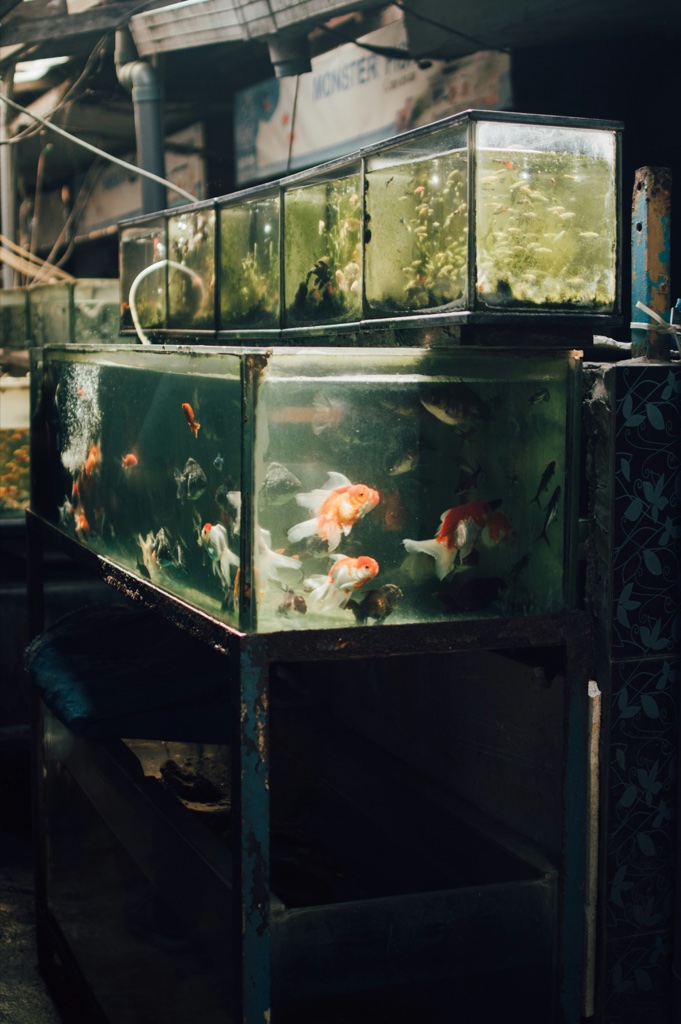
The correction
The world trade is 310 to 330 million dollars a year34, not 15 to 30 billion5.
Both numbers are real and both are correctly cited. They measure different things, and the hobby press confuses them constantly.
The 15 to 30 billion figure comes from a peer reviewed paper, and in that paper it covers the whole industry: tanks, food, equipment, retail, across about 125 countries5. The border value, which is what a country's customs service records when live fish physically cross a frontier, is about three hundred million.
252m
US dollars. Total world exports of live ornamental freshwater fish, 2024, summed across every reporting country. 2023 was about 264 million and 2022 about 256 million3
63 to 69m
US dollars a year for marine ornamentals in the neighbouring customs code4
310 to 330m
US dollars a year, total declared world trade in ornamental fish at the border34. About the size of one large supermarket chain
16,416
US dollars. Armenia's entire declared import of live ornamental freshwater fish in 20241
Four honest warnings before you read a single figure
One. It is declared customs value, not retail value. A cardinal tetra that leaves Manaus at four US cents is worth two euros in a German shop. These are the small numbers at the start of the chain.
Two. Not every country reports every year. Russia has reported nothing in this code since 2022.6 Israel reported exports in 2021 and 2022 and then stopped.7 When a country is missing from a table below, it usually means the country did not report, not that its trade stopped.
Three. Some rows are estimates, not reported figures. The database fills gaps by estimating from partner data, and those rows carry a flag. Both kinds are used here, because excluding the estimates would distort the ranking more than including them.
Four. The customs code is a container, not a description. One code holds koi carp, goldfish, guppies and wild caught Amazon tetras in the same box. Separating them needs the unit price, which is done below where it matters.
Exporters
Japan tops the table. That is koi, not aquarium fish.
Japan comes first in every year checked, and it does not mean Japan is the world's biggest supplier of aquarium fish. Divide value by weight and the picture is obvious.
| Rank | Country | Value, US dollars | Share | Weight |
|---|---|---|---|---|
| 1 | Japan | 48.3 million | 19.2% | 320 t |
| 2 | Indonesia | 33.2 million | 13.2% | 1,038 t |
| 3 | Singapore | 32.8 million | 13.0% | not reported |
| 4 | Thailand | 19.7 million | 7.8% | 658 t |
| 5 | Czechia | 18.1 million | 7.2% | 70 t |
| 6 | Sri Lanka | 16.9 million | 6.7% | 354 t |
| 7 | France | 15.9 million | 6.3% | 1,550 t |
| 8 | Malaysia | 14.3 million | 5.7% | not reported |
| 9 | United Kingdom | 8.9 million | 3.5% | 767 t |
| 10 | Netherlands | 8.3 million | 3.3% | 74 t |
| 11 | Colombia | 7.8 million | 3.1% | 499 t |
| 12 | Germany | 4.8 million | 1.9% | 35 t |
| 13 | China | 3.9 million | 1.5% | 297 t |
| 14 | Brazil | 3.7 million | 1.5% | 25 t |
| 15 | USA | 3.0 million | 1.2% | 160 t |
| 16 | Peru | 1.7 million | 0.7% | 259 t |
The unit price gives it away
151 dollars a kilogram9
Japan exported at 151 US dollars per kilogram in 2024, against 32 for Indonesia, 30 for Thailand, 16 for Colombia and 7 for Peru.9 To Hong Kong the Japanese figure is 370 dollars a kilogram and to Namibia it is 538.10 Nobody pays 538 dollars a kilo for neon tetras. That is nishikigoi, sold to collectors and pond keepers, and it sits in the same customs code as the aquarium trade and distorts every league table built from that code.
Read the European rows carefully
France and the UK are not sources
France reports 15.9 million over 1,550 tonnes, about 10 dollars a kilogram, and the UK 8.9 million over 767 tonnes, about 12.89 Those unit prices and tonnages point at cheap coldwater fish, mostly goldfish, and at re-export of Asian stock within Europe, not at tropical production. The France row is an estimate rather than a reported figure. Treat both as trade flows, not as sources.
A row to throw out
Myanmar, 2023
The 2023 table puts Myanmar sixth at 17.1 million dollars, over 11,726 tonnes.11 That is about 1.5 dollars per kilogram, which is not an ornamental fish price. Treat it as a probable misclassification and ignore it. Printing the row and rejecting it is more useful than quietly dropping it.
So, for the aquascaping hobby
The real ranking starts at number two: Indonesia, Singapore, Thailand, Czechia, Sri Lanka, Malaysia, Colombia. Indonesia is the biggest genuine supplier of aquarium fish in the world. Czechia at number five is the surprise, and it is mostly real production rather than transit. It exports 18.1 million dollars over only 70 tonnes, which is about 260 dollars a kilogram89: small numbers of specialist and rare species from a deep Czech and Slovak hobby breeding culture of thousands of small indoor breeders, selling into Germany, Austria and Poland with no import paperwork at all. It does also import about 4.0 million dollars, roughly 22 percent of its exports12, so part of the trade is buying Asian fish and reselling them within the EU. Brazil, at 3.7 million dollars and 25 tonnes, is far smaller than its reputation.8
Wild against farmed
Most of what you buy was never wild.
Two peer reviewed reviews from the same 2019 issue of one journal give the same headline figure, and it is the best supported number available. About 90 percent of ornamental freshwater fish in the trade are captive bred. About 90 to 95 percent of ornamental marine fish are wild caught.135
Both papers say plainly that the exact wild share cannot be measured, because the data does not exist. A third paper is blunter still: a 2020 systematic review set out to quantify the ornamental trade and concluded in its own title that it is an impossible task. It found that estimates of coral reef fish traded annually range from 15 to 30 million specimens and could be as high as 150 million, and that the global value of the trade had been properly estimated only twice, in 1976 and 1999.14
A slogan this hub will not repeat
"Buy a fish, save a tree" is not supported by evidence. The Rio Negro ornamental fishery is real, low impact and economically important, and when the Barcelos fishery collapsed what replaced it was cash transfers, sport fishing and food fishing, not deforestation.15 Project Piaba's own current mission page no longer uses the slogan.16
What is supported, and worth telling an Armenian beginner: the fishery is one of the least damaging ways humans extract anything from the Amazon; it supports thousands of poor households, with a figure of about 10,000 people put on the comparable Peruvian fishery in 200117; it has declined sharply, mainly for economic reasons, and that decline is not good for those households. Buying a wild caught Amazon fish from a traceable chain is a defensible choice. Claiming it as a conservation act goes further than the evidence goes.
And a simpler point that gets lost: with roughly 90 percent of freshwater aquarium fish already captive bred13, the whole argument applies to a small minority of the fish in the hobby, and to a very small minority of what is sold in Armenia.
Plants
The technology that matters is the sealed cup.
This is the single most useful thing an Armenian beginner can learn about buying plants. A nursery normally grows aquarium plants out of water, in humid air, and the plant arrives in a small pot with a rockwool plug. Those emersed leaves usually die back and the plant grows a new set underwater. That die back is normal and it is called melt.
Tissue culture is different. A tiny piece of plant tissue multiplies in a sealed sterile container on a nutrient jelly, in a laboratory, and the container is never opened until the customer opens it.
Why it matters
The seal keeps four things out
Snails.18 Pond snail and bladder snail infestations in planted tanks come almost entirely from potted plants. Pest algae, same reason. Pesticide, because greenhouse plants are sometimes treated with insecticides that kill shrimp, so a shrimp keeper buying potted plants rinses and quarantines. Planaria, hydra and dragonfly larvae, all of which travel on wet nursery plants. A sealed cup arrives with none of them.
The costs, honestly
Fiddly, fragile, and dated
A cup holds a lot of very small plants. They are fragile, they grow slowly at first, and they have to be split into many portions and planted individually, which is slow work. Per plant it is cheap. Per cup it looks expensive. And a cup has a shelf life, because the jelly runs out of nutrients.
Why it matters here specifically
The easiest live plant to move
A sealed cup is small, light, sterile and not obviously alive, which makes it the single easiest live plant to move across a border, and the first cups to reach Armenia will come in somebody’s hand luggage. Whether Armenian customs treats a sealed laboratory cup differently from a potted plant is the question to put to them directly, and the answer belongs in the group.
| Country | Who | Known for |
|---|---|---|
| Denmark | Tropica | Curated range, heavy tissue culture, the reference brand |
| Germany | Dennerle Plants | 64 species19, greenhouse plus an in-vitro range that arrives already in submersed form, so there is no melt |
| Netherlands | AquaFleur, AquaFlora | Volume and breadth. More than 200 varieties, 20,000 square meters of glass20 |
| Singapore and Malaysia | Oriental Aquarium and others | Four country production21, and manufacturing under other brands' names |
| Thailand, Indonesia, Malaysia | Many farms | Open field emersed growing. The cheap end of the market and the largest volume |
| China and Vietnam | Many laboratories | Tissue culture at volume, much of it under other brands' names |
| USA, Florida | Florida Aquatic Nurseries | The American grower, since 195722, with patented cultivars |
Read this table as who is prominent rather than who is largest. Live aquatic plants travel without a customs code of their own, so the names above come from the companies and the directories rather than from trade statistics. Southeast Asia grows the most by a wide margin, and most of it leaves under somebody else’s brand.
Hardscape
Most Japanese stone is quarried in China.
Every stone name the hobby uses is a trade name, not a geological one. There is no mineral called Seiryu and no rock type called Dragon Stone. These are marketing labels attached to whatever a quarry is currently producing that looks right, and the stones themselves are ordinary.
| Trade name | What the rock is | Effect in a soft water tank |
|---|---|---|
| Seiryu, Seiryu-seki, Ryuoh | A grey limestone or dolomitic limestone with white calcite veins | Raises GH, KH and pH. Fights CO2 injection permanently |
| Ohko, Dragon Stone | A hardened clay or mudstone, brown, full of holes and pockets | Inert |
| Elephant Skin, Grey Mountain | A grey layered stone with a wrinkled, folded surface | Generally inert. Test it |
| Frodo Stone | A pale, hard, silicified stone with dark inclusions | Inert |
| Lava rock, scoria | Frothy volcanic rock | Inert, and Armenia has about 500 scoria cones of it23 |
| Petrified wood | Silicified fossil wood | Inert |
The finding, from a Chinese export directory
A search for Seiryu Stone on one of the two main Chinese business to business export directories returns 30 first page products, and every one of them on that page comes from a single company in Hebei province24. The listed price is 350 to 600 US dollars per tonne, minimum order one tonne.24 The same directory returns 30 products under Dragon Stone and 32 under Ohko Stone, again from Chinese suppliers, described as aquascaping hardscape rock.25
Read the price again. 350 to 600 dollars a tonne is 35 to 60 US cents a kilogram at the factory gate.24 A European aquascaping shop sells the same rock at 8 to 15 euros a kilogram. The stone is not the cost. The freight, the sorting, the breakage and the retail margin are the cost.
What this proves and does not prove. It proves that large volumes of stone sold worldwide under Japanese trade names are quarried and exported from China. It does not prove that no Japanese stone exists: it does, sold under Japanese names by the Japanese company that named the style, and it is a real but small and expensive part of the market. The honest summary is that the name is Japanese, the rock is usually Chinese, and the two have been separate for years.
One more detail. Frodo Stone returned zero results on the same directory,26 which is consistent with it being a Western retail name invented downstream and applied to material bought under some other description. That is not evidence of where the rock comes from. It is evidence that the name is not used at the quarry.
What this means for Armenia, in one paragraph
The material is cheap at source and heavy, and that combination is the whole problem. A tonne of stone leaving Hebei costs a few hundred dollars and arriving in Yerevan costs many times that. The personal allowance for goods carried across a land border is 200 euros and 10 kilograms,27 and ten kilograms is one medium rock, so carrying hardscape in from Tbilisi is not a real answer. The realistic answers, in order: use Armenian basalt and scoria, which are local, inert and effectively free; buy wood from Russian marketplaces inside the customs union, where there is no threshold at all; and treat imported branded stone as a luxury rather than a requirement.
Equipment
Designed in Japan, Germany, Denmark and Korea. Made in China.
That gap is closing, because the Chinese manufacturers now design their own products and sell them under their own names, and because a Chinese LED is no longer obviously worse than a German one. That is the whole geography of aquarium equipment in two sentences, and it is why the backbone of the range in Yerevan is a Chinese brand rather than a Japanese one.
A rumour, checked
A widely repeated claim that one of the best known Chinese lighting brands is closing turns out to be more specific than that. The manufacturer's own direct storefront is liquidating: a permanent 30 percent final sale code, about 40 products left, mostly accessories, flagship collections empty, and no statement.28 Meanwhile the European distributor site trades normally and a large US retailer stocks 66 lines from the same brand including the newest 2026 models.29
So the brand is not closing. One sales channel is. That distinction matters if you were about to order from the direct store, and it is the reason this hub prefers to check a claim rather than repeat it.
Yerevan
Somebody in Yerevan is already flying fish in from Jakarta.
This is the most surprising result in the file. Armenia does not buy its fish from Russia or from Europe. It buys direct from the three big Asian source countries, by air.
| Year | Value, US dollars | Weight | Partners |
|---|---|---|---|
| 2021 | 17,978 | 326 kg | |
| 2022 | 13,781 | 139 kg | |
| 2023 | 16,239 | 261 kg | Iran 7,843; Indonesia 4,281; Sri Lanka 3,081; Thailand 1,034 |
| 2024 | 16,416 | 752 kg | Indonesia 11,356 over 711 kg; Sri Lanka 4,009 over 24 kg; Thailand 1,051 over 17 kg |
The mirror data agrees: Indonesia, Sri Lanka and Thailand each independently reported exporting ornamental freshwater fish to Armenia in 2024.31 For scale, Georgia imported 23,294 US dollars in 202432 and Turkey imported 431,185, about 26 times Armenia's figure.33 A single well stocked shop in Warsaw imports more than the whole of Armenia. That is the honest context for everything else on this page, and it is why one shop can be the entire national supply.
What the data misses
Russia is invisible in this dataset
Russia has reported no trade in this code for 2023 or 2024.6 So the absence of a Russia to Armenia fish flow is a reporting gap, not proof that no fish move. And because Armenia and Russia are in the same customs union, movements inside the union are less likely to be captured as trade at all.
One year of Iran
Iran is one year and one consignment
Iran appears in 2023 at 7,843 dollars and not in 2024.2 That is a single year of data. Do not build a theory on it.
Something the local hobby may not know
Armenia imports CITES corals
Armenia has recorded trade in the international endangered species database every year from 2015 to 2024, with 1,379 records as importer.34 Most is not aquarium trade, but 47 records are.34 Armenia imports live stony corals, which are all on Appendix II: 60 pieces in 2015 from Malaysia, then 110 in 2016 and 2017, 159 in 2023 and 88 in 2024, those four years from Indonesia. Across all 36 coral records, 32 name Indonesia, 2 Malaysia and 2 the UAE.35 It also imported freshwater stingrays from Thailand in 2022 and 2023, declared as captive bred.36
And one hard finding about the paperwork
Only 15 records of 1,379 carry a quantity reported by Armenia34
For the other 1,364 the quantity on file is the exporting country’s figure alone.34 That is a clear signal that Armenia's annual reporting under the convention is thin. It is not an accusation of smuggling: permits were clearly issued, or Indonesia could not have exported under them. But anyone in Armenia planning to import a listed species should expect the paperwork to be unfamiliar to everyone involved, and should start early.
Six routes in, ranked by whether one person can actually use them.
Russia and the customs union
Armenia is in the Eurasian Economic Union with Russia, Belarus, Kazakhstan and Kyrgyzstan. Goods from Russia move inside the union: no duty, no declaration, no value threshold. Two large Russian marketplaces run Armenian storefronts with physical pickup points in Yerevan.
What the trade data adds: the Japanese brand's own distributor list names a company in the Moscow region as its Russian distributor, alongside four Moscow area retailers including a dedicated center.37 So the nearest official source of that brand's soil, glassware, fertiliser and tools to Yerevan is Moscow, and the customs border between them does not exist.
Works today, for anyone. Equipment, substrate, tools and chemistry.
China, direct
The large marketplaces ship to Armenia, and at least one major lighting brand runs an official store there and lists Armenia and the Armenian dram in its own site's country selector.28 This is the realistic route for lighting, CO2 regulators, diffusers, tools, dosing pumps and inline equipment, at prices below anything else available. The trade offs are shipping time, no local warranty, and the liquidation of one brand's direct store noted above.
Works today, for anyone, slowly. Hardware only.
Turkey and the UAE
Both are reachable by direct flight from Yerevan and both have retailers for the Japanese brand.37 Hand carrying dry goods in a suitcase is legal within the personal allowance. But the Armenia to Turkey land border is closed, so freight goes the long way round through Georgia, and the personal land border allowance of 200 euros and 10 kilograms does not help anyone carrying substrate.27
Works for a person who is traveling anyway, for small dry items. Not a supply line.
Georgia
Tbilisi has a real aquarium trade and is about six hours by road.38 Georgia is outside the customs union, so the personal land border limit applies. And Georgia's own ornamental fish imports were only 23,294 US dollars in 2024,32 so Tbilisi is not a deep market either.
Useful for a hobbyist buying a few small things. Ten kilograms is one rock.
The European Union
The Danish nursery sells to shops and wholesalers, not to individuals, though its contact page lists a salesperson whose named territory includes countries outside the EU.18 The Japanese brand's European distributors are in Italy, Germany and Spain and also serve trade customers.37 So the route exists and it is the right route, but it is a wholesale route: it needs a registered Armenian business, a customs broker, a veterinary import permit for animals and a plant health certificate for plants.
Closed to individuals, open to a business that wants it. This is the gap in the Armenian market.
Direct from the Asian source countries
The customs data above shows somebody in Armenia is already doing this, flying fish in from Indonesia, Sri Lanka and Thailand and corals in from Indonesia under permits. It requires an importer of record, a veterinary certificate, an airport handling arrangement and a quarantine facility.
Business only. Already being done by at least one operator.
The asymmetry that is the real problem
The customs union removes the duty. It does not remove the veterinary and plant health rules, and it does not remove the endangered species convention, which applies independently of any customs arrangement in both directions.
Every route above carries hardware, and animals travel a different way entirely. Live fish and live plants go by air freight with paperwork, not by post or by a parcel forwarder. That split is the real structure of Armenian supply: buy your gear from anywhere, and buy anything alive from the shop down the road, which is exactly why that shop matters so much.
Before you spend money on this, ask the food safety and veterinary authority for the current procedure, forms and fees, and publish what they tell you. That one phone call would be the most useful thing anybody reading this page could do.
Four openings, commercially
Hardscape. One driftwood listing and sixteen stones in the whole country39, against a source price of 350 to 600 US dollars a tonne.24 Wood is light for its bulk and is the obvious first import. Stone should mostly be sourced locally.
Tissue culture plants. Sealed cups, from anywhere. Small, light, sterile and high value per kilogram, which makes them the easiest first import anybody could attempt.
A second shop. One specialist retailer serves the whole country today, which leaves room for the next one.
CO2 refills. Three doors are already identified: a brewery, an extinguisher company and three welding suppliers. Whoever knocks first has the answer.
- UN Comtrade, HS 0301.11 (live ornamental fish, freshwater), reporter Armenia, imports from World, reporting year 2024. Value 16,416 US dollars. Queried 8 September 2026. comtrade.un.org accessed 8 September 2026
- UN Comtrade, HS 0301.11, reporter Armenia, imports by partner, reporting years 2023 and 2024. Queried 8 September 2026. comtrade.un.org accessed 8 September 2026
- UN Comtrade, HS 0301.11, exports to World, all reporters, reporting years 2022, 2023 and 2024, summed. About 256, 264 and 252 million US dollars respectively. Queried 8 September 2026. comtrade.un.org accessed 8 September 2026
- UN Comtrade, HS 0301.19 (live ornamental fish, other, which in practice means marine), exports to World, all reporters, reporting years 2022 to 2024. Roughly 63 to 69 million US dollars a year; the page rounds to 65. Queried 8 September 2026. comtrade.un.org accessed 8 September 2026
- Evers, H.G., Pinnegar, J.K. and Taylor, M.I. (2019). Where are they all from? Sources and sustainability in the ornamental freshwater fish trade. Journal of Fish Biology 94(6):909–916. doi.org/10.1111/jfb.13930. Carries the 15 to 30 billion US dollar figure, explicitly for the whole industry across about 125 countries, and the marine wild-caught share. accessed 8 September 2026
- UN Comtrade, HS 0301.11, reporter Russian Federation, reporting years 2023 and 2024: zero records returned. Queried 8 September 2026. comtrade.un.org accessed 8 September 2026
- UN Comtrade, HS 0301.11, reporter Israel, exports, reporting years 2021 to 2024: values for 2021 and 2022, none for 2023 and 2024. Queried 8 September 2026. comtrade.un.org accessed 8 September 2026
- UN Comtrade, HS 0301.11, flow X (exports), partner World, all reporters, reporting year 2024. Source of the top-sixteen exporter table, the French, British, Czech and Brazilian rows. Queried 8 September 2026. comtrade.un.org accessed 8 September 2026
- Unit values computed by this hub from UN Comtrade HS 0301.11 declared value divided by net weight, all reporters, reporting year 2024. Queried 8 September 2026. comtrade.un.org accessed 8 September 2026
- UN Comtrade, HS 0301.11, reporter Japan, exports by partner, reporting year 2024. Source of the Hong Kong and Namibia unit prices. Queried 8 September 2026. comtrade.un.org accessed 8 September 2026
- UN Comtrade, HS 0301.11, flow X (exports), partner World, all reporters, reporting year 2023. Source of the Myanmar row. Queried 8 September 2026. comtrade.un.org accessed 8 September 2026
- UN Comtrade, HS 0301.11, reporter Czechia, both flows, reporting year 2024. Exports 18.1 million, imports about 4.0 million US dollars. Queried 8 September 2026. comtrade.un.org accessed 8 September 2026
- King, T.A. (2019). Wild caught ornamental fish: a perspective from the UK ornamental aquatic industry on the sustainability of aquatic organisms and market opportunities. Journal of Fish Biology 94(6):925–936. doi.org/10.1111/jfb.13900. Source of the roughly 90 percent captive-bred freshwater figure. accessed 8 September 2026
- Biondo, M.V. and Burki, R.P. (2020). A Systematic Review of the Ornamental Fish Trade with Emphasis on Coral Reef Fishes: An Impossible Task. Animals 10(11):2014. doi.org/10.3390/ani10112014. Open access. Source of the 15 to 30 million specimens range, the 150 million upper bound, and the two proper valuations in 1976 and 1999. accessed 8 September 2026
- Sobreiro, T. (2016). Dinâmica socioecológica e resiliência da pesca ornamental no Rio Negro, Amazonas, Brasil. Sustainability in Debate 7(2):118–134. doi.org/10.18472/sustdeb.v7n2.2016.15127. Source for what replaced the Barcelos fishery: multiple-resource use, government cash transfers, sport fishing and commercial food fishing. accessed 8 September 2026
- Project Piaba, mission page. projectpiaba.org/about-us/our-mission/. The current text does not contain the slogan. Its resources index, projectpiaba.org/resources/, lists no study measuring deforestation against aquarium-fish income. accessed 8 September 2026
- Moreau, M. and Coomes, O. (2007). Aquarium fish exploitation in western Amazonia: conservation issues in Peru. Environmental Conservation 34(1):12–22. doi.org/10.1017/S0376892907003566. Source of the about 10,000 people earning income from the Peruvian fishery in 2001. accessed 8 September 2026
- Tropica Aquarium Plants. tropica.com/en/plants/1-2-grow/ for the tissue-culture range and its freedom from snails, algae and pesticides, and tropica.com/en/contact/ for the trade-only sales model and the named export territory. accessed 8 September 2026
- Dennerle Plants, company site. dennerleplants.com. Source of the 64 species figure and the in-vitro range that arrives in submersed form. accessed 8 September 2026
- AquaFleur International, company site. aquafleur.com. Source of the over 200 varieties and 20,000 square metres of glasshouse. accessed 8 September 2026
- Oriental Aquarium, company site. orientalaquarium.com/about. Source of the four-country production claim. accessed 8 September 2026
- Florida Aquatic Nurseries, company site. floridaaquatic.com/about. Source of the 1957 founding year and the patented cultivars. accessed 8 September 2026
- Armenian Wikipedia, Հրաբխային խարամ (volcanic scoria). hy.wikipedia.org. About 500 Quaternary scoria cones, Gegham and Aragats massifs and around Yerevan at Arinj and Avan; explored reserves around 300 million tonnes. accessed 8 September 2026
- Made-in-China.com, product search for “Seiryu Stone”. made-in-china.com · Seiryu_Stone. 30 first-page products, all from Hebei Bao Du Import and Export Trade Co., Ltd., Hebei province; listed 350 to 600 US dollars per tonne, minimum order one tonne. accessed 8 September 2026
- Made-in-China.com, product searches for “Dragon Stone” (30 products) and “Ohko Stone” (32 products). Dragon_Stone, Ohko_Stone. accessed 8 September 2026
- Made-in-China.com, product search for “Frodo Stone”: zero results. made-in-china.com · Frodo_Stone. accessed 8 September 2026
- Armenian personal import allowance. Government decision of August 2024 as reported by ARKA news, 8 August 2024, arka.am/en/news; threshold arithmetic above the limit from EAEU Council Decision No. 107 of 20 December 2017, docs.eaeunion.org/documents/317. Goods carried in person across a land border: 200 euros and 10 kilograms. Confirm with the State Revenue Committee before spending money. accessed 8 September 2026
- Chihiros Aquatic Studio, the manufacturer’s own storefront. /collections/all/products.json, /pages/about-us, /pages/contact-us and /sitemap_blogs_1.xml. Source of the permanent 30 percent final-sale code, the roughly 40 remaining products, the empty flagship collections, the absence of any statement, and the Armenia and Armenian dram entries in the shipping and currency selectors. accessed 8 September 2026
- Buce Plant, Chihiros collection feed. buceplant.com/collections/chihiros/products.json. 66 Chihiros lines, 49 of them in stock, including the newest models. accessed 8 September 2026
- UN Comtrade, HS 0301.11, reporter Armenia, imports from World, reporting years 2021 to 2024. 17,978 / 13,781 / 16,239 / 16,416 US dollars and 326 / 139 / 261 / 752 kg. Queried 8 September 2026. comtrade.un.org accessed 8 September 2026
- UN Comtrade, HS 0301.11, partner Armenia, all reporters, exports, reporting year 2024 — the mirror query. Indonesia, Sri Lanka and Thailand each report exporting to Armenia. Queried 8 September 2026. comtrade.un.org accessed 8 September 2026
- UN Comtrade, HS 0301.11, reporter Georgia, imports from World, reporting year 2024. 23,294 US dollars. Queried 8 September 2026. comtrade.un.org accessed 8 September 2026
- UN Comtrade, HS 0301.11, reporter Türkiye, imports from World, reporting year 2024. 431,185 US dollars. Queried 8 September 2026. comtrade.un.org accessed 8 September 2026
- CITES Trade Database, shipment records with Armenia (geo entity 85) as importer, 2015 to 2024. trade.cites.org/cites_trade/shipments, country identifiers from trade.cites.org. 1,379 records, of which 47 are aquarium-relevant and only 15 carry an importer-reported quantity. Queried 8 September 2026. accessed 8 September 2026
- CITES Trade Database, importer Armenia, class Anthozoa, 2015 to 2024. Live coral pieces: 60 in 2015 (Malaysia), 110 in 2016, 110 in 2017, 159 in 2023 and 88 in 2024, the last four almost all from Indonesia. trade.cites.org. Queried 8 September 2026. accessed 8 September 2026
- CITES Trade Database, importer Armenia, Potamotrygonidae (freshwater stingrays), exporter Thailand, 2022 and 2023, source code declared captive-bred. trade.cites.org. Queried 8 September 2026. accessed 8 September 2026
- Aqua Design Amano, official distributor and retailer list. adana.co.jp distributor page. Source of the Moscow-region distributor, the four Moscow-area retailers, the Turkish and UAE retailers, and the Italian, German and Spanish European distributors. accessed 8 September 2026
- Apisto, Tbilisi aquarium retailer. apisto.ge. Yerevan to Tbilisi road time of about six hours is a route-distance estimate recorded in the Armenian scene research and not a published figure. accessed 8 September 2026
- Gazanik, the Armenian shop, live category listings. gazanik.am published product categories and the matching
/product-category/pages. Stones 16 listings, driftwood 1 listing. Counted for the Armenian scene page. accessed 8 September 2026
Continue
Where to go next.
Armenia is standing on its hardscape
The heavy half of a scape that never needs a border crossing, because the country is built out of it.
The shops directory
Where the sixteen thousand dollars a year ends up, shop by shop.
The Armenian scene
Tap water, law, community and the scene the trade figures describe.
Livestock
What can be kept out of what actually arrives, rather than what the catalogues show.