Hardscape
Five local rocks, and four of them are inert.
Basalt, volcanic scoria, obsidian, pumice and tuff are the national building materials of this country. They come out of quarries in Shirak, Aragatsotn, Syunik, Gegharkunik and Yerevan itself, they are sold by the kilogram at builders' prices, and every one of them is aquascaping stone. A scape built out of Artik tuff and Yerevan basalt costs what the petrol to fetch it costs.
There is one trap in the language, and it is worth two minutes before you go shopping.
The naming trap
Tuff and tufa are two different rocks with almost the same name, and Armenian says տուֆ for both.
Tuff is compacted volcanic ash. It is a silicate. It is inert in water and will not move your hardness. Tufa, and travertine with it, is a freshwater limestone laid down by calcium rich springs. It is almost pure calcium carbonate. In a tank it dissolves slowly and drives GH, KH and pH up. One is excellent aquascaping stone. The other is the thing beginners are warned about.
The confusion is live inside Armenian Wikipedia itself. The article titled plain Տուֆ describes volcanic tuff correctly and in detail, but its English language link points at the article for tufa, the limestone.4 Meanwhile the English article for tuff links to a separate Armenian article, Հրաբխային տուֆ. Two articles for the same rock, one of them cross linked to the wrong rock. Anyone researching Armenian stone through machine translation will hit this and get the wrong answer.
Worse, the trap is real on the ground and it is stated in the same Armenian article. The group տուֆ conditionally also covers calcareous tuffs, that is travertine, and those are widespread in the Ararat, Shirak, Vayots Dzor and Syunik provinces.4 A stone yard in Ararat or Shirak can sell you something called տուֆ that is calcium carbonate.
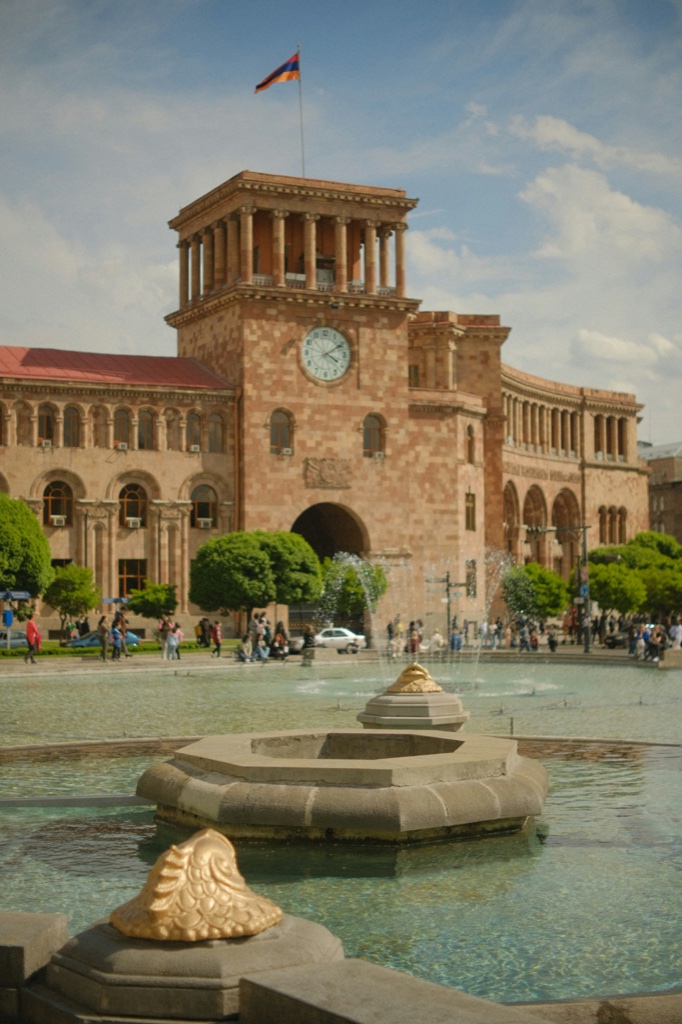
What it is
Armenian tuff, read in Armenian
Tuff is hardened volcanic ash, made of volcanic glass and pumice fragments. By composition Armenian tuffs are liparitic, that is rhyolitic, dacitic, andesitic or basaltic.4 Every one of those is a silicate. There is no carbonate in that list, so as a class Armenian tuff is inert and will not raise GH or KH. It is porous, light, easy to cut, and it comes in violet pink from Artik, yellow and orange and white from Ani, black and red from Yerevan and Gyumri.4
Rule of thumb, not a rule
Which valley you are standing in
The famous building tuffs, violet pink Artik, yellow Ani, black Yerevan, come from the volcanic highland and are silicate. Pale, banded, honey or cream coloured porous stone from Ararat or Vayots Dzor is more likely to be travertine. Do not rely on the rule. Test the stone.
Two honest cautions
Soft, and full of cavities
Tuff is friable, which is exactly why Armenians build with it. It can crumble and shed fines that cloud water for a long time. And volcanic tuffs commonly carry secondary minerals in their gas cavities, including calcite, which fizzes, and zeolites, which exchange ions and can adsorb ammonia.4 Break a piece open and test the fresh inside face, not the weathered outside.
How to test any stone yourself, in two minutes
Test one
Vinegar
Put a few drops of ordinary household vinegar on a dry, clean, freshly broken face, and watch closely in good light. Any fizzing at all, even faint fizzing you have to lean in to see, means carbonate. That stone will push GH, KH and pH up and will fight your CO2 forever. It is correct for African cichlids and wrong for a soft water planted tank. No reaction at all means no carbonate at that spot, and the stone is very likely inert.
Two limits. It only tests the spot you wet, so test several faces and always test a fresh break. And warm vinegar works better than cold.
Test two
The one week soak
Put the stone in a bucket of RO or distilled water. Measure TDS. Leave it a week. Measure again. If the TDS has climbed, the stone is dissolving into your water. Slower than vinegar and much more reliable, and the one to use before committing to a large amount of a new local stone.
The trap inside the test
Dolomite barely fizzes
Dolomite, calcium magnesium carbonate, hardly reacts with cold household vinegar.4 It can fizz almost imperceptibly and still raise your GH and KH. Powder a corner with a hammer or a file and test the dust. This matters near Yerevan, where both dolomitic marble and dolomitic basalts are documented.
Before anything goes in
Five more checks
Rinse and scrub. Boiling is optional and can crack porous rock. Reject metallic veins, rust coloured staining and crystals with a metallic shine. Soak very porous rock first, because tuff and scoria will float until they waterlog. Scrub off any cement or mortar residue from building trade offcuts, because it is strongly alkaline. Blunt sharp edges.
| Rock | Armenian | Effect on GH and KH | Verdict |
|---|---|---|---|
| Basalt | Բազալտ | None | Best default. Inert, dense, dark, and effectively unlimited. Geological reserves are put at about 125 billion cubic meters4 |
| Volcanic scoria, lava rock | Հրաբխային խարամ | None | Excellent, and doubles as filter media. About 500 scoria cones, explored reserves around 300 million tonnes4. Rinse hard. Never just say խարամ |
| Obsidian | Վանակատ | None | Chemically perfect, mechanically dangerous. Conchoidal fracture gives edges sharper than a scalpel. Tumbled or blunted pieces only |
| Pumice | Պեմզա | None | Inert. Floats until waterlogged. Good hidden filler under soil, to build a slope cheaply |
| Volcanic tuff, Artik and Ani and Yerevan | Տուֆ, Հրաբխային տուֆ | Should be none | Probably fine, but soft and friable. Test it, because the name is ambiguous |
| Calcareous tufa, travertine | Տրավերտին | Raises both | Only for a hard water tank. Ararat, Shirak, Vayots Dzor, Syunik |
| Limestone | Կրաքար | Raises both | Only for a hard water tank. Shirak, Ararat. Useful accident of the language: կիր is lime, so the word says lime stone on its face |
| Marble | Մարմար | Raises both | Avoid. Offcuts are usually resin filled, and Armenian marble carries pyrite among its accessory minerals |
| Sulphide mineralised rock | Toxic | Never. Kajaran and the Voghji, Alaverdi, Akhtala, Chochkan, Agarak, Sotk | |
| Metallurgical slag | Խարամ | Toxic | Never. Alaverdi smelter waste. This is why you always say հրաբխային խարամ for lava rock |
| Rock salt and evaporite | Քարաղ | Catastrophic | Never. Avan in north east Yerevan sits on a 700 meter salt sequence at 96.84 percent sodium chloride4 |
Two river systems to stay out of
This is not a general caution. There are published numbers. Gevorgyan and colleagues measured heavy metals in the Debed catchment in 2013 and 2014 and published them in a peer reviewed journal. Their background level for copper is 3.00 micrograms per liter.6 Copper is the classic killer of shrimp and snails at single digit microgram levels.
| Site | Copper, µg/L6 | Zinc, µg/L6 | Cadmium, µg/L6 |
|---|---|---|---|
| Background | 3.00 | 4.30 | 0.24 |
| Upper Pambak, near natural | 4 to 5 | 5.3 to 8.9 | 0.01 |
| Debed upstream of Alaverdi | 8 to 10 | 10 to 12 | 0.05 |
| Alaverdi river near its mouth | 238 to 315 | 318 to 544 | 2.9 to 3.7 |
| Debed, 4.5 km below Alaverdi | 79 to 86 | 209 to 241 | 3.2 to 3.3 |
| Akhtala river near its mouth | 381 to 788 | about 3,200 to 5,200 | 17 to 33 |
| Chochkan river, below the tailings dump | 84 to 379 | 421 to 688 | 3.8 to 4.9 |
Copper at 788 micrograms per liter is 260 times background7. The authors attribute it to the Alaverdi copper smelter and its tailings, the Akhtala enrichment combine, and the Chochkan tailings dump. The same study found arsenic in the Sotk and Masrik rivers in the Lake Sevan gold mining area reaching 13.16 micrograms per liter against a background of 0.4 to 1.6, and nickel to 37.46.6
Where not to collect
Do not collect rock, gravel or sand from the Debed below Alaverdi, from the Alaverdi, Akhtala or Chochkan rivers, or from the Sotk and Masrik area near Sevan. Upper Pambak and upper Debed are at background and are fine.
In the field, leave a rock where it is if you see brassy or golden metallic specks, a silvery grey flaky metallic mineral, green or blue crusts, stains or veins, which are copper and are the most dangerous sign in Armenia for a shrimp tank, rusty orange brown staining on a fresh break or a sulphur smell, or orange red and lemon yellow crusts, which are arsenic sulphides. And nothing at all from a tailings dump, a mine spoil heap or a slag heap.
Hrazdan and Kasakh river gravel is predominantly volcanic and is good hardscape, but carbonate rocks of Devonian, Carboniferous, Cretaceous and Eocene age outcrop in the basins of the Argichi, Vedi and Hrazdan8, so carbonate pebbles genuinely do occur. Vinegar test every river stone you collect. Every one. The columnar basalt at the Garni gorge, the Symphony of Stones, is a protected natural monument. Look at it. Do not quarry it.
The photographs on this page were taken by other people and shared on Unsplash. Every one of them is named, with thanks, on the credits page.
The shelf
What the one specialist shop actually carries.
The backbone of the local aquascaping range is Week Aqua, a Chinese brand, with Mufan, ISTA, Aquaforest and Sera around it. Week Aqua tanks and lights are decent value, they are in Yerevan today, and they come with a warranty you can walk to. Sixteen stone types, seventy seven plant lines sold loose, and a shop that answers the phone.1
ADA, Tropica, Chihiros and Seachem are carried in by the individual who wants them, which is the same arrangement for Twinstar, UNS, Aquario, Do!Aqua and 2Hr Aquarist. So there is no local standard to be behind. Everyone here is improvising with what the shelf holds, including the good ones, and the tank that wins is the one whose owner understood the water.
The binding constraints, counted
- 16
- stone types on the shelf, mostly 2,200 to 3,000 AMD per kilogram, on top of a whole volcanic highland1
- 77
- plant lines, sold loose and unbranded, which is how plants were sold before cups existed1
- 7,900
- members in the largest Armenian aquarium group, and they answer questions3
- 1
- driftwood listing in the country, so wood is the piece worth planning around1
- 0
- tissue culture cups, so plants arrive grown in air and settle in over a fortnight1
- 0
- Armenians in the IAPLC and AGA archives, which leaves the first entry from here unclaimed2
Sixteen stone types on the shelf, and a whole volcanic highland behind them, so the heavy half of a scape is solved locally. Wood is the half that still travels, and one listing in the country is what that looks like. The contest line is the interesting one: the IAPLC world ranking carries 2,617 entries from 84 countries for 2021 alone, and the Aquatic Gardeners Association archive runs back to 20002. Russia, Turkey, Ukraine, Belarus and Iran are all in there. Whoever enters from here first is the first.
- Gazanik. Shop site, contact and about pages, and its own published product catalogue. gazanik.am, its published category list. Source of every catalogue count on this page.
- IAPLC world ranking iaplc.com/e/result and the AGA Aquascaping Contest archives showcase.aquatic-gardeners.org, both searched for Armenia, both returning nothing.
- The Armenian aquarium community accounts, counted directly on 8 September 2026. Facebook group Ակվարիումիստների Ակումբ Հայաստանում, about 7,900 members, and its welcome text with the spelling ակվասկեյպինգ. facebook.com/groups/AquariumistClubArmenia. Second group Ակվարիումիստների ակումբ, about 555 members. facebook.com/groups/3740914629340576. Instagram @gazanik.am, about 3,980 followers and about 517 posts. membership and follower counts move; these are a single reading on one day
- Հայերեն Վիքիպեդիա, articles Տուֆ, Հրաբխային տուֆ, Բազալտ, Հրաբխային խարամ, Խարամ, Վանակատ, Պեմզա, Կրաքար, Տրավերտին, Մարմար, Ավանի աղահանք, and the Armenian language links for each.
- Frahm et al. (2024). Scientific Reports 14:9528, on Armenian obsidian source complexes. doi.org/10.1038/s41598-024-59661-9. Open access.
- Gevorgyan G. A. et al. (2016). Environmental Risk Assessment of Heavy Metal Pollution in Armenian River Ecosystems. Polish Journal of Environmental Studies 25(6), 2387 to 2399. pjoes.com/pdf-63734-23881. Open access. Source of the Debed copper figures.
- Our own arithmetic. Not a published source. Shahinyan prints hardness in mg-eq per litre only. Every dGH and ppm CaCO3 figure on this page, including the 2.9 to 10.9 dGH in the headline, is our conversion of his numbers at 1 mg-eq/L = 50.045 mg/L as CaCO3 = 2.804 dGH, and nothing else. So is the 2.8 to 11.2 dGH restatement of his 1.0 to 4.0 mg-eq/L overall range, the roughly 200 dGH restatement of ten times the 7 mg-eq/L sanitary norm, the 4.70 and 4.68 dGH worked two ways from the Aparan label, the bicarbonate to dKH division by 21.8, the about 3 to 11 dKH working estimate for Yerevan, the dGH column on the canal table, the 260 times background for copper, and the 250,000 AMD compensation worked example. The KH estimate is not a measured value and no source publishes one. Verify with a test kit. calculated, repeatable, unverified by a third party
- H. V. Shahinyan (2005). On the hydrogeochemical characteristics of some drinking waters supplying the city of Yerevan. Proceedings of NAS RA, Earth Sciences LVIII(1), 41 to 45. Sampling 2002 to 2004. arar.sci.am/Content/119407/file_0.pdf. Open access.
Continue
Where to go next.
Find a hardscape
Every stone and every piece of wood this hub holds, with what each one does to the water and the confidence behind it.
The Armenian scene
Tap water by district, the one real shop, the law on keeping a wild animal, and the community the scene actually lives in.
Trade and geography
Where the fish actually come from: Indonesia, Sri Lanka and Thailand, direct by air.
Building a Sevan biotope
The one build that turns the local stone problem into an advantage, because a Sevan tank wants hard alkaline water.