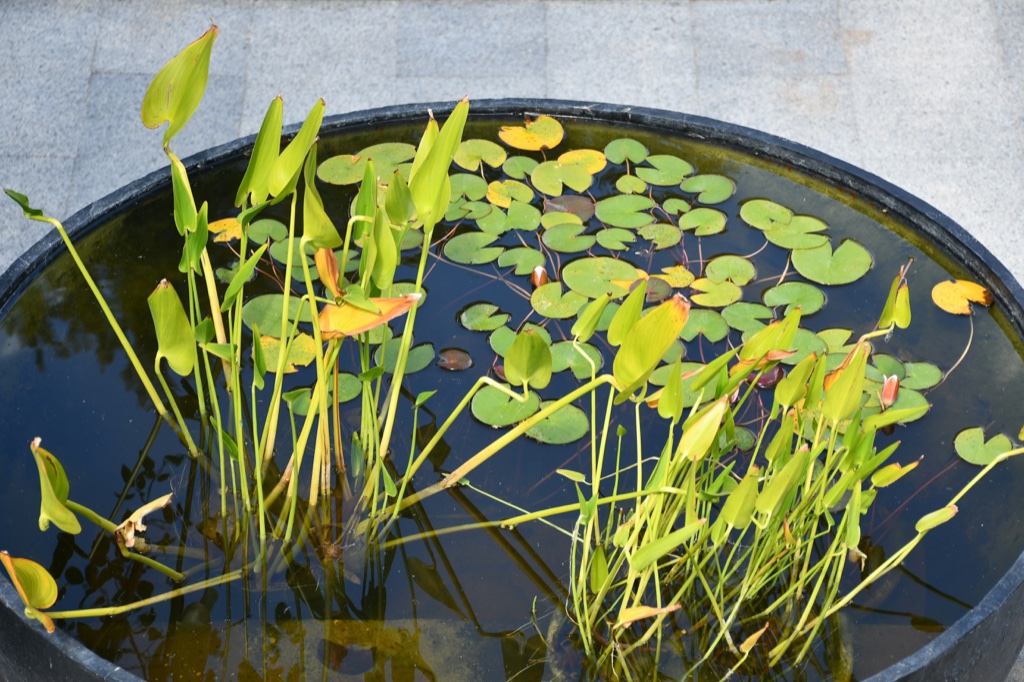
The engine, not the garnish
A floating plant is not playing the same game as a submerged one, and that is why it carries these models.
Underwater, carbon is what runs out first. Gas moves about ten thousand times more slowly through water than through air, so a submerged leaf sits in a thin skin of water it has already stripped of carbon. Across four submerged species that skin accounted for 90 percent of the total resistance to carbon fixation1. A floating leaf keeps its stomata up in open air with wind crossing them. It does not have the problem at all.
On top of that they are the fastest ammonium sink you can get2, they shade the water, which in Armenia is a cooling system rather than a nuisance, and they cost nothing. Duckweeds grow and survive across roughly 5 to 40 degrees, happiest at 20 to 303, and across 97 clones the measured relative growth rates run 0.150 to 0.338 per day at 30 over 25 degrees, and 0.113 to 0.318 at 20 over 163. A rate of 0.3 per day means doubling in a little over two days. One free handful from another keeper becomes a full mat inside a month.
Floating and rootless submerged plants exclude each other: a dense hornwort stand drives pH up and strips dissolved inorganic nitrogen below what floaters need, and pH was the strongest single inhibitor of Lemna gibba growth. Add nitrogen and the floaters win instead4. A container with fish in it is a nitrogen-rich system, so the floaters win. Thinning them is the recurring job in half the models here.
A complete mat removes the evaporative cooling that produced the 27 degree figure in the summer section5, and it calms the surface, which makes mosquitoes slightly worse rather than better6. Half to two thirds cover with an open patch is the target outdoors.
Duckweed fronds are frost sensitive, and only some species survive by forming turions: Spirodela polyrhiza does, S. intermedia, with equally frost-sensitive fronds, does not7. Keep a jar of floaters indoors over winter as an insurance culture. It costs nothing and it is your April starter.
A dense mat nobody thins is not exporting nitrogen. It is holding it for a few weeks and then handing it back8. Lift a handful out every week, dry it and weigh it, and you have measured exactly how much nitrogen left the building. A recipe with a floating mat and no harvest step is not a working recipe.
What goes in them
The physics permits far more animals than good sense does, and the market permits far fewer than either.
Every size, group and volume below comes from our species database9, 110 species9 deep, taking temperature and length from FishBase10 and minimum volumes and group sizes from the trade body wherever the trade body publishes one11. Our own species research disagreed with it in four places, and those four are printed below rather than quietly smoothed over.
One distinction travels with every temperature in that column. A database range is an aquarium recommendation, not a measured survival limit, and the hobby blends the two constantly12. Where a measured field range exists it is given separately, because it is a completely different kind of fact.
| Species | Adult size | Minimum group and volume | Published temperature | Needs aeration | On sale in Armenia | Against these models |
|---|---|---|---|---|---|---|
| Oryzias latipes, medaka | 4.0 cm SL9 | 6, in 60 L, base 60 by 30 cm9 | 18 to 24 C9 | No9 | No. Zero results at the specialist shop and zero in the classifieds under six spellings12 | The best candidate for a tub, and the only one with a multi-year field dataset behind it. Not obtainable |
| Tanichthys albonubes, white cloud | 4.0 cm TL9 | 5, in 40 L9 | 18 to 22 C9, survives to 512 | No9 | Not stocked9 | Ideal for Model B. Marginal outdoors even shaded, because a half-shaded tub still peaks near 24 to 26 C5 |
| Barbodes semifasciolatus, gold barb | 7.6 cm TL9 | 5, in 80 L9 | 18 to 24 C9 | No9 | Not stocked9 | Good for Model B at 84 L. Slightly wider heat tolerance than the white cloud |
| Danio rerio, zebra danio | 3.8 cm SL9 | 6, in 60 L9 | 18 to 24 C9 | No9 | Not stocked9 | Very hardy and very busy. Wants length rather than liters, so a tub suits it poorly |
| Corydoras paleatus, peppered cory | 6.6 cm SL9 | 5, in 60 L9 | 18 to 23 C9 | No9 | Not stocked9 | Excellent bottom fish for Model B, with a real sand floor |
| Xiphophorus maculatus, platy | up to 6 cm9 | 5, in 60 L9 | 18 to 25 C9 | No9 | Sold as platy at 1,000 AMD, though the database records no verified check139 | Hard alkaline water and warm summers suit it. Will breed heavily, which is a stocking problem two seasons out |
| Macropodus opercularis, paradise fish | 8.0 cm SL9 | 1 male, in 72 L, base 80 by 30 cm914 | 10 to 26 C9 | No9 | Not stocked9 | The widest temperature range on this table, and it breathes air, which is why a hot Meghri afternoon does not end it. One male only |
| Notropis chrosomus, rainbow shiner | 8.1 cm TL9 | 6, in 100 L9 | Not published9. Classified temperate10 | Yes, and it needs flow9 | Yes, at the specialist shop13 | Disqualified from every model here. It is the best cool-water fish on the Armenian shelf and it is a clear gravelly creek animal. See the disagreement below |
| Misgurnus anguillicaudatus, weather loach | 28 cm SL9 | 3, in 300 L, covered9 | 5 to 25 C9 | No9 | Not stocked9 | Sold small as a hardy beginner fish and reaches 28 cm. Only in Model D sized up, covered, and it climbs out9 |
| Carassius auratus, goldfish | up to 25 cm, record 48 cm TL9 | 2, in 100 L for the first and 50 L for each after, filtered always119 | 0 to 41 C9 | Yes9 | Many, in the classifieds, 500 to 6,000 AMD12 | Fails the low-effort model on the database's own aeration field. A garden pond over 1,000 L, honestly filtered, or a different animal |
| Cyprinus carpio, koi | 60 to 90 cm typical1210 | Not in our database. Trade guidance is a pond of several thousand liters, at least 60 cm deep, pumped and filtered11 | 3 to 35 C10 | Yes11 | Four listings at 1,000 to 5,000 AMD, at 7 to 8 cm12 | No, at any tub size. A 60 cm koi is about 3.1 kg and needs over 6,000 L5. This is not a matter of degree |
| Neocaridina davidi, cherry shrimp | about 3 cm11 | 5, in 20 L11 | 18 to 26 C12 | No | Several color forms, 800 AMD each13 | A locally available option. Summer only outdoors. Not in our species database, which currently holds no invertebrates |
| Gambusia holbrooki, mosquitofish | to about 6 cm10 | Not in our database, deliberately | 15 to 35 C, briefly 4210 | No | Zero listings12, and already in the wild here15 | Never, in anything. See below |
Where our own sources disagreed
Four disagreements, settled in favor of the database, and printed rather than buried.
The rainbow shiner. Our species research puts it top of the shopping list as the fish to buy today for an unheated indoor tank12. The database says it needs both aeration and flow9, which rules it out of a still, unaerated, planted container. The database wins, and the fish is out of every setup on this page. It is still the most interesting cool-water fish on the Armenian shelf. It just belongs in a different build, the way a hillstream loach does14.
The white cloud. Our species research calls it the best species you can buy today12, then later records zero at the specialist shop and zero in the classifieds12. The database agrees with the second half9. Right fish, not for sale here.
The medaka volume. Our species research asks for 40 to 45 L1214. The database asks for 60 L and a base of 60 by 30 cm9. This page uses the bigger number throughout.
The platy. Our species research recommends the variatus platy. The database holds only X. maculatus9, so that is the one named here, and there is no second list anywhere contradicting it.
Two kinds of temperature number
Medaka reads 18 to 24 in the database and 4.2 to 26.3 in a real pond. Both are correct.
The database figure is a FishBase aquarium recommendation109. The pond figure is measurement. A peer-reviewed study of wild medaka reproducing naturally for several generations in an outdoor pond in Japan recorded surface water at 4.2 degrees in January and 26.3 in August, with a spawning season of late April to early September and the population overwintering in 40 to 55 cm of still water16. The same study reports dissolved oxygen between 3.99 mg/L in September and 11.77 in April16. The outer documented limits, 0 and 42 degrees, come from the medaka research literature and circulate without attribution17.
What that settles, and what it does not. It settles, from measurement rather than folklore, that a self-sustaining population gets through winter at 4 to 8 degrees in half a meter of still unheated water. It does not settle anything about Yerevan. That Japanese pond never froze. A Yerevan container will, and the design ice thickness here is 42 cm in an average winter5. The gap between those two facts is a question about depth, volume and siting, not about the fish.
Shrimp outdoors, honestly
They are excellent all summer and they almost certainly do not survive an Armenian winter outdoors.
Nobody has published a lower lethal temperature for Neocaridina davidi12, so the answer has to come from where they actually live. Map the feral populations across Europe and in temperate regions they sit almost entirely in thermally polluted water and thermal springs. All three newly reported established populations, in Germany, Hungary and Slovakia, were in artificially warm water18. Read that as a thermometer. They have been dumped in rivers thousands of times over twenty years, and where they survive, somebody is heating the water.
Do not read it as permission to release them. The same paper reports the species expanding into colder environments and models a foreseeable expansion into western Europe and the Balkans by 205018, and it reports feral populations carrying microsporidian parasites, with the known list in this host expanded from two species to four18. A dead shrimp can still have delivered a live parasite. Bring them in before the first frost, or accept that you are killing them.
Two things every outdoor model has to answer
Standing water breeds mosquitoes, and the standard answer to that is one of the worst invasive fish in the world.
An open container outdoors in an Armenian summer breeds mosquitoes. Everybody's answer to that is mosquitofish. Gambusia is a member of the list of one hundred of the world's worst invasive alien species19. It was introduced to Armenia for mosquito control and is now in almost every water body of the Ararat plain and in the Araks, Metsamor and Hrazdan15, and Armenia carries out no monitoring or control of animal invasions at all20. Adding one more is not a small act. It is also an aggressive fin-nipper and a poor community fish.
What actually works, in order. Almost any small surface fish eats the larvae, so a stocked container has no mosquito problem at all. The question only comes up for a plant-only container, or one in its first few weeks. Shrimp do not eat larvae, so a shrimp-only tub still breeds them. For a container with no fish, reach for the bacterium Bacillus thuringiensis israelensis. It touches only the larvae of mosquitoes, black flies and fungus gnats, the regulator has concluded it poses no risk to humans, it can go into ponds without affecting the ecosystem, and this is exactly what it is for: standing water in flower pots, tyres and bird baths21. Nobody in Armenia appears to stock it, which is a real gap and worth somebody checking. After that: a small solar pump to break the surface, and stop leaving buckets and saucers standing full beside the container, because that is where most of the mosquitoes in a garden actually come from.
The legal position, stated once15
- Art. 88.1
- Keeping a wild animal in captivity without permission. 150,000 to 200,000 AMD for a citizen15
- Art. 89
- Catching a fish without a permit, at a prohibited time or with prohibited gear. 50,000 to 100,000 AMD15
- Art. 90
- Unauthorised resettlement or acclimatisation. 50,000 to 80,000 AMD15. This is the article a tub release falls under
- Art. 91
- Destroying Red Book animals, their spawning sites or their eggs. 80,000 AMD15
- 17
- taxa on the 2026 amateur fishing list, almost all food fish, rods only, two rods and two hooks per angler15
The price of the word minimal
Four things accumulate, not one, and in Armenia the one the hobby names is not the important one.
One container, worked all the way through, so you can check the arithmetic against your own: 400 L with 1.08 m2 of surface, 250 g of fish fed 2.5 g a day of 32 percent protein food, topped up with Yerevan tap water and never drained5.
| What accumulates | Rate, if nothing removed it | Does it plateau? | Cheapest fix |
|---|---|---|---|
| Nitrate | about 27 g of nitrogen a year produced, which is 1,330 mg/L on a test kit if none left5, against a recommended maximum of 2 mg NO3-N/L, about 9 mg/L on a kit, to protect the most sensitive species1 | No | Harvest and physically remove plants. A water change is not doing this job |
| Refractory organic carbon | fish food is about 45 percent carbon, so 1.1 g of carbon a day, of which a refractory 10 to 20 percent persists: about 60 g a year5. For comparison ordinary lakes run 2 to 20 mg C/L1 | No. It moves to the sediment | Net the leaf litter out in autumn. This is the same job that fixes the winter oxygen budget |
| Phosphate | about 11 g of phosphorus a year5. In hard alkaline water it co-precipitates with calcium and adsorbs to iron oxides, so it goes into the mud rather than staying dissolved1 | Buried, then released when the sediment goes anoxic | Keep the sediment oxic and feed less. A green-water bloom in August in a container that was clear in June is internal loading, not a new input5 |
| Hardness, and then everything else dissolved | a 30 cm deep container in Yerevan takes in three to five entire tank volumes of tap water a year through evaporation and lets none of the minerals out, adding 24 to 37 dGH a year5. It is a water change running in reverse | Calcium and carbonate plateau at calcite saturation. Sodium, chloride and sulfate do not, and conductivity does not at all5 | Top up with rainwater. Buy a total dissolved solids meter, not a hardness kit, for this job1 |
| Alkalinity, destroyed by nitrification | 7.1 mg of calcium carbonate per mg of ammonium nitrogen oxidised1, which in the 400 L base case is minus 27 dKH a year5 | Offset by the top-up in Yerevan. Not offset in Dilijan or Vanadzor | A handful of crushed limestone in a rain-fed container in the soft regions |
| Iron availability | Falls. Ferric iron precipitates at the pH of a sunlit alkaline container, and Yerevan tap water carries no useful iron, with metals at or below detection in almost all samples15 | No | A soil base layer, which is the strongest technical argument for Model E and is not the argument the hobby usually makes5 |
One genuinely pleasing result falls out of the middle two rows. Nitrification eats about 27 dKH a year out of the 400 L base case, and hard Yerevan tap water replaces about 24 to 37 dGH a year through evaporative top-up at 30 cm depth. They very nearly cancel5. In the Ararat valley, evaporation is what keeps a no-water-change container from crashing in pH, and it is one reason this model works better in Yerevan than the literature would predict. In Dilijan and Vanadzor it does not cancel, because those places lose far less water and get far more rain, so they add only 4 to 14 dKH a year5; check alkalinity there in autumn. The cancellation is order of magnitude rather than exact, because plant ammonium uptake diverts part of the flow and acidifies too, and denitrification in an anoxic soil layer pushes back the other way.
The evaporation figure under all of that is the weakest number on this page, and you can beat it in one minute. No Armenian station publishes pan or free-water evaporation normals, so the working figure of 5 to 10 mm a day in July in the Ararat valley comes from a generic mass-transfer coefficient bracketed by an energy-budget bound rather than from Armenian data. So take it off us. Mark the water line inside the container with a permanent marker, write the date next to it, come back in a week and measure how far it fell in millimeters, minus any rain. That one measurement is worth more than the whole model, and it is yours.
What the year actually costs
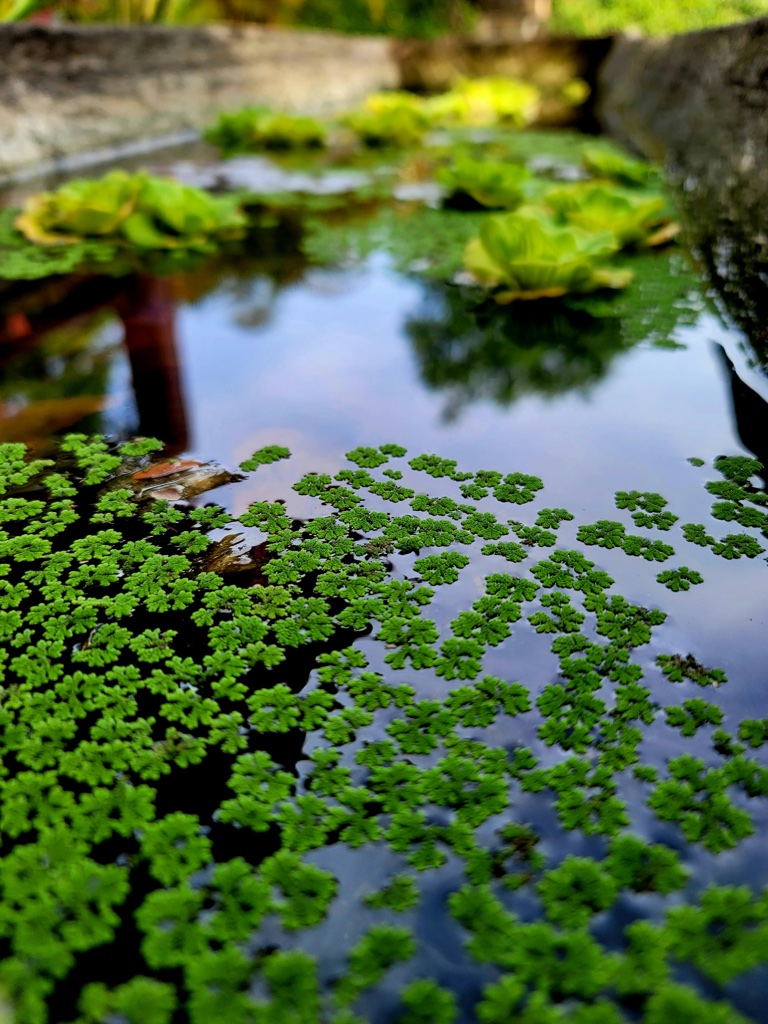
One half hour in November fixes three problems at once. That is the whole honest content of a no-maintenance claim.
Count the animals out loud at feeding time. It is the only reliable detector of a missing one, and it costs nothing.
Thin the floating plants and physically remove them from the building. This is the nitrogen export step and it gets bigger the better the system works22.
Top up evaporation, and no more than needed. Rainwater beats tap water for this, because evaporation concentrates minerals and the top-up is the mechanism behind the hardness row above5.
Stop feeding. Cyprinid digestion effectively stops, undigested food rots inside the fish, and every uneaten gram is added to the winter oxygen demand5.
Net the leaves out, cut back dying plants, siphon the worst of the mulm, and do one 30 to 50 percent water change5. This one job halves the winter oxygen problem, resets the dissolved solids drift and removes the year's carbon before it becomes next summer's sediment demand.
Record the conductivity with a total dissolved solids meter, always the same meter1. Rising readings with flat hardness is exactly the signature of evaporative concentration in hard water, and it is the drift no hardness kit will show you.
Call that no water change and you are close enough to honest. Call a container that never gets it self-sustaining and you are not. For the practical side of doing this indoors, the bucket routes, the socket and where to stand it, see planning a tank. For plants by light level, find a plant. For the soil method in full, the Walstad method.
- Our own research on materials and water chemistry. Used for: the un-ionised ammonia tissue damage threshold; the nitrate toxicity review figures and the nitrogen to nitrate conversion; alkalinity destroyed per mg of ammonium nitrogen oxidised; phosphate behaviour in hard alkaline water; total dissolved solids meters as a relative tool and why the same meter must be used every time; dissolved organic carbon concentrations in natural waters; and the boundary layer physics that limits carbon uptake by a submerged leaf, including the 90 percent resistance figure. See materials and water.
- Walstad, D. (2017, updated 2023). Nitrogen Uptake by Aquatic Plants. Free PDF. The Pistia stratiotes result of 6.4 mg/L of nitrogen cleared in 4.3 hours as ammonium against 44 hours as nitrate, citing Nelson, Smith and Best (1980), Guam Water Resources Research Center; and the Elodea nuttallii result of 75 percent of available ammonium removed in 16 hours with the nitrate almost untouched, citing Ozimek, Gulati and van Donk (1990), Hydrobiologia 200: 399 to 407. dianawalstad.com
- Appenroth, K.-J. and others (2026). Temperature-dependent clonal and species-level growth variation in Spirodela, Landoltia and Lemna. Plants 15(11): 1649. Open access. Duckweeds growing and surviving from 5 to 40 C with an optimum of 20 to 30, and relative growth rates of 0.150 to 0.338 per day at 30 over 25 C and 0.113 to 0.318 at 20 over 16 C across 97 clones. DOI 10.3390/plants15111649 open access
- Szabo, S., Koleszar, G., Zavanyi, G., Nagy, P.T., Braun, M. and Hilt, S. (2022). Disentangling the mechanisms sustaining a stable state of submerged macrophyte dominance against free-floating competitors. Frontiers in Plant Science 13: 963579. Open access. Free-floating and rootless submerged macrophytes as mutually exclusive, pH as the strongest single inhibitor of Lemna gibba, and nitrogen loading triggering a shift to floating dominance. DOI 10.3389/fpls.2022.963579 open access
- Our own physics research and our own arithmetic. Not a published source. Every figure on this page marked as calculated comes from one file, and each calculation states its model in that file so it can be argued with. Ours: the reaeration time constant table and the two-container comparison; the barometric correction to the oxygen solubility table; the night oxygen budget, the sensitivity analysis and the 0.5 g per litre stocking limit; the length to weight and minimum volume tables; the ammonia and alkalinity arithmetic; the accumulated freezing degree day reconstruction and its validation against published frost night and ice day counts; the ice thickness figures; the freeze-solid energy budget; the under-ice oxygen budget; the surface energy balance for equilibrium water temperature, the diurnal swing and the peak temperature tables; the soil frost depths; the hardness creep and evaporation arithmetic; the surface area and time constant recomputed for each model. The two inputs that move the stocking answer most, sediment oxygen demand and gas transfer velocity, are published ranges rather than measurements of an actual garden container, which is why the recommended figure is half the central calculated value. calculated, repeatable, unverified by a third party
- Our own build research: plants, containers and build recipes. The source of every container dimension, water volume, surface area, plant list, setup sequence, cost total and weekly minute figure attached to a model on this page, together with the plastics code rules, the food-safe container rules and the Armenian container sourcing. Weekly care times are approximate and depend on your setup and routine. Anything marked as an estimate in that file is an estimate here.
- Appenroth, K.-J. and others (2023). Survival strategies of duckweeds, the world's smallest angiosperms. Plants 12(11): 2215. Open access. Frost-sensitive fronds, and turion formation in Spirodela polyrhiza but not in S. intermedia. DOI 10.3390/plants12112215 open access
- Our own research comparing nitrifying and heterotrophic bacteria. Used for: nitrifiers being 0.6 to 14 percent of the prokaryotes on real home biofilter media; heterotroph growth rates of 3 to 6 per day against well under 1 for nitrite oxidisers; the 30 to 50 percent loss of nitrification capacity after overfeeding in an inert-substrate tank; mineralisation of dead plant tissue straight back to ammonium; and the sulfate limitation on hydrogen sulfide in fresh water. See cycling and bacteria.
- Our own species database, 110 species, each carrying an adult size, a minimum group, a minimum volume and footprint, a heater flag, an aeration flag, a flow flag and an Armenian availability field. Temperature and length come from FishBase, minimum volumes and groups from the trade body where one is published, and everything derived is labelled as derived in the file. It is the same data behind find a fish, and where it disagreed with our species research it was preferred.
- Froese, R. and Pauly, D. (eds.) (2026). FishBase, version 2025-2. Maximum lengths, published temperature ranges and native distributions for every species named here. fishbase.se
- Ornamental Aquatic Trade Association, United Kingdom. Care sheets on unheated aquariums, on goldfish, and on setting up and looking after a garden pond, including the 100 litres for the first goldfish and 50 for each after, always filtered. This is trade guidance from an industry body, not measured welfare science, and it is presented that way. ornamentalfish.org
- Our own species research for unheated and low-effort setups. Used for: the temperature tolerance table and its distinction between measured limits, database fields and trade guidance; the legal position and its reading of the amateur fishing order; the availability checks at the specialist shop, in the classifieds and at the nearest Georgian shop, on 8 and 9 September 2026; the absence of a published lower lethal temperature for Neocaridina davidi; and the practical shopping list. Where this file and the species database disagreed, the disagreement is written out on this page and the database was used.
- Gazanik, Arshakunyats 54/49, Yerevan. Every price on this page marked as verified was read on 9 September 2026 from the shop's own product data, through its category pages and the price printed on each product page. Stock varies by item and by day and should be checked before travelling. gazanik.am read 9 September 2026
- Seriously Fish. Species profiles for Oryzias latipes and Macropodus opercularis, used for the base footprint figures and the one-male rule. seriouslyfish.com
- Our own Armenia research. Used for: the Code of Administrative Offences articles and their amounts, the Law on Fauna, the Law on Hunting gear rule and the 2026 amateur fishing order, each cited in that file to the national legal register; Yerevan tap water by district, from Shahinyan (2005), Proceedings of the National Academy of Sciences of Armenia, Earth Sciences LVIII(1) pp. 41 to 45, sampling 2002 to 2004, giving 2.9 to 10.9 dGH by district, bicarbonate at 61 to 77 percent of anions, sulfate rarely above 11 or 12 percent, and metals at or below detection in almost all samples; the absence of published water data for Gyumri, Vanadzor, Dilijan and the Sevan towns; mosquitofish distribution in Armenia; and carbonate outcrops in the Hrazdan, Vedi and Argichi basins with the vinegar test. See Armenia.
- Kobayashi, M. and others (2012). Reproductive behavior of wild medaka in an outdoor pond. Nippon Suisan Gakkaishi 78(5): 922 to 933. Open access, in Japanese with an English abstract. Manyo-ike, Kobe College, built 1940 to 1941, 10 to 35 cm deep over most of its area and 40 to 55 cm at the deep end, no current, planted. Table 1 gives measured surface water temperatures of 4.2 C in January and 26.3 in August, a spawning season of late April to early September, dissolved oxygen between 3.99 and 11.77 mg/L and pH between 6.90 and 7.92. The only multi-year field dataset behind any recommendation on this page. DOI 10.2331/suisan.78.922 open access
- Shima, A. and Mitani, H. (2004). Medaka as a research organism: past, present and future. Mechanisms of Development 121(7): 599 to 604. The origin of the 0 to 42 C and 15 to 28 C figures that circulate in the hobby without attribution. DOI 10.1016/j.mod.2004.03.011
- Prati, S. and others (2024). Invisible invaders: range expansion of feral Neocaridina davidi offers new opportunities for generalist intracellular parasites. Biological Invasions 26. Feral populations in temperate Europe confined mainly to thermally polluted waters and thermal springs; three newly reported established populations, in Germany, Hungary and Slovakia, all in artificially warm water; expansion into colder environments over time with modelled suitability reaching western Europe and the Balkans by 2050; and the known microsporidian list in this host expanded from two species to four. DOI 10.1007/s10530-024-03324-3
- IUCN Invasive Species Specialist Group, Global Invasive Species Database, Gambusia. Confirms membership of the list of one hundred of the world's worst invasive alien species. iucngisd.org
- Arakelyan, M. and others (2024). Invasive alien species of animals in Armenia. BioInvasions Records 13(2): 293 to 303. Forty invasive animal species of which six are fish; Carassius auratus, the goldfish and Prussian carp complex, first recorded 1983, arriving by escape, release and transport contaminant, now present in all provinces; and the finding that no monitoring or control of animal invasions is carried out in Armenia at all. DOI 10.3391/bir.2024.13.2.01 open access
- United States Environmental Protection Agency, Bti for mosquito control. Affects only the larvae of mosquitoes, black flies and fungus gnats; concluded not to pose a risk to humans; can be applied to ponds, lakes and rivers without affecting aquatic ecosystems; minimal toxicity to honey bees; used in standing water in flower pots, tyres and bird baths. epa.gov
- Our own research on the Walstad method, which carries Walstad's own published statements and their citations. Used for: her filtration and aeration position and the reason for it; the two named maintenance verbs and the six-months-or-more water change figure; the first month described as a race against time; the soil and cap depths; soil sourcing and the Armenian exclusion list; the soak test protocol; the Ararat copper warning; and the finding that too poor a soil is also a failure. See the Walstad method.
Continue