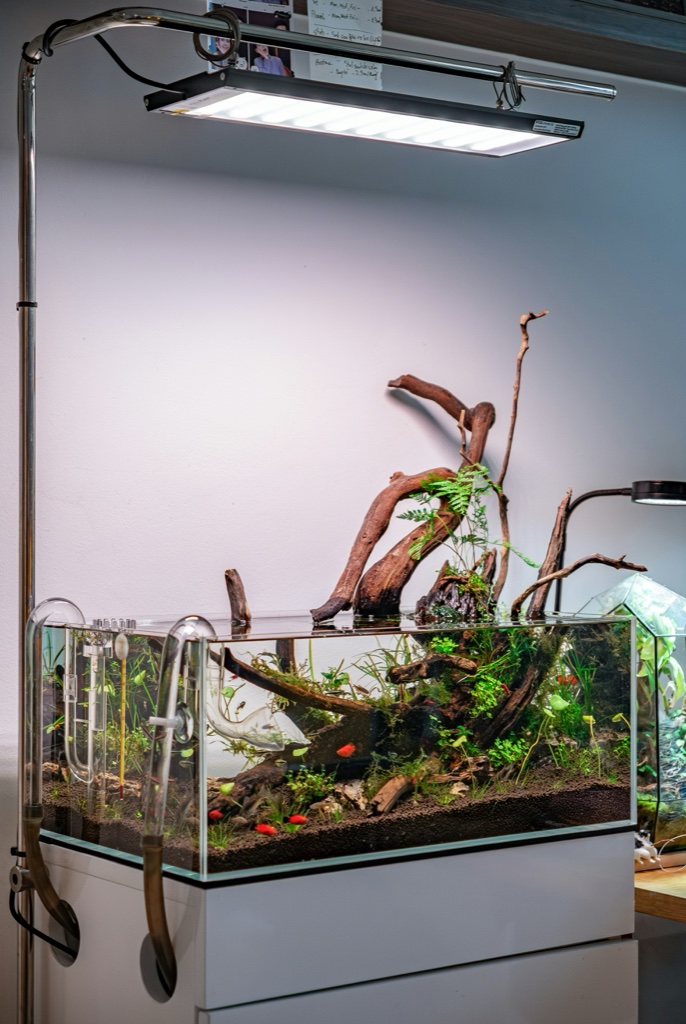
The result the whole page rests on
Oxygen enters across the surface, and the surface does not know how much water is underneath it.
Oxygen gets in one way only: across the place where air touches water. Not through the walls, not through the floor. So the supply depends on area, and the thing being supplied depends on volume Write the standard two-film expression, divide through by volume, substitute the mean depth, which is volume over area, and volume falls out of the equation entirely.
What is left is a rate constant of k over d Twice as deep, half as fast, whatever the volume. That is not a rule of thumb, and in still water it has no exceptions.
The one loose number is the gas transfer velocity. For small, sheltered, low-wind water it runs roughly 0.2 to 1.5 meters per day, and it climbs sharply with wind and with rain12. A tub against a wall in still summer air sits near the bottom of that range. The same tub in an open yard on a breezy day sits near the top. Every figure here uses 0.5 meters per day3, the middle of it.
Mean depth, not maximum depth. A tub with a deep middle and shallow shelves has a mean depth well below its deepest point, and it is the mean that goes in the formula. That is also the cheapest way to reconcile the two things depth has to do at once, which the winter section returns to.
Two containers, the same water3
dC/dt = (k / d) · (Cs − C)
tau = d / k
- C
- dissolved oxygen concentration, mg/L
- Cs
- the saturation concentration at this temperature and this barometric pressure, mg/L
- k
- gas transfer velocity, sometimes called piston velocity, m/day1
- d
- mean water depth, m, which is volume divided by surface area
- tau
- the time constant of the exponential approach back to saturation
| Mean depth | k = 0.3, still and sheltered | k = 0.5, light air movement | k = 1.0, breeze or ripple | k = 2.0, rain or fountain |
|---|---|---|---|---|
| 0.15 m | 12 h3 | 7 h3 | 4 h3 | 2 h3 |
| 0.30 m | 24 h3 | 14 h3 | 7 h3 | 4 h3 |
| 0.45 m | 36 h3 | 22 h3 | 11 h3 | 5 h3 |
| 0.60 m | 48 h3 | 29 h3 | 14 h3 | 7 h3 |
| 1.00 m | 80 h3 | 48 h3 | 24 h3 | 12 h3 |
Read the middle column against a summer night. A night is about twelve hours long. Anything whose time constant is shorter than that has its oxygen back before dawn, and needs no pump. Keep the mean depth at or below about 0.40 m and an unaerated container recovers inside a single night. Past about 0.70 m it cannot, and something has to move the water3. That threshold, and nothing else, is why one setup on this page owns an air pump and five do not.
An air pump is usually the wrong first purchase, and here is why. It does raise k by breaking the surface, and it does stop the water stratifying. Both real. It also drives off carbon dioxide, which is the plants' carbon supply, and losing the ammonia and carbon dioxide the plants want is exactly why Walstad runs her own tanks with no filter and no aerator4. Making the water shallower is free. Making the surface wider is free. Letting wind reach it is free. The pump earns its place in two situations only, a container deeper than about 0.60 m and a hole in winter ice, and never as a routine.
The second correction
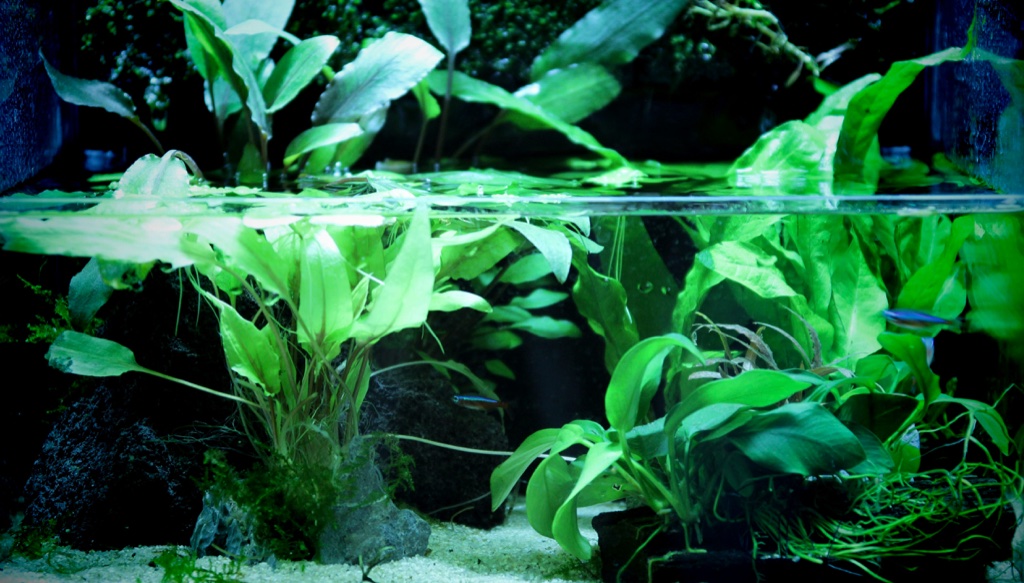
Every oxygen chart in the hobby is printed for sea level, and Armenia is not at sea level.
How much oxygen water can hold depends on the pressure of the air sitting on it. Yerevan's reference station sits at 1113 m, which is about 887 hPa against 1013 at sea level5. Correct the standard freshwater solubility table6 for that and the answer is blunt.
A Yerevan container at 30 degrees holds 6.58 mg/L when it is completely full, not 7.5636. That is about 13 percent less oxygen than the tables say, and the shortfall is roughly the same 13 percent at every temperature3. Gyumri, at 1513 m and about 846 hPa, loses about 17 percent53. Meghri, at 627 m, loses only about 7.5 percent, which partly offsets its being the hottest place in the country53.
The full temperature by station table lives on planning a tank. What matters here is that the shortfall arrives on exactly the days when the margin is thinnest, and that every stocking figure you read in an English, German or Russian source is about an eighth too generous for Armenia.
| Water temperature | Saturation in Yerevan | Fish demand | Ratio of demand to supply, against 15 C |
|---|---|---|---|
| 15 C | 8.80 mg/L3 | 106 mg/kg per hour37 | 1.03 |
| 20 C | 7.93 mg/L3 | 150 mg/kg per hour37 | 1.573 |
| 25 C | 7.20 mg/L3 | 212 mg/kg per hour37 | 2.453 |
| 30 C | 6.58 mg/L3 | 300 mg/kg per hour37 | 3.793 |
| 34 C | 6.14 mg/L3 | 396 mg/kg per hour37 | 5.363 |
Going from 15 to 30 degrees makes the oxygen situation almost four times worse. That is why every stocking figure on this page is set at the July water temperature and not at an annual average, and why shade is treated here as a life support system rather than as a comfort. The routine metabolic rate behind the demand column is a mid-range cyprinid value rather than a measurement of a goldfish or a medaka7, and mass-specific rates fall with body size in a way this model does not capture, so the column is an order of magnitude, not a species figure.
The number every model is sized against
Half a gram of adult fish per liter, at the July temperature, after the fish have grown.
Start by throwing away the rule you already know. One inch of fish per gallon, and its metric cousin one centimeter per liter, comes from nowhere. No peer-reviewed source, no aquaculture engineering text, no university extension publication. Nobody can say who wrote it down first3. It is also wrong on its own terms, three separate times.
Mass does not scale with length. Fish mass follows length to a power close to three, so doubling the length multiplies the mass by about eight. A goldfish at 10 cm is about 20 g and the same fish at 30 cm is about 579 g3. Twenty small fish and one large fish of the same total length differ in mass by a factor of thousands. The tank does not respond to fish, it responds to food. Nitrogen enters in the feed bag, and a rule that never mentions feeding cannot be right. And it ignores surface area, temperature and plants, which are the three things that actually decide the answer.
Total ammonia produced per day is about feed mass times protein fraction times 0.0928, giving roughly 0.3 mg of ammonia nitrogen per gram of fish per day at a maintenance feeding rate and about 1 mg at a growth rate38. Against that, a planted 200 L tub with a gravel bottom carries roughly 5 to 12 m2 of oxic biofilm, which at published low-concentration removal rates is 250 to 1800 mg of capacity a day against a load of 74 mg38. Several times what it needs.
Run a twelve hour night with no photosynthesis, fish respiration, sediment and plant dark respiration, and reaeration at k of 0.5. Allow a 3 mg/L drawdown, so a tub that starts near saturation ends the night above the 3 mg/L at which cyprinids begin to show stress9. The answer comes out at almost exactly 0.96 g of fish per liter at 28 degrees, for every container size3, because in a shallow tub the bottom area and the surface area are the same area and the two terms nearly cancel. The fish spend the night on the oxygen stored in the water column and nothing else.
Two of the inputs swing wide. Sediment oxygen demand runs 0.3 to 3 g of oxygen per m2 per day10, and the gas transfer velocity1 is no tighter. Either one can double or halve the answer on its own. Across their plausible ranges the calculated limit for one 200 L tub at 28 degrees runs from zero to 2.82 g per liter, a tenfold spread3. So this page designs to half of the central value, 0.5 g per liter3. The other half is the margin, and the margin is the point.
Read the sensitivity across its rows and columns. Going from a clean gravel bottom to a neglected one with leaf litter takes the limit from 1.31 to 0.20 g per liter at the same k3. Going from still air to a rippled surface takes it from 0.66 to 2.46 at the same bottom3. How much rotting organic matter is on the bottom, and whether anything moves the surface. Neither of those is a fish, and both are free to change.
| Adult length | 4 cm | 10 cm | 20 cm | 30 cm | 45 cm | 60 cm |
|---|---|---|---|---|---|---|
| Medaka or white cloud | 2 L3 | 28 L3 | Neither species reaches these lengths | |||
| Goldfish | 2 L3 | 41 L3 | 336 L3 | 1159 L3 | 3990 L3 | 9596 L3 |
| Koi, common carp | 2 L3 | 27 L3 | 224 L3 | 765 L3 | 2615 L3 | 6252 L3 |
Two things fall straight out of that table. For small fish the oxygen limit is never the binding constraint. A 200 L tub could carry 100 g of medaka on this rule, which is two hundred or more adults3. Nobody would stock that, and the reason is behavior, breeding pressure and feeding practicality rather than chemistry. Stock small fish by sense, not by the physics. For large fish it binds immediately. One adult goldfish at 30 cm needs over a thousand liters3. A koi reaching 60 cm is about 3.1 kg and needs over six cubic meters3. There is no tub in which a koi can be kept for life, and that is arithmetic rather than an opinion.
The clause that kills tubs is the last one. Stock for the adult size, at the July temperature, in the shade the container will actually have. Six 5 cm goldfish in a 200 L tub is 15 g of fish and comfortable. The same six fish at 20 cm is 1010 g, which is ten times over the limit3. Nothing was added. Nobody did anything wrong on any particular day. The same applies to breeding: a tub stocked at a tenth of its limit reaches it in two or three seasons on its own. Use find a fish for adult sizes and minimum groups before deciding a number.
Why a filter is optional and what it was actually buying
Not nitrification. Flow, and a basket you can rinse.
A filter adds surface area, which is already in surplus; forced flow through that surface, which is a real gain because a still tub moves ammonium to the biofilm only by diffusion through a thick boundary layer12; and mechanical removal of solids, which is the gain nobody credits. Solids export lowers sediment oxygen demand, and the sensitivity table shows that is the single most powerful lever on stocking.
So the true claim is a narrow one. Below about 0.5 g of fish per liter, in a planted container shallower than 0.40 m, a filter buys you flow and solids export. Not nitrification3. Get both another way, by keeping the bottom clean and letting wind reach the surface, and you do not need it. Nitrifiers are between 0.6 and 14 percent of the prokaryotes on real home biofilter media13 and they live on every wetted surface, not only in the filter.
Why plants change the arithmetic, and where they do not
They eat the ammonium before the bacteria get to it. Then they hand it back.
Plants take ammonium in preference to nitrate and floating plants are fastest at it. Water lettuce cleared 6.4 mg/L of nitrogen supplied as ammonium in 4.3 hours against 44 hours as nitrate, and Elodea nuttallii removed 75 percent of available ammonium in 16 hours while leaving the nitrate almost untouched14. At 3 to 5 percent nitrogen of dry weight and ordinary macrophyte productivity, a well grown mat absorbs 90 to 600 mg of nitrogen per m2 per day against a properly stocked tub's 117315. The whole nitrogen input, with no bacterial step at all.
Here is the condition nobody states. Uptake is storage, not export. Nitrogen inside a plant is still inside the tank, and when the leaf dies it goes straight back to ammonium13. Plants remove nitrogen only in proportion to how much plant you physically lift out. Pruning is the water change. Which is why every setup below has a thinning job, and why not one of them says no maintenance.
And three things plants do not fix
They consume oxygen at night, they raise pH in the afternoon, and they do nothing in month one.
Heavy planting raises the night respiration term. The sensitivity moves the stocking limit from 1.21 g per liter lightly planted to 0.71 with a soil substrate, heavy planting and leaf fall3. A tub that is beautiful at six in the evening can be the most dangerous object in the yard at five in the morning.
Photosynthesis strips carbon dioxide and drives pH up, and pH is the multiplier on ammonia toxicity16. At pH 8.0 and 28 degrees, total ammonia of only 0.76 mg/L already puts un-ionised ammonia at the 0.05 mg/L tissue damage threshold31612. Read the pH at five in the afternoon on a sunny day, not at eight in the morning. And in the first weeks, before the plants are growing, nothing removes ammonium quickly. That is the failure mode of the whole approach and it follows from the mechanism4.
The Armenian arithmetic, part one
The worst night of the year in Armenia is a July night, and almost nobody plans for it.
Yerevan gets 82 days a year above 30 degrees. Armavir gets 90, Meghri 915. Every book on outdoor ponds was written in Britain, Germany, the Netherlands or the northern United States, and none of them is calibrated for that.
The first answer is a pleasant surprise. An open, light-coloured, wide water surface in Yerevan in July settles at about 27.1 degrees, only about 1.5 above the mean air temperature3. Not 35. The reason is the dry air. July vapour pressure in Yerevan is 16.6 hPa and the wet bulb temperature about 18 degrees53, so evaporation carries away most of the sun's load. Armenia's dry summer is the single biggest advantage an outdoor keeper here has, and nobody ever puts it that way.
Two conditions come with that, and both carry weight. The container has to be topped up, so evaporation can keep going. And the surface has to stay open rather than disappear under a complete floating mat. Let it dry down, or cover it entirely, and you have thrown away the cooling that produced the number.
The second answer is the dangerous one. A small dark container in the open takes roughly 1.8 times the solar load per liter of a wide flat pond, because its walls collect heat while only its top can shed it3. That is about 6 degrees hotter on average, 33.3, before the daily swing is added on top3.
Peak July water temperature, Ararat valley, mean plus half the daily swing3
Shade is worth more than depth, and that falls out of the physics rather than out of preference
Going from 0.20 m to 0.60 m of depth in an unshaded light tub buys 3.1 degrees. Going from no shade to half shade at a fixed 0.30 m buys 6.13. Shade is twice as effective as trebling the depth, and it is better for a second reason: depth costs oxygen and shade does not. The time constant rises in direct proportion to depth, and deep containers stratify. Shade lowers the temperature without touching either.
It is easy to overshoot, so one caution. Past roughly 60 percent shade the plants stop growing properly3, and the plants are your nitrogen removal. At 80 percent shade the temperatures are lovely, about 20.0 degrees at peak at 0.30 m, and the container will not run itself3. Aim for half shade, concentrated between eleven and five. East facing, against a wall that blocks the afternoon, is the ideal Armenian spot, and choosing it costs nothing at all.
Morning sun and afternoon shade, free. Light color, almost free. Half shade over the middle of the day, cheap. More surface area, which helps oxygen and does not hurt temperature. More depth, which helps temperature and costs oxygen. An air pump, last3.
Under about 100 L in the Ararat valley or Meghri the container has so little thermal mass that the daily swing dominates every other consideration3. A 60 L tub 0.28 m deep, unshaded and dark, is well above 35 degrees on a July afternoon whatever else is done to it3.
Under about 50 L in full sun in Yerevan, Armavir, Ijevan or Meghri, a permanent outdoor container is not viable for fish and cannot be rescued by shape, color or stocking3. Either it is shaded for most of the day, in which case it is a plant container that happens to hold water, or it is emptied for the summer.
Past about 400 L, with half afternoon shade and a light-coloured container, the Ararat valley temperature problem simply goes away, and the question goes back to oxygen and stocking3. That is why the year-round setup on this page is a big one.
Dawn and dusk are two different tanks. At five in the afternoon the water is hottest, oxygen is supersaturated from a day of photosynthesis, pH is at its highest and therefore the toxic fraction of any ammonia present is at its maximum. At five in the morning the water is coolest, oxygen is at its minimum after twelve hours of respiration, and ammonia is at its least toxic. The oxygen emergency and the ammonia emergency happen twelve hours apart3. Any single measurement taken at a convenient hour describes one and hides the other. If you will test the water once in summer, test at dawn.
The Armenian arithmetic, part two
Cold does not kill an overwintering cyprinid. A sealed lid does.
Three things have to be true for an animal to get through winter outdoors. The container must not freeze solid. At least 25 to 30 cm of liquid water must stay under the ice, so a fish can rest on the bottom out of its way. And the oxygen under that ice must last longer than the ice does. The third one is what actually kills. The first two are what people plan for.
Ice thickness on still water follows accumulated freezing degree days through Stefan's relation17. Armenia publishes monthly normals rather than daily series, so we rebuilt the degree-day totals by treating daily means as normally distributed around each published monthly mean. The spread was pinned by making that same distribution reproduce two independently published counts, frost nights and ice days, which it does at seven of the eight stations35. That is what makes the numbers below usable.
| Station | Freezing degree days, average winter | Design ice thickness | In a cold winter | Normative soil frost depth, sandy loam | Longest continuous ice cover |
|---|---|---|---|---|---|
| Yerevan, Agro plain, 942 m | 2403 | 42 cm3 | 51 cm3 | 0.59 m318 | 10 to 20 days3 |
| Yerevan, Arabkir, 1113 m | 1853 | 37 cm3 | 45 cm3 | 0.43 m318 | 7 to 14 days3 |
| Armavir, 861 m | 2293 | 41 cm3 | 50 cm3 | 0.56 m318 | 10 to 18 days3 |
| Gyumri, 1513 m | 6453 | 69 cm3 | 84 cm3 | 1.22 m318 | 60 to 90 days3 |
| Vanadzor, 1376 m | 2273 | 41 cm3 | 50 cm3 | 0.51 m318 | 6 to 12 days3 |
| Dilijan, 1256 m | 1723 | 35 cm3 | 43 cm3 | 0.27 m318 | 4 to 8 days3 |
| Ijevan, 732 m | 613 | 21 cm3 | 26 cm3 | nil318 | 1 to 4 days3 |
| Meghri, 627 m | 363 | 16 cm3 | 20 cm3 | nil318 | 1 to 3 days3 |
The correction Stefan does not contain
Stefan's equation is derived for a lake, and a lake has no sides.
A container standing above the ground has walls in the same cold air as its surface, and thin plastic or metal conducts heat far better than the insulating ice sheet Stefan assumes. So ice grows inwards from the sides as well as down from the top, and it grows faster from the sides, because at the start there is no ice layer there to slow it down.
Which makes the test a two-part one. Internal depth greater than the ice thickness plus 30 cm of liquid, and internal width greater than twice the ice thickness plus a liquid core. Nobody states that second half anywhere, and it rules out most containers. In Gyumri, at a design 69 cm of ice, the width test alone demands an internal span above 1.4 m before any liquid survives in the middle3.
A second, independent check agrees where it matters. It ignores the insulating ice, so it is pessimistic exactly where Stefan is optimistic, and it still says: a 400 L tub freezes solid in 16 days of an average Gyumri January in still air, or 7 in wind3. Even 4000 L above ground does not survive a Gyumri winter3.
Under the ice, the budget runs out in days
Reaeration goes to zero, photosynthesis stops, and decomposition does not.
The moment ice holds, the container becomes a sealed jar with a fixed amount of oxygen in it19. Clear ice lets light through; snow does not, and then the plants stop making oxygen and start using it. The bacteria work slowly at 1 to 4 degrees, but they never stop, and autumn leaf fall has just handed them a year's groceries. The fish keep breathing too, at about 43 mg of oxygen per kg per hour at 2 degrees, roughly a seventh of their summer rate37. Small, and running for months.
Worked as a fixed inventory above a 3 mg/L floor9, a 400 L container with 200 g of fish and a bottom cleaned in November holds about 10.3 days of oxygen. The same container with autumn leaves left in holds 5.9310. In the littered case the sediment consumes twice as much oxygen as the fish do3.
Hold that against the ice column in the table above and the answer is stark. Gyumri fails by a factor of six to nine. Yerevan is marginal, and gets through a normal spell. Dilijan, Ijevan and Meghri pass. Leave the leaves in and Yerevan, Armavir and Vanadzor move from marginal to failing3. Half an hour with a net in November is the whole difference between a Yerevan container that overwinters and one that does not.
Digging answers both halves at once
Below the frost line the soil is a heat source all winter, and a cool sink all summer.
Ground below the frost line sits near the local annual mean air temperature, which is 12.5 degrees in Yerevan, 9.0 in Dilijan and 7.2 even in Gyumri5. A sunken container loses heat through one face instead of five. Sinking a container is worth more than another 20 cm of depth, and it costs only digging.
A sunken pond only has to beat the local frost line, plus 30 cm of liquid. In the Ararat valley that is a hole about 0.9 m deep. In Gyumri it is about 1.5 m318, which is an excavation rather than a Saturday. And you can check those frost depths yourself: they are the same numbers an Armenian builder uses to set a foundation18. Ask one.
Four winter instructions, and one of them is the reverse of the summer instruction. Stop feeding once the water is consistently below about 10 degrees, because cyprinid digestion effectively stops and undigested food rots inside the fish and in the container. Never break ice by hitting it; stand a pan of hot water on it and let it melt through. Keep one hole open, with a floating ball, a part-filled bottle, a block of foam or an air stone hung just below the surface. And put the air at the top in winter and never at the bottom: a deep air stone destroys the winter stratification that keeps the bottom water near 4 degrees, mixes the column and drives the fish's resting layer towards freezing. In summer stratification is the enemy. In winter it is the only warm layer the fish has3.
- Cole, J.J. and Caraco, N.F. (1998). Atmospheric exchange of carbon dioxide in a low-wind oligotrophic lake measured by the addition of SF6. Limnology and Oceanography 43(4): 647 to 656. Gas transfer velocity in low-wind small water bodies, the basis of the 0.2 to 1.5 m per day range. DOI 10.4319/lo.1998.43.4.0647 cited from standing knowledge, needs verification against the paper before the Armenian edition
- Vachon, D. and Prairie, Y.T. (2013). The ecosystem size and shape dependence of gas transfer velocity versus wind speed relationships in lakes. Canadian Journal of Fisheries and Aquatic Sciences 70(12): 1757 to 1764. Why a small sheltered container sits at the bottom of that range. DOI 10.1139/cjfas-2013-0241 cited from standing knowledge, needs verification
- Our own physics research and our own arithmetic. Not a published source. Every figure on this page marked as calculated comes from one file, and each calculation states its model in that file so it can be argued with. Ours: the reaeration time constant table and the two-container comparison; the barometric correction to the oxygen solubility table; the night oxygen budget, the sensitivity analysis and the 0.5 g per litre stocking limit; the length to weight and minimum volume tables; the ammonia and alkalinity arithmetic; the accumulated freezing degree day reconstruction and its validation against published frost night and ice day counts; the ice thickness figures; the freeze-solid energy budget; the under-ice oxygen budget; the surface energy balance for equilibrium water temperature, the diurnal swing and the peak temperature tables; the soil frost depths; the hardness creep and evaporation arithmetic; the surface area and time constant recomputed for each model. The two inputs that move the stocking answer most, sediment oxygen demand and gas transfer velocity, are published ranges rather than measurements of an actual garden container, which is why the recommended figure is half the central calculated value. calculated, repeatable, unverified by a third party
- Our own research on the Walstad method, which carries Walstad's own published statements and their citations. Used for: her filtration and aeration position and the reason for it; the two named maintenance verbs and the six-months-or-more water change figure; the first month described as a race against time; the soil and cap depths; soil sourcing and the Armenian exclusion list; the soak test protocol; the Ararat copper warning; and the finding that too poor a soil is also a failure. See the Walstad method.
- Our own climate research, the Armenian climate file. Armenian hydrometeorological service, WMO Climate Normals 1991 to 2020, as submitted to WMO and archived by NOAA and NCEI, Region VI Armenia, together with quantities derived in that file. The source of every Armenian temperature, station height, station pressure, vapour pressure, frost night count, ice day count, days above 30 C, precipitation and daily light integral figure on this page, including the 1113 m and 887 hPa for Yerevan Arabkir, the 1513 m and 846 hPa for Gyumri, the 627 m for Meghri, and the 82, 90 and 91 days above 30 C.
- Benson, B.B. and Krause, D. (1984). The concentration and isotopic fractionation of oxygen dissolved in freshwater and seawater in equilibrium with the atmosphere. Limnology and Oceanography 29(3): 620 to 632. The freshwater oxygen solubility table, and the basis of the table printed in Standard Methods. DOI 10.4319/lo.1984.29.3.0620
- Clarke, A. and Johnston, N.M. (1999). Scaling of metabolic rate with body mass and temperature in teleost fish. Journal of Animal Ecology 68(5): 893 to 905. The routine metabolic rate band and the temperature quotient of about two. DOI 10.1046/j.1365-2656.1999.00337.x cited from standing knowledge; a cyprinid-specific measured value would be better and does not exist here
- Timmons, M.B. and Ebeling, J.M. Recirculating Aquaculture. Ithaca Publishing / Cayuga Aqua Ventures. The standard engineering relation that ammonia nitrogen produced per day is feed mass times protein fraction times about 0.092, and the areal ammonia removal rates for fixed-film biofilters. standard text, needs edition and page before the Armenian edition
- United States Environmental Protection Agency (1986). Ambient Water Quality Criteria for Dissolved Oxygen. The 3 mg/L figure used as the dawn floor and as the floor of the under-ice inventory. epa.gov needs the document number and page
- Boyd, C.E. Water Quality in Ponds for Aquaculture, and Boyd, C.E. and Tucker, C.S. Pond Aquaculture Water Quality Management. Sediment oxygen demand in shallow productive ponds, 0.3 to 3 g of oxygen per square metre per day, rising with organic load and temperature. standard text, needs edition and page
- Froese, R. and Pauly, D. (eds.) (2026). FishBase, version 2025-2. Maximum lengths, published temperature ranges and native distributions for every species named here. fishbase.se
- Our own research on materials and water chemistry. Used for: the un-ionised ammonia tissue damage threshold; the nitrate toxicity review figures and the nitrogen to nitrate conversion; alkalinity destroyed per mg of ammonium nitrogen oxidised; phosphate behaviour in hard alkaline water; total dissolved solids meters as a relative tool and why the same meter must be used every time; dissolved organic carbon concentrations in natural waters; and the boundary layer physics that limits carbon uptake by a submerged leaf, including the 90 percent resistance figure. See materials and water.
- Our own research comparing nitrifying and heterotrophic bacteria. Used for: nitrifiers being 0.6 to 14 percent of the prokaryotes on real home biofilter media; heterotroph growth rates of 3 to 6 per day against well under 1 for nitrite oxidisers; the 30 to 50 percent loss of nitrification capacity after overfeeding in an inert-substrate tank; mineralisation of dead plant tissue straight back to ammonium; and the sulfate limitation on hydrogen sulfide in fresh water. See cycling and bacteria.
- Walstad, D. (2017, updated 2023). Nitrogen Uptake by Aquatic Plants. Free PDF. The Pistia stratiotes result of 6.4 mg/L of nitrogen cleared in 4.3 hours as ammonium against 44 hours as nitrate, citing Nelson, Smith and Best (1980), Guam Water Resources Research Center; and the Elodea nuttallii result of 75 percent of available ammonium removed in 16 hours with the nitrate almost untouched, citing Ozimek, Gulati and van Donk (1990), Hydrobiologia 200: 399 to 407. dianawalstad.com
- Reddy, K.R. and DeBusk, W.F. (1985). Growth characteristics of aquatic macrophytes cultured in nutrient-enriched water. Economic Botany 39: 200 to 208. Productivity and tissue nitrogen content of fast-growing aquatic macrophytes, 3 to 5 percent of dry weight. cited from standing knowledge, needs verification
- Emerson, K., Russo, R.C., Lund, R.E. and Thurston, R.V. (1975). Aqueous ammonia equilibrium calculations: effect of pH and temperature. Journal of the Fisheries Research Board of Canada 32(12): 2379 to 2383. The relation used for every un-ionised ammonia fraction on this page. This is the single most load-bearing formula behind the ammonia numbers. DOI 10.1139/f75-274 cited from standing knowledge, needs verification
- United States Army Corps of Engineers, Ice Engineering, EM 1110-2-1612, and Ashton, G.D. (ed., 1986), River and Lake Ice Engineering, Water Resources Publications. Stefan's ice growth relation and the coefficients for a windy lake, an average lake with snow, a river and a sheltered small water body. The conversion from the customary units to centimetres per root degree Celsius day is ours and is shown in the physics file. cited from standing knowledge, needs verification
- SNiP 2.02.01-83* and its successor SP 22.13330, Foundations of Buildings and Structures. The normative soil freezing depth relation and the coefficients by soil type still used in Armenian and Russian building practice. The computed 1.0 to 1.3 m for Gyumri matches ordinary local foundation practice, which is a usable cross-check. needs a citable edition; Armenian building norms will carry the authoritative figure
- Greenbank, J. (1945). Limnological conditions in ice-covered lakes, especially as related to winter-kill of fish. Ecological Monographs 15(4): 343 to 392. The winterkill mechanism. DOI 10.2307/1948425 classic reference, cited from standing knowledge
Continue