Choose an aquarium setup that fits your space and your week.
Six complete options, from a small planted jar to an outdoor tub pond. Compare the container, equipment, routine, wait time, and cost before you build.
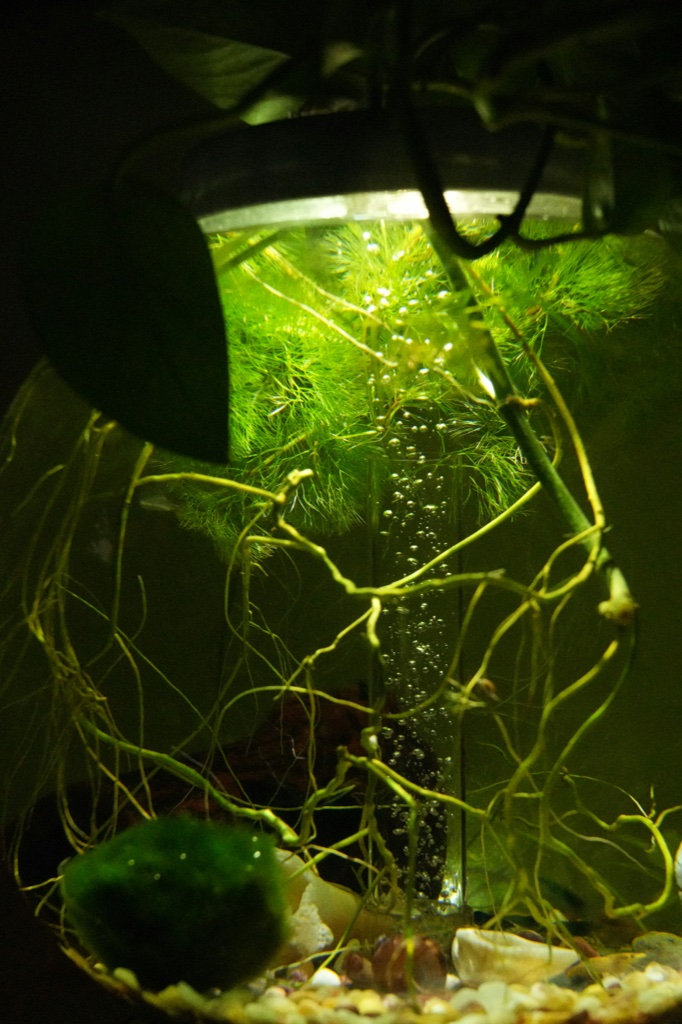
A planted glass jar with an air line. You can see the roots and stems through the curved glass.Kellen Barnes · Unsplash License · Resized; uncropped.
Six models
Five setups worth copying, and one written out in full so it can be refused.
Each setup gives you the container, water volume, planting, adult stocking limit, equipment, weekly care, and price. Local shop prices carry a citation1; estimates are labeled beside the number.
Three things go for all six. Test your tap water before you buy anything, because it is not the same across the city: Yerevan runs 2.9 to 3.8 dGH in Avan, Kanaker and Nork and up to 10.9 dGH in Davtashen, a more than threefold spread, and it hardens in summer when artesian water is blended in2. Plant heavily on day one, because the plants are the ammonia strategy and half-planting is the commonest way to fail3. And minimum water changes does not mean none: Walstad's own tanks often go six months or more between changes, and the routine in between is topping up evaporation and pruning excess growth3. The myth is what you get when you drop those last two verbs.
Model A · Indoors · All year
The three liter jar
The genuinely tiny one. Shrimp, plants, no equipment whatsoever, and the cheapest honest way in. Use a straight-sided preserving jar, not a bowl. A bowl narrows towards the top, and the top is the only part that matters.
Container
Glass preserving jar, filled only to the shoulder4
about 175 cm2 at the shoulder, about 53 cm2 if you fill into the neck4
Oxygen recovery
About 7 hours5. This estimate is called tau (τ): the time for oxygen from the air to close about two thirds of the gap between the water’s current oxygen level and its fully aerated level. A shorter time means faster recovery, not a complete refill. Plants and animals also change the oxygen level.
Three weeks with no animals. Two at the absolute minimum, with a spoon of mulm from an established tank4
no heaterno filterno air pumpno CO2
How it fails
Quietly, overnight, because 2.5 L has no buffer at all. It can go from 20 to 28 degrees in one afternoon of sun4, and the ammonia from one dead shrimp is a large slice of the entire water body. This is low equipment, not low attention. A 100 L container forgives far more. Keep it off a south windowsill.
Model B · Indoors · All year
The unheated indoor tank
Build this one. It has the widest margin for error and the best result per dram, and the way you think about it matters: an unheated tank in a heated Yerevan flat is not a coldwater tank. It is a subtropical tank at 19 to 23 degrees, with a real species list to choose from. That figure comes from the published outdoor normals plus ordinary apartment heating, because nobody has ever logged tank temperatures in Armenian apartments across a winter6. If you own a thermometer, you could.
Container
Plain glass, 60 by 35 by 40 cm, 84 L brimful, 34,000 AMD1
About 16 hours5, using the same tau estimate explained above
Budget
35 g of adult fish5, and the 0.5 g per liter figure is set at 28 degrees so it is conservative in a 21 degree room
Substrate
5 cm of inert 2 to 4 mm gravel. Free sieved river gravel works, vinegar-tested, because carbonate pebbles do occur in Hrazdan gravel2
Plants
Vallisneria, Cryptocoryne, Anubias, Java fern, two fast stems as scaffolding, hornwort and floaters. About 19,400 AMD1. Buy no carpet plants; they stall at 20 degrees with no injected carbon and a stalled carpet is an algae farm
Stock
Ten white clouds, minimum group five, minimum volume 40 L7, or eight medaka, minimum group six, minimum volume 60 L, minimum base 60 by 30 cm7. See the species section: neither is currently for sale here
Weekly
10 minutes4. Thinning the floaters is the real recurring job and it grows as the tank improves
Cost
about 101,000 AMD, or about 75,000 for the 52 L build41
no heatergentle flowno air pumpno CO2
How it fails
In week two, not month two. The plants are the ammonia sink and they have not woken up yet, so the low-effort system only becomes low-effort after week six3. Add fish after four weeks, and only once ammonia has read zero for a full week. The second failure comes in the opposite season: an unheated tank in an un-airconditioned Yerevan room can pass 30 degrees in July, which follows from a July mean daily maximum of 34.5 degrees in the city6 and is above the published ceiling of every cool-water species listed here. The filter in this build is buying flow, not nitrification. A still boundary layer starves a leaf8.
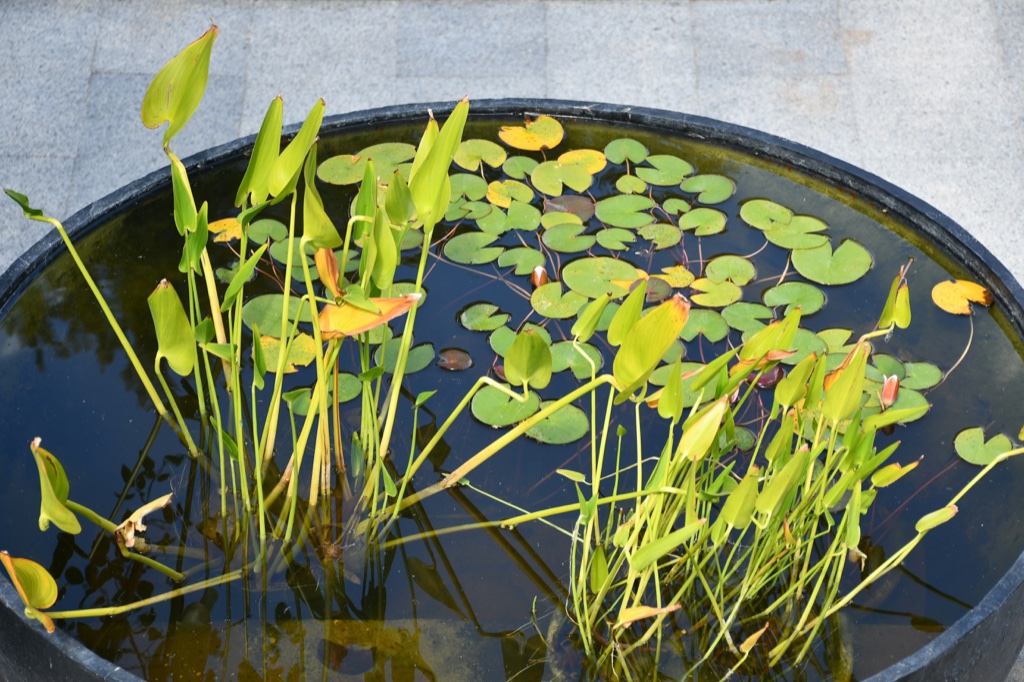
A black tub pond on a paved terrace, its dark surface covered in water lily pads with spear shaped emergent leaves rising out of the water.Anna Kharkivska · Unsplash License · Resized; uncropped.
Model C · Outdoors · April to October
The balcony tub
A builder's mortar tub on a Yerevan balcony. It teaches you more than anything else here, because you get to watch a whole season turn over in one summer. Then it comes indoors before the first frost.
Container
Mortar mixing trough, about 90 by 60 by 25 cm. Check the base for recycling code 5, polypropylene, or code 2, high density polyethylene. Reject code 3, polyvinyl chloride4. Light coloured or sleeved, never bare dark plastic in sun
Water
about 80 L. The walls taper, so measure yours with a marked bucket4
about 5,400 cm2, more than twice Model B at under two thirds of the depth4
Oxygen recovery
About 10 hours5. The wide surface helps oxygen enter the water.
Budget
40 g of adult fish5, but read the failure note before stocking any
Siting
The decision that makes or breaks it. Morning sun, afternoon shade, against the wall rather than the railing, standing on battens. Drill a 10 mm overflow 3 cm below the rim and mesh it inside4
Plants
Rush, sedge, water mint and marsh marigold, each in its own basket on bricks, never loose. Vallisneria and hornwort submerged. Floaters from a small handful in April to half or two thirds cover by July4
Stock
20 cherry shrimp at 800 AMD each1, or nothing. Shrimp must come indoors before the first frost
Weekly
20 minutes in July and August, 5 otherwise4. Topping up daily in the heat is the real work and it is not optional
It cooks, in the afternoon, while nobody is home. 80 L is under the 100 L threshold at which thermal mass stops mattering and siting decides everything5. Unshaded and light coloured it peaks near 31.8 degrees in a normal July at this depth, and 32.9 in a heat spell5. Unshaded and dark it reaches about 42.6 and everything in it dies5. The second failure is the calendar: at 20 cm it freezes through in a Yerevan winter, which has 80 frost nights6. Empty it in October and store it upside down, because water left in plastic over an Armenian winter cracks it.
Model D · Outdoors · All year, in some regions only
The sunken tub pond
A large container sunk to its rim, left in place all winter. This is the only setup here that stays outdoors through January, and the list of places it actually works is shorter than anybody wants it to be.
Container
A 750 or 1000 L polyethylene roof water tank, cut down to 75 cm tall and sunk to the rim. Already drinking-water grade, already stabilised for a lifetime of Armenian sun, already opaque4
70 cm, and below about 50 cm this model stops being honest4
Surface
about 0.79 m2, computed from the volume and the depth5
Oxygen recovery
About 34 hours5. The deeper water recovers more slowly, so this setup includes an air pump.
Budget
275 g of adult fish5. That is one 20 cm goldfish and no room for a second5
Siting
Sunk, in a yard, not a balcony. Not under a deciduous tree, and never under a walnut. Above the water table, or it floats out4
Substrate
5 cm of sieved river gravel, and volcanic scoria bulked up into a shallow shelf around a third of the perimeter for the baskets, leaving two thirds at full depth. That shelf is what keeps the mean depth below the maximum depth4
Stock
30 to 50 cherry shrimp4, treating the first winter as an experiment with a backup colony indoors. Cool-water fish: see the species section, and the sourcing is the constraint rather than the biology
October, and this one is the model. Net out fallen leaves, cut marginals back to just above the water, remove excess floaters, siphon the worst of the mulm, and do one 30 to 50 percent water change54
Cost
about 120,000 AMD, or about 88,000 with no shrimp4
no heaterno filterair pumpno CO2
How it fails
Winterkill, under an opaque lid, invisibly. A cleaned 400 L container with 200 g of fish holds about 10.3 days of oxygen under sealed ice; with the autumn leaves left in it holds 5.95, against a Yerevan ice spell of 7 to 20 days5. The half hour in October is not tidying, it is the whole margin. The summer failure is different: at 70 cm this container cannot refill its own oxygen in a night and it will stratify, so the pump is not decoration, and the air stone goes 10 cm below the surface, never on the bottom5.
Model E · Indoors · All year
The soil tank, from free Armenian materials
The Walstad method is the one major planted-tank philosophy that no customs office can block, because its main ingredient is dirt. A 60 by 35 cm footprint wants about 10.5 liters of substrate, and in bought aqua soil that is about 48,000 AMD before the tank, the light or a single plant14. Soil and gravel from the ground cost nothing. That is not a discount. It is a different price bracket.
2.5 to 4 cm of plain mineral soil, never deeper than 4 cm, under a 2.5 to 4 cm cap of washed 2 to 4 mm gravel34. Thinner cap and it is breached; coarser cap and soil migrates up through it
Why soil
Not the usual argument. In alkaline Armenian water a soil layer is the only multi-year iron and micronutrient reservoir available, because ferric iron precipitates almost immediately at the pH of a sunlit tank and gravel is a reservoir of nothing5
Water fit
Yerevan tap water is 61 to 77 percent bicarbonate on the anion side2, which is a real usable carbon reserve for the bicarbonate users this method depends on, and sulfate is rarely above 11 or 12 percent of anions, so the sulfide risk in the soil layer is lower here than in most of the world2
Three weeks before the tank is even built, for the soak test4
no heatergentle flowno air pumpno CO2
How it fails
The soil was wrong, and you find out in week one with the soil already in the tank. Three specifically Armenian traps. Do not dig soil in urban Yerevan: a 2017 assessment found lead exceeding the pollution index threshold in 99.9 percent of city samples, city-wide mercury contamination, and an identified non-carcinogenic risk to children across the whole city9. Ararat farm topsoil carries copper: 42.1 to 189 mg/kg against typical uncontaminated soils at 20 to 30, and copper is acutely toxic to shrimp and snails at concentrations that do not bother fish32. And too rich a soil releases ammonium for weeks. Soak 200 ml of soil in 1 liter of your own tap water in the dark and test ammonia at day 2, 7 and 143. Still high at day 14, reject it. Smells of rotten eggs, reject it.
Model F · The one to refuse
The goldfish bowl, written out in full
This is by a wide margin the most commonly built container in the hobby, and every part of it is wrong, so it is worth writing out in full. A round bowl or vase of 3 to 20 liters, a sunny windowsill, coloured gravel, a plastic plant, one or two goldfish, no equipment, and a plan to change the water when it goes cloudy. Five faults, each with the fix beside it.
Fault 1
The animal is too big by a factor of ten or more. An adult goldfish at 30 cm needs over a thousand liters on the oxygen rule5, and the trade body's own minimum is 100 L for the first fish and 50 L for each after, filtered always10
Fault 2
The shape minimises the only thing that matters. A bowl narrows at the top, and people then fill it to the brim, which shrinks the free surface further. A straight-sided jar of the same volume has roughly twice the surface4
Fault 3
Nothing in it takes the ammonia out. Every other model here works because live plants pull ammonium out within hours11, and the bowl swaps the plant for a plastic one and the filter for nothing at all
Fault 4
Outdoors in sun it cooks, and outdoors in December it freezes solid5
Fault 5
It leads directly to the mosquitofish mistake, and then to release. Armenia's 2024 invasive animal checklist lists 40 species of which 6 are fish, and the first entry is the goldfish and Prussian carp complex, first recorded 1983, now present in all provinces12
Weekly
60 minutes or more, forever4. Large water changes every few days, permanently, and it never becomes stable
no heaterno filterno air pumpno CO2
Why it is here
The goldfish bowl is the highest-maintenance container on this page. That is the point of putting it here. It does not fail because its owner is careless. It fails because the bowl strips out every mechanism the other five rely on and then asks one person to replace all of them by hand, forever. If you wanted something small and alive on a shelf, build Model A. If you wanted fish for a child indoors, build Model B. If you specifically wanted goldfish, the honest choices are a real garden pond over 1,000 L, or a different animal10.
The six side by side. Weekly care times are approximate4
The oxygen recovery estimates help you compare how quickly air can replenish oxygen in each setup. They use the same assumed rate of gas exchange at the surface. Shorter times mean faster recovery, but plants, animals, temperature, and water movement also matter. Use these figures as a comparison, not as a promise that a tank can go without aeration.
Which model, where. Regional verdicts follow the freezing and overheating arithmetic above56
Region
A jar
B indoor tank
C balcony tub
D sunken pond
E soil tank
Yerevan and the Ararat valley
Yes
Yes
Yes, April to October, afternoon shade required
Probably, at 0.60 to 0.75 m and sunk. Design ice 42 cm, cold winter 515. Treat the first winter as a trial
Yes
Armavir and the Ararat plain
Yes
Yes
Yes. Shade is not optional here, at 90 days above 30 C6
Probably, at size
Yes
Meghri and the Syunik lowland
Yes
Yes
Yes, longest season, shade essential
Yes. The one genuinely year-round site in the country, at a January mean of plus 2.4 C and 42 frost nights6. Summer is its only problem
Yes
Dilijan and Ijevan
Yes
Yes
Yes, cooler and easier
Yes. Ice cover 4 to 8 days against 10 days of oxygen5, so it passes. Watch alkalinity rather than hardness
Yes
Vanadzor
Yes
Yes
Yes
Marginal. 400 L and 0.60 m minimum, with an ice hole kept open5
Yes
Gyumri and Shirak
Yes
Yes, but a cold flat is a cold tank
Yes, short season, late May to September
No, not above ground, not at any realistic size.Design ice 69 cm, 60 to 90 days of continuous cover, and even 4000 L freezes solid5. A sunken pond needs 1.5 m of excavation513 and still needs the ice kept open
Yes
Gazanik, Arshakunyats 54/49, Yerevan. Every price on this page marked as verified was read on 9 September 2026 from the shop's own product data, through its category pages and the price printed on each product page. Stock varies by item and by day and should be checked before travelling. gazanik.amread 9 September 2026
Our own Armenia research. Used for: the Code of Administrative Offences articles and their amounts, the Law on Fauna, the Law on Hunting gear rule and the 2026 amateur fishing order, each cited in that file to the national legal register; Yerevan tap water by district, from Shahinyan (2005), Proceedings of the National Academy of Sciences of Armenia, Earth Sciences LVIII(1) pp. 41 to 45, sampling 2002 to 2004, giving 2.9 to 10.9 dGH by district, bicarbonate at 61 to 77 percent of anions, sulfate rarely above 11 or 12 percent, and metals at or below detection in almost all samples; the absence of published water data for Gyumri, Vanadzor, Dilijan and the Sevan towns; mosquitofish distribution in Armenia; and carbonate outcrops in the Hrazdan, Vedi and Argichi basins with the vinegar test. See Armenia.
Our own research on the Walstad method, which carries Walstad's own published statements and their citations. Used for: her filtration and aeration position and the reason for it; the two named maintenance verbs and the six-months-or-more water change figure; the first month described as a race against time; the soil and cap depths; soil sourcing and the Armenian exclusion list; the soak test protocol; the Ararat copper warning; and the finding that too poor a soil is also a failure. See the Walstad method.
Our own build research: plants, containers and build recipes. The source of every container dimension, water volume, surface area, plant list, setup sequence, cost total and weekly minute figure attached to a model on this page, together with the plastics code rules, the food-safe container rules and the Armenian container sourcing. Weekly care times are approximate and depend on your setup and routine. Anything marked as an estimate in that file is an estimate here.
Our own physics research and our own arithmetic. Not a published source. Every figure on this page marked as calculated comes from one file, and each calculation states its model in that file so it can be argued with. Ours: the reaeration time constant table and the two-container comparison; the barometric correction to the oxygen solubility table; the night oxygen budget, the sensitivity analysis and the 0.5 g per litre stocking limit; the length to weight and minimum volume tables; the ammonia and alkalinity arithmetic; the accumulated freezing degree day reconstruction and its validation against published frost night and ice day counts; the ice thickness figures; the freeze-solid energy budget; the under-ice oxygen budget; the surface energy balance for equilibrium water temperature, the diurnal swing and the peak temperature tables; the soil frost depths; the hardness creep and evaporation arithmetic; the surface area and time constant recomputed for each model. The two inputs that move the stocking answer most, sediment oxygen demand and gas transfer velocity, are published ranges rather than measurements of an actual garden container, which is why the recommended figure is half the central calculated value. calculated, repeatable, unverified by a third party
Our own climate research, the Armenian climate file. Armenian hydrometeorological service, WMO Climate Normals 1991 to 2020, as submitted to WMO and archived by NOAA and NCEI, Region VI Armenia, together with quantities derived in that file. The source of every Armenian temperature, station height, station pressure, vapour pressure, frost night count, ice day count, days above 30 C, precipitation and daily light integral figure on this page, including the 1113 m and 887 hPa for Yerevan Arabkir, the 1513 m and 846 hPa for Gyumri, the 627 m for Meghri, and the 82, 90 and 91 days above 30 C.
Our own species database, 110 species, each carrying an adult size, a minimum group, a minimum volume and footprint, a heater flag, an aeration flag, a flow flag and an Armenian availability field. Temperature and length come from FishBase, minimum volumes and groups from the trade body where one is published, and everything derived is labelled as derived in the file. It is the same data behind find a fish, and where it disagreed with our species research it was preferred.
Our own research on materials and water chemistry. Used for: the un-ionised ammonia tissue damage threshold; the nitrate toxicity review figures and the nitrogen to nitrate conversion; alkalinity destroyed per mg of ammonium nitrogen oxidised; phosphate behaviour in hard alkaline water; total dissolved solids meters as a relative tool and why the same meter must be used every time; dissolved organic carbon concentrations in natural waters; and the boundary layer physics that limits carbon uptake by a submerged leaf, including the 90 percent resistance figure. See materials and water.
Tepanosyan, G. and others (2017). Heavy metals in Yerevan urban soils. Lead exceeding the pollution index threshold in 99.9 percent of samples, city-wide mercury contamination, moderate contamination with vanadium, nickel, copper, zinc, chromium and arsenic, and an identified non-carcinogenic risk to children across the city. paywalled; the findings used here are stated in the abstract
Ornamental Aquatic Trade Association, United Kingdom. Care sheets on unheated aquariums, on goldfish, and on setting up and looking after a garden pond, including the 100 litres for the first goldfish and 50 for each after, always filtered. This is trade guidance from an industry body, not measured welfare science, and it is presented that way.ornamentalfish.org
Walstad, D. (2017, updated 2023). Nitrogen Uptake by Aquatic Plants. Free PDF. The Pistia stratiotes result of 6.4 mg/L of nitrogen cleared in 4.3 hours as ammonium against 44 hours as nitrate, citing Nelson, Smith and Best (1980), Guam Water Resources Research Center; and the Elodea nuttallii result of 75 percent of available ammonium removed in 16 hours with the nitrate almost untouched, citing Ozimek, Gulati and van Donk (1990), Hydrobiologia 200: 399 to 407. dianawalstad.com
Arakelyan, M. and others (2024). Invasive alien species of animals in Armenia. BioInvasions Records 13(2): 293 to 303. Forty invasive animal species of which six are fish; Carassius auratus, the goldfish and Prussian carp complex, first recorded 1983, arriving by escape, release and transport contaminant, now present in all provinces; and the finding that no monitoring or control of animal invasions is carried out in Armenia at all. DOI 10.3391/bir.2024.13.2.01open access
SNiP 2.02.01-83* and its successor SP 22.13330, Foundations of Buildings and Structures. The normative soil freezing depth relation and the coefficients by soil type still used in Armenian and Russian building practice. The computed 1.0 to 1.3 m for Gyumri matches ordinary local foundation practice, which is a usable cross-check. needs a citable edition; Armenian building norms will carry the authoritative figure