The largest line on the sheet
Half the score is for whether a fish could live there.
The International Aquatic Plants Layout Contest publishes what its judges score. In the secondary screening each judge takes their own top ten works and marks them out of a hundred across six criteria. Five of the six are worth ten points each. The sixth, recreation of a natural habitat for fish, is worth fifty1.
That is not a hint. It is the whole ranking. A layout that is more original, better built, better composed, more likely to survive a year and more atmospheric than its rival can lose to a layout that simply looks more like a real river with real fish in it.
A judge said so out loud. Shogo Yamaguchi explained his 2021 Best Aquarium pick by naming the criterion and pointing out that it is worth 50 points out of the 1002.
And ADA breaks that fifty into four named parts. Three of them are what you would guess. The fourth is the reason this page exists: blending of the fish type, size, and ecology in the layout1. Size, in the criteria, in writing. A fish that is the wrong length for the scene costs marks on the biggest line of the sheet.
There is a counterweight on the same page, worth knowing before anybody accuses a scaper of building a stage set. Ten of the hundred points go to long term maintenance, and that criterion asks explicitly whether the layout was created only temporarily for a photograph1. The tension between the tank and the picture is real, the contest noticed it first, and it wrote a rule against it.
How the five contests differ, and what each one is really measuring
IAPLC secondary screening, out of 1001
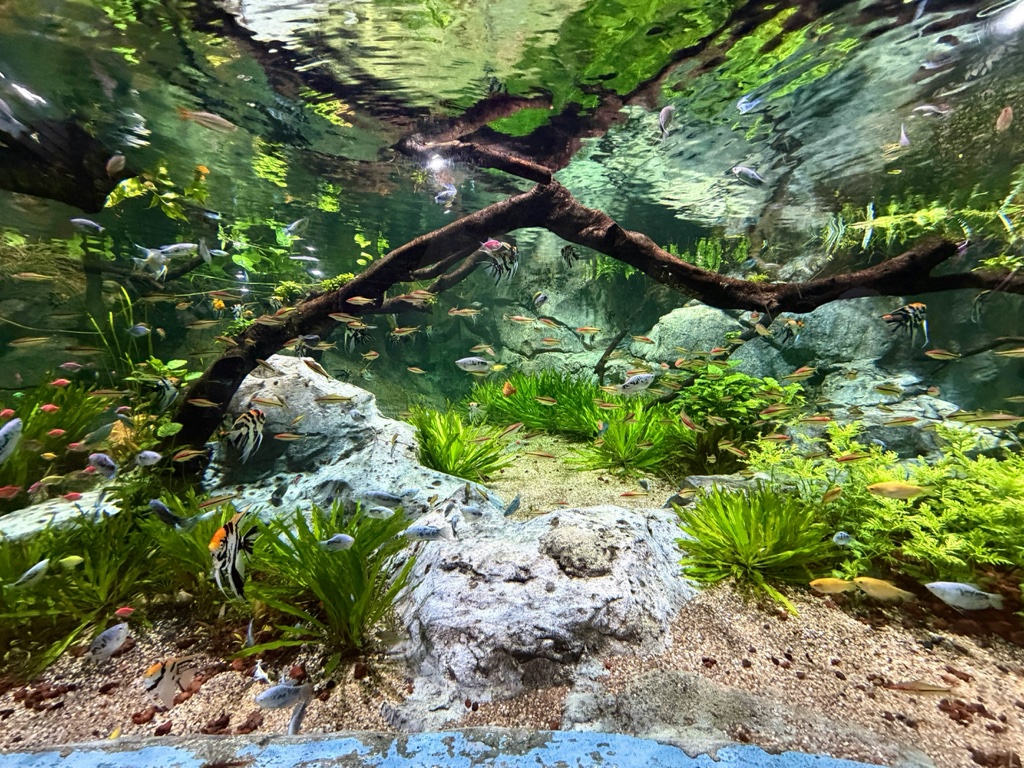
Photographs on this page come from the shared library. Every photographer is named at credits.
Two AGA podiums, twenty two years apart
Two hundred fish of one species, against six of this and six of that.
Contest entries to the Aquatic Gardeners Association showcase publish their animal lists, so this is not a matter of opinion. Here are two of them.
AGA 2022, second place. Ivan Tancler, a tank called Wave, 383.6 liters. Two hundred Paracheirodon simulans, the green neon tetra, and fifty Hyphessobrycon amandae, the ember tetra3. Two species. Two hundred and fifty fish.
AGA 2000, third place. Tolis Ketselidis, 336 liters. Six Puntius brevis, six Tateurndina ocellicauda, six Melanotaenia praecox, nine Jordanella floridae, five Otocinclus, ten Amano shrimp and two dwarf gouramis3. Seven species, mostly in sixes, and a pair of gouramis on top.
The second one is a community tank, and a nice one. The first one is a single moving element with an orange accent in it. Both got on an AGA podium, and the only thing separating them is twenty two years of the sport working out what the camera rewards.
| Year and place | Scaper and title | Volume | What went in |
|---|---|---|---|
| 2022, second | Ivan Tancler, Wave | 383.6 L | 200 Paracheirodon simulans, 50 Hyphessobrycon amandae3 |
| 2022, third | Luis Carlos Galarraga, Samurai | 324 L | 50 Paracheirodon simulans, 30 Tucanoichthys tucano, 30 Hyphessobrycon elachys, 10 Sphaerichthys vaillanti3 |
| 2017, first | Roger Goh Yu Quan, Breath Of The Wild | 495 L | 30 glowlight danio, 50 ember tetra, 20 Otocinclus4 |
| 2015, first | Fernando Boturao Francischelli, Silent Awakening | 324 L | 30 Hyphessobrycon amandae, 15 H. elachys, 20 Danio choprae, 15 Hemigrammus erythrozonus, 5 Hyphessobrycon sp., 3 Crossocheilus siamensis, 8 Sawbwa resplendens3 |
| 2013, first | Sim Kian Hong, Destiny | 540 L | 30 harlequin rasbora, 30 Rasbora espei, 10 Pristella maxillaris, 10 Otocinclus, 100 Caridina sp.3 |
| 2000, third | Tolis Ketselidis | 336 L | 6 Puntius brevis, 6 Tateurndina ocellicauda, 6 Melanotaenia praecox, 9 Jordanella floridae, 5 Otocinclus, 10 Caridina japonica, 2 Colisa lalia3 |
Read down the volume column and something else falls out. These are 324 to 540 liter tanks3. A contest layout is a meter and a half of glass photographed from one fixed point, and a 20 mm fish with pinpoint markings disappears at that distance. Scale is doing as much of the species selection as taste is.
Across the 52 of our 117 AGA records that published an animal list, the direction of travel is clear: the 2000 and 2001 podiums ran mixed communities of five to nine species including discus, Apistogramma, Corydoras and rainbowfish, and the 2025 podium ran one or two display species plus shrimp, with black neon tetra and cherry shrimp in first, rummynose and cherry shrimp in second and rummynose alone in fourth35. Fifty two entries is a small sample and it is all AGA, because no IAPLC entry we could reach publishes what is in the tank, so treat this as the shape of the AGA record rather than a law of the sport.
Neither is it a mystery why the numbers went up. The one published shoal size figure in aquarium keeping that can be attributed to a named person is Vin Kutty's Dutch style guide for the Aquatic Gardeners Association, and it asks for a dozen or so fish of one main species on the grounds that single fish of many species fail to read as a school7. That is a composition rule, written down, by somebody, decades ago. The contest record is what happens when people take it seriously and keep going.

Scale, depth and one accent
A small fish makes the tank look bigger, and the mechanism is borrowed from landscape painting.
Everything in a layout has to agree about how big the imagined world is. A carpet of two centimeter leaves next to a sword plant the size of a dinner plate tells the eye two stories at once, which is why diorama layouts use micro leaved plants and nothing else. A fish is one of those elements. A three centimeter fish in front of a two centimeter leaf keeps the agreement. A ten centimeter fish breaks it, and the tank shrinks back to the size of the glass it is in.
Small species at the back and larger ones at the front make the small ones read as far away rather than merely small. It is the least reliable of the depth devices, because unlike a stone or a leaf a fish does not stay where you put it. The ones that do hold still are sloped substrate, leaf size grading, color and contrast grading, converging lines, stone and wood size grading, and a background brighter than the midground8.
A shoal of a single species is a single moving shape. A mixed community is a collection of individuals, and the eye counts them instead of reading them. Kutty's guide puts it as a rule about the layout rather than about the animals: single fish of many species fail to give the effect of a school7, and the AGA animal lists are that rule showing its working.
A dense group moving through the gap between two plant masses traces that gap and makes you see it. Negative space in a layout is invisible until something crosses it. This is the one job a fish does that no plant, stone or piece of wood can do at all, and it is why the group goes in the open foreground rather than in among the stems.
Nobody has published this as a design law and we are not going to invent one. What is checkable is the record: the placing stockings above run one mid water mass with at most one warm accent in it, usually orange, against a tank that is otherwise green and brown.
Why the green neon and not the neon, stated as facts about the fish
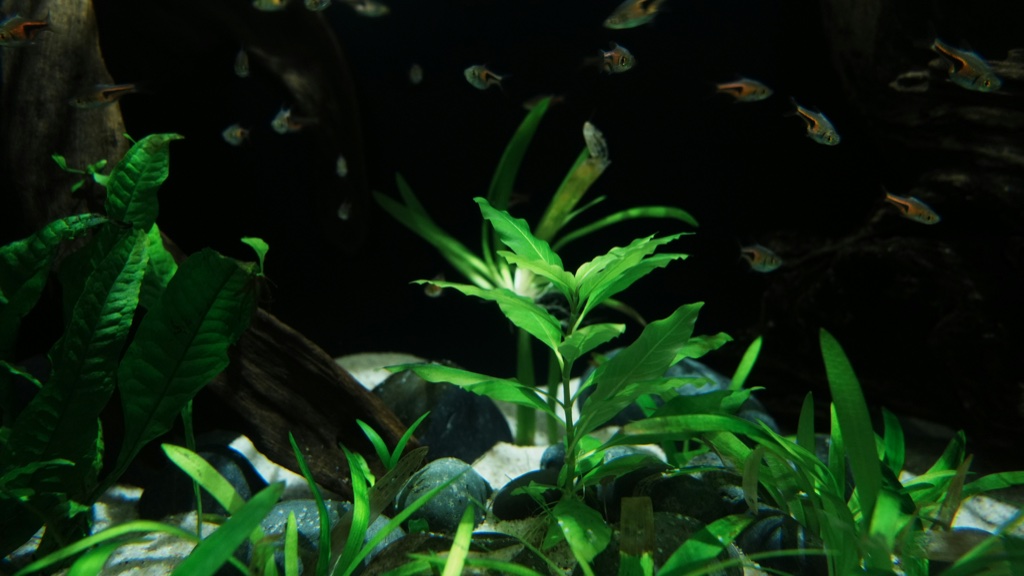
The green neon, Paracheirodon simulans, is the most used display fish in the modern AGA record and it is the least famous of the three Paracheirodon. The reasons are physical and they are published. It reaches 25 mm standard length against the neon's 30 and the cardinal's 3511. Its lateral stripe is greener rather than bluer and runs all the way to the base of the caudal fin, where the neon's stops at the adipose fin11. And it carries the least red of the three, the cardinal carrying the most11.
So in front of a green carpet the green neon reads as a moving stripe and the cardinal reads as a row of red dots. That last step is our reading of the morphology rather than something a judge wrote down, and the hobby's other favorite explanation, that green neons shoal more tightly than neons, is one nobody has measured: Seriously Fish describes simulans as gregarious and naturally forming schools in exactly the same words it uses for the ember tetra11.
It is also a harder fish than the neon. A genuine blackwater species, pH 3.0 to 6.5, and rated intermediate in our own database rather than beginner16. Choosing it for how it photographs and then giving it Yerevan tap water is the mistake that criterion is designed to catch.
Two payrolls
The crew goes in during the first fortnight. The cast goes in at about week eight.
ADA publishes its own setup schedule, and it is a production timetable rather than a philosophy. Hardscape, then planting, then equipment, then a fortnight of daily water changes with the algae crew already in the tank, first trim at one to two weeks. Twenty to thirty Amano shrimp and three to five Otocinclus for a 60 cm aquarium, in those first two weeks6.
The display fish arrive about five weeks after that. ADA's wording is that once the plants have grown healthily and the water has become stable it is finally time to add fish, and that no nitrite should be detectable in the water first6. The layout is considered finished at about week eight.
Count the animals in the contest record by how many different people used them, rather than by how many entries they appear in, and the crew wins outright. Otocinclus turns up in nine AGA layouts by nine different scapers, Crossocheilus siamensis in eight by eight, and the Amano shrimp in five by five. No display fish comes close5.
Counting by scaper matters, and here is why: one Brazilian, Luis Carlos Galarraga, accounts for most of the Hyphessobrycon elachys record on his own, so counting entries would make his signature fish look like a global default.
Who turns up in the most different people's tanks5
- Hardscape, plants, equipment. Nothing alive that swims.
- The crew, in the first fortnight, into visible algae. Twenty to thirty Amano shrimp or three to five Otocinclus per 60 cm tank6, at exactly the point when diatoms are coating everything and there is something for them to eat.
- Daily water changes, first trim at one to two weeks. The plants are still deciding whether they live here.
- Test for nitrite, and wait until it reads zero. ADA names this as the gate before any display fish6.
- The display shoal, at about week eight. Bought all at once, all the same species, into a tank that has already been running for two months.
The single most misused fish in the hobby
Otocinclus into a new tank is how you kill one
A contest scaper puts otos into a two week old tank on purpose, because it is furred with diatoms. A beginner puts them into a bare, sterile, four day old tank because a shop said they eat algae. Seriously Fish: the fish is delicate when first imported, losses are common, and this is usually down to lack of food, because it is small and needs to feed almost constantly, so it is easily starved during transportation. Fewer problems are reported when they go into mature planted tanks14. Check the belly before you buy. Hollow and concave means it has been empty too long.
And the rule is not as strict as the internet says
ADA's own finished example has four display species in it
The completed week eight layout on ADA's setup page is stocked with Inpaichthys kerri, Hyphessobrycon sweglesi, Nannostomus beckfordi, Mikrogeophagus ramirezi, Caridina japonica and Otocinclus6. Four display species, a shrimp and a catfish. So the one species doctrine is a strong tendency in the record rather than a law, and the company that invented the style does not obey it in its own worked example.
The contest shelf, species by species
One fish on this list genuinely schools. The rest of them shoal.
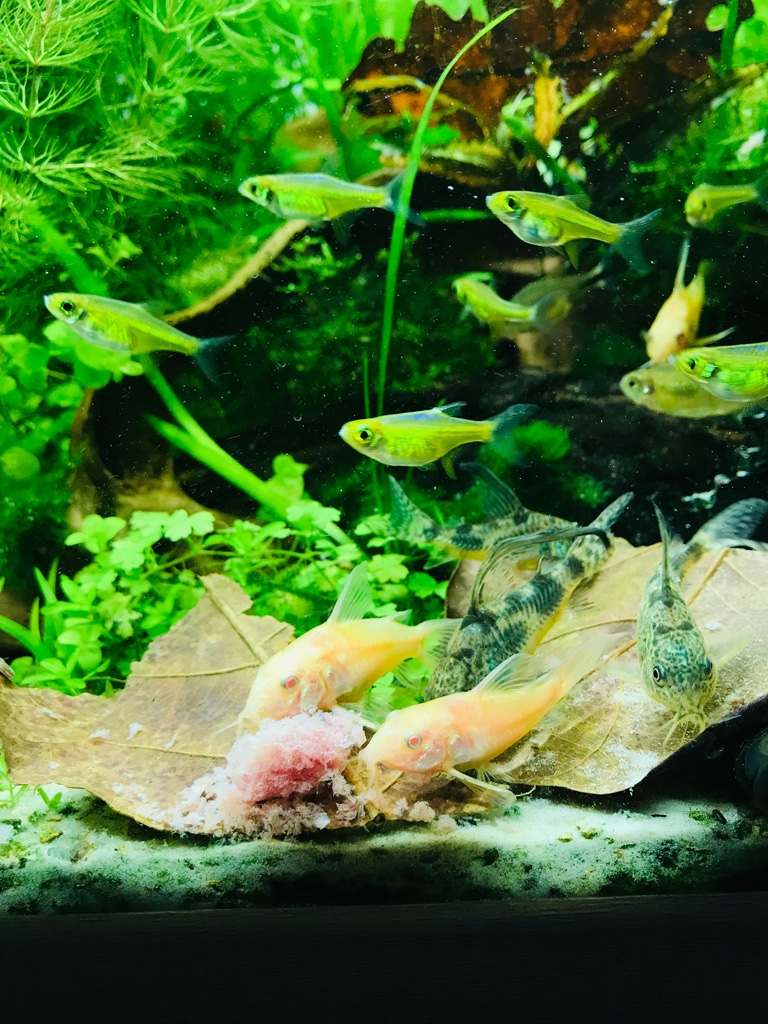
Every one of these is sold as a schooling fish, and the two words are not synonyms. A shoal is a group held together for social reasons; a school is a shoal that is also lined up and coordinated, and almost everything in the trade is doing the first thing. That distinction turns out to matter for a layout, because a polarised line drawn through open water is a different graphic object from a loose cloud.
The rummynose is the exception, and somebody counted it. Undisturbed groups of Hemigrammus bleheri held between 94.5 and 98 per cent polarisation over three weeks, and lost it entirely when the lateral line system was disabled9. That is the only measured polarisation figure attached to anything on the contest shelf. Seriously Fish independently calls it one of the more tightly shoaling small tetras, and notes that the fish sold as rummynose is usually H. bleheri rather than H. rhodostomus10. If you want a line running through an open foreground, this is the species that draws it, and it wants a 90 cm tank and a real group to do it in.
The celestial pearl danio is the clean counter example, and it is the trade's own reference that says so. Seriously Fish: though gregarious by nature it is a shoaling rather than schooling species, with rival males sparring on a regular basis during daylight hours12. It never becomes a mass. It is a texture of spots, best seen from half a meter away, and in a 400 liter contest tank it would be invisible.
One number in the table is not a finding, and it is the one that looks most like one. The line about a group of at least eight to ten specimens appears word for word on the Boraras brigittae, Boraras merah, Trigonostigma espei and Trigonostigma heteromorpha profiles, and its near twin appears on Paracheirodon simulans, Hyphessobrycon amandae and Tucanoichthys tucano13. One figure repeated across fish of very different size and temperament is house style, not measurement. It is perfectly sensible advice and Seriously Fish deserves the credit for giving it; it is just not a threshold anybody established, so the contest column below is the more informative one.
| Species | Common name | Adult SL | In placing tanks | Schools or shoals | Job in the layout | Suits |
|---|---|---|---|---|---|---|
| Paracheirodon simulans | Green neon tetra | 25 mm | 50 to 200 | Shoals | The default mid water mass. Greenest stripe and least red of the three Paracheirodon, so it does not fight a green layout | Iwagumi, nature, blackwater |
| Paracheirodon axelrodi | Cardinal tetra | 35 mm | no counts published | Shoals | The red accent. Largest red block of the three, so it reads as a color statement rather than a shape | Nature, jungle, larger tanks |
| Paracheirodon innesi | Neon tetra | 30 mm | no counts published | Shoals | The historic default, now largely absent from placing layouts in our records | Community tanks |
| Hyphessobrycon elachys | Dwarf tetra | 20 mm15 | 15 to 30 | Shoals | The smallest usable mid water mass, which is how a diorama keeps its scale agreement. Six placing layouts, more than any other display fish here | Diorama, nature, small leaved layouts |
| Hyphessobrycon amandae | Ember tetra | 20 mm | 30 to 50 | Shoals | Warm orange accent against green at a size that keeps the tank looking large | Nature, blackwater, nano |
| Boraras brigittae | Chili rasbora | 20 mm | not in our record | Shoals | Red pinpoints in a nano. Too small to register across a contest tank, which is a recommendation for a small tank rather than a mark against it | Nano, blackwater |
| Boraras merah | Phoenix rasbora | 20 mm | not in our record | Shoals | As brigittae, and routinely confused with it in the trade. Brigittae has an unbroken dark stripe, merah a row of spots | Nano |
| Trigonostigma espei | Lambchop rasbora | 30 mm | 30 | Shoals | A defined body marking repeating across the group, so the shoal reads as pattern rather than color | Nature, Asian biotope |
| Trigonostigma heteromorpha | Harlequin rasbora | 45 mm | 30 | Shoals | The largest of the three, so a deliberate foreground fish where espei and hengeli sit back | Nature, larger tanks |
| Trigonostigma hengeli | Glowlight rasbora | 30 mm | two firsts, no counts | Shoals | An orange flash on a near colourless body, which is the smallest accent available | Nature, blackwater |
| Microdevario kubotai | Green neon rasbora | 20 mm | not in our record | Shoals | Green on green. A mass that registers as movement before it registers as color | Nature, hill stream |
| Hemigrammus bleheri | Firehead tetra, sold as rummynose | 50 mm | two 2025 placings | Schools, measured9 | The only fish here that reliably makes a polarised line, so it draws a direction through the layout. In small numbers it does not school, it just looks nervous | Iwagumi, open foreground, larger tanks |
| Hemigrammus rhodostomus | True rummynose | 50 mm | not distinguished | Schools | As bleheri, and you are unlikely to be sold it | As bleheri |
| Danio margaritatus | Celestial pearl danio | 21 mm | not in our record | Shoals, explicitly not a school12 | Spotted texture, best seen close. It does not form a mass, and no amount of buying more will make it | Nano, Asian, small tanks |
| Danio choprae | Glowlight danio | 31 mm | 20 to 30 | Shoals | Banded copper accent in a cooler tank. A hill stream fish from colder water than the trade assumes | Nature, hill stream |
| Nannostomus marginatus | Dwarf pencilfish | 35 mm TL | no counts published | Shoals | Hangs in midwater among fine leaves rather than swimming laps. A still element, not a moving one, and that is the reason to choose it | Quiet nature layouts, planted midground |
| Tucanoichthys tucano | Tucano tetra | 17 mm | 30 | Shoals | The smallest fish here, for layouts where even a green neon would break the scale. Rarely available and rated advanced | Diorama, blackwater |
| Hyphessobrycon herbertaxelrodi | Black neon tetra | 32 mm | 2025 first place | Shoals | A dark horizontal line, which reads as a stroke against pale sand or bright green | Nature, contrast layouts |
| Otocinclus spp. | Otocinclus | 33 to 35 mm | 3 to 5 per 60 cm per ADA6, 20 in a winning 495 L4 | Crew, not cast | Eats diatoms and soft biofilm off glass and leaves through the algae prone first weeks. Delicate on import and usually starved on arrival14 | Every style |
| Caridina multidentata | Amano shrimp | about 5 cm | 20 to 30 per 60 cm per ADA6, 100 in a winning 540 L | Crew, not cast | Carries the largest algae workload in the tank, and it is the reason the animal exists in the trade at all. Cannot be bred in fresh water | Every style |
| Neocaridina davidi | Cherry shrimp | about 3 cm | four placing layouts | Crew, and now cast | Red pinpoints at substrate level, now named in podium animal lists alongside the display fish. Breeds readily in fresh water | Nano, nature |
| Crossocheilus oblongus | Siamese algae eater | 16 cm | 8 layouts by 8 scapers | Crew | The only animal that reliably eats black brush algae, and a trap. Sold small, reaches 16 cm, and shops frequently sell a different and much less useful fish under the name | Large tanks only |
The most used display fish in the record is one you will have to ask for
Hyphessobrycon elachys, the dwarf tetra, appears in six placing AGA layouts including two first places, which is more than any other display fish in our data5, and Seriously Fish has no profile for it at all15. Three of those six are Galarraga's own layouts, so this is partly one man's signature fish rather than a worldwide default, and that makes it more interesting rather than less. FishBase gives it 2.0 cm standard length, the Paraguay River basin, pH 6.0 to 7.2 and 24 to 27 C15, and nothing else. It is the clearest case on this site of the contest record being better information than the care sheet.
A smaller observation, offered as an observation: the glowlight rasbora, Trigonostigma hengeli, appears in two AGA placing layouts and both are firsts, while the far better known harlequin appears once, at third5. Two entries is not a pattern. It is worth a sentence only because hengeli is the least colourful of the three Trigonostigma, which is exactly what the accent rather than block argument would predict.
On the shelf in Yerevan
Six fish with AGA placing records are for sale here, and one of them won.
You do not have to import anything to stock a layout the way the podium stocks one. Gazanik, the specialist aquaristics shop in Yerevan, carries six species that appear in the animal lists of AGA layouts that placed. This is its catalog as read on 9 September 2026, with the category totals rechecked on the 11th and unchanged.
| Species | Common name | Its contest record |
|---|---|---|
| Hyphessobrycon amandae | Ember tetra | Fifty of them alongside two hundred green neons in AGA 2022 second place, Ivan Tancler's Wave. Also AGA 2015 second, Andre Luiz Longarco's Faith, and fifty embers were half the stocking of the 2017 winner34 |
| Danio erythromicron | Emerald dwarf rasbora | AGA 2024 first place, Luis Carlos Galarraga, Great Wave, 324 liters3 |
| Corydoras panda | Panda cory | AGA 2024 second, Ismael Aguilar Soria, Rolling River, 396 liters3 |
| Corydoras sterbai | Sterba's cory | AGA 2019 third, Fernando Boturao Francischelli, Nintai, 324 liters3 |
| Garra flavatra | Panda garra | AGA 2019 second, Miguel Angel Garcia, Live on Fallen Tree, 460 liters3 |
| Puntius titteya | Cherry barb | AGA 2001 third, Jeffery Senske, 983 liters3 |
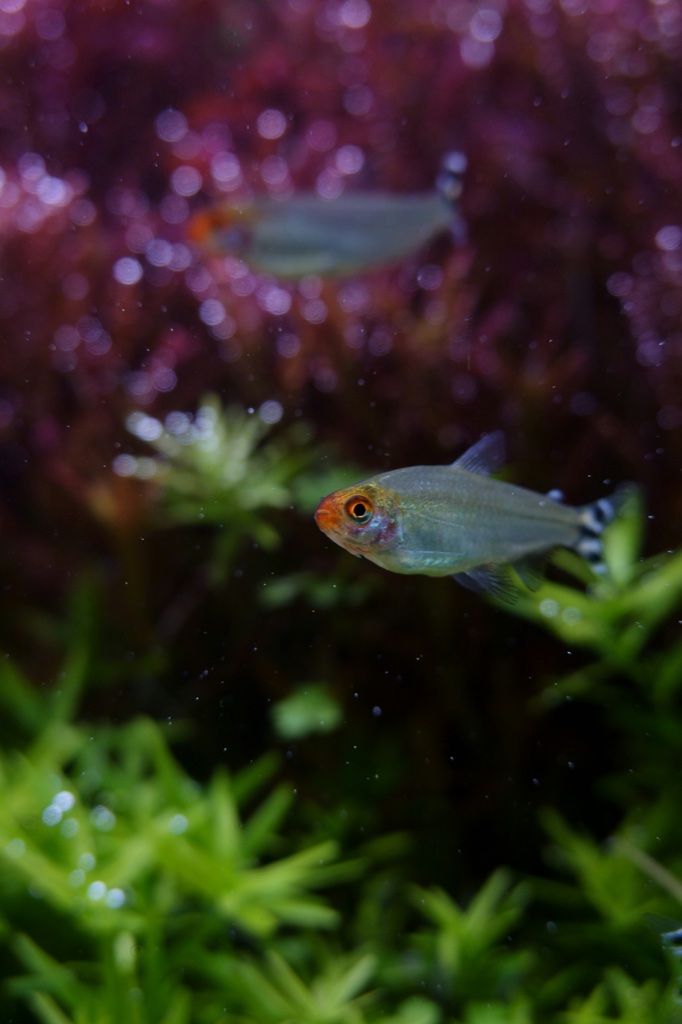
If you buy one fish off this page, buy the ember tetra. Two centimeters, beginner rated, warm orange against green, in the window of a shop twenty minutes away, and already on two AGA podiums. Buy thirty of them rather than eight, put them in front of a green midground with clear water in between, and you have the exact move the record keeps rewarding.
Two more in the same shop do the layout job without a contest record behind them. Microdevario kubotai, the green neon rasbora, which Gazanik lists under its older name Rasbora kubotai17, and Nannostomus beckfordi, the golden pencilfish, which is one of the six animals in ADA's own published week eight example layout6. If you take the kubotai, take the habitat seriously: it is a hill stream fish sold across the trade as a blackwater nano fish, which is the wrong river16, and habitat plausibility is the thing the biggest contest in the world puts fifty points on.
Several of the contest defaults are not on the shelf here, the green neon and the rummynose among them, and the ember tetra covers the same job at the same scale and is in stock. The shops directory has what each place carries and when it was last checked.
Shrimp are a shop visit rather than a database question. Gazanik's crustacean category listed five products when we checked it on 11 September 202617, and which species those are is not something we have recorded, so go and look at them. If you find out, the club would like to know.
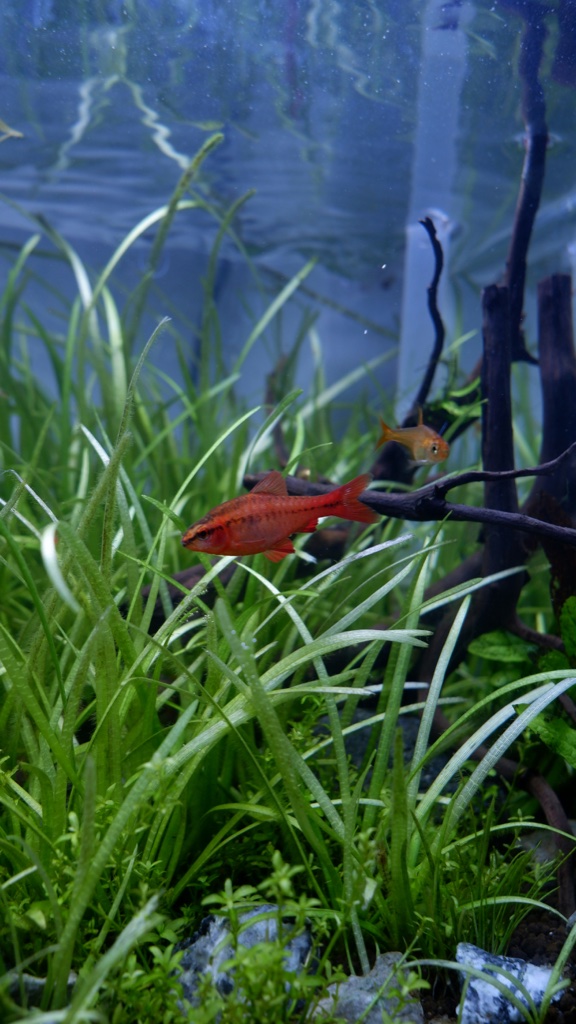
So the short version, for anybody stocking a tank they care about how it looks. Pick one species and buy far more of it than feels reasonable. Pick it small, so the tank reads big. Give it open water to cross, because that is the part of the composition it is there to reveal. Put the shrimp and the catfish in six weeks earlier than the fish you actually want to look at. And if you want the group to line up rather than drift, there is exactly one fish on the shelf with a measurement behind that promise, and you can read what the measurement actually says before you spend the money.
Then go and look at what has already won. The winners table holds every placing we have verified, and the competitions page explains which contest is asking for what.
- Aqua Design Amano. IAPLC judging criteria. iaplc.com/e/judging_criteria, accessed 11 September 2026. The six criteria and their maximum points, and the four named sub elements of the 50 point habitat criterion: creation of a healthy fish habitat, expression of its underwater environment, general condition of the fish and aquatic plants, and blending of the fish type, size, and ecology in the layout. Also the long term maintenance criterion, which asks whether a layout was created only temporarily for a photograph. primary, read in full
- Yamaguchi, S. IAPLC 2021 Best Aquarium column, published by Aqua Design Amano. The judge names reproduction of natural habitat for fish and says it is worth 50 points out of the 100 total. Via , under how the judging works. ADA's own translations vary between recreation and reproduction for this criterion
- AGA International Aquascaping Contest. Entry showcase, showcase.aquatic-gardeners.org, accessed 9 September 2026, compiled in Part 3 as 117 verified placings, of which 52 published an animal list with counts. Every stocking quoted on this page comes from an entry's own published list. our compilation from the contest's own entry pages
- AGA 2017 first place. Roger Goh Yu Quan, Breath Of The Wild, 495 litres. showcase.aquatic-gardeners.org/2017/show457.html. Thirty glowlight danio, fifty ember tetra, twenty Otocinclus. the entry page, read in full
- Our own count of the contest animals. : 138 species strings from the 52 AGA entries that published animal lists, deduplicated across spelling and common name variants, and counted by distinct aquascaper rather than by entry. The Otocinclus, Crossocheilus and Amano shrimp figures, the six placings for Hyphessobrycon elachys and the two firsts for Trigonostigma hengeli all come from here. our own compilation, repeatable from the file, sample of 52 entries out of 117 records and AGA only
- Aqua Design Amano. Start Nature Aquarium. adana.co.jp/en/contents/process, accessed 11 September 2026. The week by week setup sequence, 20 to 30 Amano shrimp and 3 to 5 Otocinclus per 60 cm aquarium in the first fortnight, the instruction that no nitrite should be detected before fish go in, and the completed week eight example layout stocked with Inpaichthys kerri, Hyphessobrycon sweglesi, Nannostomus beckfordi, Mikrogeophagus ramirezi, Caridina japonica and Otocinclus. primary, read in full
- Kutty, V. Dutch style aquascaping guide, hosted by the Aquatic Gardeners Association. A dozen or so fish of one main species as the minimum, with single fish of many species failing to read as a school. The one attributable published shoal size figure in aquarium keeping, and it is a composition rule rather than a welfare threshold. Via .
- Our own synthesis of the Nature Aquarium composition literature. , on depth devices and consistency of scale. The seven depth devices, the ranking that puts fish size grading last because fish move, and the scale agreement argument. our reading applied to fish, not a rule anybody published about fish
- Faucher, K., Parmentier, E., Becco, C., Vandewalle, N. and Vandewalle, P. (2010). Fish lateral system is required for accurate control of shoaling behaviour. Animal Behaviour 79(3): 679 to 687. Polarisation of 94.5 to 98 per cent in undisturbed Hemigrammus bleheri over three weeks, and its collapse when the lateral line system is disabled. DOI 10.1016/j.anbehav.2009.12.020 author version read in full from the University of Liege repository, handle 2268/31748
- Seriously Fish. Hemigrammus bleheri. seriouslyfish.com/species/hemigrammus-bleheri, accessed 11 September 2026. One of the more tightly shoaling small tetras, a 90 cm minimum tank length, and the note that the fish sold as rummynose is usually this species rather than H. rhodostomus.
- Seriously Fish. Paracheirodon simulans and Paracheirodon innesi. seriouslyfish.com/species/paracheirodon-simulans and /paracheirodon-innesi, both accessed 11 September 2026. The innesi profile carries the comparison: a bluer rather than greener lateral stripe extending only as far as the adipose fin rather than to the caudal fin base, and relatively less red pigment than P. axelrodi.
- Seriously Fish. Celestichthys margaritatus, the celestial pearl danio. seriouslyfish.com/species/danio-margaritatus, accessed 11 September 2026. Though gregarious by nature it is a shoaling rather than schooling species, with rival males sparring on a regular basis during daylight hours.
- The eight to ten line, traced. Seriously Fish species profiles for Boraras brigittae, Boraras merah, Trigonostigma espei, Trigonostigma heteromorpha, Paracheirodon simulans, Hyphessobrycon amandae and Tucanoichthys tucano, all accessed 11 September 2026. The same sentence, word for word on four of them and near identical on the other three, across fish of very different size and temperament. our own finding from reading the seven pages side by side
- Seriously Fish. Otocinclus macrospilus. seriouslyfish.com/species/otocinclus-macrospilus, accessed 11 September 2026. Delicate when first imported, losses not uncommon, usually down to lack of food because the fish is small and needs to feed almost constantly, and fewer problems reported when added to mature planted tanks.
- FishBase. Hyphessobrycon elachys. fishbase.se/summary/Hyphessobrycon-elachys, accessed 11 September 2026. Maximum 2.0 cm standard length, Paraguay River basin, pH 6.0 to 7.2, 24 to 27 C. Seriously Fish returns HTTP 404 for this species, checked the same day, so no profile exists to cite
- Our own species database. , 110 species with adult sizes, group figures, evidence notes, Yerevan tap water fit and shop stock flags. Readable in full at the species list. our compilation from Seriously Fish, FishBase version 2025-2 and the sources above
- Gazanik. Product catalogue, read from the shop's own WooCommerce store feeds and recorded per species on 9 September 2026, with category totals rechecked at gazanik.am/wp-json/wc/store/v1/products/categories on 11 September 2026 and unchanged: fish category 39 products, crustaceans 5. the per product endpoint returns a WordPress error, so the species level list is the 9 September read and the 11 September check confirms only the totals
Continue
Where to go next.
Shoaling and schooling
The difference between a shoal and a school, which is the column in that species table most people skim. One fish on the contest shelf genuinely schools.
The world competitions
Who has won what, how the judging works, and the scoring sheet that puts half the marks on the fish.
The shops directory
Where the six species with placing records are sold in Yerevan, and what each shop actually stocks.