Where the group has to fit
A shoal may spread across 30 cm before it starts to swim.
Schooling fish do not hold a distance in centimeters. They hold it in their own body lengths, which means the group has a size you can work out before you buy it.
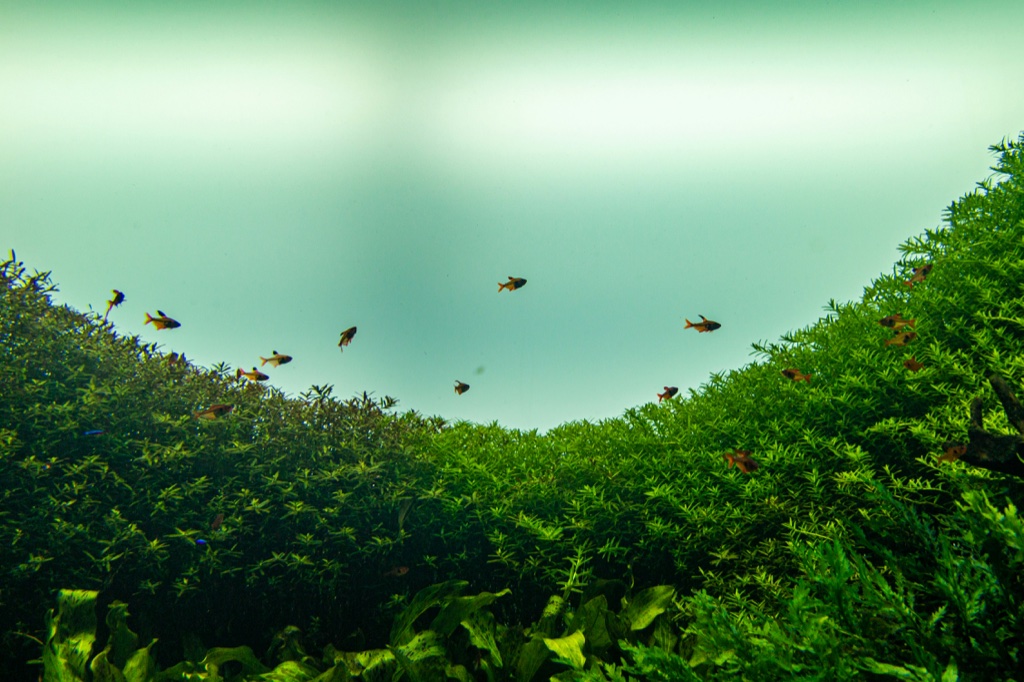
The preferred gap to the nearest neighbor runs from about half a body length to one1, a recent review puts the average at about 70 per cent of a body length, with the whole school taking up roughly one body length cubed per fish2, and the undisturbed rummynose sat at 1.45 body lengths3. Turn that into furniture. Twelve rummynose at 4 cm want three to six centimeters between them, so the relaxed group is an object something like 20 to 30 cm across. In a 60 cm tank that is half the length of the tank.
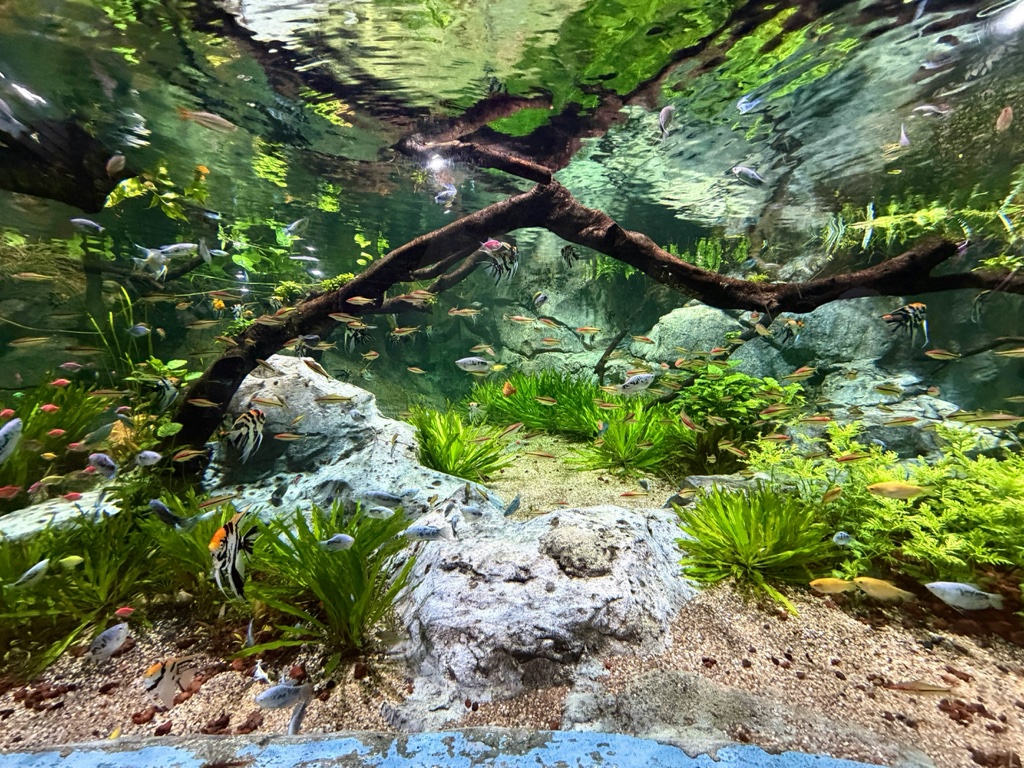
Which is the real argument for open water in an aquascape, and it is a measurement rather than a matter of taste. A 60 cm tank planted wall to wall has nowhere for the group to be. The Nature Aquarium habit of leaving a clearing at the front and a corridor through the middle is not only composition; it is the only way the fish can take their normal spacing. It also sets a floor on tank length that has nothing to do with liters: a 45 cm cube holds more water than a 60 cm shallow tank and is worse for a shoal, because what the group needs is horizontal run.
Giant danios were filmed with and without a current. In flow, the odds that at least one fish spotted a looming threat went up. In still water, the odds that three or more fish reacted went up4. Flow buys individual vigilance; stillness buys contagion. That is part of why a startled shoal in a dead calm tank goes from settled to full length panic in a fraction of a second, and it argues for gentle movement in a tank of nervous fish rather than for a wavemaker.
In a river, a fish that is being harassed swims off and a fish that dislikes its group joins another one. Group size choice is context dependent, which takes choice for granted5. Glass removes it, so every social cost concentrates instead of dispersing. The design answer is broken sightlines: a thicket, a tangle of wood, somewhere the fish at the bottom of the pecking order can be out of view. It is the closest thing to leaving that a tank can offer.
Six things to watch for
The fish show when the group or the room needs to grow.
None of the physiological markers is available to you. Cortisol in the water needs an immunoassay, cortisol in the fish needs a dead fish, and gene expression needs a laboratory. Anybody selling a stress test for a home aquarium is selling something else. What you can score is behavior, and behavior is where the findings are.
- The group stops being a group. Each fish holds position on the tank instead of on its neighbors: a corner, the filter outlet, the same leaf every day.
- More turning, less eating. Direction changes per fish rise as the group gets smaller6, and time spent turning is time not spent feeding.
- Longer freezing after a fright, and a slower return. Measured in Corydoras, where the fish with the thinner social history froze longer7. Time it with a phone.
- The fish uses the wrong part of the tank. Vertical distribution shifted upward in the zebrafish held at the lowest density8.
- Aggression appears where there was none. Also measured at the lowest density, not the highest8, and in a tank the target is whoever happens to be nearest, every time.
- No shoal re-forms after a disturbance. The strongest single sign and the easiest to see. Startle the tank, wait a minute, and watch whether they come back together or simply stay scattered.
Three open questions, and any one of them is yours to answer
Faded color as a specific consequence of a small group. Glass surfing as a specific consequence of a small group. And the idea that a particular number of fish flips a switch. All three are repeated as fact across the hobby, and all three are sitting in the literature untested against group size, which makes them cheap to settle.
Fin nipping is the interesting one. Almost everybody who has run a small group of tiger barbs, serpae tetras or black widow tetras has watched the fins go, fin condition is a standard welfare score in aquaculture, and nobody has ever put those two facts together in an ornamental species. That is the most obvious piece of real research a hobbyist could do, with a camera, a scoring rubric and two years of patience. If you take it on, the club would like to hear about it.
So here is the sentence to carry away instead of the one about six. This fish is social, which means its normal behavior is defined against other fish of its own kind. In a group that is too small, the behavior has nothing to be defined against. More is better, up to what the tank and the filter can carry. Buy them all at once, buy them all the same, and give them a clear run of water to be a group in.
Then stop waiting for the picture on the box. If your tetras are drifting about facing in every direction, ignoring you, picking at things, they are doing exactly what a settled shoal does. The day they all line up and hold it, go and find out what frightened them.
- Partridge, B. L. (1982). The structure and function of fish schools. Scientific American 246(6): 114 to 123. The source of the half to one body length nearest neighbour figure, as cited in sources 5 and 9. DOI 10.1038/scientificamerican0682-114 paywalled
- Larsson, M. (2024). Schooling fish from a new, multimodal sensory perspective. Animals 14: 1984. Average neighbour distance about 70 per cent of a body length, and roughly one body length cubed of water per fish. DOI 10.3390/ani14131984 open access
- Faucher, K., Parmentier, E., Becco, C., Vandewalle, N. and Vandewalle, P. (2010). Fish lateral system is required for accurate control of shoaling behaviour. Animal Behaviour 79(3): 679 to 687. The rummynose tetra experiment: polarisation of 94.5 to 98 per cent in undisturbed fish, the fall to 63 per cent, the shoal radius, the collisions and the month long recovery. Also the paraphrase that there is no clear dichotomy between shoaling and schooling. DOI 10.1016/j.anbehav.2009.12.020 author version read in full from the University of Liege repository, handle 2268/31748
- Chicoli, A., Butail, S., Lun, Y., Bak-Coleman, J., Coombs, S. and Paley, D. A. (2014). The effects of flow on schooling Devario aequipinnatus: school structure, startle response and information transmission. Journal of Fish Biology 84: 1401 to 1421. In flow, the probability that at least one fish detected a looming threat rose; in still water, the probability that three or more responded rose. DOI 10.1111/jfb.12365 paywalled; abstract read in full
- Hoare, D. J., Couzin, I. D., Godin, J.-G. J. and Krause, J. (2004). Context-dependent group size choice in fish. Animal Behaviour 67: 155 to 164. Preferred group size shifts with hunger, with predation cues and with the environment, so there is no single correct number for a species. DOI 10.1016/j.anbehav.2003.04.004 paywalled
- Ward, A. J. W., Herbert-Read, J. E., Sumpter, D. J. T. and Krause, J. (2011). Fast and accurate decisions through collective vigilance in fish shoals. PNAS 108(6): 2312 to 2315. Mosquitofish at group sizes of 1, 2, 4, 8 and 16 against a replica predator: 60 avoidances in 108 solitary trials, groups of 8 and 16 significantly better, and the fall in direction changes per fish as the group grows. DOI 10.1073/pnas.1007102108 full text read
- Siddiqui, M., Chiang, A., Lac, E., Kern, J., Wilkinson, G., Jungwirth, A., Allen, J. and Riley, R. J. (2024). Developmental social experience changes behavior in a threatening environment in Corydoras catfish. Ecology and Evolution 14: e70391. Juveniles reared with adults present against juveniles reared with same age fish only: more nudging, lower baseline activity, more freezing after a startle and a larger increase in cohesion in the same age group. DOI 10.1002/ece3.70391 open access
- Andersson, M., Roques, J. A. C., Aliti, G. M., Ademar, K., Sundh, H., Sundell, K., Ericson, M. and Kettunen, P. (2022). Low holding densities increase stress response and aggression in zebrafish. Biology 11: 725. Nine weeks at 1, 4, 8, 12 and 16 fish per litre. Higher free water cortisol per fish, raised vertical distribution and more frequent aggression at 1 fish per litre only, and no compromise to welfare between 4 and 16. DOI 10.3390/biology11050725 open access
- Shams, S., Chatterjee, D. and Gerlai, R. (2017). Effect of social isolation on anxiety-related behaviors, cortisol, and monoamines in adult zebrafish. Behavioral Neuroscience 131(4): 492 to 504. Lower whole body cortisol after six months of isolation, with altered serotonin and dopamine metabolism. DOI 10.1037/bne0000220 paywalled; abstract read in full
Continue