What this archive is
One lake, measured continuously for longer than most limnology has existed.
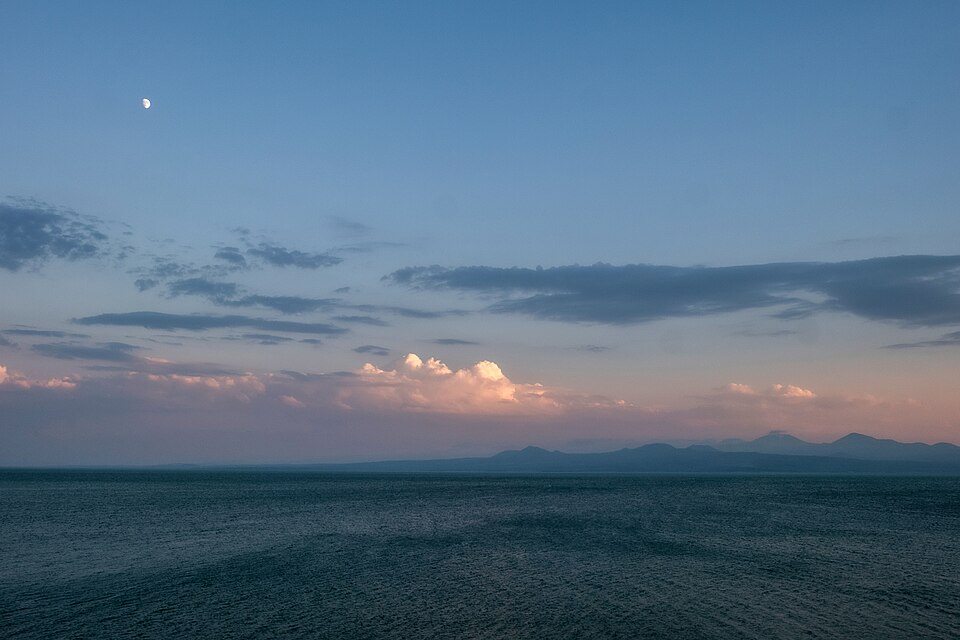
Lake Sevan is a large, cold, hard, high-altitude lake in the Lesser Caucasus, and it is one of the most intensively studied lakes on Earth. In 1930 it held 58.5 cubic kilometres of water and stoneworts grew on its bed down to 19 meters.4 A Soviet plan adopted in 1931 dropped the level by about 19 meters before it was stopped, and the lake lost 44 per cent of its water.4 The whole collapse was measured while it happened, by people standing on the shore with nets and bottles, and then written up.
That is the unusual part. Most ecological collapses are reconstructed afterwards from sediment cores and guesswork. This one has a paper trail: annual fish stock assessments, oxygen profiles, plankton counts, hydrochemistry, and a running argument between the fishery scientists and the hydroelectric engineers, published year after year in the same serials.
And it is all open. Every record listed on this page is a PDF you can download right now with no login, no fee and no institutional subscription, from arar.sci.am, the Pan-Armenian Digital Library run by the Fundamental Scientific Library of the National Academy of Sciences.5 The library holds 307,559 objects that its metadata service will list, of which 200,946 are article-level records.2 This page indexes a very small and very specific corner of it.
What this page adds. Not the PDFs, which were already there. The finding aid. No subject bibliography of Lake Sevan exists, and no index of the Station's transactions exists other than the archive's own search box.3 Below is one, with a working link on every line.
What the index holds2
- 356
- article records, each with a direct PDF link
- 135
- from the research station's own transactions, under three successive serial titles
- 13
- serials in all, plus 5 records the archive left with no journal field
- 283
- distinct author strings, unmerged
- 324
- with a Russian title
- 27
- with an Armenian title
- 5
- whose main catalogued title is in English
- 3
- that carry a DOI
Before you start reading
Four things to know about the records, and how to work with each one.
These are properties of a Soviet era Armenian archive rather than of this list, and every one of them has a workaround.
Abstracts, on the modern records
42 of the 356 records carry one, and they are trilingual.
The abstracts that do exist are all in the modern Biological Journal of Armenia records, and those are trilingual, Armenian and Russian and English in one field.2 On the other 314 the field is empty, and the description field is not a substitute because it holds a place of publication, usually Երևան. Start with the title and the page range, and the full PDF is one click away on every record.
Cite by archive identifier
3 records out of 356 carry a DOI, so use the identifier instead.
The Academy is a Crossref member and has deposited about 5,686 DOIs in total, of which exactly 100 belong to the Biological Journal of Armenia, all of them from 2022 and 2023.3 For the seventy-eight years before that, the archive identifier is the stable handle. Cite by identifier and page range and your reference will resolve for anybody.
Every record carries English
324 titles are Russian, and all 356 are given in English here.
Every record below carries a romanisation and an English title. The romanisation is always ours. The English title is ours on 260 records and is labeled our rendering on each of them, because those words were never printed anywhere and are not the author's. On the other 96 the publisher printed an English title itself, and that is reproduced verbatim, typos included, and labeled title as published. Neither is a translation of the paper. Both exist so you can decide whether to put one through a translator.
This page is the index
Search here, not in Scopus, Web of Science, DOAJ, PubMed or OpenAlex.
The Station's transactions reach none of those services, Europe PMC carries no articles from the Biological Journal of Armenia, and DOAJ's thirteen Armenian journals cover no biology, ecology, zoology, botany or agriculture.3 A literature search that stops at those five will report that a century of work on Lake Sevan was never done. It was, all 356 papers of it, and the table below is where you find it.
The shape of the run
You can see the Soviet Union collapse in the publication counts.
These are the 356 records in this index, counted by decade. Nothing was excluded to make the curve; the dip is what the archive holds.
| Decade | Records | What was happening |
|---|---|---|
| 1920s | 12 | The Sevan Lake Station opens and publishes its first volume of transactions |
| 1930s | 24 | The drawdown plan is adopted; the station is renamed and absorbed into the Academy |
| 1940s | 30 | Wartime, then the fastest phase of the drawdown |
| 1950s | 57 | The peak of descriptive limnology: hydrochemistry, benthos, plankton, macrophytes |
| 1960s | 50 | The first cyanobacterial bloom, and the first reversals of the drawdown policy |
| 1970s | 54 | Eutrophication becomes the subject; primary production and oxygen deficit work |
| 1980s | 70 | The most productive decade in the whole run |
| 1990s | 9 | The funding collapse. The Biological Journal of Armenia went from twelve issues in 1989 to one in 1994, and published nothing at all in 2000.3 |
| 2000s | 11 | Partial recovery, and the lake level starts rising again |
| 2010s | 31 | New work on the tributaries, the crayfish and the phytoplankton |
| 2020s | 8 | The DOI programme starts, and stops |
Why the 1990s matter to anyone reading this literature. The lake was doing dramatic things in exactly the decade nobody could afford to publish. Anyone comparing a Soviet-era Sevan measurement with a post-2005 one is comparing across a hole in the record, and should say so. The hole is an artefact of money, not of the lake becoming uninteresting.
Where to start
Six papers that answer a question an aquarist actually has.
Chosen for what they measure, not for their date. Each one treats, at the scale of a lake and with field data, something the hobby usually asserts from a care sheet.
Reports of the NAS RA · 1957
Nitrification processes in the water and sediments of Lake Sevan
Процессы нитрификации в воде и грунтах оз. Севан · M. E. Gambaryan · pp. 37-42
It separates nitrification happening in the water column from nitrification happening in the mud. That is exactly the distinction behind every argument about filter media against substrate, and it was settled with field measurements in 1957. PDF
Transactions of the Sevan Hydrobiological Station, vol. 12 · 1951
Distribution and biomass of stoneworts (Chara) and moss in Lake Sevan
Распространение и биомасса харовых водорослей и мха в оз. Севан · A. K. Markosyan · pp. 29-34
Chara and aquatic moss are both aquascaping plants. This measures how much of each grew, and at what depth, in a cold hard mountain lake. It is a biotope reference for a moss or stonewort layout, and it is local. PDF
Biological Journal of Armenia, vol. 29 · 1976
The eutrophication of Lake Sevan
Эвтрофикация озера Севан · T. M. Meshkova · pp. 14-22
An algae outbreak in a tank and the eutrophication of a lake are the same process at different scales. This documents it running in real time, by the scientist who ran the station. PDF
Transactions of the Sevan Hydrobiological Station, vol. 15 · 1957
A trial of the mass rearing of Daphnia (Daphnia magna)
Опыт массового разведения дафний (Daphnia magna) · T. M. Meshkova · pp. 109-136
Twenty-eight pages on culturing live food, from a state fishery programme that needed it in quantity. Longer and more systematic than anything the hobby press has published on the subject. PDF
Transactions of the Sevan Hydrobiological Station, vol. 19 · 1984
Bacterial abundance in the water and bottom sediments of Lake Sevan
Численность бактерий в воде и донных отложениях озера Севан · O. I. Tifenbakh · pp. 44-68
Counts of bacteria in open water against counts in the sediment, over a season. If you have ever wondered where the bacteria in a tank actually live, this is twenty-five pages of measured answer from a real water body. PDF
Transactions of the Sevan Hydrobiological Station, vol. 17 · 1979
On the blooming of the water in Lake Sevan, from observations for 1964 to 1972
О «цветении» воды в озере Севан (по наблюдениям 1964-1972 гг.) · N. A. Legovich · pp. 51-74
Nine consecutive years of watching a large clear lake start to bloom, by the person who recorded the first bloom. Green water with a time series attached. PDF
The complete index
All 356 records, grouped by decade.
Type a name, a species, a Russian word or an English one. The box searches the original title, our romanisation, our English rendering, every author name in both scripts, the journal, the year and the archive's own subject headings, so a search for Chara, for Мешкова or for oxygen all work.
356 records
This index needs JavaScript to filter and to render. With scripting off, the whole dataset is still in the page as JSON, in the element with id sevan-data at the foot of the document, and every record in it carries its own PDF address.
A cataloguing trap
The station's transactions sit under three different serial titles.
Anyone searching the archive for one of them finds a third of the run and stops. All three are in the index below, and they are one continuous publication.
| Serial title in the archive | Our English name | Records here |
|---|---|---|
| Труды Севанской гидробиологической станции | Transactions of the Sevan Hydrobiological Station | 107 |
| Труды Севанской озерной станции | Transactions of the Sevan Lake Station | 24 |
| Севанская гидробиологическая станция. Труды | Sevan Hydrobiological Station: Transactions | 4 |
The name changes are real history, not cataloguing noise. The body was the Sevan Fish-breeding Station from 1923, the Sevan Hydrobiological Station from 1936, the Institute of Hydroecology and Ichthyology from 1991, and since 2006 a laboratory group inside the Scientific Center of Zoology and Hydroecology.1 The archive records each masthead faithfully rather than merging them, which is correct cataloguing and a trap for anyone searching.
The oldest layer has a fourth language. 22 records in this index carry a German or French title printed by the station alongside the Russian one, for example Ueber die Dynamik der Fangmengen im Sewan-See and Les vers parasitiques des poissons du lac de Sevan. Those were the international scientific languages the station's founders had been trained in, and in the 1930s they were the only part of this work a western reader could reach. They are shown on the record where they exist, in the language they were printed in.
A second trap, in the same family. The Biological Journal of Armenia has also had three names since 1948, with continuous volume numbering, so volume 19 is 1966 and volume 1 is 1948.3 The archive normalises all three to the modern title, which is helpful for finding things and misleading if you are trying to cite one.
What is still in Yerevan and not on the internet.
Two things, and both are larger than everything above. The Institute states that it holds a bank of hydrological, hydrophysical, hydrochemical and hydrobiological data for Lake Sevan and its inflowing rivers covering 1900 to 2005. None of it is published anywhere we could reach.3 Sevan National Park runs a scientific department and publishes nothing; its scientific activity page carries one post, dated 20 March 2019.3
Two Armenian monographs that the modern literature cites constantly are print only: Hovhanissian's Lake Sevan: Yesterday, Today, Tomorrow of 1994, and Gabrielyan's Fishes of Lake Sevan of 2010.6 Most of the historical nutrient, temperature and transparency figures quoted in the current review literature trace back to the first of those two books. If you want the primary numbers rather than a summary of them, they are on a shelf in Yerevan.
- Scientific Center of Zoology and Hydroecology of NAS RA, institutional history. sczhe.sci.am/history/. Dates regular hydrobiological and ichthyological research in Armenia to the station founded in 1923, and gives the chain of bodies: Sevan Fish-breeding Station 1923 to 1936, Sevan Hydrobiological Station 1936 to 1991, Institute of Hydroecology and Ichthyology 1991 to 2006, and the present Center from 2006. The Center's own publications page is empty, which is why this page had to be built from the archive rather than from the institution. accessed 9 September 2026
- Our Lake Sevan literature list. from arar.sci.am. Search pages at
/dlibra/results, metadata by OAI-PMH at/oai-pmh-repository.xmlin thedlibra_avsformat, full text at/Content/<id>/download/. The repository-wide and Articles-set totals, 307,559 and 200,946, are thecompleteListSizeattributes returned byListIdentifierson 9 September 2026. Every count on this page other than those two is computed from the data file by at build time, so the prose cannot drift from the records. compiled 9 September 2026 - Armenian science directory. The directory of Armenian scientific journals and archives. Source for the three-script query comparison, the Crossref and DOI figures, the absence from Scopus, Web of Science, DOAJ, PubMed and OpenAlex, the issue counts of the Biological Journal of Armenia through the 1990s, the journal's three successive titles, the state of the Institute's data bank and of Sevan National Park's publishing, and the earlier and partly superseded notes on the download and Identify endpoints. Every URL in that file was checked rather than guessed. compiled 8 and 9 September 2026
- Gabrielyan, B., Khosrovyan, A. and Schultze, M. (2022). A review of anthropogenic stressors on Lake Sevan, Armenia. Journal of Limnology 81(s1):2061. doi.org/10.4081/jlimnol.2022.2061. Open access. The morphometry table behind the 1930 volume of 58.5 cubic kilometres and the 44 per cent loss, the level history from the 1931 plan to the 2001 minimum, and the stonewort depth limit. The best single modern entry point to the subject, and it cites the Russian-language work this page indexes. read 9 September 2026
- Fundamental Scientific Library of NAS RA, Pan-Armenian Digital Library. arar.sci.am. Marshal Baghramyan 24/6, Yerevan 0019. A dLibra 6 instance, open, no login, no fee, PDFs served directly and reachable from outside Armenia. The single institution that makes this page possible, and the only copy: no mirror of the archive was found. accessed 9 September 2026
- Lake Sevan reading list. The reading of the Lake Sevan and Armenian rivers literature in three languages, with access marked honestly for each item. Source for the two print-only Armenian monographs and for the account of which serials the century of Sevan work was published in. compiled 9 September 2026
Continue
Where to go next.
Lake Sevan
What the lake is now, and what a hundred years of that research describes.
Succession, the egg bank and Lake Sevan
The invasion sequence the archive documents, at the scale of a whole lake.
Reading
What else there is to read, with open access marked and the gaps stated.
Science
The three science pages the archive supports.