Succession
The order of appearance was written down in 1912, and it has not needed correcting.
A new tank does not fill up with everything at once. It runs a sequence, and the sequence is repeatable enough to have been measured a hundred and fourteen years ago and still be usable as a schedule.
Lorande Loss Woodruff set up twenty four flasks, each 5 grams of hay in one liter of tap water in a 1,500 cc flask, plugged with cotton and left in a well lit room at room temperature1, and counted the organisms in them daily for three months. His flasks are a two liter pond jar, and they are also, structurally, a newly filled aquarium.
First, he settled where the organisms come from, by design rather than by argument. Different flasks had the hay sterilised, or the water sterilised, or both, or neither, so the source could be isolated. His conclusion was that air, water and hay are all sources of the protozoa in an infusion, increasing in importance in that order, and that of the three, air is practically a negligible factor.1 The solid material carries the life. Almost nothing interesting arrives through the opening. Hold that thought for where the animals come from, where the same result appears from the other direction and eighty years later.
Second, the order itself. The water goes markedly turbid within forty eight hours from countless bacteria; a bacterial surface mat, the zoogloea, begins forming about day 3, reaches its greatest thickness around day 30 and then falls or thins; the water darkens from day 3 or 4, and the color tracks acidity, with pale yellow shades going with relatively high acidity and dark brown with relatively low; flagellate maxima fall between day 4 and day 27; Colpoda peaks around days 12 to 15; crawling hypotrich ciliates appear from about day 6 and peak between days 10 and 16.1
Third, and this is the biology rather than the timetable, he identified what drives the order. He put the emphasis on the biological interrelations, food and specific excretion products, as the most important factors determining the observed sequence1, rather than on the chemistry of the water. Nothing can eat until there is something to eat. Litter dissolves, bacteria eat the dissolved carbon, flagellates eat bacteria, ciliates eat flagellates and bacteria, rotifers and crustaceans eat all of it, and each level takes longer to get going than the one below because each is larger and slower to reproduce. That is a trophic cascade running forwards in time instead of downwards through a food web, and it is the reason a new tank has an order at all. Within limits, the higher the temperature the faster the whole sequence proceeds.1
Two endings, and light decides which
Woodruff named both outcomes in his first paragraph, and it is the most quotable sentence in the whole of this material. An infusion runs a kaleidoscopic series of phenomena from its inception until it finally reaches a stage of sterility, or, in the presence of sunlight, of practically stable equilibrium in which animals and green plants become so adjusted that a veritable microcosm exists.1
Sterility, or a working microcosm. A closed jar is a batch culture: a fixed amount of energy goes in on day one as litter and sediment organic matter, and after that the only new energy is whatever light and photosynthesis supply. Take the light away and the system spends its capital and stops. Leave the light on and it can close the loop and persist.
That is the same sentence as an aquarium. An unlit tank with fish in it is a batch culture with a feeding tube attached, and every gram of food is an energy import that has to be exported again as waste, water change or plant growth. A lit, planted tank runs a real primary producer inside it. The nitrogen still needs exporting, but the carbon and oxygen budgets are being partly settled internally. This is the whole argument for plants over equipment, stated in 1912 about a jar of hay.
The sediment version: a Winogradsky column2
- 18
- weeks under light at room temperature, sequenced rather than guessed at
- Top
- Cyanobacteria at the soil and water interface, marking it along with Alpha- and Betaproteobacteria
- Deep
- Clostridia mark the deepest layer
- Least
- diverse and least rich part of the column is the green top, which is a useful corrective
- Founder
- community structure was set by which sediment the column was built from; the added cellulose mattered less than depth and sediment source
And the modern aquarium version of the same experiment agrees with both. Three home aquaria followed weekly from setup showed a community succeeding continuously over twelve weeks, with comammox Nitrospira establishing and then dominating from weeks 6 to 12.3 Cycling is not a switch that flips when the test kit reads zero. It is a succession with an order, and the test kit only reports on one guild in it.
Where the animals come from
The animals arrive in the mud, not in the water.
This is the best single idea the site holds, it is understandable at eight years old, and it is the reason a jar of clear pond water does almost nothing while a jar with two spoons of pond mud in it fills up with animals.
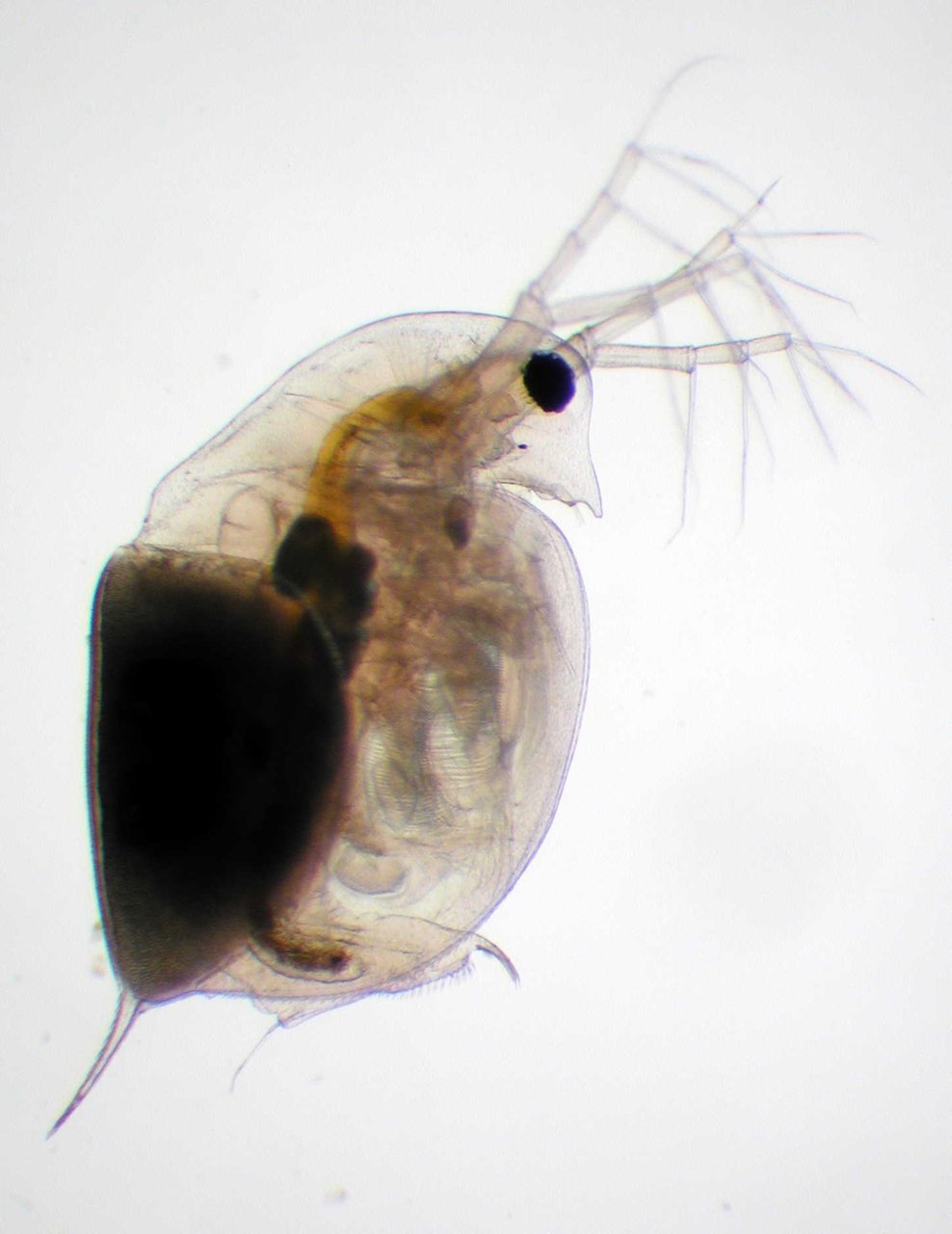
Rotifers, ostracods, copepods and water fleas such as Daphnia and Moina do not spend the dry season or the winter as adults. They make a resistant egg or cyst that sinks, is buried, and waits. In Daphnia the package has a name worth learning: the ephippium, a dark saddle shaped case the animal moults off with one or two eggs sealed inside. Ecologists call the accumulated layer of these things an egg bank, and treat it as a seed bank for animals: a reservoir of past generations held in the sediment, which restocks the water when the habitat refills.45
It is not a metaphor, and it has been run as an experiment in containers. A 2023 study of roadside drainage ditches took cores of moist ditch soil with a 5 cm bulb planter, held them cold and dark at 4 degrees for four weeks, warmed them to 20 degrees under a 14 hour day, and poured 400 mL of filtered lake water over each. Animals hatched: commonest were the ostracod Heterocypris incongruens and bdelloid rotifers of the genus Rotaria, with some Brachionus rotifers and a springtail. Per gram of dry sediment per week, emergence ran from zero up to about 1.7 individuals and was still going four weeks in, and the animals were healthy enough to found laboratory cultures.6
Every part of that protocol is biology rather than craft. The cold period is a refractory phase: many resting eggs will not hatch until they have been cold, because hatching in November would kill the animal.
How long can an egg wait? The foundational measurement of the age of viable diapausing eggs recovered from dated lake sediment was published in 19957, and it started resurrection ecology, a field that hatches animals out of old mud to study how populations changed. The practical ceiling at which large numbers can still be revived is somewhere around 70 to 100 years, with hatching success falling as the layer gets older.8
There is a genetics point inside this that explains the population dynamics. Daphnia are cyclic parthenogens: the ephippium is produced sexually and enters diapause, and every hatchling from a resting egg is genetically unique and then reproduces clonally.9 One animal becomes a swarm of copies, which is why a live food culture crashes and recovers in steps rather than smoothly, and why a sediment bank holds far more genetic variation than the water above it does at any moment.
Three independent lines, one conclusion: the solid material carries the community
Put the three findings next to each other, because they were reached in different centuries with different tools and they agree.
Sterilised-hay and sterilised-water controls: air, water and solid material are all sources, in increasing order of importance, and air is practically negligible1.
Community structure in a Winogradsky column was set by a founding population that depended on which sediment the column was made from, and the supplemental cellulose mattered less than depth and sediment source2.
Ostracods and rotifers hatched out of ditch sediment held cold and then warmed, at up to about 1.7 individuals per gram per week6.
The aquarium translation is direct, and it is the reason mature media works. When a keeper seeds a new tank with a squeeze of somebody else's filter sponge, a cup of established substrate or a handful of mulm, they are making a withdrawal from exactly this kind of bank: an assembled community plus its resting stages, in the solid phase. A bottle of water with one selected organism in it is a different transaction, and the filter already showed what happens when the organism in the bottle is not the organism that ends up running the filter. We know of no published comparison of sponge-squeeze seeding against bottled products in a home aquarium, which is a gap somebody could close.
Competition
Algae are not a disease. They are the other photosynthesiser, and they are better at almost everything.
Nothing on this page treats algae as a fault condition. An alga is a primary producer competing with the plants for light, carbon and nitrogen, and the traits it competes with are structural.
The algal advantages are real and they are not going away. A single cell has a very high surface area to volume ratio, no structural investment to pay for, a generation time of hours rather than weeks, and it lives suspended in or attached to exactly the resource it needs. It also disperses everywhere, which is why no tank is ever algae free at the start. On the direct comparisons, algae win most of them.
What a plant has instead is a small list of things an alga cannot do, and every one of them has appeared already on this page. It can root into the sediment and mine a nutrient reservoir that free-living algae cannot reach, which is root uptake and roots in anoxic mud. It can grow emergent or floating and take carbon dioxide from the air at a diffusion rate ten thousand times better than through water, which is roots in anoxic mud. It can build biomass and shade the water. And it can pull iron and other nutrients out of the water column faster than the algae do.
Nitrogen form is the sharpest of those levers. Root and leaf uptake established that aquatic plants strongly prefer ammonium and take it fast1011. The mirror of that finding on the algal side is that ammonium above roughly 0.02 mg/L suppresses nitrate uptake in algae12, which is a marine phytoplankton result and should be read as a mechanism rather than as a tank measurement. Read the two together and the competition is not for nitrogen in general, it is for ammonium in particular, in the hours after it appears, and it involves the nitrifiers of the filter as a third party. A well planted tank is a tank where the plants get to the ammonium first.
Allelopathy, handled honestly
The idea that plants chemically inhibit algae is popular in the hobby and it is a genuinely open question in the science, so it gets a straight account rather than a verdict.
For. The standard review finds that allelopathy occurs in all aquatic habitats, that all groups of primary producers can produce and release active compounds, and that inhibiting a competitor's photosynthesis is a frequent mode of action.13 A later review and meta-analysis of field evidence proposes allelopathy as an important mechanism in the interaction between submerged macrophytes and phytoplankton in shallow lakes, on the grounds that the allelopathically active genera, Myriophyllum, Ceratophyllum, Elodea, Najas and the charophytes, are among the commonest plants in those lakes; the same authors are explicit that in situ evidence is hard to get and that most experiments used plant extracts rather than living plants.14 Note the verb. They propose.
Against. The sceptical review's argument is in its title: in a real water body you cannot separate allelopathy from three simpler explanations that are always also present, namely that the plants take the nutrients, the plants shade the water, and the plants shelter the zooplankton that eat the algae.15
What this means for your tank. Allelopathy is real and measurable in the laboratory; that is not in dispute. Whether it is a significant reason any particular aquarium has less algae is not established, and nutrient competition plus shading are sufficient to account for most of what aquarists actually see. It is also worth noticing that this is one small field disagreeing with itself rather than two camps: the leading proponent and a co-author of the leading sceptical review both appear in the reference trail behind the soil substrate method. The version of that argument as it plays out in the hobby is on the Walstad page.
And the sensible target is control, not eradication. A tank with some algae is a tank with a functioning primary producer community in it. A tank with none has usually been sterilised into a state it cannot hold.
The same biology, outdoors
Lake Sevan is what happens when the same mechanisms run at the scale of a whole lake.
Every process on this page has an outdoor version, and Armenia has an unusually complete case study of the ones that go wrong. It is also the reason the biosecurity rule on this site is absolute rather than advisory.
A trophic cascade, measured over sixty years
Two whitefish taxa from Lake Ladoga were acclimatised into Sevan between 1924 and 1927 on the reasoning that the pelagic consumer niche was empty. They hybridised into a local form, reached about 30,000 tonnes of biomass by 1988, collapsed to under 5,000 tonnes in the early 2000s, and stood at about 2,000 tonnes in 2019. On the way the plankton inverted: when whitefish were abundant the zooplankton crashed and the algae rose, and when the whitefish went, large Daphnia came back.16
That is a textbook trophic cascade, and the animal at the bottom of it is the same Daphnia from the egg bank, hatching out of the same kind of sediment egg bank. Remove the planktivore and the grazer returns and the water clears. It is the mechanism that makes a pond jar work, running across a lake and a century.
A niche substitution, and then a disease
The narrow-clawed crayfish arrived accidentally in the 1980s. Commercial stock ran 1,528 tonnes in 2013 and 4,580 tonnes in 2016, then collapsed to 105 tonnes in 2020.16 The study of that collapse states that the crayfish successfully replaced the endemic Sevan khramulya in the chain of detritivores, and attributes the crash to burn-spot disease plus heavy fishing.17 An introduced animal took over the decomposer-consumer role of decomposition from a native, held it for thirty years, and then a pathogen removed it in four. Thirty two years from accident to peak to two percent of peak, all of it measured.
Armenia has exactly three endemic freshwater fish and all three are in the Lake Sevan basin18, and two of the four named forms of the Sevan trout are recorded as extinct worldwide, last seen in 1982 and 198619. On the plant side the lake carries something an aquarist will recognize: Fontinalis antipyretica, willow moss, grows wild in the macroalgae and moss belt at 6 to 16 meters20, and is sold across Europe as a coldwater aquarium moss. Buy it. Do not dig it. The lake, its endemics and the law around them are on the Lake Sevan page.
Temperature is the gate, and it is moving
What decides whether a released ornamental survives a winter is thermal tolerance, and that is a physiological property with a measurable value. Feral Neocaridina davidi populations in Europe are mainly confined to thermally polluted waters and thermal springs, and the first Central European record came from a thermally polluted canal of the River Oder2122. Modeling of the same species predicts thermally suitable habitat in the Mediterranean and a foreseeable expansion into colder regimes, with the parasites traveling even where the shrimp itself does not persist.22 The gate is currently closed by winter in most of Europe. It is not closed permanently, and a species-by-species risk screen for this region says so: of 32 non-native freshwater fish screened for the South Caucasus, the number rated very high risk rises from 4 under current climate to 12 under projected climate.23
The propagule logic of the egg bank runs in this direction too, and that is the point of putting these next to each other. A resting egg is a dispersal device. A cyst survives drying, freezing and a bird's gut. A stem of hornwort carries snail eggs, hydra, planaria, ostracods, resting eggs and filamentous algae, and a liter of tank water carries the plankton, the bacteria and the pathogens. Nothing released into a natural water body is a single organism, and nothing about it is reversible. A 2024 survey records forty invasive animal species established in Armenia, of which six are fish, arriving by escape, deliberate release and transport contamination, and states that no monitoring or control of animal invasions is carried out in the country.24
- Woodruff, L.L. (1912). Observations on the origin and sequence of the protozoan fauna of hay infusions. Journal of Experimental Zoology 12(2): 205 to 264. Sheffield Biological Laboratory, Yale. The 24 flask design with sterilised hay and sterilised water controls, the finding that air is a negligible source, the sequence of appearance, maximum and disappearance, the 48 hour turbidity, the zoogloea, the temperature effect, and the sterility against microcosm sentence. DOI 10.1002/jez.1400120204. Public domain; full volume at archive.org public domain, full text free
- Rundell, E.A., Banta, L.M., Ward, D.V., Watts, C.D., Birren, B. and Esteban, D.J. (2014). 16S rRNA gene survey of microbial communities in Winogradsky columns. PLoS ONE 9(8): e104134. Open access. The oxic and anoxic stratification, the 18 week incubation under light, the depth biomarkers, the low diversity of the top layer, the founder effect of sediment source over cellulose source, and the hydrogen sulfide and ferrous sulfide explanation for black sediment. DOI 10.1371/journal.pone.0104134 open access
- McKnight, M.M., Szabolcs, N., Graham, A. and Neufeld, J.D. (2025). Microbial community succession of home aquarium biofilters associated with early establishment of comammox Nitrospira. ISME Communications 5(1): ycaf212. Open access, PMC12704419. The 1.6, 3.1 and 3.8 percent sponge figures and the 0.6 to 14.1 percent bead range, the dominant heterotrophic genera, the twelve week succession, and heterotrophs assisting nitrifier establishment. DOI 10.1093/ismeco/ycaf212 open access
- Hairston, N.G. Jr. (1996). Zooplankton egg banks as biotic reservoirs in changing environments. Limnology and Oceanography 41(5): 1087 to 1092. The paper that framed sediment egg banks as reservoirs rather than as debris. DOI 10.4319/lo.1996.41.5.1087
- Brendonck, L. and De Meester, L. (2003). Egg banks in freshwater zooplankton: evolutionary and ecological archives in the sediment. Hydrobiologia 491: 65 to 84. The standard review of the subject. DOI 10.1023/A:1024454905119
- Trujillo, J., Schwing, C.D., Muturi, E.J. and Cáceres, C.E. (2023). Heterocypris incongruens maintains an egg bank in stormwater habitats and influences the development of larval mosquito, Culex restuans. Ecology and Evolution 13(8): e10445. Open access. The coring and hatching protocol, the taxa recovered from ditch sediment, and the per-gram emergence counts. DOI 10.1002/ece3.10445 open access
- Hairston, N.G. Jr., Van Brunt, R.A., Kearns, C.M. and Engstrom, D.R. (1995). Age and survivorship of diapausing eggs in a sediment egg bank. Ecology 76(6): 1706 to 1711. The foundational measurement of how long a viable diapausing egg persists in dated lake sediment. DOI 10.2307/1940704
- Weider, L.J., Jeyasingh, P.D. and Frisch, D. (2018). Evolutionary aspects of resurrection ecology: progress, scope, and applications. An overview. Evolutionary Applications 11(1): 3 to 10. Open access. The 70 to 100 year practical ceiling on reviving large numbers of dormant propagules, and the inverse relation between hatching success and layer age. DOI 10.1111/eva.12563 open access
- Ebert, D. (2022). Daphnia as a versatile model system in ecology and evolution. EvoDevo 13: 16. Open access. Cyclic parthenogenesis, the ephippium sinking and entering diapause, and the point that each hatchling from a sexually produced resting egg is genetically unique and then reproduces clonally. DOI 10.1186/s13227-022-00199-0 open access
- Ozimek, T., Gulati, R.D. and van Donk, E. (1990). Can macrophytes be useful in biomanipulation of lakes? The Lake Zwemlust example. Hydrobiologia 200: 399 to 407. Paywalled. The Elodea nuttallii result of 75 percent of the ammonium removed in 16 hours with the nitrate almost untouched. Bibliographic record only; we did not obtain the full text and no DOI is asserted here.
- Ferguson, A.R. and Bollard, E.G. (1969). Nitrogen metabolism of Spirodela oligorrhiza: utilization of ammonium, nitrate and nitrite. Planta 88(4): 344 to 352. Paywalled. Ammonium taken up fast and nitrate essentially ignored, under sterile conditions, which removes bacteria as an explanation. Bibliographic record only; we did not obtain the full text and no DOI is asserted here.
- Dortch, Q. (1990). The interaction between ammonium and nitrate uptake in phytoplankton. Marine Ecology Progress Series 61: 183 to 201. The suppression of nitrate uptake by ammonium, and the concentration at which it begins. A marine phytoplankton study, cited here as a mechanism rather than as an aquarium measurement. Open access at the publisher; the concentration threshold reaches us through a secondary summary and the primary was not read, so the figure is quoted as approximate.
- Gross, E.M. (2003). Allelopathy of aquatic autotrophs. Critical Reviews in Plant Sciences 22(3 to 4): 313 to 339. Paywalled at the publisher, free green copy in the University of Konstanz repository. The standard review: allelopathy in all aquatic habitats, all groups of primary producers capable of it, and inhibition of a competitor's photosynthesis as a frequent mode of action. DOI 10.1080/713610859
- Hilt, S. and Gross, E.M. (2008). Can allelopathically active submerged macrophytes stabilise clear-water states in shallow lakes? Basic and Applied Ecology 9(4): 422 to 432. Free green copy at Konstanz. The review and meta-analysis of field evidence, worded as a proposal, and the authors' own statement that in situ evidence is hard to obtain and most experiments used extracts rather than living plants. DOI 10.1016/j.baae.2007.04.003
- van Donk, E. and van de Bund, W.J. (2002). Impact of submerged macrophytes including charophytes on phyto- and zooplankton communities: allelopathy versus other mechanisms. Aquatic Botany 72(3 to 4): 261 to 274. Paywalled, no open copy found. The sceptical case: nutrient uptake, shading and zooplankton refuge cannot be separated from allelopathy in the field. DOI 10.1016/S0304-3770(01)00205-4
- Gabrielyan, B., Khosrovyan, A. and Schultze, M. (2022). A review of the anthropogenic stress on Lake Sevan and the current state of the ecosystem. Journal of Limnology 81(s1): 2061. Open access. The whitefish acclimatisation, hybridisation, biomass series and plankton inversion, and the crayfish tonnage series. DOI 10.4081/jlimnol.2022.2061 open access
- Ghukasyan, G., Asatryan, A., Melkonyan, H., Badalyan, A., Shahnazaryan, G. and Gabrielyan, B. (2023). A study of the narrow-clawed crayfish collapse in Lake Sevan, with oxidative stress biomarkers in healthy and burn-spot-infected animals. Environmental Monitoring and Assessment 195: 1278. The replacement of the Sevan khramulya in the detritivore chain, and the attribution of the crash to burn-spot disease plus fishing. DOI 10.1007/s10661-023-11921-3 paywalled, abstract open
- Pipoyan, S. and Arakelyan, A. (2018). The freshwater fish fauna of Armenia and the East Transcaucasian district. Twenty seven endemic species and subspecies out of 73 native taxa for the district, of which Armenia's three endemics are a subset, all in the Lake Sevan basin. Recorded in our survey of the Armenian science literature; the full citation trail is in the Sevan literature archive.
- Red Book of Animals of the Republic of Armenia (2010). Annex to Government Decision N 71-N of 29 January 2010. The four named forms of the Sevan trout, the last-record dates of 1982 and 1986, and the legal statuses. arlis.am open access, Armenian
- Barseghyan, A.M. (1975). The aquatic vegetation of the Lake Sevan basin. In Flora, Vegetation and Plant Resources of Armenia (Takhtajania), vol. 6: 73 to 87. Botanical Society, Yerevan. In Russian with an Armenian summary. The only specialist survey of the higher plants of the lake: the two depth belts, and Fontinalis antipyretica in the macroalgae and moss belt at 6 to 16 metres. Scanned, no text layer. arar.sci.am PDF open access, Russian
- Jablonska, A. and others (2018). First record and DNA barcodes of Neocaridina davidi in Central Europe, from a thermally polluted canal of the River Oder, Poland. Knowledge and Management of Aquatic Ecosystems 419: 14. DOI 10.1051/kmae/2018004
- Prati, S., Grabner, D.S., Hupało, K., Weiperth, A., Maciaszek, R., Lipták, B., Bojko, J., Bérces, F. and Sures, B. (2024). Invisible invaders: range expansion of feral Neocaridina davidi offers new opportunities for generalist intracellular parasites. Biological Invasions 26: 2499 to 2523. Feral populations confined mainly to thermally polluted waters and thermal springs, the modelled thermally suitable habitat and foreseeable expansion into colder regimes, and the parasites travelling with the invasion. DOI 10.1007/s10530-024-03324-3
- Mumladze, L., Kuljanishvili, T., Japoshvili, B., Epitashvili, G., Kalous, L., Vilizzi, L. and Piria, M. (2022). Risk screening of 32 non-native and horizon freshwater fish species for the South Caucasus under current and projected climate. NeoBiota 76: 109 to 133. Open access. Very high risk species rising from 4 to 12 under projected climate. DOI 10.3897/neobiota.76.82776 open access
- Arakelyan, M. and others (2024). Invasive alien species of animals in Armenia. BioInvasions Records 13(2): 293 to 303. Open access. Forty invasive animal species of which six are fish, the escape, release and transport contaminant pathways, and the finding that no monitoring or control of animal invasions is carried out in Armenia. DOI 10.3391/bir.2024.13.2.01 open access
Continue
Where to go next.
What is in the mud
The same succession in two litres, where it takes weeks instead of decades.
Lake Sevan
The lake the invasion section is about, and what it is like under the surface now.
The Sevan archive
A hundred years of published work on that lake, indexed and free to read.
Nitrification, decomposition and roots
The organism scale processes underneath all of this.