Problems for children
This page continues
Optics and structural load have pages of their own.
Gas exchange and depth
Volume cancels. Only depth matters.
Oxygen enters water across the air to water interface and nowhere else. Not through the glass, not through the substrate. So the supply term is proportional to area, and the thing being supplied is proportional to volume That single asymmetry decides the shape of every container on this site.
The standard two film expression for gas transfer across a water surface gives the rate of change of dissolved mass. Divide through by the volume to turn mass into concentration, then notice that volume over area is the definition of mean depth. Substitute, and the volume is gone.
Two containers holding the same water do not re-oxygenate at the same rate. The shallower one does it faster, in exact inverse proportion to its mean depth. A container twice as deep recovers half as fast, whatever its volume. A 20 liter tank and a 400 liter tank of the same depth recover at the same rate as each other.
Mean depth, not maximum depth. A tub with a deep middle and shallow shelves has a mean depth well below its deepest point, and it is the mean that goes into the formula.
Same 200 liters, two shapes. Our own arithmetic1
- 1.00 x 0.80 x 0.25 m
- surface 0.80 m2, mean depth 0.25 m1
- 0.50 x 0.40 x 1.00 m
- surface 0.20 m2, mean depth 1.00 m1
- 2.0 / day
- rate constant k/d for the shallow one at k = 0.5 m/day
- 0.5 / day
- rate constant for the tall one
- 4x
- the resupply rate per liter, for exactly the same water and exactly the same cost of water
dM/dt = k · A · (Cs − C)
dC/dt = (k / d) · (Cs − C) where d = V / A
C(t) = Cs − (Cs − C0) e−t/τ τ = d / k
- M
- mass of dissolved gas in the container
- k
- gas transfer velocity, also called piston velocity, in meters per day
- A
- water surface area, square meters
- V
- volume, cubic meters
- d
- mean depth, V / A, meters
- Cs
- saturation concentration at the water's temperature and the local barometric pressure, mg/L
- C
- actual concentration, mg/L
- τ
- time constant of the exponential approach to saturation, in the same time units as k
The derivation is three lines and the third one is the whole result. Flux across a surface scales with that surface. Divide by volume to get a concentration rate. V/A is mean depth by definition. Volume has disappeared from the answer.
Gas transfer velocities for small, sheltered, low wind water bodies are reported in the lake and pond literature roughly between 0.2 and 1.5 meters per day, rising sharply with wind and with rain23. A tub against a wall in still summer air is at the bottom of that range. The same tub in an open yard on a breezy day is at the top. That factor of seven in k is larger than any factor the aquarist controls through equipment.
| Mean depth | k = 0.3 m/day, still and sheltered21 | k = 0.5, light air movement21 | k = 1.0, breeze or ripple31 | k = 2.0, rain, fountain, wind31 |
|---|---|---|---|---|
| 0.15 m | 12 h | 7 h | 4 h | 2 h |
| 0.30 m | 24 h | 14 h | 7 h | 4 h |
| 0.45 m | 36 h | 22 h | 11 h | 5 h |
| 0.60 m | 48 h | 29 h | 14 h | 7 h |
| 1.00 m | 80 h | 48 h | 24 h | 12 h |
The operative threshold. Keep the mean depth of an unaerated container at or below about 40 cm and it will refill its own oxygen inside a single night. Past about 70 cm it cannot, and something has to move the water1. That rule is a reading of the table above against a twelve hour night, not a measurement, and it is ours.
There is a second effect that the equation does not contain, because the equation assumes the container is mixed. A shallow tub is mixed, because night time cooling at the surface makes the top water denser than the water beneath it and it sinks. This convective overturn happens every night and it is free. A container deeper than roughly half a meter, warmed at the top by the sun, does not do this reliably in summer. It stratifies, the warm oxygenated layer floats on a cold layer cut off from the air, and the cold layer goes anoxic. A deep barrel does not have the volume you paid for. Its effective volume in high summer is the mixed upper layer, and the stagnant bottom is not a reserve. It is an oxygen sink that will release sulfide and reduced iron when it finally turns over.
Altitude
Every oxygen table in the hobby is wrong here, and it is wrong by 13 percent.
Gas solubility is proportional to the partial pressure of that gas above the water. Partial pressure follows barometric pressure. Armenia is high, so every dissolved oxygen figure printed in an aquarium book, which is a sea level figure, overstates what a tank in Yerevan can actually hold.
Yerevan's Arabkir reference station sits at 1113 m, with a station pressure of about 887 hPa against 1013.25 at sea level4. The correction is not simply the pressure ratio, because the water vapour in the air above the surface takes up part of the total pressure and does not scale with altitude. The dry gas fraction is what matters, so the saturation vapour pressure has to be subtracted from both sides.
Cs(P) = Cs(1013.25) · (P − esat) / (1013.25 − esat)
- Cs(1013.25)
- the sea level freshwater solubility at that temperature, from the Benson and Krause table5
- P
- station pressure in hPa, 887 for Yerevan Arabkir4
- esat
- saturation vapour pressure of water at the water temperature, from Buck6
Benson and Krause is the primary measurement behind the freshwater oxygen solubility table that the standard methods handbooks reprint5. The pressure correction applied to it here, and every number in the table below, is ours1.
| Water temp | Sea level5 | Yerevan Arabkir, 887 hPa41 | Gyumri, 846 hPa41 | Meghri, 940 hPa41 | Yerevan shortfall1 |
|---|---|---|---|---|---|
| 0 C | 14.62 | 12.79 | 12.19 | 13.56 | 12.5 percent |
| 10 C | 11.29 | 9.87 | 9.40 | 10.46 | 12.6 percent |
| 20 C | 9.09 | 7.93 | 7.55 | 8.42 | 12.8 percent |
| 25 C | 8.26 | 7.20 | 6.85 | 7.64 | 12.8 percent |
| 28 C | 7.83 | 6.82 | 6.49 | 7.24 | 12.9 percent |
| 30 C | 7.56 | 6.58 | 6.26 | 6.99 | 13.0 percent |
| 34 C | 7.07 | 6.14 | 5.84 | 6.53 | 13.2 percent |
A Yerevan tank at 30 degrees holds 6.58 mg/L when full, not 7.56. That is 13 percent less oxygen than every table in every aquarium book51, and it applies on exactly the days when the margin is thinnest. Gyumri at 1513 m loses 17 percent. Meghri at 627 m, the lowest station in the country, loses only 7.5 percent41, which partly offsets its being the hottest place in Armenia.
The same correction applies to carbon dioxide and nobody applies that one either. At 887 hPa the partial pressure of atmospheric carbon dioxide is 12.5 percent below sea level, so a Yerevan tank at air equilibrium holds about 0.55 mg/L of free carbon dioxide at 25 C rather than the 0.63 mg/L a sea level tank holds1. At altitude every gas is scarcer. See the windowsill tank for what that does to a submerged leaf, and easy setups for what it does to stocking.
The scissors
Supply falls and demand rises, in the same direction, at the same time.
Warm water holds less oxygen and warm fish need more of it. Taking routine metabolic rate to scale with a temperature quotient of 2, going from 15 to 30 degrees makes the ratio of demand to supply 3.8 times worse, and going to 34 makes it 5.4 times worse1. Neither half of that is visible in a single measurement, which is why summer stocking is set at the July temperature on this site and not at an annual mean.
When to measure
The oxygen emergency and the ammonia emergency are twelve hours apart.
At 5 pm in a planted tank in July the water is hottest, oxygen is supersaturated from a day of photosynthesis, pH is at its highest because the plants have stripped the carbon dioxide out, and the toxic un-ionised fraction of any ammonia present is therefore at its maximum. At 5 am oxygen is at its minimum and pH at its lowest. Any single measurement taken at a convenient hour describes one of these and hides the other. In summer, test at dawn.
Diffusion and the boundary layer
Water and air hold almost the same carbon dioxide. The difference is transport, and it is four orders of magnitude.
The comparison the hobby makes, 400 parts per million in air against 0.7 milligrams per liter in water, sounds like a factor of hundreds. It is not. It compares a mixing ratio with a mass concentration. Put both in the same units and Henry's law says the dissolved concentration is 82 to 92 percent of the gas phase concentration1. In molar terms air and water hold almost the same amount of carbon dioxide.
What differs is how fast the molecule can move.
DCO2, air ≈ 1.6 × 10⁻⁵ m2/s7
DCO2, water ≈ 1.92 × 10⁻⁹ m2/s at 25 C8
ratio ≈ 8,000 to 10,000
J = D · (Cbulk − Csurface) / δ
- D
- molecular diffusion coefficient of the gas in the medium
- J
- flux to the leaf surface, per unit area
- δ
- thickness of the unstirred diffusive boundary layer clinging to the leaf
Fick's first law across a stagnant film. Flux is proportional to the concentration difference and inversely proportional to the film thickness. Concentration is one lever. Thickness is the other, and it is the one flow moves.
Because transport in water is four orders of magnitude slower, the still film of water clinging to a submerged leaf becomes the bottleneck rather than a detail. Black, Maberly and Spence measured that boundary layer at 90 percent of the total resistance to carbon fixation in four submerged freshwater macrophytes9. Across fourteen submerged freshwater species, underwater photosynthesis rose on average threefold when carbon supply went from ambient to saturating10.
A leaf in air has a boundary layer too, and in air it is a minor resistance. Stomata dominate there, and stomata are under the plant's own control. The correct statement is that a leaf in air is not carbon limited and a leaf under water is, and the cause is the diffusion coefficient rather than the concentration.
| Water speed past the leaf | Momentum boundary layer111 | Diffusive boundary layer81 | Relative carbon flux at the same concentration1 |
|---|---|---|---|
| 0.2 cm/s, effectively still | 18.3 mm | 2.36 mm | 1.0 |
| 0.5 cm/s | 11.6 mm | 1.49 mm | 1.6 |
| 2 cm/s, a normal planted tank drift | 5.8 mm | 0.75 mm | 3.1 |
| 5 cm/s | 3.7 mm | 0.47 mm | 5.0 |
| 10 cm/s, strong | 2.6 mm | 0.33 mm | 7.1 |
Read the last column and then go back to the previous section. Going from a dead spot to a gentle 2 cm per second drift roughly trebles the carbon reaching the leaf1, without changing the dissolved concentration by one milligram. The boundary layer thickness falls as the inverse square root of velocity, so the first small amount of movement buys most of the benefit and each further doubling buys 40 percent more.
This is the mechanism behind two pieces of advice that otherwise sound like folklore. Injecting carbon dioxide works because raising the dissolved concentration from 0.7 to 25 mg/L is a thirty-five-fold rise in the gradient across that film1. Flow distribution matters more than flow rate because a dead spot is not merely stagnant. It is a place where plants receive less carbon than the drop checker suggests, where detritus settles, and where algae start. Neither of those is a fact about equipment. Both are Fick's law.
Where this is used. Materials and water for the carbon dioxide chapter and the drop checker lag, and the windowsill tank for the emersed leaf that escapes the problem entirely by not being under water.
Flow
A tank is turbulent in the open water and laminar everywhere it matters.
The Reynolds number is the ratio of inertial to viscous forces in a moving fluid. It decides whether a flow mixes itself or slides in sheets, and in an aquarium it comes out on opposite sides of the transition depending on which length you put in it. That is the whole reason flow is confusing in this hobby.
Re = U · L / ν
- U
- characteristic velocity, meters per second
- L
- characteristic length: pipe bore, leaf width, tank width, depending on the question
- ν
- kinematic viscosity of water, 8.93 × 10⁻⁷ m2/s at 25 C and 1.00 × 10⁻⁶ at 20 C11
The conventional transition is around Re = 2,300 in a pipe and around 500,000 along a flat surface. Below a few hundred, viscosity wins outright and the flow is laminar.
| Where | Velocity1 | Length scale | Re111 | Regime |
|---|---|---|---|---|
| Inside a 13 mm lily pipe on a 1,000 L/h canister | 2.09 m/s | 13 mm bore | 30,500 | Fully turbulent |
| Bulk circulation across a 50 cm tank | 5 cm/s | 0.5 m | 28,000 | Turbulent |
| Past a 3 cm leaf in a normal planted tank | 2 cm/s | 30 mm | 672 | Laminar |
| Past the same leaf in a dead spot | 0.2 cm/s | 30 mm | 67 | Deeply laminar |
| Past a 1 mm moss filament | 2 cm/s | 1 mm | 22 | Viscosity dominates completely |
Read that table as one sentence. The water leaving the filter is genuinely turbulent and mixes itself thoroughly. By the time it reaches a leaf it is laminar, and at a moss frond viscosity has won by a factor of a hundred. Turbulence in the open water does not reach the leaf surface. The unstirred layer from the boundary layer exists precisely because the local Reynolds number there is in the tens, and no amount of mixing in the middle of the tank changes that. What raises the flux is the bulk velocity at the leaf, because that thins the layer, and only distribution delivers it.
Which is why turnover rate is a poor proxy for anything. Turnover is filter flow divided by tank volume, quoted as times per hour. Three separate objections, in increasing order of seriousness.
- Rated flow is not real flow. A rating is measured on the maker's bench with no hoses, no bends, an empty basket and a clean sponge. A loaded filter delivers less, and it delivers progressively less between cleanings. The number on the box is an upper bound that the tank never sees.
- Turnover has no length in it, so it cannot predict a velocity. Ten turnovers an hour in a 30 liter nano is a different water speed from ten turnovers an hour in a 300 liter tank, because the cross section the water has to cross is different. The quantity that matters at the leaf is centimeters per second, and turnover does not determine it.
- Turnover says nothing about where the water goes. A filter circulating ten times an hour in a loop across the front glass, leaving the back corner still, is worse than one doing six times an hour evenly. The hobby's usual figures, four to five turnovers an hour for a community tank and six to ten for an injected planted tank, are conventions with no published study behind them1, and this site repeats them only with that label attached.
The measurement that beats the calculation. Turn the carbon dioxide on and watch where the mist goes, or drop a few plant fragments in and watch where they stop. Where they stop is where the boundary layer is thickest, where detritus will settle, and where the algae will start. That takes two minutes and it answers a question no turnover figure can.
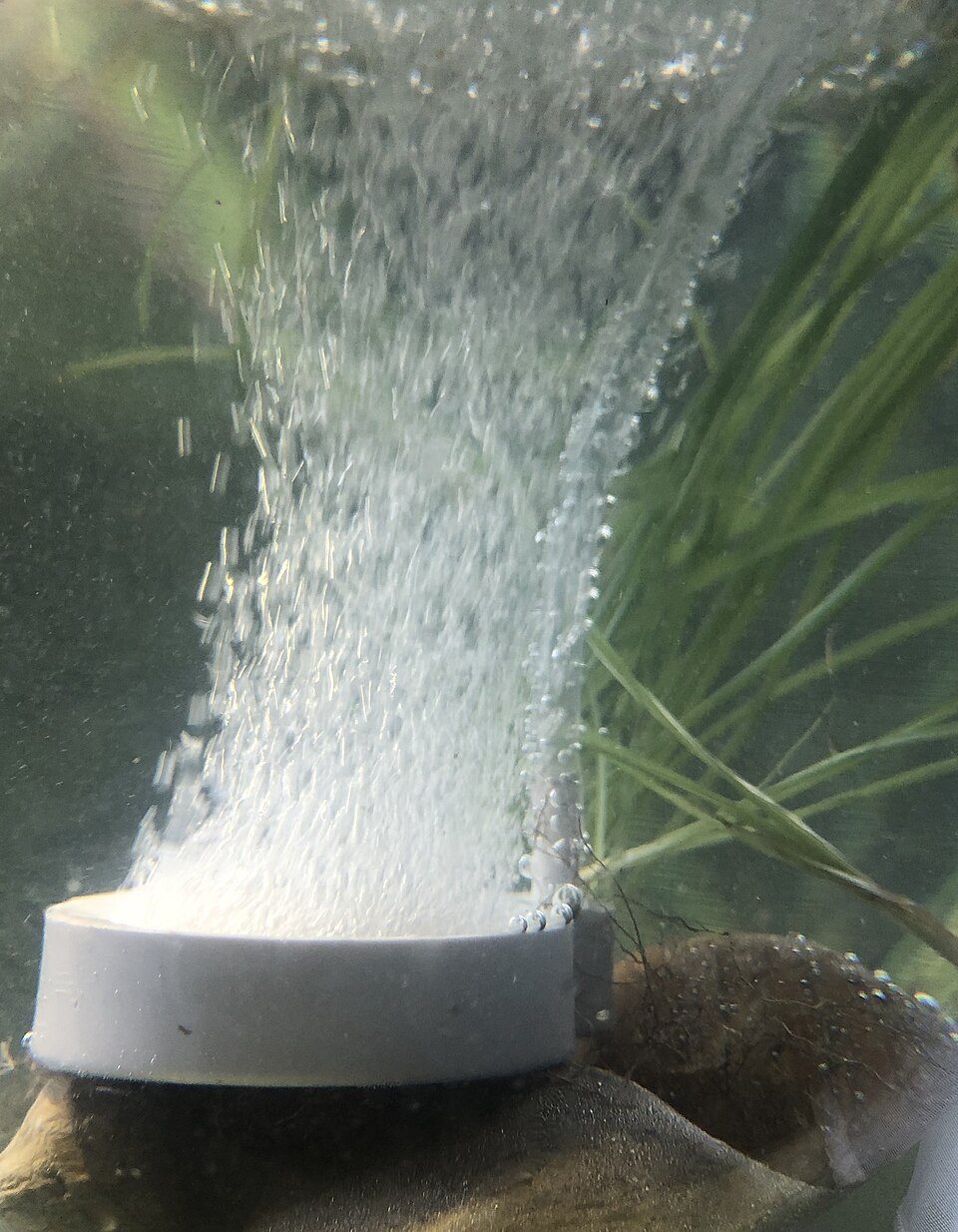
Two more consequences of the same physics, both already on the site. Surface renewal, not bubbles, is what an air stone buys. The lift moves water from the bottom to the top and spreads it across the surface, constantly replacing the thin surface film with water from below, which is a direct increase in the gas transfer velocity k in gas exchange and depth. Angling a filter return to break the surface does the same job with no pump and no salt spray. And surface agitation is a trade. It drives oxygen in and carbon dioxide out, so in an injected tank you want just enough ripple to break the film, and in an uninjected one more is nearly always better.
Heat
Thermal mass sets the swing. Evaporation sets the mean. Indoors, the evaporation is switched off.
Water temperature is two separate quantities and the hobby merges them. The daily mean is set by an energy balance at the surface. The daily swing around that mean is set by the heat capacity of the column, which is to say by depth. Different levers move each one.
absorbed shortwave = net longwave + sensible convection + latent evaporation
ΔTswing = f · Qday / (d · ρ · cp)
- ρ cp
- volumetric heat capacity of water, 4.18 MJ per cubic meter per kelvin1
- d
- mean depth, meters. The swing is inversely proportional to it
- Qday
- the day's absorbed shortwave, MJ per square meter
- f
- the fraction retained to the afternoon peak rather than lost the same day, taken as 0.35 throughout this site
- Lv
- latent heat of vaporisation of water, 2,440 kJ per kilogram at room temperature1. Every kilogram that leaves carries that much energy with it
Net longwave is linearised at an emissivity of 0.97, giving 5.7 to 6.2 W per square meter per kelvin at room temperatures. Sensible convection is taken at 3.5 to 4 W per square meter per kelvin for free convection over a horizontal water surface in still indoor air, and the evaporation coefficient at 20 W per square meter per kilopascal still and 40 with a fan. Saturation vapour pressures are Buck's6, at the Yerevan station pressure4. The balance, and every temperature below, is ours1.
The first result is that Armenia's dryness is a gift, outdoors. A wide, light coloured, open water surface in Yerevan in July sits at about 27.1 C mean, only 1.5 K above the mean air temperature1. Not 35. The July vapour pressure in Yerevan is 16.6 hPa, which at 30 C air is 39 percent relative humidity and a wet bulb temperature of about 19.5 C, leaving 10.5 K of evaporative headroom41. Evaporative cooling does most of the work of removing the solar load. In a humid climate at the same air temperature the same tub would run several degrees hotter.
The second result reverses the intuition, and it is the important one. Move the same water indoors onto a sunny windowsill and both of the large cooling terms disappear. There is no net longwave loss, because the room is at the water's own temperature rather than a cold sky. And there is no wind, so the evaporation coefficient collapses. Indoors you keep the sun and lose the cooling.
| Where | Depth | Daily mean41 | Swing1 | Daily peak1 |
|---|---|---|---|---|
| Wide light tub outdoors, unshaded | 0.20 m | 27.1 C | 12.5 K | 31.8 C |
| Wide light tub outdoors, 50 percent shade | 0.30 m | 22.5 C | 3.1 K | 24.1 C |
| Sill tank indoors, unventilated flat at 28 C air | 0.15 m | 33.4 C | 5.8 K | 36.3 C |
| Sill tank indoors, heat spell, 31 C air | 0.15 m | 35.2 C | 5.8 K | 38.1 C |
| Sill tank indoors, January, heated flat at 22 C and 16 percent humidity | 0.15 m | 22.0 C | 2.1 K | 23.0 C |
| Black 200 L barrel outdoors, unshaded, heat spell | 0.20 m | 33.2 C | 22.4 K | 42.6 C |
The indoor tank in a Yerevan July is four to six degrees hotter than the same water sitting outdoors in full sun in the same city, and it is closer to the black barrel than to the outdoor tub. That number is the windowsill page's headline and it is the most surprising result the site holds. Read the January row against it: indoors, in the darkest month, the solar gain and the evaporative loss into extremely dry Armenian winter indoor air cancel to within a tenth of a degree, and the water sits at exactly room temperature for free.
Depth buys stability, not coolness, and shade buys both. Going from 0.20 m to 0.60 m in an unshaded outdoor tub buys 3.1 K of peak. Going from no shade to 50 percent shade at a fixed 0.30 m buys 6.1 K. Shade is twice as effective as trebling the depth1, and depth costs oxygen through gas exchange and depth while shade does not. That is the physics behind the ordering used across easy setups: site it, lighten it, shade it, widen it, deepen it, and only then buy a pump.
The fan arithmetic
A fan is a latent heat pump, and it bills you in water.
Evaporation is the only cooling mechanism available indoors that can go below air temperature, and its ceiling is the wet bulb temperature. Armenia's semi-arid summer puts the wet bulb about ten kelvin below room air, which is a large budget by the standards of most climates.
Nobody reaches the wet bulb. But the fraction achieved rises steeply with air movement over the surface, because the evaporation coefficient does. On a 100 L tank in a 30 C room at 39 percent humidity, an open tank with no fan already sits 4.0 K below the room, a gentle clip fan 6.6 K below, a fan aimed across the surface 7.8 K below, and two strong fans 8.7 K below1.
Two honest notes. The hobby's usual "a fan buys 2 to 4 degrees" is the marginal gain over an already evaporating open tank, and it is consistent with this. And an open tank is 4 K below the room before you do anything1, which is why a cover glass is the enemy in summer and a friend in winter.
What the fan costs. Our own arithmetic1
- 2,440 kJ/kg
- latent heat, the reason it works at all
- 1.07 L/day
- evaporated by that 100 L tank with no fan1
- 3.23 L/day
- with a fan across the surface
- 3 percent
- of the tank volume, every day, for as long as the heat lasts
- 90 L
- over a 30 day hot spell, which is close to a whole tank volume
- Our own arithmetic and our own estimates. Not a published source. Gas exchange: the two film expression divided by volume to give the depth form, the time constant table, the two-shape comparison at 200 litres, and the 40 cm and 70 cm working rules. Altitude: the pressure correction applied to source 3 using vapour pressures from source 4 at the station pressures in source 5, the percentage shortfalls, the 12.5 percent carbon dioxide reduction, and the demand to supply ratio at a temperature quotient of 2. Diffusion: the Schmidt number of 465 from sources 6 and 15, the Blasius boundary layer thicknesses at 3 cm from the leading edge, the cube root of Schmidt scaling to the concentration layer, and the relative flux column. Optics: every refractive index, critical angle, Snell's window, apparent depth factor, refracted angle and dispersion spread, computed from source 10; the 3 mm ray separation over a 0.5 m path; the Fresnel reflectances at the air to water and air to glass faces; the transmission and half depth columns computed from source 12; the ratio of the Sevan extinction coefficient to the pure water value; and the 13 m one percent depth. Flow: every Reynolds number, at the viscosity in source 15. Heat: the whole surface energy balance and all eight scenario temperatures, the diurnal swings, the wet bulb depressions, the fan table and the evaporation figures. Structure: the mass and pressure table, the household object comparisons, the bending moments at mid span and near the wall, the span sensitivity, the whole-room sanity check, and the glass thickness and pane force tables using the coefficients in source 19. calculated, repeatable, unverified by a third party
- Cole, J.J. and Caraco, N.F. (1998). Atmospheric exchange of carbon dioxide in a low-wind oligotrophic lake measured by the addition of SF6. Limnology and Oceanography 43(4): 647 to 656. The gas transfer velocity band for small low-wind water bodies that every time constant on this page rests on. DOI 10.4319/lo.1998.43.4.0647
- Vachon, D. and Prairie, Y.T. (2013). The ecosystem size and shape dependence of gas transfer velocity versus wind speed relationships in lakes. Canadian Journal of Fisheries and Aquatic Sciences 70(12): 1757 to 1764. Why a small sheltered container sits at the bottom of that band. DOI 10.1139/cjfas-2013-0241
- Armenian hydrometeorological service, WMO Climate Normals 1991 to 2020, as submitted to WMO and archived by NOAA NCEI, Region VI Armenia. Station heights, station pressures, monthly means and vapour pressures. Source of Yerevan Arabkir at 1113 m and 887 hPa, Gyumri at 1513 m and 846 hPa, Meghri at 627 m and 940 hPa, and the July vapour pressure of 16.6 hPa. primary normals public; the derived station pressures and wet bulb figures are ours
- Benson, B.B. and Krause, D. (1984). The concentration and isotopic fractionation of oxygen dissolved in freshwater and seawater in equilibrium with the atmosphere. Limnology and Oceanography 29(3): 620 to 632. The primary measurement behind the freshwater oxygen solubility table that the standard methods handbooks reprint, and the sea level column of the altitude table. DOI 10.4319/lo.1984.29.3.0620
- Buck, A.L. (1981). New equations for computing vapor pressure and enhancement factor. Journal of Applied Meteorology 20(12): 1527 to 1532. Every saturation vapour pressure used in the altitude correction and in the heat balance. DOI 10.1175/1520-0450(1981)020<1527:NEFCVP>2.0.CO;2
- Massman, W.J. (1998). A review of the molecular diffusivities of H2O, CO2, CH4, CO, O3, SO2, NH3, N2O, NO and NO2 in air, O2 and N2 near STP. Atmospheric Environment 32(6): 1111 to 1127. The diffusion coefficient of carbon dioxide in air, the other half of the ten thousandfold ratio. DOI 10.1016/S1352-2310(97)00391-9
- Jahne, B., Heinz, G. and Dietrich, W. (1987). Measurement of the diffusion coefficients of sparingly soluble gases in water. Journal of Geophysical Research: Oceans 92(C10): 10767 to 10776. The diffusion coefficient of carbon dioxide in water, and therefore the Schmidt number used for the boundary layer table. DOI 10.1029/JC092iC10p10767
- Black, M.A., Maberly, S.C. and Spence, D.H.N. (1981). Resistances to carbon dioxide fixation in four submerged freshwater macrophytes. New Phytologist 89(4): 557 to 568. The measurement that the boundary layer accounts for 90 percent of the total resistance to carbon fixation. DOI 10.1111/j.1469-8137.1981.tb02335.x paywalled; the 90 percent figure is quoted as reported in the secondary literature
- Nielsen, S.L. and Sand-Jensen, K. (1989). Regulation of photosynthetic rates of submerged rooted macrophytes. Oecologia 81(3): 364 to 368. The threefold average rise in underwater photosynthesis across fourteen species when carbon supply goes from ambient to saturating. DOI 10.1007/BF00377085 paywalled; quoted as reported in the secondary literature
- Huber, M.L., Perkins, R.A., Laesecke, A., Friend, D.G., Sengers, J.V., Assael, M.J., Metaxa, I.N., Vogel, E. and others (2009). New international formulation for the viscosity of H2O. Journal of Physical and Chemical Reference Data 38(2): 101 to 125. Adopted as IAPWS release R12-08. The kinematic viscosity used in every Reynolds number and in the Schmidt number. DOI 10.1063/1.3088050
Continue
Where to go next.
Optics
Refraction, the mirror on the underside of the surface, and dispersion answered rather than asserted.
Floor loading and glass thickness
Floor loading, our own published correction to it, and why glass thickness follows height.
Easy setups
Where volume cancelling stops being a curiosity and becomes five setups with no air pump.
Chemistry
Henry's law from the chemistry side, and the carbon dioxide transport question.