This page continues
Choose the oxygen route that matches the equipment in front of you.
The surface film
The surface does the work. The bubbles mostly just stir it.
Oxygen gets into a tank across the boundary between air and water, and essentially nowhere else. Not through the glass, not out of the substrate. Bubbles do carry some gas across their own skins on the way up, but they are only in the water for a second or two, which is nothing next to a surface that is working every minute of the day.1
What drives it is a concentration gradient, and the law for that is old enough to have been written in German.
That is the microscopic picture. The one you can actually use is the same idea wrapped up for a whole surface, and it is the two-film theory Lewis and Whitman published in 1924. Picture a thin film of gas and a thin film of liquid pinned either side of the interface, both of them still, both of them crossed only by diffusion, with everything beyond them well mixed and therefore free.
Everything in this hobby that claims to aerate is a change to one of those terms, and once you know which term a device touches you know what else it will do to the tank. That is the only reason the equation is here.
Now the contact time, because it settles the bubble argument on its own. A bubble a few millimeters across rises through still water at roughly a quarter of a meter per second.5 In a tank 40 cm deep that is about 1.6 seconds from the air stone to the surface, and a fast one is gone in a second.6 An unaerated tank of that depth, on the other hand, takes hours to refill its oxygen through the surface alone, and the physics page works that out properly, including the awkward result that the volume cancels and only the mean depth matters.
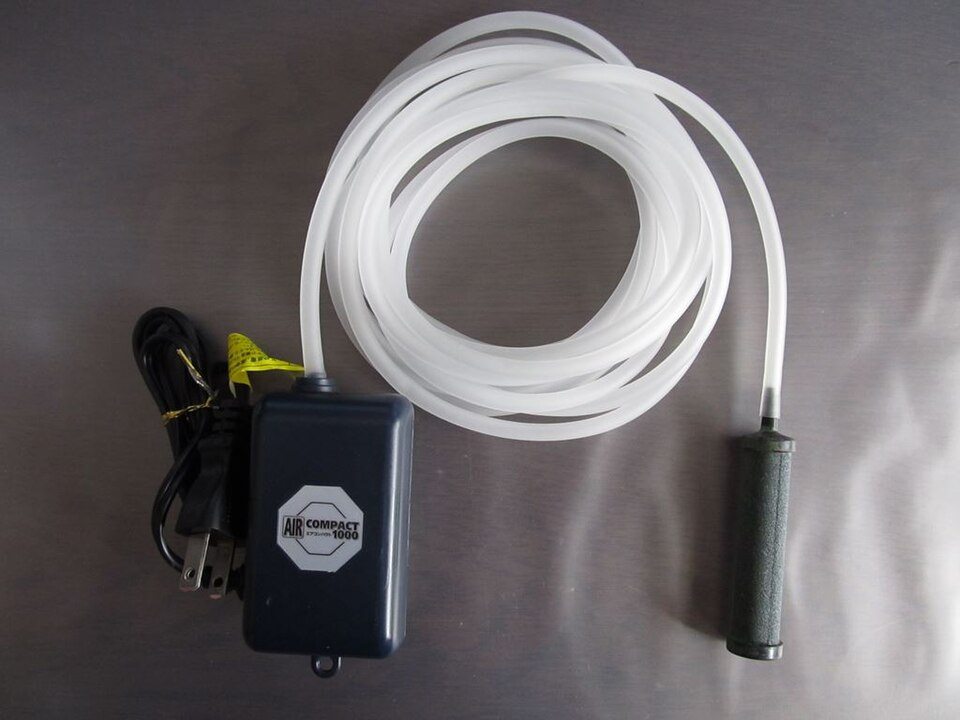
So what is the air stone buying? Very little through the skin of the bubbles. What it buys is the plume. A rising column of bubbles drags water up with it, spreads that water out across the top and sends it back down the glass, so the film at the surface is being swapped out continuously. A film that never sits still never gets a chance to come to equilibrium, so the gradient across it stays steep and the flux stays high. That is a change to KL, and it is worth far more than anything the bubbles carried in person.
What the letters mean
- J
- flux, gas crossing a square meter of surface per second2
- D
- diffusion coefficient of the gas in water2
- KL
- liquid-side transfer velocity, meters per second3
- a
- interfacial area per unit volume, per meter3
- C*
- saturation concentration, set by Henry's law at that temperature and pressure4
- C
- what is dissolved at the moment
- C* − C
- the driving force, and the only term that can change sign
C is below C* gas comes in. When it is above, the same surface, the same coefficient and the same equation push it back out. Nothing in the equation knows which gas it is dealing with, which is why a device that helps your oxygen is doing something to your carbon dioxide at the same time.Bubble size
Half the diameter, twice the surface, and the arithmetic is one line.
Everybody knows small bubbles are better. Almost nobody can say by how much, and the answer is embarrassingly simple, because it is pure geometry with no chemistry in it at all. Take a spherical bubble of diameter d. Its surface is πd² and its volume is πd³/6, so divide one by the other and the whole thing collapses.
KLa, so this is not a metaphor, it is the same term.
And the benefit compounds, because a smaller bubble also rises more slowly, which gives it longer in the water than the big one that shot past it5. More area, more time, same air.
| Class | Diameter | What produces it | Area per unit volume | Behavior in the tank |
|---|---|---|---|---|
| Coarse | 3 to 5 mm1 | Bare airline, or a low-porosity air bar1 | 1,200 to 2,000 /m6 | Rises fast, splashes hard, transfers least per liter of air1 |
| Fine | 1 to 3 mm1 | Ordinary carborundum or sand air stone1 | 2,000 to 6,000 /m6 | The dense even column most people picture1 |
| Micro | under 1 mm1 | Fine ceramic diffuser, or limewood1 | over 6,000 /m6 | Hangs in the water far longer, maximum interfacial contact1 |
One thing to hold on to before you go and buy a limewood stone. A bubble is not a one-way valve. A bubble of air is mostly nitrogen and oxygen with barely a trace of carbon dioxide in it, so a fresh one arriving at the bottom of your tank is a source of oxygen and a sink for carbon dioxide, both at once, and making it smaller improves both transfers equally. In a tank with no injection that is unambiguously good. In an injected tank it is a trade, and the carbon dioxide arithmetic puts a number on which side you are on.
The airlift
A sponge filter is a pump with no moving parts.
A sponge filter looks like it should not work. There is no impeller in it, nothing spins, and yet water moves steadily through the foam for years. What is doing the pumping is the air line: air goes down a rigid lift tube and is released at the bottom through a stone, and the rising bubbles do the rest.1 The engineering name for this is an airlift pump, sometimes a mammoth pump, and it is genuinely old technology.7
The mechanism is hydrostatic, not magic. Fill the inside of the tube with a froth of bubbles and water, and that mixture is less dense than the plain water standing outside it. Two columns of different density, connected at the bottom, cannot balance. The lighter one is pushed up.17
Water leaving the top of the tube leaves a low pressure zone behind it at the base, and the tank equalises that by pulling water inward through the foam from every direction at once.1 That is the whole reason a sponge filter suits shrimp and fry: the flow is slow, it arrives through a very large area of foam, and nothing in the path can shred anything. The foam is doing mechanical straining and housing the bacteria at the same time.
And its aeration is the same trick as the air stone's. The outlet dumps a steady stream of water across the top of the tank, which is surface renewal by another route. A sponge filter is not a gentler way of oxygenating than an air stone; it is an air stone with a chimney on it, and it does the same thing to carbon dioxide.
Airlift setup
Set the outlet at the surface and spend the air on moving water.
An airlift works best when most of its tube is underwater. The deeper the bubble release point sits below the outlet, the longer the light air-and-water column becomes and the more useful lift it can make.7 Put the outlet at the waterline or just under it, aimed across the surface. Raising it into the air makes the pump lift water farther before it can return to the tank, so more of the available pressure becomes splash instead of circulation.
Add air until the outlet carries a steady stream and the surface moves from end to end. If the tube turns into noisy froth while the water flow barely changes, the extra bubbles are slipping through the water rather than carrying more of it.7 At that point, a wider lift tube, a deeper release point, or a second filter will use the air more effectively than simply opening the valve farther.
Carbon dioxide
And here is what each of them does to your carbon dioxide.
This is where the two halves of this page meet, and the answer falls straight out of the two-film equation with no new physics needed. The trick is to notice that in an injected planted tank, the two gases are sitting on opposite sides of saturation.
Oxygen in a working tank is usually a little below its saturation value, so the surface is slowly topping it up. Injected carbon dioxide is held enormously above its saturation value — a typical 30 mg/L target against an air-equilibrium figure near 0.55 mg/L at Yerevan's altitude46, which is the same Henry's law calculation the chemistry page runs. So the surface is not topping carbon dioxide up. It is draining it, constantly, and the regulator is paying for that loss all day.
Carbon dioxide C* = 0.55, C = 30 → (C* − C) = −29.5 mg/L, going out
29.5 ÷ 2.2 ≈ 13 Our own arithmetic6, using the Yerevan oxygen saturation8 and the Yerevan carbon dioxide equilibrium4, with an injected target of 30 mg/L and a tank sitting a little under saturation. The two gases do not diffuse at identical rates so this is not exact to the decimal, but that correction is small and the factor of thirteen is not.
Read it as a price list. Every unit of KLa you buy with an air stone, a spray bar aimed at the surface or a sponge filter outlet is applied to both gases at once, and in mass terms the carbon dioxide leaves about thirteen times faster than the oxygen arrives. That is not an argument against aeration. It is the reason you cannot have a violently rippling surface and a stable 30 mg/L of carbon dioxide at the same time, however good the regulator is.
The oxidator is the one device that changes a different term. It releases oxygen by diffusion, without any vigorous mixing of the surface layer, so the film stays calm and the carbon dioxide is not blown out of it.9 C for oxygen goes up. KLa does not move. The carbon dioxide term never learns that anything happened. That, and not the silence, is the actual reason an oxidator exists in a planted tank.
| Device | Which term it moves | Cost to injected CO2 | Consumable | Noise | Effect on iron |
|---|---|---|---|---|---|
| Air stone on a pump | Raises KLa, mostly through the plume renewing the surface1 | High, and it scales with how hard you run it6 | Electricity, and a stone that clogs | Pump hum plus bubble noise9 | Oxidising, same direction as the oxidator11 |
| Sponge filter airlift | Raises KLa, same mechanism with a chimney on it17 | High, for the same reason | Electricity, plus rinsing the foam | Pump hum | Oxidising11 |
| Filter outflow rippling the surface | Raises KLa, adjustable by aiming the outlet | Moderate, and it is the term you can actually tune | None beyond the filter you already run | Quiet unless it splashes | Oxidising11 |
| Peroxide oxidator | Raises C for oxygen and leaves KLa alone9 | None. The surface film is never disturbed9 | Peroxide, monthly at 30 percent910 | Silent. No moving part exists9 | Oxidising, and this is the one that catches people9 |
Which leaves two arrangements that both work, and they are not the same arrangement. Run the air at night, when the carbon dioxide is off and the plants have stopped producing oxygen and started consuming it: you get the surface renewal exactly when the tank needs it and the injection is not paying for it. Or run an oxidator, keep the surface calm around the clock, and accept that you now have to think about chelates. Both of those are consistent with the equation. Turning an air stone on at midday under full injection is not.
And the surface still has to work regardless. Every device on this page is competing with, or cooperating with, a plain water surface whose performance is set by mean depth and by how much the air above it is moving — which is worked out, with the time constants, on the physics page.
- The Physics of Aquarium Aeration, Filtration and Fluid Dynamics. Aquarium aeration guide covering surface exchange, bubble classes, airlifts, and sponge-filter flow. The physical laws used here are cited to the published literature below.
- Fick, A. (1855). Ueber Diffusion. Annalen der Physik und Chemie 94: 59 to 86. The first law of diffusion,
J = −D dC/dx, which every gas exchange calculation on this page rests on. - Lewis, W.K. and Whitman, W.G. (1924). Principles of gas absorption. Industrial and Engineering Chemistry 16(12): 1215 to 1220. The two-film theory, and the
dC/dt = KLa (C* − C)form used throughout this page and on the physics page. - Sander, R. (2015). Compilation of Henry's law constants (version 4.0) for water as solvent. Atmospheric Chemistry and Physics 15(8): 4399 to 4981. Open access. The saturation concentration
C*for both gases, and the carbon dioxide solubility behind the 0.55 mg/L air-equilibrium figure used here. DOI 10.5194/acp-15-4399-2015 open access - Clift, R., Grace, J.R. and Weber, M.E. (1978). Bubbles, Drops, and Particles. Academic Press. The standard reference for the terminal rise velocity of millimetre-scale bubbles in water, roughly a quarter of a metre per second in the fine to coarse range, and for the fact that smaller bubbles rise more slowly.
- Our own arithmetic. Not a published source. Every calculated figure on this page, with its inputs.
One, bubble contact time. 0.40 m of depth divided by 0.25 m/s from 5 gives 1.6 s.
Two, the interfacial areas.
6/devaluated at 5, 3 and 1 mm, giving 1,200, 2,000 and 6,000 per metre. Three, the peroxide yield. 100 g of a 30 percent solution by mass is 30 g of H2O2, which at 34.015 g/mol is 0.882 mol, which by the balanced equation gives 0.441 mol of O2, which at 31.999 g/mol is 14.11 g. Per gram of solution, 0.141 g of oxygen. The 3 percent figure is the same calculation divided by ten, 1.41 g. Divided across the refill intervals reported in 9 and 10 this gives 0.34 to 0.50 g per day at 30 percent and 0.35 to 0.71 g per day at 3 percent, and in 200 litres that is 1.7 to 2.5 and 1.8 to 3.5 mg per litre per day. Four, the tank total. 7.20 mg/L at 25 degrees for Yerevan at 887 hPa, which is the sea level 8.26 mg/L from 8 corrected for station pressure on the physics page, times 200 litres, is 1.44 g of dissolved oxygen in a saturated tank. 14.11 divided by 1.44 is 9.8, printed as roughly ten. Five, the nitrification oxygen demand. Two moles of O2 at 31.999 g/mol per mole of nitrogen at 14.007 g/mol is 4.57 g of oxygen per gram of ammonia nitrogen, from the reaction in 12. At an illustrative 40 mg of ammonia nitrogen a day that is 0.183 g of oxygen a day. The 40 mg figure is a chosen illustration, not a measurement of any tank. Six, the iron rate factor. The rate law in 11 is second order in hydroxide, so the rate ratio between two pH values is 10 raised to twice their difference. From pH 7.8 to pH 6.6 is 1.2 units, and 102.4 is 251, printed as about 250. Seven, the two driving forces. Oxygen at C* 7.20 and C about 5.0 gives +2.2 mg/L inward; carbon dioxide at C* 0.55 and C 30 gives −29.5 mg/L outward; the ratio is 13.4, printed as about thirteen. The liquid-side transfer velocity is not identical for the two gases, so the ratio is approximate, and the 30 mg/L injected target is the one used across this site rather than a measurement of your tank. Eight, the ferric hydroxide equation is balanced by us rather than quoted: four iron, twelve oxygen, twenty hydrogen and a charge of +8 on each side. calculated, repeatable, unverified by a third party - Nicklin, D.J. (1963). The air-lift pump: theory and optimisation. Transactions of the Institution of Chemical Engineers 41: 29 to 39. The engineering treatment of the airlift pump, which is the mechanism inside every sponge filter.
- Benson, B.B. and Krause, D. (1984). The concentration and isotopic fractionation of oxygen dissolved in freshwater and seawater in equilibrium with the atmosphere. Limnology and Oceanography 29(3): 620 to 632. The primary measurement behind the freshwater oxygen solubility table the standard handbooks reprint, and the 8.26 mg/L sea level figure at 25 degrees that the Yerevan correction starts from. DOI 10.4319/lo.1984.29.3.0620
- Aquarium oxidators in freshwater and planted tanks. Russian-language practical guide covering catalytic oxygen release, refill intervals, temperature, catalyst care, redox, and interactions with iron and phosphate.
- Söchting Oxydator. Manufacturer product documentation and instructions for use. Cited for the construction of the device and the refill interval on the manufacturer's own concentrated solution. This is manufacturer literature, not an independent test, and no independent measurement of the oxygen output of any aquarium oxidator has been traced for this page.
- Stumm, W. and Morgan, J.J. (1996). Aquatic Chemistry: Chemical Equilibria and Rates in Natural Waters, 3rd edition. Wiley. The oxygenation kinetics of ferrous iron,
−d[Fe(II)]/dt = k [Fe(II)][O2][OH−]2, second order in hydroxide and first order in dissolved oxygen. Everything this page says about the direction and the size of the iron effect comes from that rate law.