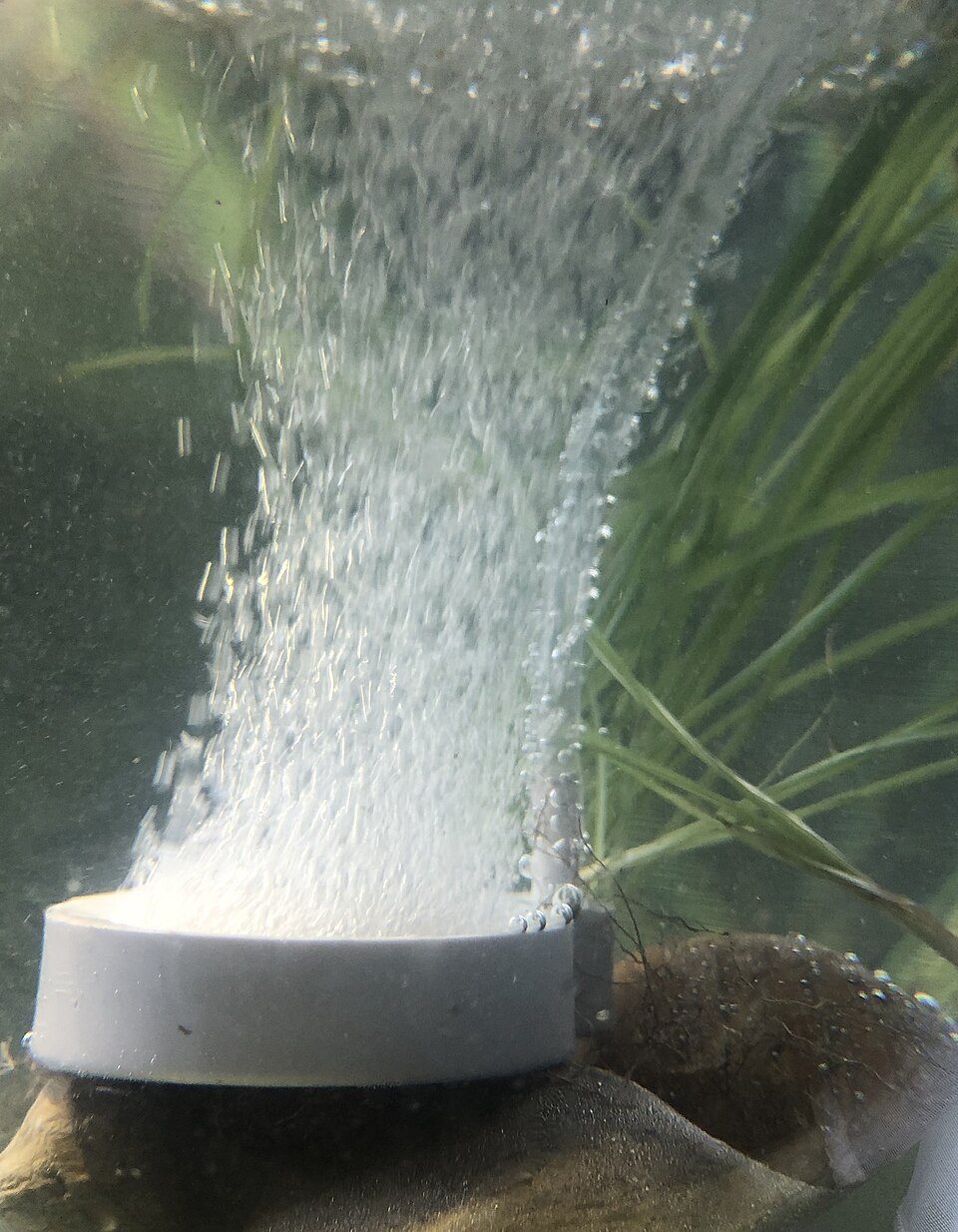
The oxidator
An oxidator makes its own oxygen and never disturbs the surface.
A Söchting-type oxidator is a sealed glass or plastic flask you stand in the tank. You fill it with hydrogen peroxide, drop a ceramic catalyst tablet into the bottom, and close it.12 There is no pump, no airline and no diaphragm anywhere in the system, so it makes no sound at all and will sit in a bedroom1. What happens inside is one reaction.
The catalyst is not a consumable and this is the part people get wrong. A catalyst speeds a reaction up without being consumed by it, so the ceramic tablet does not get used up and does not expire. When an oxidator goes quiet it is almost always because the pores have silted up with organic film or bacterial growth and the peroxide can no longer reach the surface. Wash it and it works again. You replace it when you break it or lose it.1
The oxygen produced inside builds a small excess pressure and leaves through the porous ceramic wall of the flask, partly as dissolved gas and partly as bubbles too small to see.1 Nothing about that touches the top of the tank. There is no plume, no splash, no column of water being dragged to the surface. The film up there goes on doing exactly what it was doing before you put the device in.
There is still a ceiling, and it is the same ceiling as everything else. Dissolved oxygen cannot be pushed far past C* and held there. Saturation is a property of the water temperature and the pressure above it, not of how hard you try3, and anything you add beyond it makes (C* − C) negative, at which point the surface film starts venting oxygen back out at exactly the rate the equation says. An oxidator walks the tank up towards saturation and then holds it there.1 It is not a route around Henry's law, and neither is anything else.
What is consumed, and what is not1
The arithmetic of a filling
What one filling of peroxide is actually worth, in grams.
Nobody sells you an oxidator in units of oxygen, which is a shame, because the conversion is a single line of stoichiometry and it turns a vague device into a number you can compare against anything else in the tank.
= 30 g H2O2
÷ 34.015 g/mol = 0.882 mol H2O2
× ½ (two peroxides give one oxygen) = 0.441 mol O2
× 31.999 g/mol = 14.1 g of O2 Our own arithmetic from the balanced equation and standard molar masses4. Expressed by mass rather than by volume so that no assumption about the density of the solution is hiding in it. Per gram of 30 percent solution: 0.141 g of oxygen
Now put that beside the tank. Fresh water at 25 degrees holds 8.26 mg/L of oxygen at sea level5, and Yerevan sits high enough that the real figure here is 7.20 mg/L. A 200 liter tank, completely saturated, therefore contains about 1.44 g of dissolved oxygen in total.45 So a 100 g filling carries roughly ten times the entire oxygen content of that tank4 — and then meters it out over a month or more rather than all at once.
| Filling | Oxygen in it | Runs for | Oxygen per day | In a 200 L tank |
|---|---|---|---|---|
| 100 g at 30 percent | 14.1 g4 | 4 weeks1 | 0.50 g/day4 | 2.5 mg/L per day4 |
| 100 g at 30 percent | 14.1 g4 | 6 weeks1 | 0.34 g/day4 | 1.7 mg/L per day4 |
| 100 g at 3 percent | 1.41 g4 | 2 to 4 days1 | 0.35 to 0.71 g/day4 | 1.8 to 3.5 mg/L per day4 |
Why 3 percent is not a shortcut
The two refill intervals in the table are the same device doing the same job, ten times over.
Pharmacy peroxide is 3 percent and the branded oxidator solution is around 30 percent1, so the same flask holds a tenth of the oxygen. A tenth of the payload at a similar delivery rate empties roughly ten times sooner, which turns four to six weeks into three or four days.4 Which is very close to the two to four days actually reported1, and the small difference is real chemistry rather than a rounding error: decomposition rate depends on the concentration in the flask and on temperature, not only on how much is in there.
So the choice is not about performance, it is about how often you want to open the tank. Same oxygen per day either way. One of them asks you to do it monthly.
Handle the strong solution as what it is
Thirty percent peroxide is not the bottle from the pharmacy.
Concentrated hydrogen peroxide is a strong oxidiser and causes severe eye and skin injury; it is handled with gloves and eye protection and kept away from combustible material.6 The 3 percent bottle you have in a cupboard is a different proposition from the refill concentrate, and the gap between them is the same factor of ten that makes the concentrate convenient.
Inside a closed flask over a working catalyst, the peroxide is being converted into water and oxygen continuously, so what is in the tank at any moment is the flask rather than the reagent. The care belongs at the point where you pour it.
The filter
For the filter bacteria this is simply good, and the number is 4.57.
The organisms that turn ammonia into nitrate need oxygen to do it, in a quantity you can calculate rather than guess at. Write the overall nitrification reaction out and the oxygen is right there in the stoichiometry.7
2 × 31.999 g O2 ÷ 14.007 g N = 4.57 g of oxygen per gram of ammonia nitrogen The division is ours4; the reaction is the standard overall one7. Note the two protons on the right as well. That is the same reaction eating your carbonate hardness, and the water changes page does the alkalinity side of it.
Put a tank through it. Say your tank turns over 40 mg of ammonia nitrogen a day — your figure depends entirely on stocking and feeding and you should use your own, this one is just a peg to hang the arithmetic on. That is 0.18 g of oxygen consumed by the filter alone, every day, before a single fish or plant has breathed.4 Set that next to the 0.34 to 0.50 g a day a 30 percent filling delivers and the oxidator covers that particular demand about two or three times over.
And the rate genuinely depends on the supply: nitrifying organisms are obligate aerobes, and nitrification slows measurably as dissolved oxygen falls, which is why oxygen limitation shows up as a stalled cycle rather than as a fish problem.8 A filter that is short of oxygen does not announce it. It just gets slower, and the ammonia test creeps. The cycling page has the biology; only the oxygen belongs here.
Micronutrients
The bill arrives in the iron.
Here is the complaint that brings people to this subject in the first place. An oxidator goes into a healthy planted tank, and over the following weeks the reds fade, new leaves come through pale, and growth quietly slows. Nothing was removed and nothing was overdosed.1 What changed is the valency of the metals, and the mechanism is well understood outside this hobby.
Plants take iron up as the ferrous ion, Fe2+, which is soluble and mobile. Ferric iron, Fe3+, is neither. Raise the dissolved oxygen and you raise the oxidising power of the water, and free ferrous iron is oxidised to ferric, which promptly forms hydroxides and phosphates and drops out as an invisible rust that no root can use.1
−d[Fe(II)]/dt = k · [Fe(II)] · [O2] · [OH−]2 The rate law for the oxygenation of ferrous iron9. Read the square on the hydroxide term. It means the reaction runs a hundred times faster for every single unit you go up in pH, and it is first order in oxygen, so raising dissolved oxygen raises it proportionally. The ferric hydroxide equation is balanced as written and is the end state4.
That square is the most useful thing on this page for a planted tank. Going from pH 7.8 to pH 6.6 slows ferrous oxidation by a factor of about 250, from the rate law alone.49 An injected tank sitting at pH 6.6 is a fundamentally friendlier place for iron than the same tank at pH 7.8, and running steady carbon dioxide to hold a slightly acid pH is exactly the countermeasure the oxidator literature recommends.1 Now you can see why it works, and roughly by how much.
Once the iron is ferric it is not coming back on its own. Ferric hydroxide is so sparingly soluble at aquarium pH that the free ferric ion concentration in equilibrium with it is negligible for plant nutrition.10 And it takes company with it: ferric iron binds phosphate into poorly soluble iron phosphate, so a phosphate test can read low while the substrate is quietly accumulating it, and manganese, zinc and copper are pushed towards their less soluble oxidised forms at the same time.1
The cheap default in most bottles. It loses its hold on iron first as pH rises and as the water oxidises, which is precisely the condition an oxidator creates.1 The general rule behind that is that a chelate has to out-compete hydroxide for the metal, and hydroxide gets stronger with every pH unit.10
Holds iron up to about pH 7.5, which covers most injected planted tanks comfortably.1 This is the usual answer if an oxidator and a fertiliser routine have to live in the same tank.
The strongest of the three, holding iron even in hard alkaline water, at the cost of tinting the water faintly pink.1 Worth it when the alternative is dosing iron that precipitates before a leaf sees it.
The pH figures above are the working numbers the oxidator guidance gives1, and the real crossover also depends on how much calcium and phosphate are competing for the same ligand10. Treat them as the order of preference, which is solid, rather than as thresholds to the decimal.
If you own a redox meter
The oxidising power of the water is measurable, in millivolts.
The oxidator guidance puts a balanced planted tank at roughly +200 to +300 mV, calls anything below about +150 to +200 mV a reducing environment with an organic surplus and a risk of the substrate souring, and puts strongly oxidising water, the kind an oxidator plus vigorous aeration produces, above roughly +350 to +450 mV, where iron and the other micronutrients start getting locked up.1 We have not traced those bands to a published measurement, so they are marked as untraced and given as the guidance's own rule of thumb.
The direction, though, is not in doubt, because it is the rate law above. More oxygen means faster ferrous oxidation, and lower pH means much slower.
The dial you have
Output is adjustable, which is the part most owners never use.
The number of catalyst tablets in the flask sets how fast the peroxide is broken down, so running one instead of two turns the device down — worth doing in cool months, or in any tank where the oxygen is comfortable and the iron is not.1
The other half of the same idea is housekeeping. Siphoning and filter cleaning reduce the organic load the oxidising power is being spent on in the first place.1
- Aquarium oxidators in freshwater and planted tanks. Russian-language practical guide covering catalytic oxygen release, refill intervals, temperature, catalyst care, redox, and interactions with iron and phosphate.
- Söchting Oxydator. Manufacturer product documentation and instructions for use. Cited for the construction of the device and the refill interval on the manufacturer's own concentrated solution. This is manufacturer literature, not an independent test, and no independent measurement of the oxygen output of any aquarium oxidator has been traced for this page.
- Sander, R. (2015). Compilation of Henry's law constants (version 4.0) for water as solvent. Atmospheric Chemistry and Physics 15(8): 4399 to 4981. Open access. The saturation concentration
C*for both gases, and the carbon dioxide solubility behind the 0.55 mg/L air-equilibrium figure used here. DOI 10.5194/acp-15-4399-2015 open access - Our own arithmetic. Not a published source. Every calculated figure on this page, with its inputs.
One, bubble contact time. 0.40 m of depth divided by 0.25 m/s from 5 gives 1.6 s.
Two, the interfacial areas.
6/devaluated at 5, 3 and 1 mm, giving 1,200, 2,000 and 6,000 per metre. Three, the peroxide yield. 100 g of a 30 percent solution by mass is 30 g of H2O2, which at 34.015 g/mol is 0.882 mol, which by the balanced equation gives 0.441 mol of O2, which at 31.999 g/mol is 14.11 g. Per gram of solution, 0.141 g of oxygen. The 3 percent figure is the same calculation divided by ten, 1.41 g. Divided across the refill intervals reported in 1 and 2 this gives 0.34 to 0.50 g per day at 30 percent and 0.35 to 0.71 g per day at 3 percent, and in 200 litres that is 1.7 to 2.5 and 1.8 to 3.5 mg per litre per day. Four, the tank total. 7.20 mg/L at 25 degrees for Yerevan at 887 hPa, which is the sea level 8.26 mg/L from 5 corrected for station pressure on the physics page, times 200 litres, is 1.44 g of dissolved oxygen in a saturated tank. 14.11 divided by 1.44 is 9.8, printed as roughly ten. Five, the nitrification oxygen demand. Two moles of O2 at 31.999 g/mol per mole of nitrogen at 14.007 g/mol is 4.57 g of oxygen per gram of ammonia nitrogen, from the reaction in 7. At an illustrative 40 mg of ammonia nitrogen a day that is 0.183 g of oxygen a day. The 40 mg figure is a chosen illustration, not a measurement of any tank. Six, the iron rate factor. The rate law in 9 is second order in hydroxide, so the rate ratio between two pH values is 10 raised to twice their difference. From pH 7.8 to pH 6.6 is 1.2 units, and 102.4 is 251, printed as about 250. Seven, the two driving forces. Oxygen at C* 7.20 and C about 5.0 gives +2.2 mg/L inward; carbon dioxide at C* 0.55 and C 30 gives −29.5 mg/L outward; the ratio is 13.4, printed as about thirteen. The liquid-side transfer velocity is not identical for the two gases, so the ratio is approximate, and the 30 mg/L injected target is the one used across this site rather than a measurement of your tank. Eight, the ferric hydroxide equation is balanced by us rather than quoted: four iron, twelve oxygen, twenty hydrogen and a charge of +8 on each side. calculated, repeatable, unverified by a third party - Benson, B.B. and Krause, D. (1984). The concentration and isotopic fractionation of oxygen dissolved in freshwater and seawater in equilibrium with the atmosphere. Limnology and Oceanography 29(3): 620 to 632. The primary measurement behind the freshwater oxygen solubility table the standard handbooks reprint, and the 8.26 mg/L sea level figure at 25 degrees that the Yerevan correction starts from. DOI 10.4319/lo.1984.29.3.0620
- NIOSH Pocket Guide to Chemical Hazards: hydrogen peroxide. US National Institute for Occupational Safety and Health. Public domain. The hazard classification of concentrated hydrogen peroxide as a strong oxidiser causing severe eye and skin injury, and the handling precautions. cdc.gov/niosh/npg
- Walstad, D. (2017, reissued 2023). Nitrogen Uptake by Aquatic Plants. Open access, with its own reference list to the primary literature. The overall nitrification reaction used here, including the two protons that make it an alkalinity consumer. PDF
- US Environmental Protection Agency (1993). Manual: Nitrogen Control. EPA/625/R-93/010. Public domain. That nitrifying organisms are obligate aerobes and that the nitrification rate falls as dissolved oxygen falls, which is the engineering basis for aeration design in every treatment plant.
- Stumm, W. and Morgan, J.J. (1996). Aquatic Chemistry: Chemical Equilibria and Rates in Natural Waters, 3rd edition. Wiley. The oxygenation kinetics of ferrous iron,
−d[Fe(II)]/dt = k [Fe(II)][O2][OH−]2, second order in hydroxide and first order in dissolved oxygen. Everything this page says about the direction and the size of the iron effect comes from that rate law. - Lindsay, W.L. (1979). Chemical Equilibria in Soils. Wiley. The solubility of ferric hydroxide across the pH range, and the competition between a synthetic chelate and hydroxide, calcium and phosphate for the metal, which is why chelate choice is a function of pH.
Continue
Where to go next.
Oxygen and aeration
How air stones, bubbles, surface movement and sponge-filter airlifts exchange oxygen and carbon dioxide.
Phosphate, iron, copper and tannins
Iron, phosphate and trace elements in the chemistry reference.
Electrics and power cuts
The electrical alternative, including pumps, safe sockets and power cuts.