Claim two, sized honestly
Uptake is not export. The pruning is the water change, and nothing happens until you cut.
Three separate steps, which the hobby collapses into one. Uptake, the plant takes nitrogen out of the water into its tissue. Growth, it can only do that at the rate it is building tissue. Export, the nitrogen leaves the tank only when the tissue is cut off and thrown away.
A pothos whose old leaves yellow and drop into the water has removed nothing. It has taken nitrogen around a loop of a few weeks and handed it back to the bacteria. That is the single most important sentence on this page for anybody who actually runs the build.
Sheeran and Rasmussen fed aerial and soil-formed roots of Anthurium andraeanum, Epipremnum aureum and Philodendron scandens nitrate, ammonium and glycine with one source labeled with nitrogen-15. Aerial roots were consistently better at nitrogen uptake than soil roots, in all three species1. The roots a pothos grows into water and air are its better nitrogen organs, not a compromise.
Arima and colleagues built a 15 C recirculating aquaculture system for medaka, developed a nitrifying community that cleared 1 mM ammonia in a day, and found nitrate then accumulated, "which was mitigated by the introduction of Epipremnum aureum"2. Measured, in fish water, at a temperature an unheated Armenian tank sits at. No removal rate is given.
In Endler guppy tanks run for four weeks, nitrate in the unplanted controls reached 33.75 and 35.00 mg/L in two runs, against 8.75 and 11.50 mg/L with Najas guadalupensis. Java moss did much less, and Najas grew 1.6-fold in biomass against Java moss at 1.2-fold3. That is a good submerged plant doing well, and it is the fair comparison.
Nobody has published a nitrogen or phosphorus removal rate for Epipremnum aureum in an aquarium or an aquaponic system. Pothos is one of the best studied plants in the world for cleaning air and one of the least studied for cleaning water, so anybody quoting you a figure with a citation attached is citing a study that was never run. It is also a cheap experiment, and the first person to run it owns the number.
The honest way to give a number is therefore to derive it from growth, show the working, and label it a calculation. Nitrogen in uses the standard aquaculture relation, total ammonia nitrogen produced per day equals feed mass times protein fraction times 0.092.
| Fish load, fed 1 percent of body mass a day at 32 percent protein | Ammonia nitrogen produced4 | As test-kit nitrate in 37.5 L4 | Fresh pothos you must cut and bin, per month4 |
|---|---|---|---|
| 15 g of fish, which is 8 to 10 Endlers or white clouds | 4.4 mg N/day | 0.52 mg/L per day | 53 g at 2.5 percent tissue nitrogen |
| 30 g of fish | 8.8 mg N/day | 1.04 mg/L per day | 106 g |
| 60 g of fish | 17.7 mg N/day | 2.09 mg/L per day | 212 g |
| 250 g of fish, a normally stocked community tank | 73.6 mg N/day | 8.69 mg/L per day | 888 g a month, which is 11 kg a year |
The two inputs that carry that table are estimates and must be labeled. Tissue nitrogen for pothos is taken at 2 to 3 percent of dry mass by analogy with foliage-plant tissue analysis; no published foliar analysis for Epipremnum aureum was found. The fresh-to-dry ratio for aroid foliage is taken at 10 to 1. A real figure for either would move every number here proportionally.
| Growth rate | Fresh equivalent4 | Nitrogen removed at 2.5 percent4 | Test-kit nitrate cleared per week, in 37.5 L4 |
|---|---|---|---|
| 0.1 g dry per day | 1 g fresh a day, 0.4 kg a year | 2.5 mg N/day | 2.1 mg/L |
| 0.2 g dry per day | 2 g fresh a day, 0.7 kg a year | 5.0 mg N/day | 4.1 mg/L |
| 0.5 g dry per day | 5 g fresh a day, 1.8 kg a year | 12.5 mg N/day | 10.3 mg/L |
| 1.0 g dry per day | 10 g fresh a day, 3.6 kg a year | 25 mg N/day | 20.7 mg/L |
A vigorous pothos at a bright window, running several vines and putting out a leaf every week or so on each, sits somewhere around 0.2 to 0.5 g of dry matter a day. So the answer, and it is a good one and a limited one:
A single well-grown pothos on a bright windowsill removes roughly 5 to 12 mg of nitrogen a day. That is the entire nitrogen output of 15 to 40 grams of fish, fed normally. It is not the output of a stocked community tank.4
Which reads as a limit and is really a design instruction: pothos is a complete nitrogen solution for a lightly stocked small tank and a partial one for anything larger. This build is the first case, by construction. The consequence for the fish load is direct and is the reason the stocking section below says 15 grams and means it. Because the plant is climbing a bright wall, which is the condition measured to give the highest growth rate5, the upper end of that range is the right one to read for this specific setup.
The mechanism that may matter more
The root mass is probably working as a biofilter before it works as a nutrient sink.
A pothos root mass hanging in a tank is a large, permanently wetted, oxygenated surface, and nitrifiers colonise every wetted surface rather than only filter media. At a conservative areal nitrification rate of 0.05 to 0.15 g of ammonia nitrogen per square meter per day, one square meter of root surface adds 50 to 150 mg of ammonia-processing capacity a day4. The load from 15 grams of fish is 4.4 mg a day. Even a young root mass is an order of magnitude past it.
That is almost certainly what people are observing when a tank "gets better" within a fortnight of adding a pothos, because plant uptake at the rates above cannot move a nitrate reading that fast. It has not been separated experimentally and should be read as an open question, not a finding. It is cheap to test: two identical tanks, one with a live pothos and one with an inert plastic root analogue of the same surface area.
The wetland literature, and its warning
In a pond, most of the benefit is not the plant at all.
Borne, Tanner and Fassman-Beck compared two stormwater ponds, one retrofitted with a floating treatment wetland. Nitrogen removal improved, but through lower dissolved oxygen and more organic matter raising denitrification, and "direct uptake by the plants appears to be of less importance"6.
Abi Hanna and colleagues ran four 6.5 cubic meter lagoons at 24, 48 and 72 percent floating wetland coverage for 16 months. The best case improved total nitrogen removal by up to 55 percent, mean 13 percent, and again the gain came mainly from denitrification promoted by falling dissolved oxygen as coverage rose7.
Neither result transfers cleanly to an aquarium, which has no thick anoxic sediment, so uptake and nitrification carry more of the load here. But the second half does transfer, and it is a cost of this design: covering water lowers the oxygen underneath it.
Stated fairly against submerged plants, because the honest comparison is not flattering
Per gram of plant, the emersed leaf wins, and the carbon section explains why. Per tank, the comparison is different, because a heavily planted tank contains far more plant than one pothos does. At macrophyte mat productivity of 3 to 12 grams of dry matter per square meter per day and 3 to 5 percent tissue nitrogen, a full floating mat over this tank's 0.25 square meters would remove 23 to 150 mg of nitrogen a day, which is two to twelve times the pothos figure4.
So the fair statement is not that pothos beats submerged plants. It is that leaves in air beat leaves under water, and that a floating aquatic mat beats a single houseplant, because it has more leaf area in the same tank. Pothos wins in Armenia because you can get one. That is a supply argument, not a biology argument, and it should be said as one.
The design conflict, which is real
The pothos is competing with your aquascape, and it wins.
Stripping nitrogen and phosphorus toward zero is the feature. It is also the problem, if you wanted the submerged plants to grow. Fast stem plants are the highest-demand plants in a tank and are the first to show it: lower leaves yellow and drop.
Nitrate at zero is not a goal. Our water research recommends a maximum of 2 mg of nitrate nitrogen per liter for the most sensitive species and reports adverse effects on sensitive species above 104. Those are ceilings, not targets. A planted tank wants a test-kit nitrate somewhere around 5 to 20 mg/L, not zero. Zero nitrate with high light and phosphate present is the classic cyanobacteria setup, which is hobby consensus rather than a measured result.
So choose one. Either the pothos is the filter and the submerged planting is slow, undemanding and low-light, or the aquascape is the point and the pothos stays small and hard pruned. A demanding stem scape and a big pothos in the same 40 liters is a fight the pothos wins4.
And one thing fish water cannot supply
Aquarium water is not a complete fertiliser.
It is nitrogen and phosphorus rich and iron and micronutrient poor. A pothos living on a tank alone will eventually show interveinal chlorosis on new leaves. That is not a reason not to do it; it is a reason to expect it and to have an iron and trace supplement to hand once every year or two.
Two further claims are repeated everywhere and have nothing behind them. Pothos roots release oxygen into the water: unsupported for this species, and a plant whose leaves are in air has no reason to pump oxygen down. Pothos roots kill algae by allelopathy: no evidence found, and the observed algae suppression already has two sufficient explanations in nutrient competition and shade, of which the shade term is much the larger.
The question everybody asks
Every houseplant guide says overwatering kills plants. Then a pothos sits underwater for five years and thrives.
Both are true and the reconciliation decides which species work. It is not the water that kills an overwatered plant. The pores fill, the dissolved oxygen in them runs out within hours, the root switches to fermentation, its energy budget collapses, it stops actively transporting water, the plant wilts, and only then do the pathogens finish it. The governing constant is that oxygen moves through water roughly ten thousand times slower than through air4, which is the same constant that limits carbon at a submerged leaf.
A saturated pot is a sealed, static, organically rich medium where oxygen cannot be resupplied. An aquarium is an open body of water in contact with the atmosphere, with a measurable reaeration rate and oxygen being produced in it all day. The correct contrast is not wet against dry. It is resupplied against not resupplied.
Scott and Villouta, reviewing why nutrient film hydroponics was abandoned for strawberries, found two constraints, oxygen depletion and susceptibility to Pythium root rot, "coupled through root-zone oxygen status": hypoxia impairs root membrane integrity, alters exudates, and facilitates zoospore encystment and necrotrophic attack8. Rot is a thing that hypoxia invites, not a thing that happens instead of it.
Ries, Park and Meng raised dissolved oxygen in hydroponic lettuce from 2.9 to between 3.5 and 4.0 mg/L and got a 98 to 139 percent increase in shoot fresh mass9. Small absolute changes near the bottom of the range have very large effects.
Roots formed under low oxygen build more air space: in wheat under drought and flooding the aerenchyma-to-cortex ratio rose 2.1-fold under both11. In adventitious roots, upland grasses run 1 to 8 percent gas volume in aerated conditions and wetland grasses 8 to 45 percent, rising to 15 to 55 percent under oxygen deficiency10. A wetland root can be more than half air by volume.
Zhu and colleagues tracked the bacterial community on pothos across an 86-day transition from soil to hydroponic culture, with 98 community profiles, and found continuous shifts throughout12. A useful counter to the assumption that a transplant either takes in a week or fails. No root porosity or aerenchyma figure has been published for Epipremnum aureum or Monstera deliciosa, so applying the grass anatomy above to an aroid is a plausible extrapolation and nothing more.
The correction that changes the shopping list
"Any epiphyte will do" is backwards, and it was tested in a single genus.
Gao, Zhang and Zhang compared leaf and root anatomy of 9 terrestrial and 15 epiphytic species of Cymbidium in a common garden. Terrestrial species had larger stomata and enhanced root cortical development; epiphytes had thicker velamen and larger xylem vessels. Their conclusion: epiphytic species showed greater potential for drought tolerance, terrestrial species more resistance to waterlogging stress13.
Within one genus, under identical conditions, epiphytism selected for surviving drying out and terrestrial habit selected for surviving being underwater. The reason is obvious once stated: what makes life hard for a plant on a branch is that the branch dries out in an afternoon.
The right predictor is ecology, not epiphytism. Look for hemiepiphytes, riparian plants and swamp-margin plants. Epipremnum, Monstera, Philodendron, Syngonium and Rhaphidophora germinate on or reach the ground and climb, keeping roots running down the trunk into a wet forest floor. Their aerial roots are climbing and absorbing organs attached to a ground root system. A true epiphytic orchid has no ground connection at all and its root is engineered for a wet-then-dry cycle. Those are different machines.
The trap inside the good news
The root mat degrades its own oxygen supply, and it does it slowly enough to look like success.
The same review states it in one line: "progressive root mat development degrades passive film aeration"8. The mass grows, obstructs flow, thickens boundary layers and raises oxygen demand, all at once. The wetland trials reach it from the other side, with dissolved oxygen falling as floating coverage rose from 24 to 72 percent7.
The plant creates the conditions that kill it, on a timescale of months to years. For this build that means a pothos root mass which has filled a small shallow tank is not a stable end state. It is the point at which the design stops working, and it arrives without warning because everything up to it looked like it was going well. The annual hard cut-back in the maintenance table is the answer, and it is not optional.
| Plant | In a tank? | Confidence | Why |
|---|---|---|---|
| Pothos, Epipremnum aureum | Yes. The reference case | Measured | The only houseplant with a published result in a fish system2, and its aerial roots beat its soil roots at nitrogen uptake by isotope labeling1. Hemiepiphyte, native to the Society Islands, roots in water in about two weeks15 |
| Pothos cultivars: Golden, Neon, Marble Queen, N'Joy, Manjula | Yes, with one caveat | Strong | Same species, same roots. The heavily variegated ones grow slower, because less chlorophyll means less carbon means less nitrogen removed; this is leaf-level physiology rather than a measurement in this species. Golden and Neon are the working cultivars |
| Philodendron, P. hederaceum and the climbing species | Yes. The easiest after pothos | Strong | Same ecology, same aerial roots, and included in the isotope study1. Smaller leaved and less vigorous than pothos, so less nitrogen removal and less shade |
| Monstera, M. deliciosa | Yes, and think about the size | Strong | Hemiepiphyte with the same root type. The problem is scale: a happy monstera puts a root the thickness of a finger through the whole tank and needs a 2 m support |
| Syngonium, S. podophyllum | Yes | Strong | Hemiepiphytic aroid. Softer stems and more prone to rotting at the waterline, so keep the growing point well clear of the surface |
| Spider plant, Chlorophytum comosum | Yes | Measured, indirectly | Not an aroid and not a hemiepiphyte, but genuinely tolerant. Used as the planted species in bioretention systems with oyster shell media that removed over 90 percent of ammonium, nitrate and total nitrogen at low loading16. The plantlets root in water readily, which is the free supply route |
| Inch plant, Tradescantia zebrina | Yes, and it is the fastest | Strong | Roots from any node in days and grows faster than anything else here, so exports more nitrogen per week for its size. Brittle, and every fragment that sinks and rots is nitrogen coming back. This is the species where the export discipline matters most |
| Peace lily, Spathiphyllum wallisii | Yes, and people get it wrong | Strong | It is a crown-forming rosette, not a vine, and its growing point sits at the base. Submerge the crown and it rots. Roots in the water, crown held above it in a basket. "Peace lily rots in water" means "I drowned the crown" |
| Lucky bamboo, Dracaena sanderiana | Yes, and read the next paragraph | Measured, and the news is bad | Not a bamboo and not in Poaceae; it is an Asparagaceae Dracaena14. An Egyptian survey of nurseries, warehouses and shops found up to 47.67 percent disease infection, with Rhizoctonia solani at 80.89 percent of 246 fungal isolates, plus Fusarium oxysporum, F. solani, Aspergillus niger and Alternaria17 |
| Orchids | No with roots submerged. Yes mounted above the water | Measured | The velamen is a sheath of dead empty cells that fills by capillarity and then must drain. It is a wet-then-dry organ, not a gill. Saturating the velamen of a Vanda hybrid initially raised hydration, but prolonged waterlogging to 120 hours caused oxidative stress in the submerged roots18. Five days, in the genus most often photographed in a glass of water |
| African violet, Streptocarpus ionanthus | No, not as usually meant | No evidence either way | Leaf cuttings root in water reliably, which is where the folklore comes from. The whole plant is a flat rosette with the crown at soil level, so the crown sits at the waterline by construction, and extension guidance calls it very susceptible to crown and root rots with overwatering the most common problem19. The crown geometry is the objection, not the fuzzy leaves |
| Sansevieria, Hoya, Zamioculcas, succulents, Ficus | No | Strong | Arid origin, thick cuticles, no flooding adaptation. Do not assume that because your pothos is thriving in water, your Sansevieria will |
Two naming corrections worth making while we are here. Lucky bamboo is Dracaena sanderiana in Asparagaceae, and bamboos are Poaceae; the two are not close relatives and the resemblance is a segmented green stem and nothing else14. It matters practically, because people give it bamboo conditions, meaning full sun and constant flooding, when it is a West African forest understorey plant that wants shade. And African violet is Streptocarpus ionanthus; Saintpaulia ionantha is now a synonym14. A hub that is settling Armenian aquascaping vocabulary should not repeat an English marketing error while doing it.
Is it safe with fish and shrimp
Pothos is toxic to cats and dogs. The word that matters is the first word in the toxic principle.
The ASPCA lists pothos as toxic to dogs, cats and horses, with the toxic principle given as "insoluble calcium oxalates", and clinical signs of oral irritation, swelling of mouth and tongue, drooling and difficulty swallowing20. North Carolina State Extension records calcium oxalate crystals in all parts of Epipremnum aureum, medium poison severity15.
Insoluble. The crystals are needle-shaped raphides held inside specialised cells called idioblasts. They do not dissolve into water. There is no leachate.
And the toxicity is mechanical rather than chemical. Konno, Inoue and Nakamura demonstrated the needle effect: raphides act synergistically with a cysteine protease because the needles punch holes in membranes, cuticles and epithelium and let the protease through. Amorphous calcium oxalate produced no synergism, which confirms the needle shape is doing the work21. The injury requires tissue to be crushed or chewed so that idioblasts rupture.
And the roots are the wrong organ for it. A systematic review screened 1,305 species and confirmed raphides in 797 across 46 families and 24 orders, finding leaves the most prominent raphide-containing location and roots the least reported22.
The aquatic verdict on pothos oxalate
- Leaching
- None. The principle is insoluble and an intact root releases nothing20
- Grazing
- A fish or shrimp taking biofilm off the outside of a root does not breach the tissue and is not exposed
- Biting
- A fish that bites through a root could rupture idioblasts and would get oral irritation, not systemic poisoning21
- Reports
- No published case of fish or invertebrate poisoning by Epipremnum in an aquarium was found. Absence of reports is weak evidence and is presented as weak evidence.
- Risk
- The animals that would test it are the rasping ones. With a large loricariid, an adult goldfish or some cichlids the root mass gets eaten, and it is the plant that is at risk
The hazard that will actually kill something
It is not the oxalate. It is the systemic insecticide on a shop-bought houseplant.
Neonicotinoids are applied to ornamentals as soil drenches and granules, they are highly water soluble, and they move into every tissue. Krischik and colleagues showed that soil-applied imidacloprid translocates into ornamental flowers at levels that killed adult lady beetles and butterfly larvae feeding on them23.
The aquatic thresholds are brutally low. Morrissey and colleagues reviewed 29 studies from 9 countries and toxicity data for 49 aquatic species and recommended staying below 0.2 micrograms per liter for short-term acute exposure and 0.035 micrograms per liter chronic to protect aquatic invertebrate communities24.
0.035 micrograms per liter is 35 nanograms. In 37.5 liters that is 1.3 micrograms of imidacloprid in total4, and a pot of treated potting soil carries milligrams. There is no margin. The first casualty is shrimp and snails rather than fish, because the compound is an insect neurotoxin and crustaceans share the target. A cherry shrimp colony that dies within days of a new plant going in is the classic presentation. Reassurance based on Daphnia is worthless here: Daphnia magna is anomalously tolerant, with a median lethal concentration above 100,000 micrograms per liter24, and sensitivity has not been measured in Neocaridina davidi at all. The direction is not in doubt; the magnitude is.
The procedure, and it costs nothing but patience
Six weeks in a jar before anything goes in the tank.
1. Take a cutting from a plant that has lived in a home for a year or more. A cutting from somebody's existing plant is free and has no nursery chemistry on it. Pothos is in almost every flat and office in the country. This is the best option and also the cheapest.
2. Cut the vine into pieces of two or three nodes and throw the root ball away. Do not try to wash a nursery root ball clean. You cannot remove a systemic compound from inside the tissue, and the tissue you are keeping is the stem.
3. Strip the lowest leaf so a bare node is exposed.
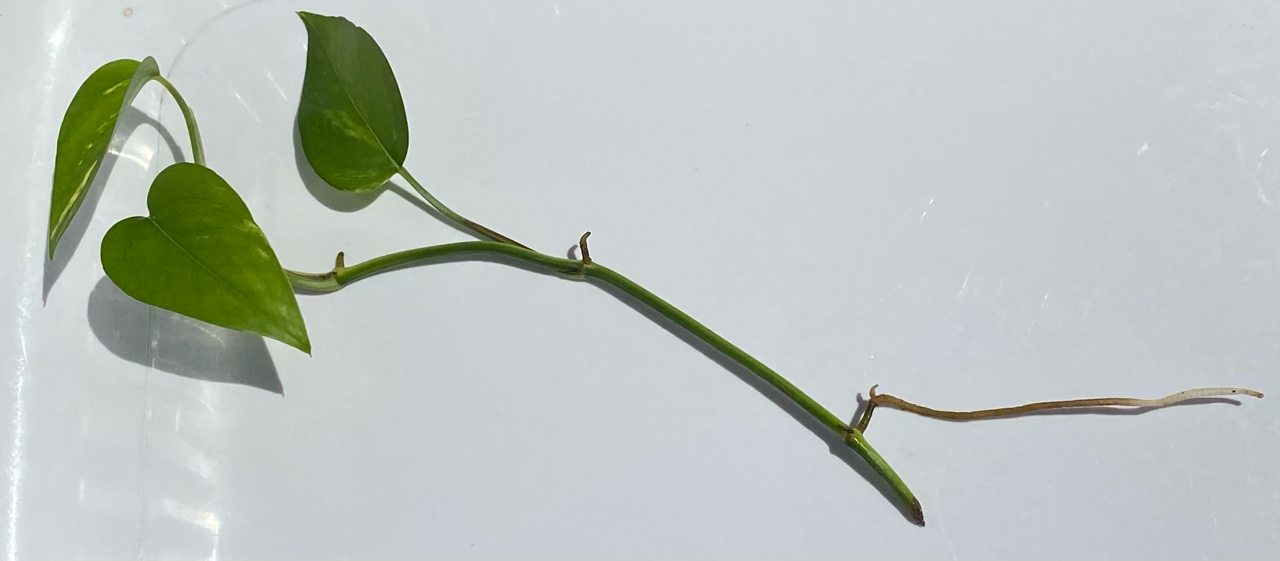
4. Root the cuttings in a jar of plain water on the same windowsill for four to six weeks, changing the water weekly. Roots appear in about two weeks15.
5. Only then put them in the tank. The jar stage does three jobs at once: it grows water roots rather than soil roots, it flushes any systemic residue through several complete changes, and it quarantines a Rhizoctonia or Fusarium problem out of the aquascape17.
Two smaller hazards, both real. Slow-release fertiliser prills in nursery potting mix are designed to release nitrogen and phosphorus over months and will do it in your tank, so every particle must go. And some ornamental fungicides are copper based, which is acutely toxic to shrimp and snails; no copper test kit was found in the Armenian specialist catalog during this research, which makes prevention the only control available.
- Sheeran, L. and Rasmussen, A. (2023). Aerial roots elevate indoor plant health: physiological and morphological responses of three high-humidity adapted Araceae species to indoor humidity levels. Plant, Cell & Environment 46(6): 1873 to 1884. Nitrogen-15 labelling in Anthurium andraeanum, Epipremnum aureum and Philodendron scandens. DOI 10.1111/pce.14568 open access, but abstract only was retrievable; both the publisher PDF and the repository copy refused automated access, so no numeric rate from it is quoted
- Arima, J., Matsumoto, T., Nagamura, H., Tsukamoto, R., Haga, H. and Shimizu, K. (2025). Development of a nitrifying bacterial community for a low temperature recirculating aquaculture system. World Journal of Microbiology & Biotechnology 41(4): 123. Nitrate accumulation mitigated by the introduction of Epipremnum aureum, at 15 C, in fish water. DOI 10.1007/s11274-025-04341-7 paywalled; abstract read. The result is qualitative and no removal rate is given
- Csontos, D., Bartal, Z.P. and Bakacsy, L. (2024). Removal of nitrate and phosphate by aquatic plants during aquarium-based ornamental fish production. North American Journal of Aquaculture 86(4): 413 to 423. The Endler guppy tanks, the control nitrate at 33.75 and 35.00 mg/L, and the Najas guadalupensis and Java moss comparison. DOI 10.1002/naaq.10349 open access
- Our own arithmetic and our own estimates. Not a published source. Reaeration: the two-film expression divided by volume to give the depth form, the time constants, and the 40 cm and 70 cm working rules. Carbon: the air and water molar concentrations by the ideal gas law and Henry's law with a van 't Hoff temperature correction, at sea level and at 887 hPa; the 12.5 percent altitude reduction; the thirty-five-fold gradient on injection. Oxygen: the pressure correction applied to source 4 with vapour pressures from source 5; the stored and overnight-delivered oxygen for 37.5 litres; the demand-to-supply ratio at a temperature quotient of 2. Light: the 0.75 double-glazing transmission, the capture fractions of 0.53 in January and 0.49 in June, and the conversion of the hobby's light bands to a daily integral over eight hours. Nitrogen: the load table from the 0.092 feed-to-ammonia factor, the tissue export table, the growth-to-removal table, the root surface area against an areal nitrification rate of 0.05 to 0.15 g per square metre per day, and the floating mat comparison. Heat and water: the whole indoor energy balance for eight scenarios, the evaporation and transpiration figures, the top-up share, the tank volumes of tap water a year, and the mineral addition. Also ours: the 50 kg loaded weight, the 1.3 microgram whole-tank imidacloprid figure, and the Yerevan tap water spread of 2.9 to 10.9 dGH and 170 to 470 mg/L, which comes from our own materials research. calculated, repeatable, unverified by a third party
- Brito, C., Mantuano, D., De Toni, K.L.G. and Mantovani, A. (2025). Increasing leaf sizes of the vine Epipremnum aureum (Araceae): photosynthesis and respiration. PeerJ 13: e19214. The canopy light saturation near 1,000 micromoles per square metre per second, and the finding that vertical plants in high light produced leaves 9 to 13 times larger with the highest relative growth rate. DOI 10.7717/peerj.19214 open access
- Borne, K.E., Tanner, C.C. and Fassman-Beck, E.A. (2013). Stormwater nitrogen removal performance of a floating treatment wetland. Water Science and Technology 68(7): 1657 to 1664. Source of "direct uptake by the plants appears to be of less importance". DOI 10.2166/wst.2013.410 paywalled; abstract read
- Abi Hanna, R., Borne, K.E., Andres, Y. and Gerente, C. (2024). Effect of floating treatment wetland coverage ratio and operating parameters on nitrogen removal: toward design optimization. Water Science & Technology 89(6): 1466 to 1481. Four lagoons of 6.5 cubic metres at 24, 48 and 72 percent coverage over 16 months, and the fall in dissolved oxygen with coverage. DOI 10.2166/wst.2024.064 paywalled; abstract read
- Scott, S. and Villouta, C. (2026). Dissolved oxygen limitation and Pythium root rot in strawberry nutrient film systems: mechanisms, research gaps, and prospects for substrate-free production. Frontiers in Plant Science 17. The coupling of hypoxia and root rot through root-zone oxygen status, and the finding that progressive root mat development degrades passive film aeration. DOI 10.3389/fpls.2026.1829367 open access
- Ries, J., Park, Y. and Meng, Q. (2026). Active aeration enhances tissue hydration and fresh mass in hydroponic lettuce and modulates calcium-mobilizing biostimulant efficacy. Scientific Reports 16. Dissolved oxygen from 2.9 to between 3.5 and 4.0 mg/L, shoot fresh mass up 98 to 139 percent. DOI 10.1038/s41598-026-46661-0 open access
- Yamauchi, T. and Nakazono, M. (2021). Climate-smart crops: key root anatomical traits that confer flooding tolerance. Breeding Science 71(1): 40. The upland against wetland root porosity ranges. DOI 10.1270/jsbbs.20119 open access
- Guhr, T., Song, Z., Andersen, A.G., Jimenez, J. de la C. and Pedersen, O. (2025). Root morphology and anatomy respond similarly to drought and flooding in two wheat cultivars. Annals of Botany 136: 1239 to 1250. The 2.1-fold increase in the aerenchyma-to-cortex ratio under both stresses. DOI 10.1093/aob/mcaf152 paywalled; abstract read
- Zhu, B., Wang, J., Zhang, X., Zhang, B., Li, Z. and Hao, L. (2026). A bacteria community sequencing data set from pothos (Epipremnum aureum). Scientific Data 13. An 86-day soil-to-hydroponic transition across 98 community profiles. DOI 10.1038/s41597-026-06677-7 open access
- Gao, T.-Y., Zhang, W. and Zhang, S.-B. (2025). Differentiation in water adaptation strategy between epiphytic and terrestrial species of Cymbidium, Orchidaceae. AoB PLANTS 17. Nine terrestrial and fifteen epiphytic species in a common garden. The source that overturns the epiphyte hypothesis. DOI 10.1093/aobpla/plaf030 open access
- GBIF Secretariat. GBIF Backbone Taxonomy, queried through the species match interface. Every accepted name here, including Epipremnum aureum (Linden & Andre) G.S.Bunting, Dracaena sanderiana Mast. in Asparagaceae, and Saintpaulia ionantha H.Wendl. as a synonym of Streptocarpus ionanthus (H.Wendl.) Christenh. gbif.org open data
- North Carolina State Extension Plant Toolbox. Epipremnum aureum. Society Islands native range, vines root easily in water in about two weeks, calcium oxalate in all parts, medium poison severity. plants.ces.ncsu.edu free
- Luo, Y., Fu, T., Dong, Y., Sun, X., Han, Y., Liu, C. and Xie, W. (2026). A study on the hydraulic and pollutant removal performance of bioretention systems using plants and oyster shells. Journal of Environmental Management 402: 129130. Chlorophytum comosum as the planted species, over 90 percent removal of ammonium, nitrate and total nitrogen at low influent loading. DOI 10.1016/j.jenvman.2026.129130 paywalled; abstract read
- Abdel-Rahman, T.F.M., Abdel-Megeed, A. and Salem, M.Z.M. (2023). Characterization and control of Rhizoctonia solani affecting lucky bamboo (Dracaena sanderiana) using some bioagents. Scientific Reports 13. Survey of nurseries, warehouses and shops in three Egyptian governorates: highest disease infection 47.67 percent, R. solani 80.89 percent of 246 isolates, plus Fusarium, Aspergillus and Alternaria. DOI 10.1038/s41598-023-33628-8 open access
- Santos, G. de S., Lima, J.F. de and Moreira, A.S.F.P. (2025). Effects of the velamen water saturation on the photosynthetic performance of Vanda hybrid (Orchidaceae), a species with conspicuous pneumathodes. Flora 332: 152846. Oxidative stress in submerged roots after 120 hours of waterlogging. DOI 10.1016/j.flora.2025.152846 paywalled; abstract read
- Clemson Cooperative Extension Home and Garden Information Center. African Violet. Very susceptible to crown and root rots; overwatering the most common problem; cold water on the leaves causes white blotches and ring patterns. hgic.clemson.edu free
- ASPCA Animal Poison Control Center. Toxic and Non-Toxic Plants: Pothos. Toxic to dogs, cats and horses; toxic principle insoluble calcium oxalates; clinical signs listed. aspca.org free
- Konno, K., Inoue, T.A. and Nakamura, M. (2014). Synergistic defensive function of raphides and protease through the needle effect. PLOS ONE 9(3): e91341. The demonstration that the needle shape rather than the chemistry does the damage. DOI 10.1371/journal.pone.0091341 open access
- Lawrie, N.S., Medrano Cuetos, N., Sini, F., Salam, G.A., Ding, H., Vancolen, A., Nelson, J.M., Erkens, R.H.J. and Perversi, G. (2023). Systematic review on raphide morphotype calcium oxalate crystals in angiosperms. AoB PLANTS 15. 1,305 species screened, raphides confirmed in 797 across 46 families and 24 orders; leaves the most prominent location, roots the least reported. DOI 10.1093/aobpla/plad031 open access
- Krischik, V., Rogers, M., Gupta, G. and Varshney, A. (2015). Soil-applied imidacloprid translocates to ornamental flowers and reduces survival of adult lady beetles and larval butterflies. PLOS ONE 10(3): e0119133. DOI 10.1371/journal.pone.0119133 open access
- Morrissey, C.A., Mineau, P., Devries, J.H., Sanchez-Bayo, F., Liess, M., Cavallaro, M.C. and Liber, K. (2015). Neonicotinoid contamination of global surface waters and associated risk to aquatic invertebrates: a review. Environment International 74: 291 to 303. 29 studies from 9 countries, toxicity data for 49 species, the 0.2 and 0.035 micrograms per litre protective thresholds, and the Daphnia magna tolerance caveat. DOI 10.1016/j.envint.2014.10.024 paywalled; abstract and thresholds widely reproduced
Continue
Where to go next.
The windowsill tank
The tank the plant sits on: long, shallow, on the sill, and why that shape works.
Building it, and what it costs
What it costs and how to put it together.
Find a plant
Everything else that will grow in it, filterable on the light you actually measured.
Nitrification, decomposition and roots
Root uptake, and why it substitutes for leaf uptake rather than adding to it.