Claim four, second half, and it is the one that fails
Indoors behind glass you keep the sun and lose the cooling.
A wide open tub outdoors in a Yerevan July peaks at about 31.8 C, because Armenia is dry and evaporative cooling is powerful and there is a cold sky to radiate to. Put the same water on a south windowsill inside the flat and it peaks at 36.3 C. The tank indoors is four to six degrees hotter than the same water in full sun outdoors, in the same city.
The model, written out so it can be disagreed with. Steady state on the water surface: absorbed shortwave equals net longwave to the room plus sensible convection plus evaporation. Net longwave is linearised at emissivity 0.97, giving 5.7 to 6.2 watts per square meter per kelvin at room temperatures. Sensible convection is taken at 4 watts per square meter per kelvin for free convection over a horizontal water surface in still indoor air. Evaporation uses a coefficient of 20 watts per square meter per kilopascal for still indoor air, and 40 with a fan. The diurnal swing is 35 percent of the day's absorbed shortwave divided by the column heat capacity. Absorbed shortwave comes from the capture arithmetic in the light section, at 3.8 megajoules per square meter per day in January and 10.4 in June after a 10 percent surface reflection allowance1.
The structural point, and it is counter-intuitive. Indoors, the two large loss terms that cool an outdoor pond are gone. There is no net longwave loss to a cold sky, because the room is at the water's own temperature. And there is no wind, so the evaporation coefficient collapses. That is the whole mechanism, and the conclusion is robust to any plausible value of the two estimated coefficients even though the specific temperatures are not.
| Scenario | Room air | Water, daily mean1 | Diurnal swing1 | Water, daily peak1 | Evaporation1 |
|---|---|---|---|---|---|
| January, heated flat, 16 percent humidity | 22.0 C | 22.0 C | 2.1 K | 23.0 C | 1.6 mm/day |
| January, heated flat, 30 percent humidity | 22.0 C | 22.5 C | 2.1 K | 23.6 C | 1.4 mm/day |
| July, unventilated flat | 28.0 C | 33.4 C | 5.8 K | 36.3 C | 2.3 mm/day |
| July, air-conditioned room | 25.0 C | 31.1 C | 5.8 K | 34.0 C | 2.2 mm/day |
| July heat spell, unventilated | 31.0 C | 35.2 C | 5.8 K | 38.1 C | 2.8 mm/day |
| July, 50 percent shaded by blind or leaf cover | 28.0 C | 29.2 C | 2.9 K | 30.7 C | 1.7 mm/day |
| July, 80 percent shaded | 28.0 C | 26.7 C | 1.2 K | 27.3 C | 1.3 mm/day |
| July, unshaded, fan across the surface | 28.0 C | 29.9 C | 5.8 K | 32.8 C | 3.6 mm/day |
Read the January row first, because it is genuinely excellent. The water sits at exactly room temperature. The solar gain and the evaporative loss into extremely dry Armenian winter indoor air cancel to within a tenth of a degree. 22 C is the middle of the range a low-tech tank wants, and it is achieved for free, in the darkest month of the year, in a country where the outdoor January mean is minus 2.4 C2. This is a very good, zero-equipment aquarium and Armenia is one of the better places on earth to build it.
Then read the July row. The same tank runs at 33 to 35 C mean and peaks at 36 to 38 C. And the oxygen goes the other way at the same moment. At Yerevan's station pressure, saturated water at 36 C holds about 5.93 mg/L while fish oxygen demand at a temperature quotient of 2 is roughly six times what it was at 15 C321. The measured temperature quotient across 26 to 31 C for neon tetra is 1.92, which means a rise of 10 C nearly doubles the oxygen a fish needs4.
And the temperatures in that table are past what the measured animals survive. The chronic lethal maximum, the temperature at which the animal cannot live rather than the acute one it can briefly withstand, is 33.5 C for neon tetra, 35.9 C for black neon and 34.9 C for the peppered cory4. Those are the three aquarium species with published chronic figures. A chronic lethal temperature is not a target or a ceiling; long before it, growth, immune function and breeding stop.
The verdict, and it is the headline of this page. A shallow tank on a south windowsill is the best low-effort aquarium in Armenia from October to April and the most dangerous one from June to September. It is not a design with a summer problem. It is a design that has a summer, and has to be managed for it, deliberately, every year.
Shade the glass from June to September. A cheap external roller blind, a reed screen, or the pothos canopy itself trained across the window. 50 percent shade takes the peak from 36.3 to 30.7 C; 80 percent takes it to 27.3 C1. This is the whole answer and it costs a few thousand dram.
Or move the tank off the sill for the summer. One meter back into the room removes the direct beam entirely, and the difference between 36.3 C on the sill and the room's own 28 C is that beam and nothing else1.
Run the room's air conditioner, if there is one. Worth 2.3 K of peak1. It costs money and dries the room. Third option, not the first.
A small fan across the water surface. Worth 3.5 K of peak, because it raises the evaporation coefficient. It costs 1.3 mm/day of extra evaporation, which is 55 percent more top-up water and therefore 55 percent faster hardness creep1. A genuine trade, not a free win.
Raise the water level. Going from 15 to 25 cm cuts the swing from 5.8 to 3.5 K, about 1.2 K off the peak1. It costs oxygen resupply rate. Cheap, and small. Fifth for a reason.
Do not buy an air pump for this. It fixes nothing thermal, and the reaeration arithmetic says the tank does not need one. Buying a pump in response to a hot tank is the commonest wrong move in this build.
The structural answer is a stocking decision rather than a mitigation. Stock the tank for the summer it will actually have. Either accept 30 to 32 C as the summer condition and stock for it, or run it as a shrimp and plant tank with no fish at all, which removes the oxygen constraint almost entirely and is a completely respectable outcome for a windowsill tank. And note the regional split, because advice that is right for Yerevan is wrong here: Dilijan has 13 days a year at or above 30 C against Yerevan's 822, so the Dilijan and Vanadzor version of this build is quietly better than the Yerevan one and nobody would guess it.
How much to trust this. The indoor energy balance is calculated, not measured, and two estimated coefficients carry it. Use an aquarium thermometer to check your own south-facing window on a warm afternoon. Your measured temperature is more useful than an estimate. If you do it, the result belongs in this hub.
What it takes from the tank
Four more costs, and the two people expect are not the two that matter.
The expected complaints are that the roots take up the space and that the leaves steal the light. Neither is the problem. A root mass of 1,500 grams fresh displaces 1.5 liters, which is 4 percent of this tank1. A root mesh that looks like it has taken over a small tank has taken almost none of the water. And on a Yerevan windowsill the shading is not a loss at all; it is the algae control, as the light section showed. Away from a window, under a lamp, that sign flips and the shading is a straight loss.
The four that do matter are below, in the order they are likely to bite.
| Root mass, fresh | Night oxygen demand from the roots alone1 | As a drawdown1 | Against the tank's whole stored supply31 |
|---|---|---|---|
| 50 g | 18 to 60 mg | 0.5 to 1.6 mg/L | Stored oxygen at saturation is 298 mg at 20 C, 270 mg at 25 C and 247 mg at 30 C |
| 100 g | 36 to 120 mg | 1.0 to 3.2 mg/L | The surface delivers only 38 to 190 mg over a night, depending on k and the deficit |
| 200 g | 72 to 240 mg | 1.9 to 6.4 mg/L | Now comparable to everything the tank holds |
| 400 g | 144 to 480 mg | 3.8 to 12.8 mg/L | At the top of the range it exceeds the entire stored supply |
A pothos root mass of a few hundred grams fresh is competing with the fish for the overnight oxygen budget of a small tank. At night the plant and the animals are not partners. They are competitors for the same gas, and this rather than displacement is why the root mass has to be cut back on a schedule. The root respiration rate behind that table, 0.3 to 1.0 mg of oxygen per gram of dry root per hour, is a literature range for herbaceous fine roots applied to a plant it was not measured in; thick old water roots are probably at or below the low end, which would make the competition milder than shown.
| Where the water goes | Rate1 | As liters per day over 0.25 m21 |
|---|---|---|
| The tank's own surface, Yerevan January, heated flat at 22 C and about 16 percent humidity | 1.4 to 1.6 mm/day | 0.35 to 0.40 L |
| The tank's own surface, Yerevan July, unventilated flat at 28 C | 2.3 mm/day | 0.57 L |
| The tank's own surface, July with a fan across it | 3.6 mm/day | 0.90 L |
| The plant, on top of all of that, at an established 0.3 m2 of leaf area | 0.15 to 0.45 L/day | Additional |
Transpiration is taken at 0.5 to 1.5 liters per square meter of leaf area per day, a normal indoor foliage plant range. Against a tank evaporation of about 0.35 to 0.57 liters a day, an established pothos roughly doubles the water leaving the tank. It is a pump moving aquarium water into the room, and it runs all year.
What that does to the water is the part nobody writing in a humid climate has to think about. Every liter of tap water added to replace evaporation brings its minerals in, and none leave.
| Quantity | This 15 cm sill tank1 | For comparison, an outdoor Yerevan tub at 30 cm1 |
|---|---|---|
| Water loss | 1.4 to 2.8 mm/day, with no rain to offset it | 900 to 1,400 mm a year net |
| Top-up as a share of volume | 6.5 to 13 percent per week | Much less |
| Tank volumes of tap water per year | 3.4 to 6.8 | 3.0 to 4.7 |
| Mineral added per year, at 8 dGH Yerevan tap | 500 to 950 mg/L as calcium carbonate | 429 to 667 mg/L |
A shallow indoor tank in Armenia is a worse evaporative concentrator than an outdoor tub, because it is shallower and because there is no rain. Calcium and carbonate hardness will plateau once the water passes calcite saturation, visible as white scale on the glass and on the pothos roots at the waterline. Sodium, chloride and sulfate do not plateau. They just keep rising.
Two practical consequences. Buy a TDS meter rather than a GH kit for this job, record the reading on the day the tank is filled and once a season thereafter, and do a 40 percent water change when it has roughly doubled. And test the tap water before you start, because the Yerevan spread is more than threefold by district, from 2.9 to 10.9 dGH and 170 to 470 mg/L of dissolved solids1. Do not take a number off the internet. Above all, note that the top-up is not a water change. It is the exact opposite of one, and that is the strongest argument for the single water change a no-water-change system should still get. See what is actually in the tap water.
Cost four, and it is worth saying once. Removing the plant is destructive. A pothos root mass that has grown for two years is threaded through the hardscape, into the substrate and under the wood, and pulling it out means pulling the aquascape apart. Plan for it at build time by keeping the roots to one side or growing them through a mesh pot, or accept that they will fuse with the layout. And a large root mass torn out carelessly is an ammonia event waiting to happen, because every broken root left in the substrate mineralises.

No photograph yet. The one aesthetic gift of a shallow tank is that it makes small stones read as large landscape: in 15 centimeters of water a rock that would look modest in a normal tank is a mountain. Keep the hardscape low and let the depth do the work.
Building it, and the two steps everyone skips.
The only genuinely hard part
Nobody in Armenia sells a long shallow tank.
The shallowest long tank in the Armenian specialist catalog is 900 by 450 by 450 mm, which is 45 cm front to back and will not sit on a windowsill. Three routes. A custom glass build at 1000 by 250 by 200 mm from one of the tank builders on the classifieds is the right answer and is a trivial job for one of them. Two standard 500 by 300 by 350 tanks side by side works and has a seam down the middle. One standard 500 by 300 tank filled to 15 cm is the cheap start, at half the volume; everything on this page scales, so halve the fish and halve the pothos.
Check the sill before you order anything. 37.5 liters of water plus glass plus substrate is about 50 kg, spread over 100 by 25 cm1. A Soviet-era stone or concrete sill will not notice. A modern PVC window sill will not carry it. Measure the sill depth too: many are 15 to 20 cm rather than 25.
The step with the longest lead time
Start the pothos cuttings six weeks before the tank.
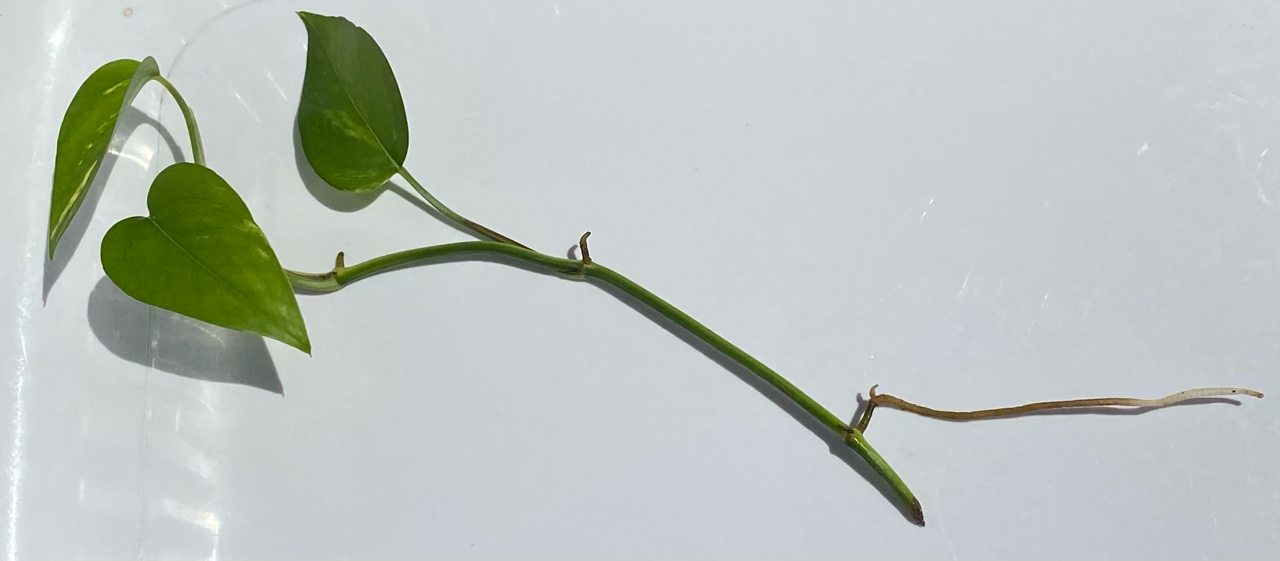
The jar stage in the safety section is not a nicety. It is what makes the roots water roots from the start, it is the only way to flush a systemic insecticide, and it is the quarantine. Six weeks in plain water on the same windowsill, changed weekly. Roots appear in about two weeks5 and the rest of the time is doing the other two jobs.
Then train the vines vertically, from the day they go in. A moss pole, a line of small adhesive hooks up the wall beside the window, or fishing line run from the sill to a hook near the ceiling. Vertical in high light is the condition that produced leaves 9 to 13 times larger and the highest growth rate6, and growth is nitrogen removal. A pothos left to trail downward makes small leaves and removes less. And train roughly half the canopy over the water, because that is the algae control.
The rest of it, briefly, because the parts that are not specific to a windowsill live elsewhere
Depth: 15 cm, and not more1. The entire no-aeration argument is depth. Substrate: 2 to 3 cm only, and no aqua soil, because a shallow sunlit tank with a nutrient-rich substrate and no injected carbon is the worst algae combination on this page. Washed river gravel is free and is fine, vinegar-tested, because carbonate pebbles occur in Armenian river gravel. Hardscape: local basalt or scoria, kept low.
Submerged plants: the list that does not compete. Anubias, Java fern, Cryptocoryne, mosses. No carpets, no demanding stems, no red plants. Pick them with the plant finder, which filters on light and carbon together. The one thing that would genuinely improve this build is a handful of floating plants, giving a second emersed nitrogen sink with far more leaf area than the pothos, and they are the one thing the Armenian trade does not stock. Ask an established keeper; a handful is free.
Stock: fewer animals than you want, and the recommended version has no fish at all. Fifteen cherry shrimp and whatever snails arrive on the plants removes the summer oxygen constraint almost entirely and is a completely respectable outcome. If there are fish, 15 grams is the load the nitrogen budget above was built on. That is 8 to 10 small livebearers or white clouds, and it is a ceiling rather than a starting point. Pick them against the summer temperature, not the winter one, with the fish finder, and read the livestock page on why an unheated tank in a heated flat is a subtropical tank rather than a cold one.
Mark the water line on the glass with a permanent marker on day zero. Everything in the evaporation section needs it, and in the first week you should top up to the line twice and note how much water it took. That measurement is your own flat's evaporation rate, and it beats every calculation on this page.
| How often | Task | Why, and what fails if you skip it |
|---|---|---|
| Twice weekly | Top up to the marked line. Three minutes | 6.5 to 13 percent of the volume a week1. Much more frequent than a normal tank, because this one is shallow. Skip it and the tank drops and concentrates |
| Daily | Look at it. Feed lightly, or not at all if there are no fish | A tank that is not watched is a tank whose problems are found late |
| Monthly | Cut and bin 50 to 200 g of fresh pothos, whole vine sections back to a node, not just the yellow leaves. Ten minutes | This is the water change. Uptake without export removes nothing. The number for your stocking is in the nitrogen table1 |
| Monthly | Wipe the front glass. Fish out dropped leaves before they rot | Green film on a windowsill tank is normal. A rotting leaf is nitrogen coming back in |
| Set a reminder for 1 June | Put the blind up, or move the tank off the sill. Twenty minutes, once | The one task with a deadline and a consequence. Unshaded, the water peaks at 36.3 C and in a heat spell 38.1 C1, past the measured chronic lethal maximum of every aquarium species with a published figure4 |
| 1 October | Take the blind down | The winter light is the reason for the whole build. Do not leave it shaded |
| Once a season | Read the TDS meter and write the number down. Five minutes | Rising dissolved solids with flat hardness is evaporative concentration. When it has roughly doubled from the fill number, do a 40 percent water change1 |
| Annually | Cut the pothos root mass back hard, to about a quarter of the tank. Thirty minutes | A few hundred grams fresh starts competing with the animals for the overnight oxygen1, and the mat degrades its own aeration as it grows7 |
| Every 1 to 2 years | Iron and trace supplement for the pothos, or a single yellowing-leaf diagnosis | Fish water is nitrogen and phosphorus rich and micronutrient poor. Expect it rather than being surprised by it |
| Never | Do not vacuum the substrate. Do not add an air pump to fix a temperature problem | Neither helps, and the second is the commonest wrong response to the summer |
What "no equipment" really costs, in one line each. No filter, so the pothos root mass and the glass and substrate are the biofilm, and that is nothing at all if the root mass is cut to nothing. No air pump, so 15 centimeters of depth is doing it, and that fails if the water gets deep or hot. No heater, so a heated Armenian flat and a south window are doing it, and that fails in an unheated Gyumri flat in January. No lamp, so the window is doing it, and it over-delivers, with the plant as the dimmer switch. No water changes, so the pruning is doing it, and that fails if you do not prune. And one job you did not have before: the top-up, which is the anti-water-change.
- Our own arithmetic and our own estimates. Not a published source. Reaeration: the two-film expression divided by volume to give the depth form, the time constants, and the 40 cm and 70 cm working rules. Carbon: the air and water molar concentrations by the ideal gas law and Henry's law with a van 't Hoff temperature correction, at sea level and at 887 hPa; the 12.5 percent altitude reduction; the thirty-five-fold gradient on injection. Oxygen: the pressure correction applied to source 4 with vapour pressures from source 5; the stored and overnight-delivered oxygen for 37.5 litres; the demand-to-supply ratio at a temperature quotient of 2. Light: the 0.75 double-glazing transmission, the capture fractions of 0.53 in January and 0.49 in June, and the conversion of the hobby's light bands to a daily integral over eight hours. Nitrogen: the load table from the 0.092 feed-to-ammonia factor, the tissue export table, the growth-to-removal table, the root surface area against an areal nitrification rate of 0.05 to 0.15 g per square metre per day, and the floating mat comparison. Heat and water: the whole indoor energy balance for eight scenarios, the evaporation and transpiration figures, the top-up share, the tank volumes of tap water a year, and the mineral addition. Also ours: the 50 kg loaded weight, the 1.3 microgram whole-tank imidacloprid figure, and the Yerevan tap water spread of 2.9 to 10.9 dGH and 170 to 470 mg/L, which comes from our own materials research. calculated, repeatable, unverified by a third party
- Armenian hydrometeorological service, WMO Climate Normals 1991 to 2020, as submitted to WMO and archived by NOAA NCEI, with station pressures, solar altitudes and derived quantities computed in our own sibling climate research. Source of every Armenian temperature, humidity, sunshine, station pressure and sun angle figure here, including Yerevan Arabkir at 1113 m and 887 hPa, Gyumri at 1513 m and 846 hPa, the 82 and 13 days a year at or above 30 C, and the January mean of minus 2.4 C. primary normals public; the derived quantities are ours
- Benson, B.B. and Krause, D. (1984). The concentration and isotopic fractionation of oxygen dissolved in freshwater and seawater in equilibrium with the atmosphere. Limnology and Oceanography 29(3): 620 to 632. The saturation equation used here is the form published in APHA Standard Methods for the Examination of Water and Wastewater. DOI 10.4319/lo.1984.29.3.0620 paywalled; the equation is reproduced in many open sources
- Cooper, C.J., Mueller, C.A. and Eme, J. (2019). Temperature tolerance and oxygen consumption of two South American tetras, Paracheirodon innesi and Hyphessobrycon herbertaxelrodi. Journal of Thermal Biology 86: 102434. The temperature quotient of 1.92 and the chronic lethal maxima of 33.5 and 35.9 C. The peppered cory figure of 34.9 C is from Conte, de Campos and Eme (2023), Journal of Thermal Biology 116: 103616. DOI 10.1016/j.jtherbio.2019.102434 paywalled; abstracts free on Europe PMC
- North Carolina State Extension Plant Toolbox. Epipremnum aureum. Society Islands native range, vines root easily in water in about two weeks, calcium oxalate in all parts, medium poison severity. plants.ces.ncsu.edu free
- Brito, C., Mantuano, D., De Toni, K.L.G. and Mantovani, A. (2025). Increasing leaf sizes of the vine Epipremnum aureum (Araceae): photosynthesis and respiration. PeerJ 13: e19214. The canopy light saturation near 1,000 micromoles per square metre per second, and the finding that vertical plants in high light produced leaves 9 to 13 times larger with the highest relative growth rate. DOI 10.7717/peerj.19214 open access
- Scott, S. and Villouta, C. (2026). Dissolved oxygen limitation and Pythium root rot in strawberry nutrient film systems: mechanisms, research gaps, and prospects for substrate-free production. Frontiers in Plant Science 17. The coupling of hypoxia and root rot through root-zone oxygen status, and the finding that progressive root mat development degrades passive film aeration. DOI 10.3389/fpls.2026.1829367 open access
Continue
Where to go next.
The windowsill tank
The design argument the build follows from, and the window as a winter instrument.
The pothos and the species list
The plant that does the work, and the pruning that is the water change.
Heat, cooling and the winter heater
The general version of the summer problem, with five ways to cool a tank.
The shops directory
Where the few things this needs could be bought.