The idea this page exists for
The animals do not arrive. They are already in the mud, waiting.
The obvious mental model is wrong. It says that a jar of pond water contains tiny animals, they swim about, and if you are patient you see them. That is not what happens, and it is why a jar filled from a clear stretch of water usually does very little.
Most of what appears hatches out of the sediment. Rotifers, ostracods, copepods and water fleas such as Daphnia and Moina do not spend the dry season or the winter as adults. They make a resistant egg or cyst that sinks, is buried, and sits in the mud until conditions are right. In Daphnia that package has a name a child can learn: the ephippium, a dark saddle-shaped case the animal moults off with one or two eggs sealed inside it. Ecologists call the accumulated layer of these things an egg bank, and they treat it as a seed bank for animals: a reservoir of past generations held in the sediment, which restocks the water when the habitat refills12.
This is not a metaphor. It has been done as an experiment, in containers, and it works. A 2023 study of roadside drainage ditches in Illinois did almost exactly what this page asks you to do. The team took cores of moist ditch soil with a 5 cm bulb planter, held them cold and dark at 4 degrees for four weeks, then warmed them to 20 degrees under a 14 hour day and poured 400 mL of filtered lake water over each one3. Animals hatched. The commonest were ostracods, Heterocypris incongruens, and bdelloid rotifers of the genus Rotaria, with some Brachionus rotifers and a springtail3. Counted per gram of dry sediment and per week, the emergence ran from zero up to about 1.7 individuals, and it was still going four weeks in3. The animals hatched from the sediment were healthy enough to found laboratory cultures3.
Read the numbers again, because they set your expectations. Roughly one animal per gram of dry mud per week3 means that a small handful of sediment, a hundred grams or so wet, is not a guarantee of anything in the first week and is a near certainty by the fourth. Patience is not a virtue here, it is the method.
How long can an egg wait? Longer than the person watching the jar has been alive. Researchers routinely hatch dormant eggs and cysts recovered from dated sediment layers, and the practical limit at which large numbers can still be revived is somewhere around 70 to 100 years, with hatching success falling as the layer gets older4. The foundational measurement of how old a viable egg in a lake sediment bank can be was published in 19955, and it started a whole field, resurrection ecology, that hatches animals from old mud in order to study how populations changed.
So the single most important instruction on this page is about dirt. Take sediment. Take the top two or three centimeters, where the recent eggs are, from more than one spot. A jar of water with no mud in it is a jar of water. A jar with mud in it is an egg bank you have just rained on.
The Illinois ditch experiment, as a recipe3
- 5 cm
- core diameter, a tulip bulb planter, moist soil not open water
- 4 weeks
- at 4 degrees, dark, uncovered. A winter the eggs need before they will read spring
- 20 C
- then warmth, and a 14 hour light to 10 hour dark day
- 400 mL
- of filtered lake water poured over the sediment
- 35 µm
- sieve, once a week, then the water goes back and the mud is stirred
- 4
- weeks of weekly counts, and it had not finished
Plural ephippia. The dark, saddle-shaped, thick-walled case a Daphnia moults off with one or two eggs sealed inside. It floats or sinks, survives drying and freezing, and is the single most common way a water flea gets from one pond to another, usually on a bird.
The equivalent for a protozoan, and for many rotifers and copepods: the animal encases itself, or its egg, in a resistant wall and shuts down. Dust-sized, and effectively everywhere.
The layer of dormant eggs and cysts accumulated in sediment, treated by ecologists as a reservoir that buffers a population against bad years and restocks the water when the habitat refills12. Your jar is a small, deliberate withdrawal from one.
The programmed dormancy itself, as distinct from simply being inactive. It usually has to be broken by a specific cue, most often cold followed by warmth and light, which is why the four cold weeks in the study above are not optional padding.
Succession
What appears, in what order, and why that order and not another.
A jar does not fill up with everything at once. It runs a sequence, and the sequence is repeatable enough that it was measured and published in 1912 and has not needed correcting. Lorande Loss Woodruff set up twenty four flasks, each 5 grams of hay in one liter of tap water in a 1,500 cc flask, plugged with cotton and left in a well lit room at room temperature6, and counted the organisms in them daily for three months. Your jar is that experiment with pond mud instead of hay.
Two of his findings are worth having before you start.
First, on where the organisms come from. He tested it deliberately, by sterilising the hay, or the water, or neither, in different flasks. His conclusion: air, water and hay are all sources of the protozoa in an infusion and they increase in importance in that order, and of the three, air is practically a negligible factor in seeding infusions6. The solid material carries the life. Nothing interesting blows in through the cloth. This is the same finding as the egg bank, arrived at from the other direction and eighty years earlier.
Second, on order. In flasks seeded with representatives of the main protozoan groups, there was a definite sequence of appearance of the dominant types at the surface: Monad, then Colpoda, then Hypotrichida, then Paramecium, then Vorticella, then Amoeba6. In plain terms: small swimming flagellates, then a small ciliate, then flat crawling ciliates, then the big cigar-shaped ciliate everybody has seen in a textbook, then the stalked filter feeder that sticks to surfaces, then the amoeba. And the sequence of maximum numbers and of disappearance was identical to the sequence of appearance6. Each group booms and busts in turn.
| Stage | When6 | What you see with the naked eye | What is happening |
|---|---|---|---|
| Bacteria | Turbid within 48 hours | The water goes cloudy and slightly milky, and small bubbles collect in the litter at the bottom and rise | Countless bacteria, evenly distributed at first, feeding on what has dissolved out of the litter. The bubbles are mostly carbon dioxide6 |
| Surface film | From day 3, thickest near day 30 | A grey or fawn skin on the water, which may later sink as a sheet and re-form | Woodruff's zoogloea: a bacterial mat that builds, falls to the bottom and forms again, moving the center of population as it goes6 |
| Browning | Day 3 to 4 onward | Water darkens from straw to tea to dark brown | The color tracks acidity: pale yellow shades go with relatively high acidity, dark brown shades with relatively low6. It is also tannin, which is the leaf litter section below |
| Flagellates, the monads | Appear about day 2; maxima between day 4 and day 27 depending on the flask | Nothing, without a lens. A faint haze at best | Thousands per cubic centimeter, then a crash, and sometimes a second smaller peak weeks later6. They eat the bacteria |
| Small ciliates, Colpoda | Peaks around day 12 to 15 | Nothing, without a lens | Bigger bacteria eaters that outcompete the flagellates once the bacteria are dense |
| Crawling ciliates, hypotrichs | From about day 6, peaking day 10 to 16 | With a hand lens against a dark background, moving specks on the glass | They graze the film rather than the open water. This is when the walls of the jar start to be worth looking at |
| Paramecium and Vorticella | Later, often day 30 to 50 | Paramecium is a just-visible white speck. Vorticella is a tiny stalked bell that snaps shut | Larger predators of the smaller cells, and the first sessile filter feeders |
| Amoebae | Last of the six | Nothing, without a microscope | Chiefly bottom dwellers, and the one form whose position in the sequence moved forward over the course of the experiment6 |
| Rotifers | First weeks | With a lens, translucent specks that stretch and contract, some fixed to the glass by a foot | Bdelloid rotifers of the genus Rotaria and Brachionus hatched from ditch sediment in the Illinois study, and were among the two commonest things to emerge3 |
| Ostracods, seed shrimp | Week 1 to week 4 and beyond | Visible. Grains of rice or sesame seeds that scuttle over the mud and stop dead | The commonest animal to hatch out of ditch sediment in the Illinois study, at up to about 1.2 individuals per gram of dry sediment in a week3. If you get one animal, expect this one |
| Copepods | Usually after the rotifers | Visible. A jerky, darting dot with two long antennae, sometimes with two egg sacs behind it | Hatched from cysts and eggs in the sediment, then breeding in the jar |
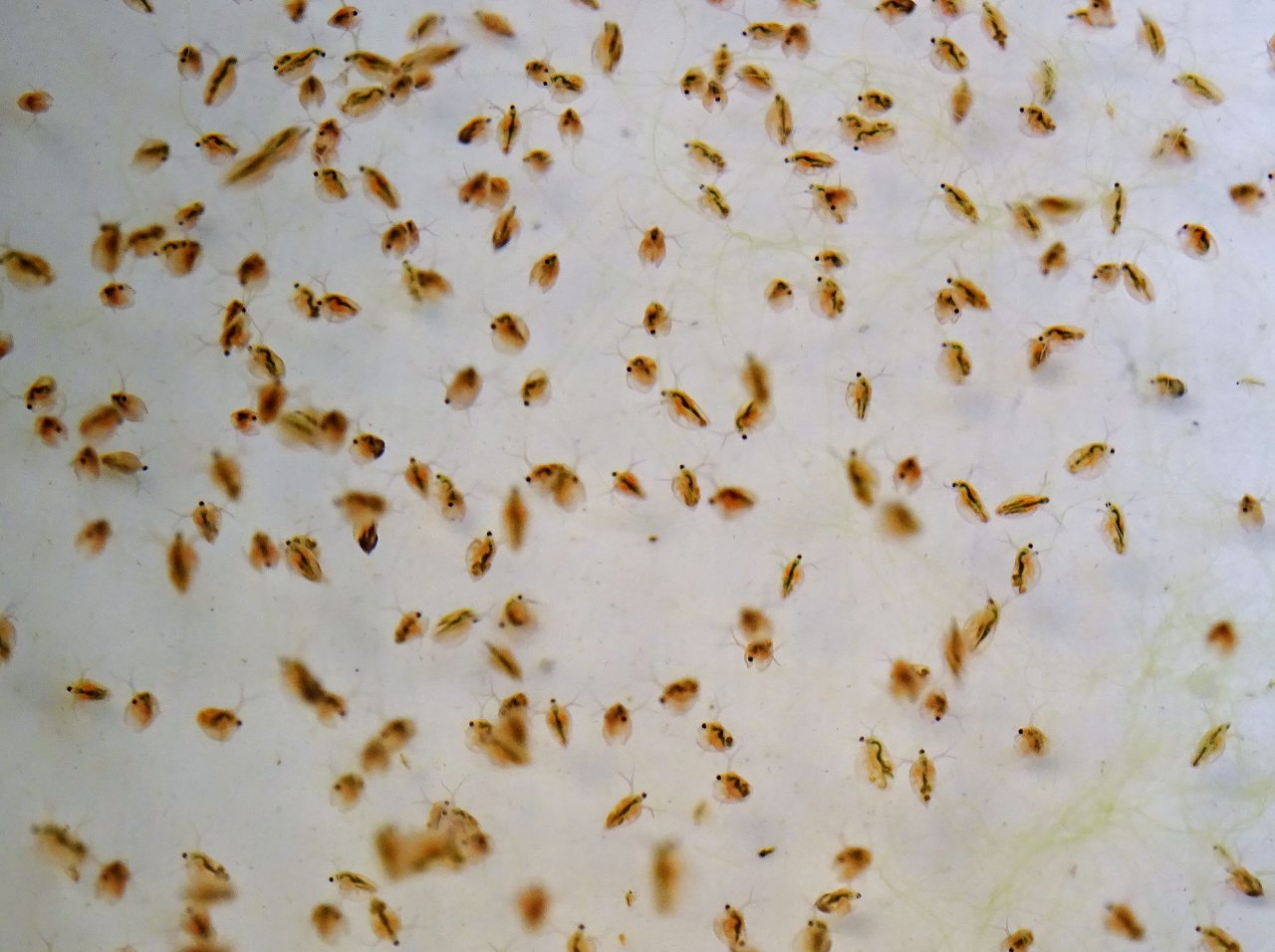
| Cladocerans, Daphnia and Moina | The least reliable, and the prize | Visible. A translucent comma that hops. You can see the gut as a dark line and the heart beating | Hatched from an ephippium in the mud. Every hatchling from a resting egg is genetically unique and then reproduces clonally7, which is why one animal becomes a swarm |
Why that order
It is a food chain assembling itself, smallest first.
Nothing in the jar can eat until there is something to eat. The litter dissolves, the bacteria eat the dissolved carbon, the flagellates eat the bacteria, the ciliates eat the flagellates and the bacteria, the rotifers and crustaceans eat all of it, and each of them takes longer to get going than the one below because each is bigger and slower to reproduce. Woodruff reached the same conclusion by elimination: he put the emphasis on the biological interrelations, food and specific excretion products, as the most important factors determining the observed sequence6, rather than on the chemistry of the water.
Warmth speeds the film, it does not change the reel
A warm window runs the sequence faster.
Woodruff noted that the rate of development of an infusion depends on the temperature it is kept at, and that within limits the higher the temperature the faster the sequence proceeds6. A jar in a Yerevan July will race through stages that take a month in March. That is a variable worth using deliberately rather than an accident, and it is one of the paired-jar experiments further down this page.
The gap, and it is an open one
Keep the log and you will have produced data that does not currently exist.
Nobody has published the succession for a jar of Armenian pond mud on a Yerevan windowsill, which makes it one of the easiest pieces of real observation anybody here could contribute. The jar is the same jar and the mud does the same thing, so all it takes is somebody writing it down. The order above is from hay infusions in a laboratory6 and from a controlled hatching experiment on Illinois ditch sediment3. Both are strong evidence for the order. Neither is a measurement of your jar, and the day numbers should be treated as a shape rather than a schedule. A dated log from a sill in Yerevan is therefore not a lesser version of the published work. It is the only version there is.
Fuel
Leaf litter is the fuel. Without it the jar is a glass of water with mud in it.
A jar on a windowsill gets light, so some energy arrives as photosynthesis. But most of what the first few weeks run on is the dead plant material you put in. That is not a hobby opinion, it is the standard model of how small water bodies work: the leaves that fall in from the bank are allochthonous organic matter, energy fixed somewhere else and delivered as coarse particulate matter, and the review literature on stream ecosystems treats litterfall, retention, storage and breakdown as the base of the whole system8. Take two or three soggy dark leaves from the water's edge, not fresh green ones off the tree. The soggy ones are already colonised, which saves the jar a fortnight.
The chain, in the order it runs. Soluble material leaches out first and the bacteria eat it, which is why a jar goes markedly turbid inside forty eight hours6. Then fungi and bacteria colonise the leaf itself and start on the structural material, cellulose and lignin, which they can digest and almost no animal can. Fungi and bacteria are the decomposers doing that work, and their relative importance and the factors controlling their activity are the second half of the standard review8. Only then is the leaf worth eating: an ostracod or a rotifer is not eating leaf, it is eating the microbial layer growing on the leaf, plus the fine particles that come off it. This is why litter is a slow-release feeder rather than a meal.
Tannins are the reason the water goes brown, and they are not neutral. A 140 day submerged decomposition experiment published in 2025 measured what tannins actually do. Tannin in the water rose sharply over the first 14 days and peaked there in almost every treatment, and by day 140 it was still 59 to 184 percent above the 2.51 mg per liter it started at9. The litter itself lost 84 to 95 percent of its tannin content over the 140 days9. So the brown is a phase, and a long one.
And there is a dose response, which is the practical instruction. A low tannin addition raised the decomposition rate of the other litter by 1.33 to 12.70 percent. A high addition lowered it by 6.21 to 6.82 percent9. The mechanism runs both ways: at low concentrations the breakdown products of tannin, gallic acid among them, are a usable carbon source that stimulates microbes, and at high concentrations tannins bind enzymes, precipitate proteins, disrupt microbial membranes and lock nitrogen into complexes the decomposers cannot get at9. High tannin also inhibits the nitrifying bacteria specifically, so ammonium accumulates rather than being converted9.
Which translates to: a few leaves, not a jar packed with them. Two or three small leaves in two liters is the working amount; a jar stuffed with litter is the high-tannin treatment, and the published high-tannin treatment decomposed more slowly, held a poorer bacterial community and accumulated ammonium9. If you want to test that, it is one of the paired-jar experiments below, and it is a good one because the prediction is counterintuitive: more food, less life.
How much tannin is in a leaf9
- under 20
- mg per gram: a low-tannin plant
- 20 to 50
- mg per gram: medium
- over 50
- mg per gram: high
- 18.69
- mg/g, Osmanthus fragrans litter, measured
- 12.20
- mg/g, Canna glauca litter, measured
- 130
- mg/g in Myriophyllum verticillatum, the source they used to dose the high treatments
The sediment variant, and a second jar worth making
The Winogradsky column: the same mud, stood on end, so the bacteria sort themselves into stripes.
The pond jar is about animals. There is a second, older jar that is about bacteria, and it costs the same nothing. Pack a tall narrow glass, a 1 liter one is fine, two thirds full with the same sediment, mixed with a little shredded paper or newspaper for cellulose, top it with water, and stand it in the light. That is a Winogradsky column, and it has been a teaching object for over a century. What it does is turn an invisible chemical gradient into visible bands.
Requiring only the input of light, the column establishes a structured microbial ecosystem carrying out the carbon, nitrogen and sulfur cycles10. Over time the community stratifies, with an oxic top layer and anoxic layers below it, and hydrogen sulfide generated by sulfur-reducing microbes in the anoxic zone diffuses upward toward the oxygen10. Everything interesting happens where the two meet.
A 2014 study sequenced the bacteria in such columns rather than guessing at them, and the results are worth knowing before you look at yours. The columns were incubated under light at room temperature for 18 weeks10. Depth was one of the strongest structuring factors: Cyanobacteria appeared only at the soil and water interface, Alphaproteobacteria and Betaproteobacteria also marked that interface, and Clostridia marked the deepest layer10. The very top of the column, dominated by Cyanobacteria, was the least diverse and least rich part of it10, which is a useful corrective to the assumption that the green part is the busy part.
The black layer has an explanation and it is not rot. Anaerobic respiration of sulfate generates hydrogen sulfide, which has a distinctive odour and spontaneously forms ferrous sulfide with iron, visible as a black colouration of the sediment10. If the bottom of your column, or the bottom of your pond jar, goes black, you are looking at iron sulfide and you have found the anoxic zone.
And the finding that ties this page together. Community structure was determined by a founding population that depended on which sediment the column was made from, and the supplemental cellulose source mattered less than depth and sediment source did10. Two of the ponds sampled differed in exactly the way two collecting spots differ: one was entirely shaded and received substantial leaf litter, the other received more direct sunlight10, and their columns did not converge. Where you dug decides what you get. That is the egg bank argument again, at the scale of bacteria.
Green sulfur bacteria are strict anaerobes typically found in the green zone in the lower middle of a Winogradsky column, using hydrogen sulfide as an electron donor in photosynthesis10. Photosynthesis without oxygen, in a jar on your sill.
Purple sulfur bacteria also use hydrogen sulfide as an electron donor, and store the elemental sulfur they generate in globules inside the cell. Purple non-sulfur bacteria do the same at lower sulfide concentrations10.
In the sequenced columns, distinct green and red-violet zones were not apparent, though patches of color were present throughout at different intensities10. The textbook picture of tidy stripes is the best case, not the usual one.
The sulfur cycle in a column runs on sulfate. Our own water page notes that Yerevan tap water is unusually low in sulfate, with sulfate rarely above 11 or 12 percent of anions11, so a column made with tap water here may band weakly. Use pond water, and if it still does nothing, that is a result worth writing down.
- Hairston, N.G. Jr. (1996). Zooplankton egg banks as biotic reservoirs in changing environments. Limnology and Oceanography 41(5): 1087 to 1092. The paper that framed sediment egg banks as reservoirs rather than as debris. DOI 10.4319/lo.1996.41.5.1087
- Brendonck, L. and De Meester, L. (2003). Egg banks in freshwater zooplankton: evolutionary and ecological archives in the sediment. Hydrobiologia 491: 65 to 84. The standard review of the subject. DOI 10.1023/A:1024454905119
- Trujillo, J., Schwing, C.D., Muturi, E.J. and Cáceres, C.E. (2023). Heterocypris incongruens maintains an egg bank in stormwater habitats and influences the development of larval mosquito, Culex restuans. Ecology and Evolution 13(8): e10445. Open access. The hatching protocol, the taxa recovered from ditch sediment, the per-gram emergence counts, and the ostracod and mosquito interaction. DOI 10.1002/ece3.10445 open access
- Weider, L.J., Jeyasingh, P.D. and Frisch, D. (2018). Evolutionary aspects of resurrection ecology: progress, scope, and applications. An overview. Evolutionary Applications 11(1): 3 to 10. Open access. The 70 to 100 year practical ceiling on reviving large numbers of dormant propagules, and the inverse relationship between hatching success and the age of the layer. DOI 10.1111/eva.12563 open access
- Hairston, N.G. Jr., Van Brunt, R.A., Kearns, C.M. and Engstrom, D.R. (1995). Age and survivorship of diapausing eggs in a sediment egg bank. Ecology 76(6): 1706 to 1711. The foundational measurement of how long a viable diapausing egg persists in dated lake sediment. DOI 10.2307/1940704
- Woodruff, L.L. (1912). Observations on the origin and sequence of the protozoan fauna of hay infusions. Journal of Experimental Zoology 12(2): 205 to 264. Sheffield Biological Laboratory, Yale. The 24 flask design, the sterilised-hay and sterilised-water controls, the finding that air is a negligible source, the six-step sequence of appearance, maximum and disappearance, the 48 hour turbidity, the zoogloea, the colour and acidity relationship, the temperature effect, and the day counts quoted in the table. DOI 10.1002/jez.1400120204. Public domain; the full volume is readable at archive.org public domain, full text free
- Ebert, D. (2022). Daphnia as a versatile model system in ecology and evolution. EvoDevo 13: 16. Open access. Cyclic parthenogenesis, the ephippium sinking to the bottom and entering diapause, and the point that each hatchling from a sexually produced resting egg is genetically unique and then reproduces clonally. DOI 10.1186/s13227-022-00199-0 open access
- Abelho, M. (2001). From litterfall to breakdown in streams: a review. TheScientificWorldJournal 1: 656 to 680. Open access. Litterfall as allochthonous organic matter, retention and storage, the mechanisms of leaf breakdown, and the relative roles of fungi and bacteria. DOI 10.1100/tsw.2001.103 open access
- Li, L. and colleagues (2025). Regulatory mechanisms of tannins on the decomposition rate of mixed leaf litter in submerged environments. Plants 14(19): 3064. Open access. The 140 day submerged experiment: the tannin classification thresholds, the measured tannin content of each litter species, the rise and peak of tannin in the water at day 14, the residual increase at day 140, the dose response on decomposition rate, the enzyme and protein binding mechanisms, and the inhibition of nitrifiers with ammonium accumulation. DOI 10.3390/plants14193064 open access
- Rundell, E.A., Banta, L.M., Ward, D.V., Watts, C.D., Birren, B. and Esteban, D.J. (2014). 16S rRNA gene survey of microbial communities in Winogradsky columns. PLoS ONE 9(8): e104134. Open access. The oxic and anoxic stratification, the 18 week incubation under light at room temperature, the depth biomarkers including Cyanobacteria at the soil and water interface and Clostridia at depth, the low diversity of the top layer, the founder effect of sediment source over cellulose source, the hydrogen sulfide and ferrous sulfide explanation for black sediment, the green and purple sulfur bacteria, and the observation that distinct coloured zones were not apparent. DOI 10.1371/journal.pone.0104134 open access
- Our own Armenia research. Used on this page for two things only: the protected area aggravation under RA Criminal Code Article 385(2), and the low sulfate content of Yerevan tap water. Both are cited to their primary sources in that file, the legal one to the national legal register at arlis.am and the water one to Shahinyan (2005), Proceedings of the National Academy of Sciences of Armenia, Earth Sciences LVIII(1) pp. 41 to 45. See Armenia.
Continue
Where to go next.
A jar from a pond
The build itself: what to collect, the six things to get right, the week by week schedule and the log.
Succession, the egg bank and Lake Sevan
The same processes at tank and lake scale, with the literature behind them.
Nitrification, decomposition and roots
Decomposition as the engine and tannins as the brake, which is what leaf litter is doing in the jar.
The law and the biosecurity
Before collecting anything anywhere: what is protected, and why biosecurity runs both ways.