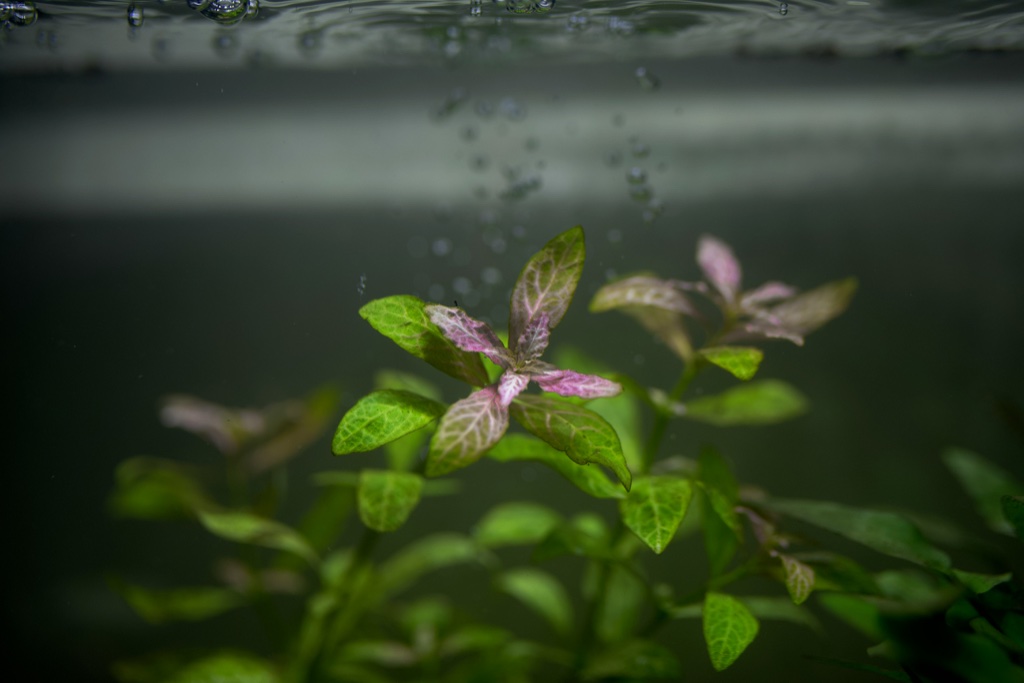
The minor species
Phosphate, iron, copper, tannins, and the one reaction that runs whether or not you do anything.
Five shorter mechanisms. Each one is here because it is chemistry rather than folklore, and each one is cross linked to the page that treats it at length.
Phosphate
A phosphate reading of zero is not evidence of a phosphate-poor tank.
Phosphate is a triprotic acid, and which form is present depends on pH the same way ammonia does. At aquarium pH the dominant species are dihydrogen phosphate and hydrogen phosphate.
pKa roughly 2.1, 7.2 and 12.3
The reason the water column reads low is that phosphate does not stay in the water column. It adsorbs onto iron and aluminium oxides in the substrate, and it precipitates with calcium in hard alkaline water as calcium phosphate. Both are reversible. When a submerged substrate goes anoxic and its iron oxides are reduced, the phosphate they were holding is released.1
So the practical rule. Changing water does not touch the sediment reserve. The water change that is genuinely justified on phosphate grounds is the one after you disturb the substrate, and that argument is set out on the water changes page.
Iron and chelation
Free iron does not exist in an aerated planted tank, which is why fertilisers sell chelates.
Iron in oxygenated water at anything above about pH 5 is ferric, and ferric iron hydrolyses and precipitates as hydrous ferric oxide almost immediately. Dosing iron sulfate into a planted tank mostly makes rust.
Fe3+ + 3 H2O → Fe(OH)3(s) + 3 H+
Fe3+ + Ln- ↔ FeL (the chelate, which keeps it in solution) Balanced by us2. L is the chelating ligand: EDTA, DTPA or EDDHA.
Which chelate matters, and the reason is pH. The iron chelates used in horticulture hold their iron over different pH ranges, which is why EDDHA is the one used on calcareous soils and EDTA is not.3 A tank at the carbonate ceiling from section one sits at pH 8.22, which is the top of the range where an EDTA chelate is still doing its job. Aquarium fertiliser labels rarely state which chelate they use, and almost never state a pH range.
Copper
A copper number on its own does not predict copper toxicity.
The Armenian figures are on the hardscape page and they are not marginal. Copper in the Akhtala river near its mouth runs 381 to 788 micrograms per liter against a catchment background of 3.00. The Alaverdi river near its mouth runs 238 to 315, the Debed 4.5 km below Alaverdi 79 to 86, and the Chochkan below the tailings dump 84 to 379.4 Akhtala is over a hundred times background2.
The chemistry that the concentration alone hides. What reaches a gill is not total copper. Carbonate, hydroxide and dissolved organic carbon all complex Cu2+, and calcium and magnesium compete with it at the uptake site, so hardness, alkalinity and organic carbon all change the toxicity of the same measured concentration.5 Soft, clear, low-alkalinity water is the worst case, and that is exactly the water a Caridina keeper builds on purpose.
The Yerevan correction, which reverses the obvious story. Copper, zinc, lead, cadmium, iron and arsenic were at or below detection in almost all Yerevan tap samples.6 The supply is clean. The risk is your own plumbing, because stagnation time raises dissolved metal from pipes and fittings.7 Run the cold tap for a minute or two before drawing water for a shrimp tank, and never draw from the hot side.
Tannins and humic substances
Brown water is a dose, not a state, and the dose response is not monotonic.
Tannins are polyphenols. They leach, they acidify weakly, they complex metals, and they bind proteins. In a 140 day submerged decomposition experiment tannin in the water rose sharply over the first 14 days and peaked there, and by day 140 it was still 59 to 184 percent above the 2.51 mg/L it started at, while the litter itself had lost 84 to 95 percent of its tannin content.8
And the dose matters in both directions. A low tannin addition raised the decomposition rate of the other litter by 1.33 to 12.70 percent and a high addition lowered it by 6.21 to 6.82 percent. At low concentration the breakdown products, gallic acid among them, are a usable carbon source. At high concentration tannins bind enzymes, precipitate proteins and lock up nitrogen, and high tannin inhibits the nitrifying bacteria specifically, so ammonium accumulates.8 Join that to section two and a heavily tannic tank is a tank whose ammonia removal has been slowed down chemically.
The other half is protective. Dissolved organic carbon from the upper Rio Negro protects fish against the ionoregulatory damage that low pH would otherwise cause.9 Humic substances are not a decoration and they are not only an acid. The jar dosing guidance is on the pond jar page.
Evaporative concentration
The only reaction on this page that needs no chemistry at all, and it is the strongest.
Water evaporates pure. Everything dissolved in it stays. You top up with tap water, which brings more of everything. There is no equilibrium and no ceiling.
n is weeks, e is the fraction of volume lost to evaporation per week. Derived and used at length on the water changes page.
The one number worth memorising: the tank doubles its dissolved load after 1/e weeks, whatever the substance and whatever the tap water. At 5 percent a week that is 20 weeks.
Why it belongs on a chemistry page. Calcium bends below that line, because snail shells, shrimp moults, pruned plant tissue and carbonate scale on the heater all remove some. Sodium and chloride have no sink at all and follow it exactly. A general hardness reading that has stopped rising has not stopped accumulating; it has run out of the one thing you were measuring.
Yerevan tap, by district
Volcanic rock, not limestone, which is why the water is soft and the pH is low.
The supply springs rise on the western slopes of the Gegham range out of fractured andesite and basalt. The paper's overall summary is dissolved solids 0.17 to 0.47 g/L, total hardness 1.0 to 4.0 mg-eq/L and pH 6.25 to 7.30, and it classifies the water as bicarbonate and chloride, calcium and magnesium and sodium.6 In German degrees that range is 2.8 to 11.2 dGH.2
| District | Dissolved solids | Hardness as printed | Hardness in dGH | pH |
|---|---|---|---|---|
| Arabkir, north | 0.180 to 0.425 g/L6 | 1.25 to 3.30 mg-eq/L6 | 3.5 to 9.32 | 6.40 to 7.226 |
| Davtashen, west and north west | 0.220 to 0.390 g/L6 | 1.60 to 3.90 mg-eq/L6 | 4.5 to 10.92 | 6.15 to 6.936 |
| Avan, Kanaker, Nork | 0.170 to 0.290 g/L6 | 1.05 to 1.35 mg-eq/L6 | 2.9 to 3.82 | 6.01 to 7.216 |
| Central districts | 0.164 to 0.410 g/L6 | 1.20 to 3.30 mg-eq/L6 | 3.4 to 9.32 | 6.30 to 7.156 |
Three chemical conclusions follow from that table, and they are the reason it is on this page rather than only on the Armenia page.
One. Bicarbonate is 61 to 77 percent of the anions everywhere and sulphate is rarely above 11 or 12 percent.6 Essentially all the calcium and magnesium is paired with bicarbonate, so GH and KH track each other, exactly as the charge balance in section one predicts. The working estimate is KH roughly equal to GH, so about 3 to 11 dKH by district.2 That is a calculation from published ion ratios, not a measurement. Verify it with a test kit.
Two. Much of Yerevan is already above the uninjected carbonate ceiling of 2.7 dGH2, so limestone hardscape in an uninjected tank has almost nowhere left to go. The Avan, Kanaker and Nork end at 2.9 to 3.8 dGH2 is the closest to the ceiling and the most likely to move.
Three. Tap pH is 6.0 to 7.36, well below the pH 8.2 our calcite model predicts for a tank at equilibrium. That gap is not an error in either number. Tap water is not at equilibrium with calcite or with the atmosphere; it is a groundwater carrying more dissolved CO2 than air equilibrium, and it degasses after it comes out of the tap. A pH reading taken from a freshly filled bucket and one taken the next morning are measuring two different waters, and section three is why.
The seasonal caveat matters too. Harder artesian water is blended into the softer spring supply when summer demand rises, so a water change in August is a larger chemical event than the same change in March. From 2027 the operator is obliged to publish hardness and dissolved mineral data for consumers.10 Until then, test the water you are putting in, not only the tank.
- Walstad, D. (2023). Ecology of the Planted Aquarium, 4th edition. ISBN 979-8-9875741-0-2. The submerged soil chapter, including phosphate release when iron oxides are reduced, and cation exchange capacity. Read through this hub's own Walstad research file, which cites the book's page ranges. dianawalstad.com
- Our own arithmetic. Not a published source. Every calculated figure on this page, with its inputs.
One, the carbonate system. The four equilibria and the charge balance
2[Ca2+] = [HCO3-]combined intoh3 = K12 K2 [CO2]2 / (2 Ksp)and solved at 25 degrees with log K1 -6.35, log K2 -10.33 and log Ksp(calcite) -8.48, from 1 and 2. Activity corrections are ignored and equilibrium is assumed perfect, so every calcium figure is a slight underestimate. The uninjected row is solved at 420 ppm of atmospheric CO2, which is 0.63 mg/L dissolved at 25 degrees by Henry's law from 3, and returns pH 8.18, 19.4 mg/L calcium, 0.967 meq/L bicarbonate and 2.72 dGH, printed as pH 8.2, 19.4 mg/L and 2.7 dGH. The three injected rows are set at a fixed dissolved concentration of 10, 20 and 30 mg/L and therefore do not move when the atmosphere does. The same figures are published on the water page and were recomputed independently here; they agree to the printed digit. The validation: re-solved at 0.0003 atmospheres, the CO2 content of air that 1 used, our model gives 17.2 mg/L of calcium, between the 16 mg/L Garrels and Christ calculated and the roughly 20 mg/L the Frear and Johnston experiments gave, both as reported in 1 page 92. Sitting below the experimental value is the expected direction of error for a model that ignores activity corrections. Two, the ammonia table.pKa = 0.09018 + 2729.92/(273.2 + T)andf = 1/(1 + 10(pKa - pH)), both from 5 as printed in 6, evaluated at 20, 25 and 28 degrees. Ionic strength is not corrected for, which shifts pKa slightly in hard water. Three, Henry's law.H(T) = HΘ exp(2400 (1/T - 1/298.15))withHΘ = 3.3 × 10⁻⁴ mol m-3 Pa-1from 3, and the air-side concentration from the ideal gas law, at 1013 hPa and at Yerevan's 887 hPa station pressure. The 887 hPa figure is the Arabkir station value used across this site; the Agro plain runs nearer 906 hPa. The ratios of 1.08 and 1.22 and the 0.55 to 0.63 mg/L dissolved figures follow from that. Four, the unit conversions. 1 German degree is 10 mg/L of CaO, which is 0.17833 mmol/L, which is 17.85 mg/L as CaCO3 and 0.3567 meq/L and 21.8 mg/L as bicarbonate. Nitrate ion to nitrate nitrogen is 62.005 divided by 14.007, which is 4.427, rounded to 4.43. Five, the dechlorination equations. These are balanced by us from the standard half reactions and are stated as balanced equations, not as measured yields. What actually happens in a bucket depends on dose, pH and contact time, and Helz and Nweke (1995) and MacCrehan and colleagues (2005), both on the chemistry page, are the reason we do not claim a yield. Six, the Yerevan district figures are converted from the mg-equivalent per litre unit the source prints, at 1 mg-eq/L = 2.804 dGH, from 6. The carbonate hardness estimate for Yerevan is inference from the published bicarbonate fraction, not a measurement; nobody publishes a KH figure for Yerevan tap water. calculated, repeatable, unverified by a third party - Lucena, J.J. (2003). Fe chelates for remediation of Fe chlorosis in strategy I plants. Journal of Plant Nutrition 26(10-11): 1969 to 1984. The pH range over which each iron chelate actually holds its iron. Verified through Crossref; full text not read, and flagged for checking. DOI 10.1081/PLN-120024257
- Gevorgyan, G.A., Mamyan, A.S., Hambaryan, L.R. and Khudaverdyan, S.K. (2016). Environmental risk assessment of heavy metal pollution in Armenian river ecosystems. Polish Journal of Environmental Studies 25(6): 2387 to 2399. The 3.00 microgram per litre copper background, the 381 to 788 Akhtala figures, and the Alaverdi, Debed and Chochkan copper figures. DOI 10.15244/pjoes/63734
- Di Toro, D.M., Allen, H.E., Bergman, H.L., Meyer, J.S., Paquin, P.R. and Santore, R.C. (2001). Biotic ligand model of the acute toxicity of metals. 1. Technical basis. Environmental Toxicology and Chemistry 20(10): 2383 to 2396. Why a copper concentration on its own does not predict copper toxicity: hardness, alkalinity and dissolved organic carbon all change how much of it reaches the gill. DOI 10.1002/etc.5620201034
- Shahinyan, H.V. (2005). On the hydrogeochemical characteristics of some drinking waters supplying the city of Yerevan. Proceedings of the National Academy of Sciences of Armenia, Earth Sciences LVIII(1): 41 to 45. Sampling 2002 to 2004, roughly eight or nine samples per point. Open access. Tap water hardness, dissolved solids and pH by Yerevan district; the finding that bicarbonate is 61 to 77 percent of the anions and sulphate rarely above 11 or 12 percent; and the finding that copper, zinc, lead, cadmium, iron and arsenic were at or below detection in almost all samples. PDF at arar.sci.am
- Lytle, D.A. and Schock, M.R. (2000). Impact of stagnation time on metal dissolution from plumbing materials in drinking water. Journal of Water Supply: Research and Technology - Aqua 49(4): 243 to 257. Why you run the cold tap before drawing water for a shrimp tank. Verified through Crossref; full text not read, and flagged for checking. DOI 10.2166/aqua.2000.0021
- Li, L. and colleagues (2025). Regulatory mechanisms of tannins on the decomposition rate of mixed leaf litter in submerged environments. Plants 14(19): 3064. Open access. The 140 day submerged experiment: the tannin peak at day 14, the residue at day 140, the dose response on decomposition rate, and the inhibition of nitrifiers with ammonium accumulation. DOI 10.3390/plants14193064 open access
- Duarte, R.M., Smith, D.S., Val, A.L. and Wood, C.M. (2016). Dissolved organic carbon from the upper Rio Negro protects zebrafish against ionoregulatory disturbances caused by low pH exposure. Scientific Reports 6: 20377. Open access. Humic substances are not only a colour. DOI 10.1038/srep20377 open access
- Republic of Armenia sanitary standards. Norms N 2-III-A2-1 for the 1,000 mg/L total mineralisation limit, and Rules 2.1.4.001-23 of 2023, which obliges the operator to publish hardness and dissolved mineral data for consumers from 2027. arlis.am
Continue
Where to go next.
Chemistry
The major equilibria these sit underneath: carbonate, ammonia and Henry's law.
Find a hardscape
What each rock and each piece of wood contributes, material by material.
Fifteen mechanisms, rated
Trace depletion and metal accumulation rated for how well each one is supported.
Find a plant
Iron and phosphate where they matter most, which is in front of a plant.
Peroxide oxidators
How strongly oxidizing water changes iron, phosphate and trace nutrients.