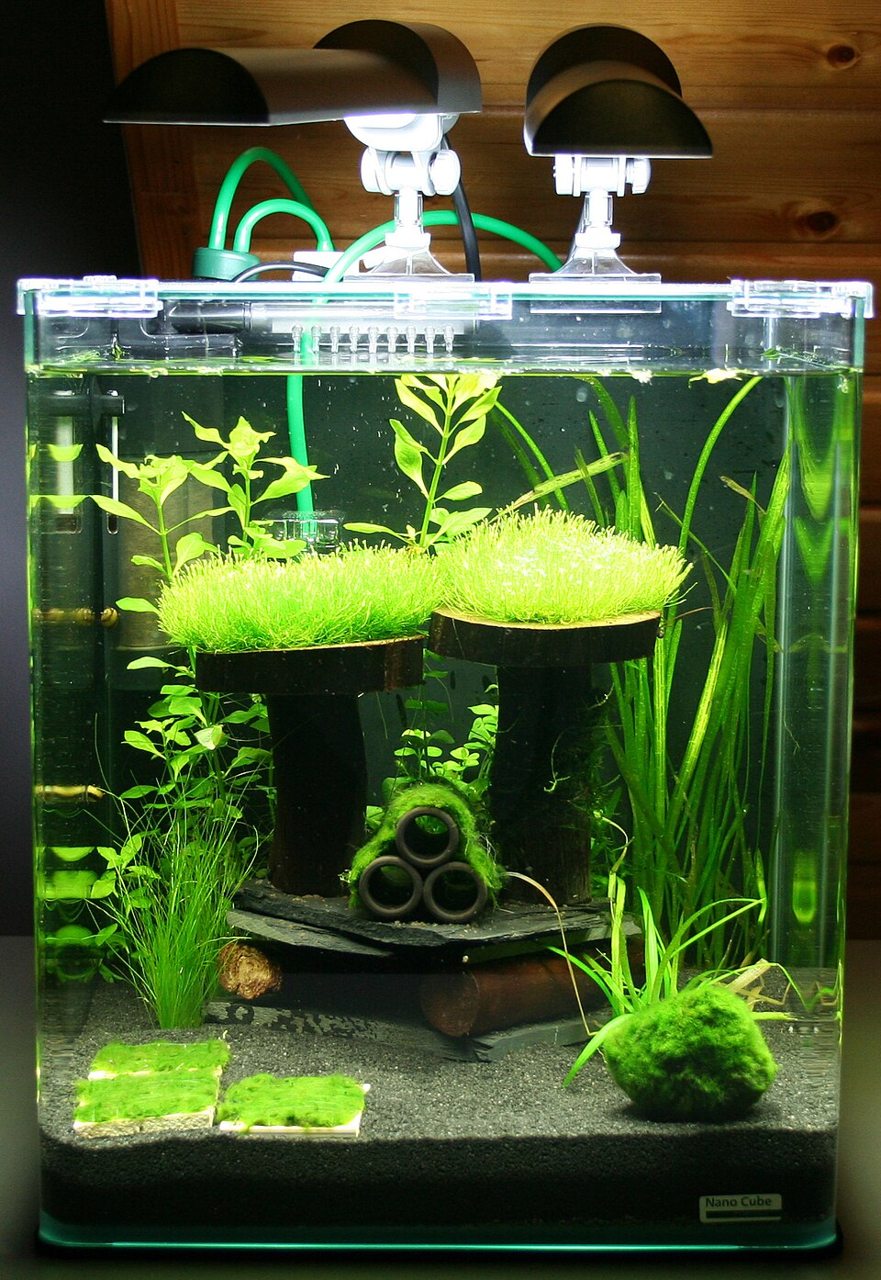
Structure
Floor loading. The correction we had to make to ourselves.
What we asserted. That pressure on the floor, in kilopascals under the stand, scales with tank size, so a big tank is a structurally different proposition from a small one because it presses harder.
What the arithmetic showed. It does not. Pressure under the stand is almost flat across the entire range of domestic tanks, and the assertion was wrong for a reason worth understanding rather than just correcting.
| Tank | Grand total1 | Cabinet footprint1 | Pressure1 |
|---|---|---|---|
| 60 L | 97 kg | 0.18 m2 | 5.3 kPa |
| 100 L | 160 kg | 0.28 m2 | 5.6 kPa |
| 180 L | 262 kg | 0.40 m2 | 6.4 kPa |
| 240 L | 339 kg | 0.60 m2 | 5.5 kPa |
| 350 L | 524 kg | 0.75 m2 | 6.9 kPa |
| 500 L | 766 kg | 1.08 m2 | 7.0 kPa |
Every tank from 60 to 500 liters lands between 5.3 and 7.0 kPa, and it has to. Here is the reason, and it is a scaling argument rather than a coincidence. A tank grows in all three directions at once, so its mass grows roughly as the cube of its linear size while its footprint grows as the square. The ratio of the two is a length, and the length in question is the height of the water column That height barely changes across the whole domestic range: 36 cm in the 60 liter tank and 50 cm in the 500 liter one1. Add glass, substrate and cabinet and the pressure under the stand is essentially the pressure of a water column 55 to 70 cm tall. That is all it ever is.
pfloor = m g / Afootprint ≈ ρ g heffective
The mass over the footprint is, dimensionally, a density times a height. Tanks all have roughly the same height, so they all have roughly the same floor pressure. The non-linearity is real but it is in the total mass, which goes from 97 kg to 766 kg, a factor of eight1, and not in the pressure.
| Object | Pressure on the floor1 |
|---|---|
| Filled bath, 170 x 70 cm, 250 kg | 2.1 kPa |
| Washing machine, 80 kg on 60 x 60 cm | 2.2 kPa |
| Aquarium, any size from 60 to 500 L | 5.3 to 7.0 kPa |
| Full bookcase, 200 kg on 90 x 30 cm | 7.3 kPa |
| An adult standing on both feet | 21 kPa |
| Refrigerator on four 5 x 5 cm feet | 88 kPa |
The figure that circulates in aquarium forums is the residential live load in the building codes. SNiP 2.01.07-85, which Armenia inherited, gives 1.5 kPa2; Eurocode 1 gives 2.0 kPa recommended for the same category3. Taken at face value, every tank in the table above is three to five times the code limit, including the 60 liter one, which nobody worries about That is the tell. The code number is a uniformly distributed load, meaning a load spread evenly over the whole floor. It is not a crushing limit and it cannot be compared to a local pressure. An aquarium of any size presses less hard than a bookcase full of books and a quarter as hard as you do standing up.
A floor slab does not fail in crushing. It fails in bending. So the right test is the bending moment the tank causes in the member that spans between the bearing walls, compared against the moment the code's live load was designed to cause. And bending depends enormously on where along the span the load sits
uniform load over the span: M = w L2 / 8
point load P at a from one support, b from the other: M = P a b / L
the same load at mid span: M = P L / 4
- L
- clear span between bearing walls. 3.2 m is a common Soviet era slab span1
- w
- the code's uniformly distributed live load23
- M
- bending moment per meter width of a one-way slab strip, kN.m/m
At L = 3.2 m the design live load moment is 1.5 × 3.22 / 8 = 1.92 kN.m per meter width under SNiP, and 2.56 under Eurocode. The tank is treated as a patch load spread sideways through the screed over the cabinet length plus 0.6 m. All of the arithmetic below is ours1.
| Tank | Total mass1 | Moment at mid span1 | Percent of allowance21 | Moment at 15 percent of the span from the wall1 | Percent21 |
|---|---|---|---|---|---|
| 60 L | 97 kg | 0.63 kN.m/m | 33 percent | 0.32 | 17 percent |
| 100 L | 160 kg | 0.90 | 47 percent | 0.46 | 24 percent |
| 180 L | 262 kg | 1.29 | 67 percent | 0.66 | 34 percent |
| 240 L | 339 kg | 1.48 | 77 percent | 0.75 | 39 percent |
| 350 L | 524 kg | 1.96 | 102 percent | 1.00 | 52 percent |
| 500 L | 766 kg | 2.50 | 130 percent | 1.28 | 67 percent |
Read the last two columns against each other, because that is the whole finding. A 350 liter tank in the middle of the room uses, by itself, the entire bending allowance the slab was designed to give to your furniture, your visitors and everything else put together. The same tank moved to within half a meter of a bearing wall uses half of it. Position is worth more than a factor of two, and it costs nothing. No other decision in this section is that cheap.
And the span works in the unintuitive direction. The same 240 liter tank at mid span uses 91 percent of the allowance on a 2.7 m span, 77 percent on 3.2 m and 41 percent on 6.0 m1. A short span is worse for a concentrated load, not better. A long span slab is built much stronger because its own uniform load moment grows with the square of the span, while a point load's moment grows only linearly. The small room that feels safer has proportionally less reserve for a heavy object than the big one does.
The sanity check that keeps this in proportion. Spread over a whole 12 m2 room, a 500 liter tank is only 0.63 kPa, which is 42 percent of the SNiP allowance for that room; a 240 liter tank is 0.28 kPa, or 18 percent1. The tank is not, in total, an outrageous load for a residential floor. It is only outrageous where you put it.
What is still unverified here. The exact clause numbers, and which instrument is currently in force in Armenia, were not retrieved. Armenia inherited the Soviet loading code and has since issued its own building norms. The three code values agree closely enough that none of the conclusions above depends on which applies, but the current Armenian document should be obtained before this is published in Armenian.

Pressure and the surface
Glass thickness is set by height, not by liters, and every table on the internet is quietly assuming a shape.
Pressure in a static fluid depends on depth and on nothing else. Not on volume, not on the width of the tank, not on how much water is above you in total. This is the same structure as gas exchange and depth and it has the same consequence: a quantity everyone reaches for, liters, is not in the equation.
p(z) = ρ g z
Fpane = ½ ρ g H2 · W
σmax = β q b2 / t2 so t = √(β q b2 / σallow)
- z, H
- depth below the surface, and the full water depth
- W
- pane width
- q
- ρgH, the pressure at the base, used as a uniform pressure by the standard hand method
- b
- the short side of the pane, which for almost every aquarium is the height
- β
- a coefficient depending only on the aspect ratio, from Timoshenko's plate solution for a rectangular plate simply supported on four edges4
- σallow
- 6 MPa. Annealed float glass has a nominal short term bending strength of 40 to 45 MPa, but strength is set by surface flaws and falls under sustained load, so a factor of about 7 is what reproduces industry practice. This is an estimate, not a derivation.
Two errors are left in deliberately and they push in opposite directions. Treating the triangular pressure distribution as uniform over-estimates the load. Treating the free top edge of an open tank as simply supported under-estimates the stress. They partly cancel, and the result lands close to what manufacturers actually build, which is the honest justification for using it.
| Water depth | Pressure at the base1 | Total push on the pane1 | In kilograms force1 |
|---|---|---|---|
| 0.30 m | 2.94 kPa | 0.53 kN | 54 kgf |
| 0.40 m | 3.92 kPa | 0.94 kN | 96 kgf |
| 0.50 m | 4.91 kPa | 1.47 kN | 150 kgf |
| 0.60 m | 5.89 kPa | 2.12 kN | 216 kgf |
Force on the pane goes as the square of the depth. Ten centimeters taken off the height of a 1.2 m tank removes a third of the push. And in the stress equation the required thickness goes as the pane height directly, because b appears squared under a square root, so it lands as a linear cost in millimeters of glass. Two tanks of 240 liters, one 120 x 50 x 40 cm and one 120 x 40 x 50 cm, hold identical water and need 8.6 mm and 11.5 mm of glass respectively1. A table of glass thickness by liters is meaningless. Height is the variable and liters is not.
72.8 mN/m at 20 C for clean water against air5. It is what holds the meniscus up the glass, what lets a springtail stand on the surface, and what makes a rimless tank fill above its own rim by a few millimeters before it spills.
A still surface accumulates a layer of proteins and lipids from food and decay. That film raises the resistance to gas transfer directly, which is to say it lowers k in gas exchange and depth. A surface skimmer is not a cosmetic device. It is a device for restoring the gas transfer velocity.
Both raise k, but ripple does it by continuously replacing the film with water from below. That is surface renewal, and it is the mechanism. The bubbles are a way of buying it, not the thing itself.
The curved water surface against the glass is a lens with a short radius, so the bottom two centimeters of every aquascape photograph taken through the front pane at a low angle is distorted by it. Shooting square on, and slightly below the water line, removes it.
- Our own arithmetic and our own estimates. Not a published source. Gas exchange: the two film expression divided by volume to give the depth form, the time constant table, the two-shape comparison at 200 litres, and the 40 cm and 70 cm working rules. Altitude: the pressure correction applied to source 3 using vapour pressures from source 4 at the station pressures in source 5, the percentage shortfalls, the 12.5 percent carbon dioxide reduction, and the demand to supply ratio at a temperature quotient of 2. Diffusion: the Schmidt number of 465 from sources 6 and 15, the Blasius boundary layer thicknesses at 3 cm from the leading edge, the cube root of Schmidt scaling to the concentration layer, and the relative flux column. Optics: every refractive index, critical angle, Snell's window, apparent depth factor, refracted angle and dispersion spread, computed from source 10; the 3 mm ray separation over a 0.5 m path; the Fresnel reflectances at the air to water and air to glass faces; the transmission and half depth columns computed from source 12; the ratio of the Sevan extinction coefficient to the pure water value; and the 13 m one percent depth. Flow: every Reynolds number, at the viscosity in source 15. Heat: the whole surface energy balance and all eight scenario temperatures, the diurnal swings, the wet bulb depressions, the fan table and the evaporation figures. Structure: the mass and pressure table, the household object comparisons, the bending moments at mid span and near the wall, the span sensitivity, the whole-room sanity check, and the glass thickness and pane force tables using the coefficients in source 19. calculated, repeatable, unverified by a third party
- SNiP 2.01.07-85*, Nagruzki i vozdeystviya (Loads and actions), Table 3. The Soviet residential floor live load of 1.5 kPa, inherited by Armenia. The exact clause number and the currently binding Armenian instrument were not retrieved.
- EN 1991-1-1:2002, Eurocode 1: Actions on structures, Part 1-1: General actions, Table 6.2, Category A. The 2.0 kPa recommended residential live load and the 2.0 kN concentrated load on a 50 by 50 mm square. Clause numbers not independently verified.
- Timoshenko, S. and Woinowsky-Krieger, S. (1959). Theory of Plates and Shells, 2nd edition. McGraw-Hill. The rectangular plate solution and the beta and alpha coefficients used for glass thickness and deflection. standard text; not consulted in the original for this page, the coefficients are the standard tabulated ones
- Vargaftik, N.B., Volkov, B.N. and Voljak, L.D. (1983). International tables of the surface tension of water. Journal of Physical and Chemical Reference Data 12(3): 817 to 820. The basis of IAPWS release R1-76, and the source of 72.8 mN/m at 20 C. DOI 10.1063/1.555688
Continue
Where to go next.
Physics
The rest of the physics: gas, altitude, diffusion, optics, flow and heat.
Planning a tank
Where the tank goes, which is the decision floor loading actually constrains.
Easy setups
Shallow tanks, which solve the glass thickness problem by not having the height.
The shops directory
Where a tank could be bought, once you know what the floor will take.