The number everybody repeats
Six is a familiar starting convention, not a universal biological threshold.
Keep them in groups of at least six. It is on the shop label, in the care sheet, in the forum reply and in the video. Follow it back and the trail stops before it reaches anybody.
FishBase carries the same line, in groups of five or more with a minimum aquarium of 60 cm, for the cardinal tetra, the neon, the harlequin rasbora, the tiger barb and the gold barb alike, and all of them trace back to a single entry in its reference list, number 51539, which is aquarium hobby literature rather than an experiment1. One figure covering fish of very different sizes and temperaments is the signature of a convention, not of a measurement.
The Aquatic Gardener has been published for 41 years. Across 163 issues and 1,228 articles there is not one whose title or keywords mentions Corydoras, Betta, rasbora, danio, Otocinclus, goldfish, gourami, Apistogramma, hillstream loach or the white cloud mountain minnow1. There is no journal article behind the rule because the article was never written.
The one published shoal size figure in aquarium keeping that can be attributed to a named person is Vin Kutty's Dutch style guide, hosted by the Aquatic Gardeners Association, and it asks for a dozen or so fish of one species2. Read it in context and it is a rule about composition. A dozen of one fish reads as a school across a two meter layout; one of each reads as a pet shop. Kutty never claimed it was a threshold for the animal's welfare, and it is not one.
So the ancestor of keep them in a group, in this hobby, is Dutch aquascaping. And the number it handed down was twelve. The people who took that rule most seriously were the competitors, and what they put in a placing tank starts at fifty.
- 5 species
- cardinal, neon, harlequin, tiger barb, gold barb, all given the identical group line1
- 1 reference
- behind all five of them, and it is hobby literature1
- 163 issues
- of the field's own journal, 1985 to 20261
- 1,228 articles
- indexed across those issues1
- 0
- of them about Corydoras, Betta, rasbora, danio or any of the other eight species names searched1
- 12 fish
- the one attributable published number, and it is about how a layout reads2
What has been measured
Experiments show a pattern: benefits grow with the group, then level out.
There is real evidence about group size. It is small enough to read in an afternoon, it is mostly on zebrafish, and it lands nowhere near six.
The biggest single study held zebrafish for nine weeks at five densities, from one fish per liter up to sixteen, and measured cortisol, aggression, distribution and growth together. Welfare was compromised at one fish per liter and nowhere else: those fish put more cortisol into the water per fish, pushed higher in the tank and fought more often than any of the crowded groups3. The authors' conclusion is that zebrafish can be held anywhere between four and sixteen fish per liter without compromising their welfare3.
Read that the right way round, because it is the opposite of what the hobby worries about. Too few was the measured problem, and the band that cost the fish nothing ran from four per liter all the way to sixteen.
The bottom of the range has been probed once more, and the result is the most useful number on this page for a small tank. Zebrafish in groups of four held themselves against a current better than zebrafish in pairs, and each fish in the four spent less time out in front, which is the position that costs the most to hold4. The improvement appears between two fish and four. Not at six, and not at any other round number.
And a fish does not use a constant anyway. Preferred group size shifts with how hungry the animal is, with what it has just been frightened by and with where it is standing5. That is the real objection to the rule. Six is not too low or too high. It is the wrong kind of answer.
| What was found | In which fish | The number |
|---|---|---|
| Higher cortisol, more aggression, fish pushed up the water column3 | Zebrafish, nine weeks | only at 1 fish per liter |
| No cost to welfare found anywhere in the band above that3 | Zebrafish, nine weeks | 4 to 16 fish per liter |
| Better holding against flow, less time in the costly lead position4 | Zebrafish | 4 beats 2 |
| Preferred group size moves with hunger, threat and surroundings5 | Several species | no constant |
| Group size changes behavior, and differently in each species6 | Four aquarium species | species by species |
| Mixing species changes it again, and again species by species7 | Community assemblages | species by species |
The last two rows are the only published studies that ask the hobby's own question, in the hobby's own animals, and both are behind paywalls with no abstract published for the first of them67. Two papers, standing under every stocking recommendation ever written. Anybody with a university library login can move this whole subject forward in an afternoon.
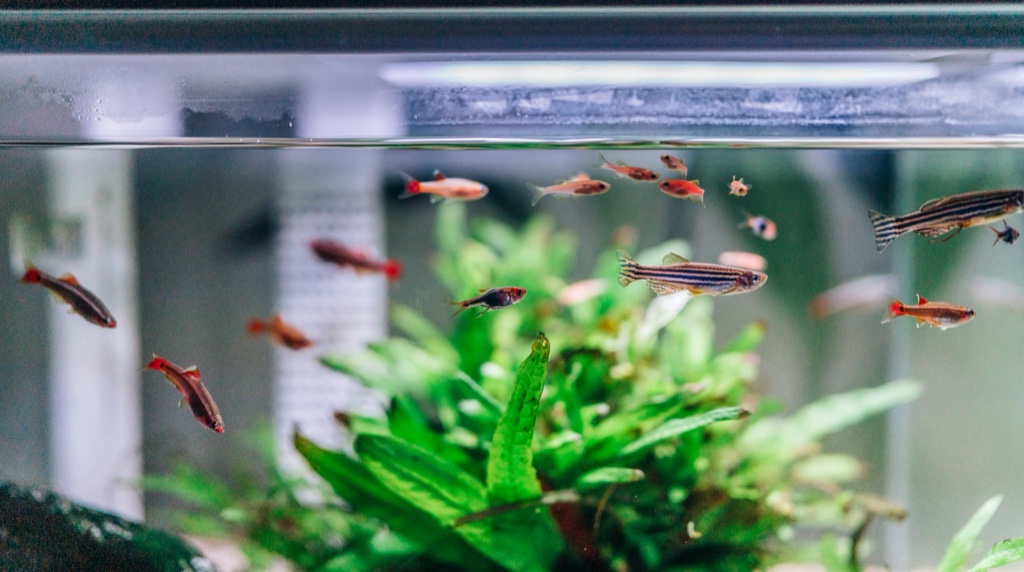
Four species out of one hundred and ten
Four familiar fish have experimental group-size evidence.
Every species in the species list carries a group size and, beside it, what that figure actually rests on. Sixty one of the hundred and ten say convention in their own note, in as many words8. Four say something better.
| Species | The figure | What it came from |
|---|---|---|
| Devario aequipinnatus giant danio |
8 | Schools of eight measured against solitary fish in a swim tunnel, across fourteen speeds, with direct aerobic and anaerobic metabolism rather than an inference from kinematics. Total energy per tail beat came out up to 56 per cent lower in the school, maximum aerobic performance 44 per cent higher, recovery from exercise 43 per cent faster9. The cheapest cruising speed was about one body length a second. |
| Danio rerio zebrafish |
4 and up | Nine weeks at five densities found welfare compromised only at one fish per liter3, and groups of four already outperformed pairs4. The evidence lives at the bottom of the range, which is exactly where a beginner's decision lives too. |
| Hemigrammus bleheri rummynose tetra |
94.5 to 98% | Chosen for the lateral line experiments precisely because its schooling is constant enough to measure, and it held that polarisation for three weeks undisturbed10. This is the closest thing the ornamental trade has to a documented full time schooler. The dozen we suggest buying is still our figure, not a measured floor. |
| Corydoras species the small armoured catfish |
15 to 25 | A peer-reviewed husbandry protocol runs 15 to 25 adults in a 76 cm tank on fine sand, at 23 to 27 C, pH 6.5 to 7.2 and roughly 4 to 5 dGH11. It is a laboratory stocking figure rather than a welfare floor, and it is still the only peer-reviewed husbandry document anybody has written for an ornamental fish. It also sits a long way above the shop's six. |
One more thing about cories, because it is the group most often sold two at a time. They shoal and they almost never school. They forage together, rest in contact and go up for air in a loose rush, and they will not line up for you no matter how many you buy. A buyer told to expect schooling sees none of it, decides the fish does not care, and takes two home. That is the single most expensive misunderstanding in this whole subject, and it comes straight out of using one word for every social fish in the shop.
There is also good evidence that how a young cory was raised follows it into adulthood. Juveniles reared with adults present, against juveniles reared only with their own age group, behaved differently as subadults: the same-age fish nudged each other more, were less active at rest, froze for longer after a startle and bunched together harder when frightened12. The authors put it down to the group security the fish had while growing up. Which means farm-raised juveniles from a single-age cohort are not quite the animal the wild accounts describe, and twelve bought together are not the same social object as six now and six in the spring
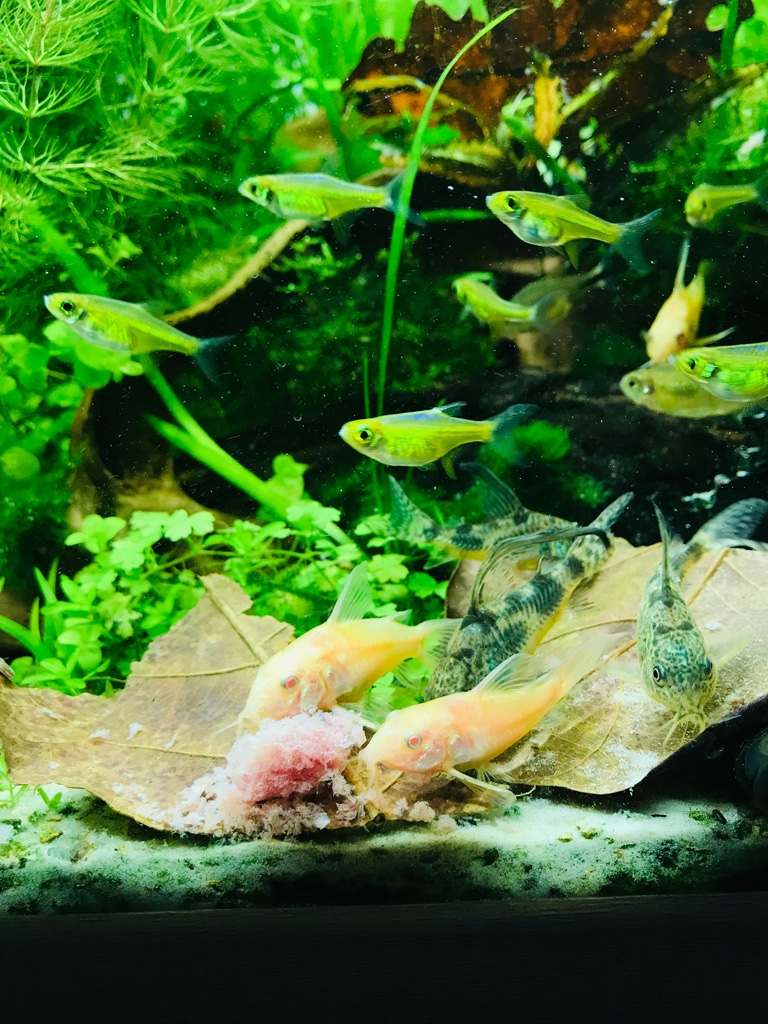
What the extra fish are for
A larger group shares the work of watching and gives each fish more time to explore.
That is the mechanism, not a turn of phrase, and somebody counted it. Mosquitofish were tested alone and in groups of two, four, eight and sixteen against a model predator. Solitary fish avoided it in 60 of 108 trials. Groups of eight and sixteen did significantly better, they made their minds up faster, and they matched a mathematical model of perfect shared watching almost exactly13.
The line inside that result is the one worth keeping. Each individual fish in a large group changed direction less often than a fish in a small one13. They were scanning less, and the group still did better, because whichever fish saw the threat first pulled everyone else round with it. Vigilance gets divided up. Buy more fish and you buy every one of them a smaller share of the job.
That is what people are seeing when they say a small group looks nervous. It is not an impression. It is a measured rate of direction change, and you can count it yourself with a phone timer.
Shared watching, in mosquitofish13
The honest argument for a group, which is not the one usually given
Shoaling evolved for five reasons, and four of them are switched off the moment the fish is in a tank. There is no predator to confuse and none to be diluted among. The measured energy saving needs fish swimming hard in one direction at a sustained speed9, which a group of tetras hovering over a carpet is not doing. Shared watching still happens, but it is watching for nothing.
Point that out and the usual argument for buying a group falls over. Here is the one that does not. The behavior is not a calculation the fish runs each morning. It is a disposition built in over evolutionary time, and it goes on running in an empty white box with no threat in it, exactly the way it runs in a river. A fish kept alone does not become a fish that does not need company. It becomes a fish doing a social behavior with nobody to do it with.
What isolation does to the animal has been measured, and the honest version is stranger than the folklore. Zebrafish kept alone for six months came out with lower whole body cortisol than grouped fish, not higher, alongside clear changes in serotonin and dopamine metabolism14. Isolated juveniles ate more and converted it worse, expressed more of an inflammatory gene, and grew narrower intestinal villi15. So anybody who tells you a lone shoaling fish is stressed and means a cortisol reading is over-claiming, and anybody who says it is fine because its cortisol is normal is wrong in the other direction. The animal is measurably changed, down to its gut lining. Stress is simply the wrong word for it.
Buy one fish, twelve times. Not twelve fish.
There is a good reason to buy a shoal that all looks the same, and the shop will never give it to you, because variety inside a group is the thing being sold. When one individual in a group looks different from the rest, predators single it out, and the whole group loses some of its protection because that fish gives the hunter a way through the confusion1617. Oddity is not a private problem for the odd fish.
Fish sort themselves accordingly. Size oddity raises predation risk in minnow schools, which is why schools segregate by size in the first place18, and large guppies given the choice picked a shoal that matched their own size over a shoal that was simply bigger16. Assortment by species, by size, by color and by parasite load are all documented16.
Every one of these is a normal Saturday in a shop: six neons and one albino neon, a shoal of cardinals with two rummynose for variety, five small cories and one big one, a bag of assorted platies, one long-finned individual among five standard ones. Nothing in a tank is going to eat any of them. What is left is the avoidance, which shows up as the odd one held at the edge of the group, or chased, or simply never joined.
The caveat belongs right here rather than in a footnote: nobody has measured the welfare of an odd fish in a predator-free aquarium. The step from predators pick out odd fish to the odd fish in your tank has a worse time is an inference. It is a well-founded one, because avoidance is the part that was under selection, and it is still an inference. Buy one species, at one size, in one visit. It is a better tank and a cheaper bill.
- Our own trace of the group size rule. , 8.2 and 8.3. The identical FishBase group line across the cardinal tetra, neon, harlequin rasbora, tiger barb and gold barb, and its single common reference, number 51539, which is aquarium hobby literature. Also the complete 41 year index of The Aquatic Gardener, 163 issues and 1,228 article entries from 1985 to 2026, searched for Corydoras, Betta, rasbora, danio, Otocinclus, goldfish, gourami, Apistogramma, hillstream loach and white cloud mountain minnow, with no article title or keyword matching any of them. our own search of published indexes, repeatable, unverified by a third party
- Kutty, V. Dutch style aquascaping guide, hosted by the Aquatic Gardeners Association. A dozen or so fish of one main species, with single fish of many species failing to read as a school across a layout. The one attributable published shoal size figure in aquarium keeping, and it is a composition rule rather than a welfare threshold. Via
- Andersson, M., Roques, J. A. C., Aliti, G. M., Ademar, K., Sundh, H., Sundell, K., Ericson, M. and Kettunen, P. (2022). Low holding densities increase stress response and aggression in zebrafish. Biology 11: 725. Nine weeks at 1, 4, 8, 12 and 16 fish per litre. Higher free water cortisol per fish, raised vertical distribution and more frequent aggression at 1 fish per litre only, and no compromise to welfare between 4 and 16. DOI 10.3390/biology11050725 open access
- Suriyampola, P. S., Iruri-Tucker, A. A., Padilla-Velez, L., Enriquez, A., Shelton, D. S. and Martins, E. P. (2022). Small increases in group size improve small shoals' response to water flow in zebrafish. Journal of Zoology 316: 271 to 281. Groups of four held against a current better than pairs, and individuals in the four spent less time in the costly leading position. DOI 10.1111/jzo.12952 open access
- Hoare, D. J., Couzin, I. D., Godin, J.-G. J. and Krause, J. (2004). Context-dependent group size choice in fish. Animal Behaviour 67: 155 to 164. Preferred group size shifts with hunger, with predation cues and with the environment, so there is no single correct number for a species. DOI 10.1016/j.anbehav.2003.04.004 paywalled
- Saxby, A., Adams, L., Snellgrove, D., Wilson, R. W. and Sloman, K. A. (2010). The effect of group size on the behaviour and welfare of four fish species commonly kept in home aquaria. Applied Animal Behaviour Science 125(3 to 4): 195 to 205. The only located study that asks the hobby's group size question directly, and it found the effect to be species specific. DOI 10.1016/j.applanim.2010.04.008 paywalled, and no abstract is published in Crossref, PubMed, Europe PMC or Semantic Scholar; the four species are not named publicly
- Sloman, K. A., Baldwin, L., McMahon, S. and Snellgrove, D. (2011). The effects of mixed-species assemblage on the behaviour and welfare of fish held in home aquaria. Applied Animal Behaviour Science 135(1 to 2): 160 to 168. The companion study on community tanks, and again the effects depend on which species. DOI 10.1016/j.applanim.2011.08.008 paywalled
- Our own species database. , 110 species. Every record carries a group size and an evidence note saying what that figure rests on: measured, protocol, biology, arithmetic or convention. Most of those notes use the word convention. The evidence-based numbers are Devario aequipinnatus, Danio rerio, Hemigrammus bleheri and Corydoras species. Readable in full at the species list. our own compilation from the sources above and from FishBase, version 2025-2
- Zhang, Y. and Lauder, G. V. (2024). Energy conservation by collective movement in schooling fish. eLife 12: RP90352. Five schools of eight giant danios against five solitary fish over fourteen speeds: energy per tail beat up to 56 per cent lower, maximum aerobic performance 44 per cent higher, recovery 43 per cent faster, cheapest speed about one body length a second. The only direct energetic measurement of schooling. DOI 10.7554/eLife.90352 open access, full text read
- Faucher, K., Parmentier, E., Becco, C., Vandewalle, N. and Vandewalle, P. (2010). Fish lateral system is required for accurate control of shoaling behaviour. Animal Behaviour 79(3): 679 to 687. The rummynose tetra experiment: polarisation of 94.5 to 98 per cent in undisturbed fish, the fall to 63 per cent, the shoal radius, the collisions and the month long recovery. Also the paraphrase that there is no clear dichotomy between shoaling and schooling. DOI 10.1016/j.anbehav.2009.12.020 author version read in full from the University of Liege repository, handle 2268/31748
- Chiang, A., Haine, S. S. S., Goldring, R., Jungwirth, A., Siddiqui, M., Wilkinson, G., Manica, A. and Riley, R. J. (2024). Comprehensive husbandry protocol for Corydoras catfish and many other Amazonian species. JAALAS. 15 to 25 adults in a 76 cm tank on fine sand at 23 to 27 C, pH 6.5 to 7.2 and roughly 4 to 5 dGH. The only peer-reviewed husbandry protocol found for any ornamental species. DOI 10.30802/AALAS-JAALAS-24-039 open access via PMC11467888
- Siddiqui, M., Chiang, A., Lac, E., Kern, J., Wilkinson, G., Jungwirth, A., Allen, J. and Riley, R. J. (2024). Developmental social experience changes behavior in a threatening environment in Corydoras catfish. Ecology and Evolution 14: e70391. Juveniles reared with adults present against juveniles reared with same age fish only: more nudging, lower baseline activity, more freezing after a startle and a larger increase in cohesion in the same age group. DOI 10.1002/ece3.70391 open access
- Ward, A. J. W., Herbert-Read, J. E., Sumpter, D. J. T. and Krause, J. (2011). Fast and accurate decisions through collective vigilance in fish shoals. PNAS 108(6): 2312 to 2315. Mosquitofish at group sizes of 1, 2, 4, 8 and 16 against a replica predator: 60 avoidances in 108 solitary trials, groups of 8 and 16 significantly better, and the fall in direction changes per fish as the group grows. DOI 10.1073/pnas.1007102108 full text read
- Shams, S., Chatterjee, D. and Gerlai, R. (2017). Effect of social isolation on anxiety-related behaviors, cortisol, and monoamines in adult zebrafish. Behavioral Neuroscience 131(4): 492 to 504. Lower whole body cortisol after six months of isolation, with altered serotonin and dopamine metabolism. DOI 10.1037/bne0000220 paywalled; abstract read in full
- Dissinger, A., Rimoldi, S., Terova, G. and Kwasek, K. (2024). Chronic social isolation affects feeding behavior of juvenile zebrafish. PLoS ONE 19(8): e0307967. Higher feed intake with a worse conversion ratio, raised expression of the inflammatory gene il-1b, and narrower intestinal villi in isolated juveniles. DOI 10.1371/journal.pone.0307967 open access
- Rodgers, G. M., Kimbell, H. and Morrell, L. J. (2011). Balancing the dilution and oddity effects: decisions depend on body size. PLoS ONE 6(7): e14819. The statement that predators preferentially target phenotypically distinct individuals, the list of documented assortment by species, size, colour and parasite load, and the large guppies that chose a size matched shoal over a larger one. DOI 10.1371/journal.pone.0014819 open access, full text read
- Landeau, L. and Terborgh, J. (1986). Oddity and the confusion effect in predation. Animal Behaviour 34(5): 1372 to 1380. The reference experiment for both the confusion effect and the oddity effect, largemouth bass hunting silvery minnows. DOI 10.1016/S0003-3472(86)80208-1 paywalled with no published abstract; cited for the existence of the finding, and no figure from it is quoted on this page
- Theodorakis, C. W. (1989). Size segregation and the effects of oddity on predation risk in minnow schools. Animal Behaviour 38: 496 to 502. Size oddity raises predation risk, which is why schools segregate by size. DOI 10.1016/S0003-3472(89)80042-9 paywalled
Continue