Electrics
Several appliances, a lot of water, and usually one socket.
An aquarium puts several permanently powered mains appliances within centimeters of a large open container of conductive water, in a room where somebody will regularly put both arms into it. Nothing else in a home does this. It deserves a few minutes of thought at the siting stage, because after the tank is full the wiring is as hard to change as the tank is to move. Armenia runs 230 volts at 50 hertz, with Type C and Type F sockets.
Total load is almost never the problem. Everything on a normal planted tank except a chiller adds up to a few hundred watts, well under two amps, which no domestic circuit notices1. The socket count is the problem. That is five or six plugs for one tank, and a dozen for two. The failure is never an overloaded circuit. It is a tower of adapters on the floor behind the stand, in the one place in the house most likely to get wet.
The residual current device is the item that actually saves a life. A fuse or a circuit breaker protects the cable from catching fire. It does not protect a person. A residual current device compares the current going out with the current coming back, and if some of it is leaving by another route, which is what happens when it is going through a person or into a tank, it disconnects in tens of milliseconds. The standard sensitivity for additional protection of general purpose sockets is 30 mA2.
The Armenian specific, and it is a real one. A great deal of Armenian housing was wired in the Soviet period without a protective earth: two wires to the socket, the third pin connected to nothing, and no residual current device in the consumer unit. A Schuko socket in such a flat has earth pins that go nowhere. If you cannot see an RCD in the consumer unit, assume there is not one.
If the installation cannot be changed, a portable plug-in RCD with a test button protects everything downstream of it and costs very little. Put every aquarium appliance behind one. It is not as good as a properly earthed installation with a device at the board, and it is enormously better than nothing. If an electrician can fit a 30 mA device at the consumer unit2, do that instead, and do it before the tank is filled. Press the test button every few months, because an RCD that has never been tested is a device you are trusting on faith.
What is plugged in, on a planted 100 L tank. Typical appliance ratings, from no measured survey
- Heater
- 100 W, sized from the table above1. Intermittent, more in winter
- Filter
- 5 to 20 W, always on
- Light
- 20 to 60 W, six to eight hours a day
- Air pump
- 2 to 5 W, always on or at night
- CO2 solenoid
- 5 W, daytime only
- Fan
- 3 to 10 W, summer only
- Chiller
- 200 to 350 W while running, summer only, if fitted
- 6
- plugs for one tank. Count them before you choose the wall
Water travels along a cable by surface tension. Let every cable hang below the level of the socket before it rises to the plug, so the lowest point is in mid air. Water reaches that point and drips on the floor instead of running into the socket. Do it for the cables that could not possibly get wet as well.
Beside the tank, never underneath it and never directly behind it. A socket below a tank is a socket in the path of every spill the tank will ever have.
When a filter has to come out fast with wet hands, hunting through six identical black cables is how the wrong one gets pulled. Two minutes with a marker pen, once.
Mount the power board on the wall or on the side of the stand, above the level any spill can reach. The floor behind an aquarium is the worst shelf in the house.
A canister that has to be lifted out and sat on the floor with its lid off needs enough cable to get there. A short cable is a cable that gets tugged, and a tugged cable is a pulled plug or a dragged appliance.
Keep the heater and light cables clear of the water hoses, so a hose disconnected during maintenance does not drag a live cable into the bucket with it.
The power cut
How long is a tank safe without power, and what to do first.
Power cuts happen. The question is what breaks and in what order, and the answer is not what most people expect.
Temperature is not the emergency. Computed with the same model: a 100 liter tank at 25 C in a room at 22 C is at 24.5 C after one hour, 23.5 after three, and 21.0 after twelve. Even with the room at 14 C it is still 21.9 C after three hours and 16.6 after twelve1. Water has an enormous heat capacity and a tank is a poor radiator. In a normal flat the temperature will not kill anything in a day. A blanket or a duvet over the tank slows it further and is the right winter response, but it is not urgent in the first hours.
Oxygen is the clock. With the filter stopped the surface goes still, and a still surface takes up only a few milligrams of oxygen an hour, as the aeration section showed. Meanwhile the fish, the biofilm and the substrate keep consuming. As an order of magnitude: a 100 liter tank at 27 C in Yerevan holds about 590 milligrams of dissolved oxygen at 85 percent of saturation3. Total demand from fish, filter biofilm and substrate in a moderately stocked planted tank is plausibly 60 to 250 milligrams an hour. Falling from that starting point to 4 mg/L, which is where warm-water fish begin to be in real trouble, takes roughly one to three hours with no resupply3.
So the honest answer is this. In summer, in a stocked warm tank with no surface movement, the margin is a small number of hours. In winter, in a cool lightly stocked tank, it is a day or more. The three variables are temperature, stocking and how much organic matter is sitting in the substrate, and between them they move the answer by an order of magnitude. If you want a single number to plan against, plan for two hours in July and a day in January3, and note that everything in the list below either buys time or costs nothing.
What to do, in order
While the power is off
Seven actions, cheapest and most useful first
- 01
Stop feeding immediately and do not resume until the power is back. Food is oxygen demand and then it is ammonia. A healthy fish loses nothing by not eating for two days.
- 02
Turn the lights off and leave them off, including after the power returns, until the filter is running properly again.
- 03
Move the surface by hand. Scoop a jug of water and pour it back from a height for a minute, every half hour. This is not folklore. It is the same surface renewal mechanism described above, applied by arm, and it is the highest value action available with no equipment at all.
- 04
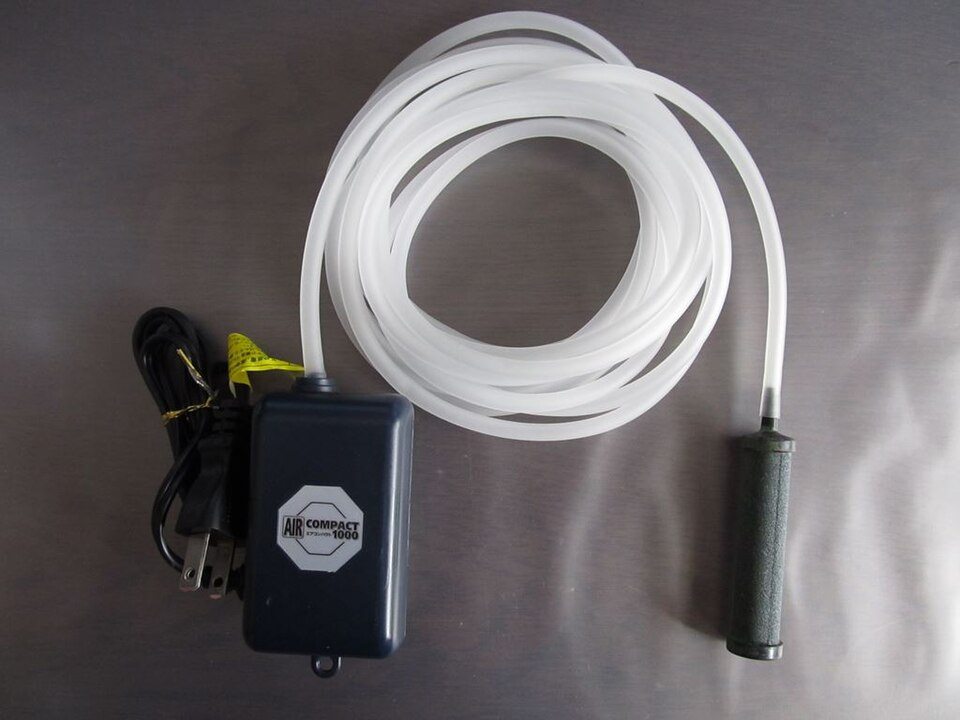
Run an air pump off a battery. An air pump draws 2 to 5 watts. A small uninterruptible power supply with a 12 volt 7 amp-hour battery holds about 84 watt-hours, which after inverter losses runs a 3 watt pump for the better part of a day1. Battery air pumps that switch over automatically when the mains drops are inexpensive. For a tank in Armenia this is the best value insurance on this page, and it is a reason to own an air pump even in a tank that does not otherwise need one.
- 05
Adjust for the season. In summer take the lid off, lay a wet towel across the top and run a battery fan over it if you have one. In winter put a blanket over the tank and leave it alone.
- 06
Do not restart a canister filter blind after a long cut. A canister is a sealed volume of media with no flow, and it goes anoxic quickly. Our own research found that the overwhelming majority of the biomass in a filter is heterotrophic rather than nitrifying4, and anoxic heterotrophs produce hydrogen sulfide and other reduced compounds. Restarting the pump pushes that entire volume into the tank in a few seconds. Under an hour, restart normally. One to four hours, restart and stand there and watch. Over four hours, or if it smells of rotten eggs when opened, open it, pour the water away, rinse the media in tank water, reassemble, and only then restart. The threshold is a judgement, not a constant, and it depends on how dirty the filter already was.
- 07
A sponge filter does not have that problem at all, because it holds no standing volume and it restarts on a battery pump. That is a design argument rather than a cheapness argument, and it is worth knowing before the filter is bought rather than during the first cut.
When the power comes back
Three checks, in this order
- 01
Temperature first, before anything is switched on. If it has moved a long way, bring it back slowly rather than all at once.
- 02
Filter next, following the rule above. Then the heater. Lights last, and preferably not until tomorrow.
- 03
Feed lightly the next day, and test for ammonia over the following week The nitrifying population may have taken a knock, and it is the slow-growing one, so the consequence arrives days after the event rather than during it.
- Our own calculation, not a published finding. The steady-state energy balance. Everything on this page marked computed comes from one model, stated in full in the cooling section so it can be argued with. Named inputs: a 100 L tank of 80 by 35 by 40 cm; an overall 5.5 watts per square metre per kelvin through the glass; 3.5 watts per square metre per kelvin of convection from the open surface; evaporation from the Lewis relation; latent heat 2,440 kJ per kilogram; ice enthalpy 334 kJ per kilogram; barometric pressure 887 hPa from 1; saturation vapour pressure from Buck 3. It is a model presented as an order of magnitude, not a measurement, and no tank has been instrumented to check it. The bucket and water-change arithmetic on this page is ours too. How we handle our own arithmetic
- IEC 60364-4-41, Low-voltage electrical installations, Part 4-41: Protection for safety, protection against electric shock. Paywalled at the IEC. The international basis for additional protection of general purpose socket outlets by a residual current device not exceeding 30 mA. The 30 mA figure quoted here is the widely adopted national practice derived from it. This page is not electrical advice and does not substitute for an electrician.
- Our own calculation, not a published finding. The oxygen and aeration budget. Named inputs: the Benson and Krause saturation equation 2, corrected for station pressure 1 and saturation vapour pressure 3; the measured temperature quotient of 1.92 4; a 3 mm bubble rising 40 cm at 25 cm per second with an ordinary film coefficient; the zero-wind transfer velocity of 2.07 cm per hour from Cole and Caraco (1998) applied to a 0.28 square metre surface; and an assumed 85 percent of saturation. The whole-tank demand range of 60 to 250 milligrams an hour is an order-of-magnitude estimate and not a measurement, and the power-cut clock inherits that uncertainty. How we handle our own arithmetic
- Our own research, W3, nitrifying bacteria versus waste bacteria. The source for the 1.6, 3.1 and 3.8 percent ammonia oxidiser figures on home biofilter sponges, the biomass yields of about 0.15 against 0.63 to 0.67, and the growth rate contrast of well under one against three to six per day. That file carries its own primary citations. The whole argument that dechlorination protects the filter rather than the fish rests on it. See also our cycling page.
Continue
Where to go next.
Planning a tank
The rest of the planning: siting, temperature, conditioning and the checklist.
Heat, cooling and the winter heater
What the heater is for and how it fails, which is the other half of the electrics.
Easy setups
The setups with nothing plugged in at all, which is one way to answer this page.
Cycling and the bacteria
What actually dies first when the pump stops, and how long it takes.
Where to put the tank
Put the tank where the sockets, water route and maintenance space work together.