Siting
The tank is going to stay exactly where you first put it.
Water weighs a kilogram a liter. Add glass, substrate, stone and a stand, and a modest tank is a piece of furniture that cannot be nudged, turned, levelled or slid. Moving it means catching every fish, draining it, lifting the hardscape out and rebuilding the scape from nothing. In practice nobody does that. So the tank stays where it went on the first afternoon, for years, and the person who chose that spot had owned an aquarium for zero days.
Choose a comfortable height for maintenance
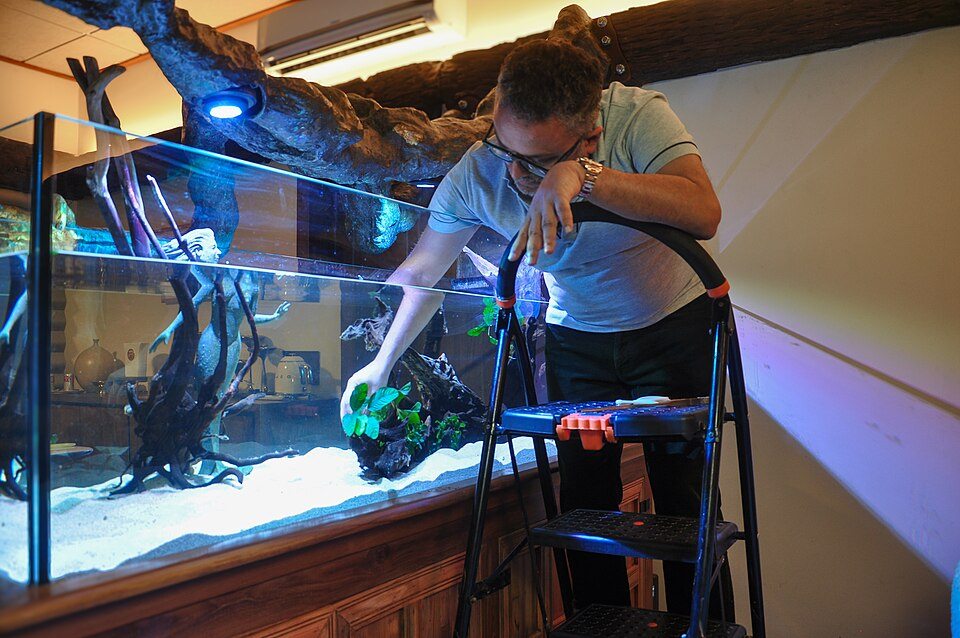
Before you buy the stand, check its height together with the aquarium. Our practical starting point: keep the tank’s top rim below your armpit when you stand beside it with both feet on the floor. You should be able to do routine care without a chair, steps, or a stepladder.
Test your reach while the tank is empty. Can you reach the plants and bottom with your usual tools, without standing on tiptoe, raising your shoulder, or leaning your weight on the glass? A low rim alone is not enough if the tank is too deep or too wide. Choose the height and depth for the person who will maintain it; if you work seated, test from your usual seated position instead.
Leave clear space above the tank to open or remove the lid and move the light. Leave enough room in front to stand comfortably and set down a bucket. A tank that looks good from the sofa should also be easy to clean next month.
Direct sun is the first thing to rule out, and it is not a summer question. The sun stands 26.4 degrees above the horizon at midday in Yerevan at the winter solstice and 73.1 degrees at the summer solstice1. A corner that is deep in shadow in June can take full sun in December. Check the site against both, or check it against the sun angles rather than against whatever today happens to be doing.
Sunlight does two unwelcome things at once. It delivers a light budget the plants cannot use, because carbon or nutrients run out long before the light does, and everything left over feeds algae. And it puts heat into the water on a schedule you do not control, which is the subject of the next section and the serious one in Armenia.
A window is a thermal hole in the wall. Single glazing in an older Yerevan flat sits close to the outdoor temperature, and the outdoor temperature in Yerevan runs from a January mean daily minimum of minus 7.8 C to a July mean daily maximum of 34.5 C1. A tank pressed against that glass rides a daily cycle, and fish tolerate a steady temperature far better than a moving one. A meter back into the room is a different microclimate.
A radiator is worse, because it is an uncontrolled heat source on a schedule set by someone else. There is a second Armenian point here. Unflued gas heaters are common in Armenian homes and they put water vapour into the room. That does not matter to the fish, but it does change the cooling arithmetic later on this page: moist air evaporates less, and evaporation is the cheapest cooling there is.
Three distances that decide whether maintenance happens
- Tap
- Two full buckets is about 20 kg. A 30 percent change on a 200 L tank is 60 L, which is six trips each way2. Within hose reach it is one hose and no trips
- Drain
- The same again, and harder, because the water going out is dirty and will not go quietly into the nearest sink
- Socket
- Beside the tank and above the water line. Not across the room, not behind furniture, and never underneath
- 0
- of these can be changed once the tank is full
A tank beside a slamming door, or on a suspended floor in a walkway, receives an impulse every time somebody passes. Fish read that as a predator. Shy species, and every fish for its first fortnight, spend that time hidden instead of eating.
An air pump or canister on the same board as the tank hums into the glass and into the room. A pump that hums at night is a pump that gets switched off at night, and then forgotten. The nuisance you tolerate is the equipment you eventually disable.
Enough clearance to get an arm down to the substrate and to lift a light or a lid clear. A tank under a shelf is a tank you cannot plant, and a tank you cannot plant becomes a tank you do not tend.
Somewhere to sit and look at it. This is not sentiment. A tank that is not watched is a tank whose problems are found late, and late is the difference between an adjustment and a disaster.
Hoses, cables, a canister that has to come out and sit on the floor with its lid off. Plan the gap now; you cannot make one later.
Every tank spills eventually. Somewhere for a bucket to stand during maintenance, and a surface that survives a liter on the floor, are part of the site and not an afterthought.
What is deliberately not on this page. Weight and floor loading, stand construction and levelling, pump sizing and turnover, and the logistics of the filter itself are covered by the companion page in this section rather than repeated here. Start from Materials and water for that material.
- Our own climate research, P6, the Armenian climate file. Armenian hydrometeorological service, WMO Climate Normals 1991 to 2020, as submitted to WMO and archived by NOAA and NCEI, together with quantities derived in that file. The source of every Armenian temperature, humidity, vapour pressure, sunshine, station pressure and solar altitude figure on this page, including the 82 and 90 days above 30 C, the 34.5 C July mean daily maximum, the 887 and 846 hPa station pressures, and the winter indoor humidity floor of 14 to 22 percent.
- Our own calculation, not a published finding. The steady-state energy balance. Everything on this page marked computed comes from one model, stated in full in the cooling section so it can be argued with. Named inputs: a 100 L tank of 80 by 35 by 40 cm; an overall 5.5 watts per square metre per kelvin through the glass; 3.5 watts per square metre per kelvin of convection from the open surface; evaporation from the Lewis relation; latent heat 2,440 kJ per kilogram; ice enthalpy 334 kJ per kilogram; barometric pressure 887 hPa from 1; saturation vapour pressure from Buck 3. It is a model presented as an order of magnitude, not a measurement, and no tank has been instrumented to check it. The bucket and water-change arithmetic on this page is ours too. How we handle our own arithmetic
Continue